Category Archives: Half-assed

Films in this category have something to offer but also have one or more flaws that detract from the experience. Still, these movies are probably better than most of the shit on Netflix.

Berlinale 2021: Albatros (Drift Away)

Laurent is a good cop in a small town in Normandy, where little ever happens. The police work may be on the dull side but his recent engagement to Marie means his personal life makes up for it. Laurent (Jérémie Renier) and Marie (Marie-Julie Maille) have already been together long enough to share a home and a daughter, Poulette (Madeleine Beauvois), who was excited to be part of the low-key proposal. But then things take a turn for the more interesting.

A local farmer goes missing, armed with a rifle and seemingly suicidal after a series of failed inspections that threaten his livelihood. This being a small town, the farmer is known to Laurent, a friend. Laurent is obviously very motivated to have this man found safely, but does his familiarity cloud his judgement? When the farmer is eventually located, it leads to an altercation, resulting in Laurent discharging his weapon in an effort to prevent the farmer from taking his own life. Laurent kills him.

The aftermath is as messy as you’d expect. Everyone agrees it was an accident, but was it reckless? Negligent? The farmer’s sister obviously thinks so; she’s suing both Laurent and the force. Thrown into self-doubt, recrimination, and emotional turmoil, Laurent takes off on a journey he must take alone. Which, honestly, is where the film lost me. Up until it veers off into a very different direction, I was enjoying this slow-burn character study. Renier kept things dignified, stoic but just expressive enough to hint at upheaval behind the façade. Unfortunately, director Xavier Beauvois muddies the water with some confusing and unnecessary subplots, taking away from the power and potency of Renier’s performance.

Albatros’s final moments redeem some of its earlier mistakes but there’s no way the film needed to be two hours long, which seems to dilute the urgency and impact of what should have been the movie’s central themes. Albatros is a good idea unevenly executed, not quite saved from a stellar star performance.

Coming 2 America

It’s been 33 years since pampered African Prince Akeem (Eddie Murphy) first came to America, and in 2021, he will return.

King Jaffe Joffer (James Earl Jones) is getting older, and as he prepares his son Akeem to take his place, he reveals that he has tracked down Akeem’s bastard American son, a son Akeem didn’t know he had, a little souvenir from that trip to Queens more than thirty years ago. Akeem and Lisa (Shari Headley) have three daughters, but women can’t inherit the throne in Zamunda. Fearing instability upon his passing, particularly from General Izzi (Wesley Snipes), King Joffer urges Akeem to go to America and bring home his first-born male heir in order to keep their kingdom peaceful.

As you can imagine, learning that you’re a prince is a bit of surprise, and it’s a bit of a culture shock when Lavelle (Jermaine Fowler) does indeed return to the palace with the dad he never knew, with Mom Mary (Leslie Jones) and Uncle Reem (Tracy Morgan) in tow to add a little…flavour to the royal proceedings. Akeem has selected a bride for his son, the alluring and diplomatically wise choice, Bopoto, daughter of General Izzi. But it is the palace groomer Mirembe (Nomzamo Mbatha) who catches Lavelle’s eye. As every man becomes his father, Akeem finds himself in the position of forbidding Lavelle’s love match and enforcing the political one. Akeem was supposed to be different when he was king but it looks like he’ll follow in his father’s footsteps, for better of worse.

This movie isn’t a remake but it’s awfully close, following the events of the first film like they’re identical twins, even repeating a lot of the same jokes. Murphy reassembles the entire team and there’s no denying this sequel is an extreme act of fan service and that Eddie Murphy himself is having a grand old time reliving his youth and revisiting a pivotal time in his life and career. The result is surprisingly watchable. Is it great? No. But it’s fun and familiar improving on the first, delivering a more modern and more quickly paced comedy. Murphy and director Craig Brewer work well together, but since both are mega fans of the first film, they’re content to coast on its fumes. Ultimately Coming 2 America is 110 minutes devoted to remembering how great Coming To America was. It’s a cast reunion with some great costumes and some fun cameos. It’s a celebration 33 years in the making and if you were a fan of the first, you’re walking away happy.

Boss Level

Here we go again…

Roy (Frank Grillo) is living the same day over and over. We catch up with him after he’s died about 40 times, only to wake up again to an assassin swinging a machete at his head, and even if he escapes that threat, Roy has discovered he is the target of many, many more killers. Eventually, one of them is going to get Roy, and once they do, he will restart his personal Groundhog Day again and again and again. Who are these killers and why do they want Roy dead? That’s what Roy will have to figure out in order to escape this time loop and save the world, with some help from his scientist ex-wife (Naomi Watts) and with serious opposition from her evil boss (Mel Gibson) and his sidekick (Will Sasso).

Did we need another time loop movie? Definitely not. But Boss Level is not the worst of the bunch. If you can look past some dumb dialogue, such as its insistence that Street Fighter II is an 80s sidescroller (which is so obviously wrong in so many ways), there is a decent action movie here. Again, not a great one, but a serviceable one. It’s no Groundhog Day, Edge of Tomorrow, or Palm Springs, as it doesn’t add anything new to the live/die/repeat genre, and doesn’t bother to even try.

Still, it’s a workable popcorn movie and we certainly haven’t had a lot of those lately. If you’re in the market for one of those, this will probably fit the bill, as long as you are willing to put up with a lack of originality, Mel Gibson’s involvement, and the repeated misclassification of a classic 2D fighting game that was released in 1991.

Berlinale 2021: Ted K

Ted Kaczynksi, more popularly known as The Unabomber, lived in isolation in a 10×12 cabin in the woods of Lincoln, Montana. Arguably that might be enough to have driven anyone crazy, but director Tony Stone puts together a more detailed and intimate portrait of one man’s descent from loner to terrorist.

Focusing primarily on the seven years before his arrest while Ted (Sharlto Copley) was living that hermit life off the grid in the middle of a forest, Ted K doesn’t provide much context or insight into who Ted was before he left society completely, or what might have driven him to do so. Filmed in the same woods where he lived and using the 25 000 pages of his coded diary as its basis, the film tries to remain impartial, merely eavesdropping on our subject while he mutters to himself, shakes his fist at planes overhead, begs family for money over collect calls made from a phone booth. He rails against the industrial system, sometimes generally, sometimes more specifically (leaf blowers, snow mobiles), the destruction of nature, the proliferation of technology, which he predicts will be our downfall.

Bomb making becomes just one of his daily tasks in his cramped cabin. More angry than evil, more sick than disturbed, Ted exists on the margins of society in more ways than one. As his mental health frays and unravels, he seeks to soothe his pain with vengeance. Unable to engage in any meaningful way, anonymously sending violence through the mail to imagined adversaries feels like such an on-the-nose characterization of Ted’s particular psychology that if it was fiction rather than fact, you wouldn’t quite believe it.

At times I felt alienated by the film, which does its job a little too well painting Ted K as an unknowable type, but Sharlto Copley’s performance kept drawing me back in. His exact recipe is known only to him, but its ingredients include neuroses, coiled anger, desperation, internal grand-standing, loneliness, disconnection, superiority, inferiority, and more. Yet Stone chooses to show him in mostly banal circumstances, even his terrorism reduced to ordinary little tasks performed in ramshackle shed by a solitary, mumbling man. The film is Copley’s alone; other people are mere footnotes and even his victims are spared little thought. He is the subject of the largest manhunt in FBI history, but of that we have no sense. The film has no sense of urgency or drama. Ted K is just a sad and lonely man going about his business. The movie asks for no mercy, no sympathy, it just tries to get inside his head, and sometimes even succeeds in doing so.


Berlinale 2021: Tides

In the not too distant future, humanity will have completely decimated the Earth and fled 500 light years away, to a distant, alternate planet in the Keplar star system. But this planet isn’t the utopia they’d hoped; within just a couple of generations, they’ve lost the ability to reproduce. The first envoy they send back to Earth to check things out disappears completely. The second fares only a little bit better.

Astronaut Blake (Nora Arnezeder) barely survives the splashdown landing and immediately has some real problems; there are survivors, and they’re none too trusting.  Earth is a barren wasteland ruled by extreme tides and split into two warring, violent factions. But they are able to reproduce – Blake sees plenty of children and babies before she’s taken prisoner. Her jailers turn out to be surprisingly friendly – leader Gibson (Iain Glen) knew her as a child, was a friend of her father, who disappeared with the first envoy. He’s been working very hard to make things tenable for the Keplar community to return to Earth but lacks the means to communicate. Only Blake has that, but the longer she’s there, the more sinister everything seems, and she’s no longer convinced it’s the best course. But Gibson and his gang aren’t about to let go of their plans without a fight.

Tides doesn’t have a great script. Its details are frustratingly vague, and if you care about strict logic, I’m pretty sure the math here doesn’t remotely add up. But if you’re simply in the mood for an unabashed sci-fi genre film, you’ve got yourself a sure bet. So sure, in fact, you might find it looking familiar. It actually feels like, rather than telling its own story, director Tim Fehlbaum is setting up some sort of dystopian hub where more successful films in the genre might convene. It wouldn’t feel strange to see Tom Hardy drive by with someone strapped to the front of his doon buggy, or Kevin Costner sail by on a really big boat. But aside from building a world that feels and looks familiar, Tides fails to establish its own story. Despite a committed performance by Arnezeder and some interesting nuggets of premise, Tides is ultimately too weak to stand on its own legs.

Sundance 2021: The World to Come

Picture it: mid-19th century American East Coast frontier. Life is hard; it’s round the clock, back breaking work just to stay alive. It’s dirty, full of drudgery, isolating, dark, and monotonous.

Dyer (Casey Affleck) is a poor farmer who will toil his whole life away and never have anything to show for it. His wife Abigail (Katherine Waterston) works just as hard at even more menial tasks. Their relationship is predicated on hard work and common sense. Their life is colourless, hard-scrabble, and bereft after the loss of their only child. When another couple appears in the “neighbourhood” (which is to say, another isolated cabin miles and miles away), their dreary lives are cheered just a little bit by the ability to see another face once in a while. Abigail becomes particular friends with the wife, Tallie (Vanessa Kirby), though Tallie’s husband Finney (Christopher Abbott) is a real stick in the mud, another burden to be borne, but worth the price of seeing Tallie.

If Dyer notices that Abigail and Tallie are growing closer by the day, he’s hardly the type to say anything, but Finney is much more jealous, and perhaps this isn’t the first time his wife has wandered over to someone else’s homestead. Abigail and Tallie relieve their loneliness and ignite something in each other’s company. Their relationship turns intimate, and physical, a balm on their otherwise psychologically taxing existence.

The World To Come is based on Jim Shepard’s lyrical story of the same name, which is fine for a piece of literature but translated less well on screen. Katherine Waterston provides a poetic voice-over that grows tiresome very quickly, not to mention suspicious. Dyer, who eats potatoes for every meal of every day of his sad little life, hardly seems the type to have said that “contentment is a friend who rarely visits” although the sentiment, at least, rings true, the biggest excitement in his life provided by a molasses enema when he gets the flu.

Waterston and Kirby are wonderful together, and the setting is absolute perfection. The sense of longing and emptiness are well conveyed, and Waterston does a fine job embodying both Abigail’s stoic reticence and the private, flowery language of her journal. The World to Come has plenty of isolated aspects to admire but they amounted to a boring film and a frigid love story that I didn’t need to see (again: this is hardly the first of its kind). Mona Fastvold is an excellent director who picked a crummy script and failed to breathe enough life into the story to justify it or indeed to hold any emotional heft. This one left me cold.

 The World To Come will be released via video on demand on March 2, 2021.

Red Dot

Engaged and pregnant, Nadja (Nanna Blondell) and David (Anastasios Soulis) travel to the north of Sweden for a hiking trip to hopefully check out the northern lights. A little parking lot scuffle involving scratched cars, racism, and dead deer turns into something much more sinister, turning their romance under the stars into a real nightmare.

Sleeping in their tent wayyyyyy out in the middle of the snowy nowhere and “keeping warm,” they suddenly notice lights on the horizon that aren’t northern. Outside the tent, a red dot appears in the middle of Nadja’s chest, and then David’s head. They can’t see anything, but a red dot would make anyone nervous. Trying to get back to their car, the gunshots start. The first to fall is their dog, Boris. Poor, innocent Boris. But no time for mourning! Unknown psychotic gunmen are out there, apparently very upset about some cosmetic bumper damage. Cold and increasingly wounded, Nadja and David are chased out into the frozen wilderness where crazed shooters are only a portion of their worries. Survival becomes all-consuming and increasingly unlikely.

Director Alain Darborg’s movie really has nowhere to go but deeper and deeper into the fray and we go limping along with it. If you’re in the mood for a harrowing movie about constantly almost dying, this might be right up your alley, or across your frozen tundra or what have you. The pursuit is relentless and after a while, borderline monotonous. And then there’s a twisty ending that’s kind of infuriating because it comes out of absolutely nowhere and is kind of unfair and totally unearned. But there it is. If you’re in it just for the action I bet you can overlook it but if you were hoping for a good, satisfying movie, keep moving, it’s best to look elsewhere.

Sundance 2021: Prisoners of the Ghostland

Prisoners of the Ghostland is a collaboration between America’s most bonkers actor, Nicolas Cage, and Japanese auteur Sion Sono, known for grotesque violence, extreme eroticism, and surreal imagery. I’m not the biggest fan of Nic Cage’s recent reincarnation as a b-movie cartoon, but I thought this combination was made in movie heaven and couldn’t wait to check it out at the Sundance Film Festival.

But you know what? It wasn’t that great. It was okay, but I expected some pretty bananas action from these two knuckleheads and instead Cage seems to be playing it straight, giving us a film that’s far more conventional than I ever would have guessed. Had they embraced the subversive, unhinged kind of film I was expecting/hoping for, Prisoners of the Ghostland could have been an instant cult classic, instead I’m left feeling disappointed after having been promised “the wildest movie I’ve ever made” by Cage himself, which is patently untrue.

Cage plays Hero, a notorious bank robber who’s released from prison in the savage, post-apocalyptic frontier city of Samurai Town in order to rescue the wealthy warlord Governor’s granddaughter, Bernice. The Governor (Bill Moseley) will guarantee Hero’s freedom in exchange for Bernice’s swift return, but straps him into a leather suit programmed to self-destruct in just a few days as a little extra incentive. And while we’re at it, the suit is also loaded with explosives should Hero raise a hand against a woman, and more explosives in the crotch region should Hero pop a boner for Bernice (Sofia Boutella).

Hero does indeed find Bernice, by accident, and I do mean accident – he immediately crashes his car and is rescued by the people in Ghostland, where Bernice is being held. Ghostland is under some mysterious curse that prevents anyone from leaving and is guarded by the “survivors” of a prisoner transport bus crash who were turned into monsters thanks to radiation. The people of Ghostland are obsessed with time, and they’re not even the ones strapped into leather jumpsuits charged with deadly explosives. The town is peppered with crumbling mannequins that house prisoners inside them; Bernice is broken out of her shell but is still voiceless, and not much help against the curse, the cult, the gunslingers, the ghosts, the samurai, or the irradiated convicts.

Prisoners of the Ghostland isn’t a complete wash. There are some crazy-cool visuals, a western-spoof vibe, an interesting soundtrack, and plenty of dirty neon lighting up our Hero’s path. And there’s Chekhov’s gun, of course: if in the first act you have rigged a suit with ball-sac bombs, then in the following one they should explode. And indeed they do. But I wanted more than just scrotal thrills, I wanted a whole anatomy of weird and wonderful, I wanted a rainbow parade of the absurd, I wanted Nic Cage at his best worst most demented, I wanted Cage and Sono to make a movie that would get banned in 17 countries and give me a nosebleed and an ice cream headache and leave me out of breath and intellectually bedazzled. Okay, that’s asking a lot, but I dared to dream big, and what I got was a strange, supernatural cinematic question mark that’s not half as nuts as anything else Cage has made in the last decade.

Sundance 2021: Jockey

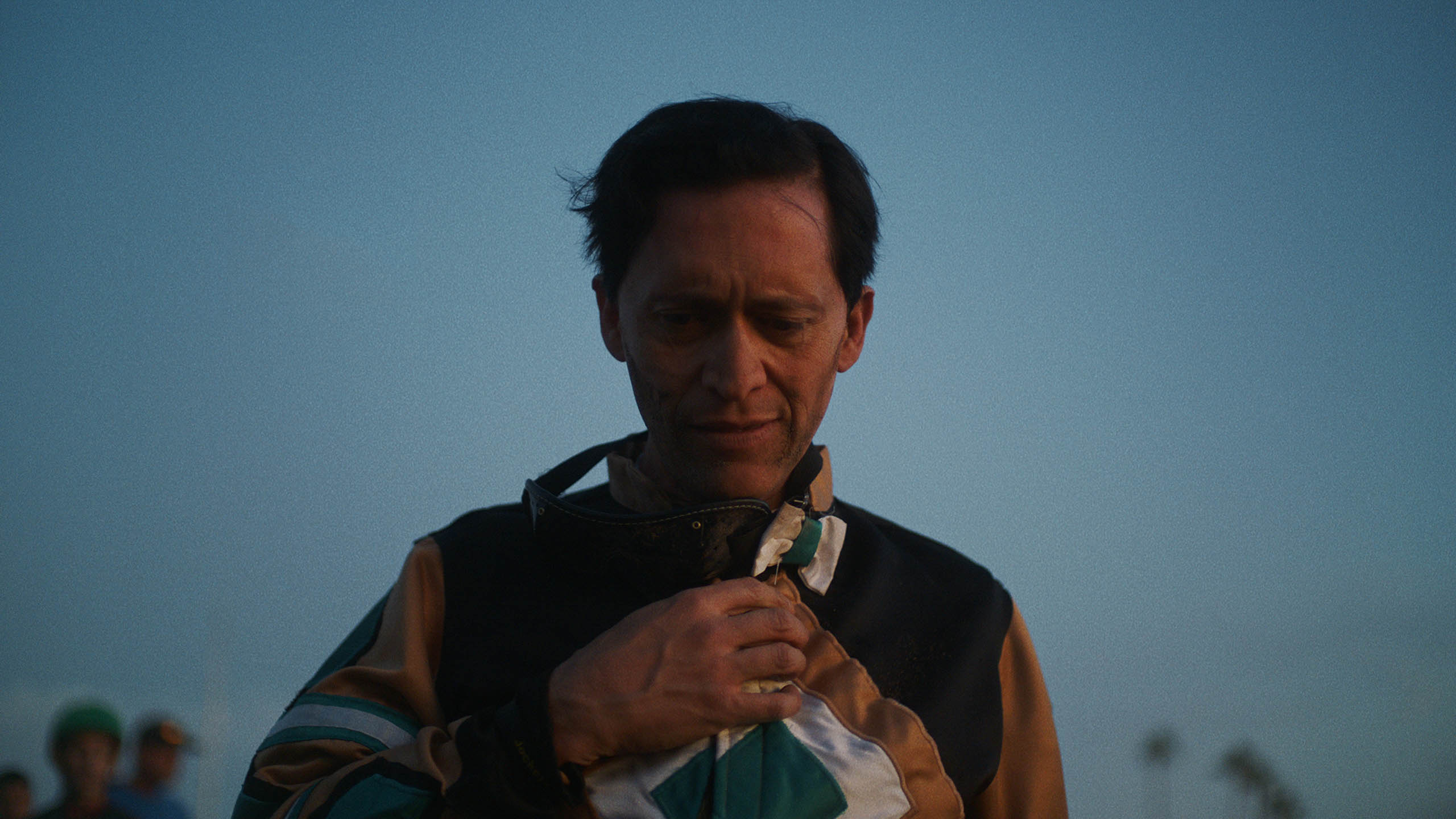
Jackson Silva (Clifton Collins Jr.) is an aging jockey who wants to win one last time before his body breaks down completely. It’s against the advice of his doctor, of course, and he’s already past his prime, but he doesn’t know when to quit, or what he’d do after, so he just keeps doing the one thing he’s good at.

Gabriel (Moises Arias) is a young jockey with his whole career in front of him, and a lot of promise. He’s come to be Jackson’s protégé but also claims to be his son – a son Jackson didn’t know he had.

Have you ever seen a one trick pony in the field so happy and free? You don’t really have to answer that, it’s a lyric from a Bruce Springsteen song from the movie The Wrestler. The Wrestler is about an aging wrestler whose body is past its prime but he doesn’t know when to quit or what he’d do after so he just keeps doing the one thing he’s good at.

Jockey is actually a perfectly good movie. Clifton Collins Jr. is never better as a man coming to terms with his own expiration date. It’s an intimate, low-key character study with a weighty impact. But I’ve seen this movie. I’ve seen it dozens of times and probably you have too. Director Clint Bentley shows a real mastery but I just can’t forgive it for being The Wrester, with horses. If you love horses then maybe Jockey will be your The Wrester – though I believe The Wrestler is the much superior film, and the one you should watch if you’re going to watch any. And anyway, this movie isn’t called The Horse. It’s about the small people who ride atop them, most of whom didn’t go to college first to get a “fallback career” as their mothers likely counselled them. Jackson is forced to contemplate his exit, and to consider his legacy, and his life beyond. Mickey Rourke did the same in The Wrester, and found there wasn’t much for him outside the ring. Its subtle heartbreak still haunts me more than a decade later. Jockey, while well made and beautifully acted, I’m already on my way to forgetting.

Sundance 2021: Human Factors

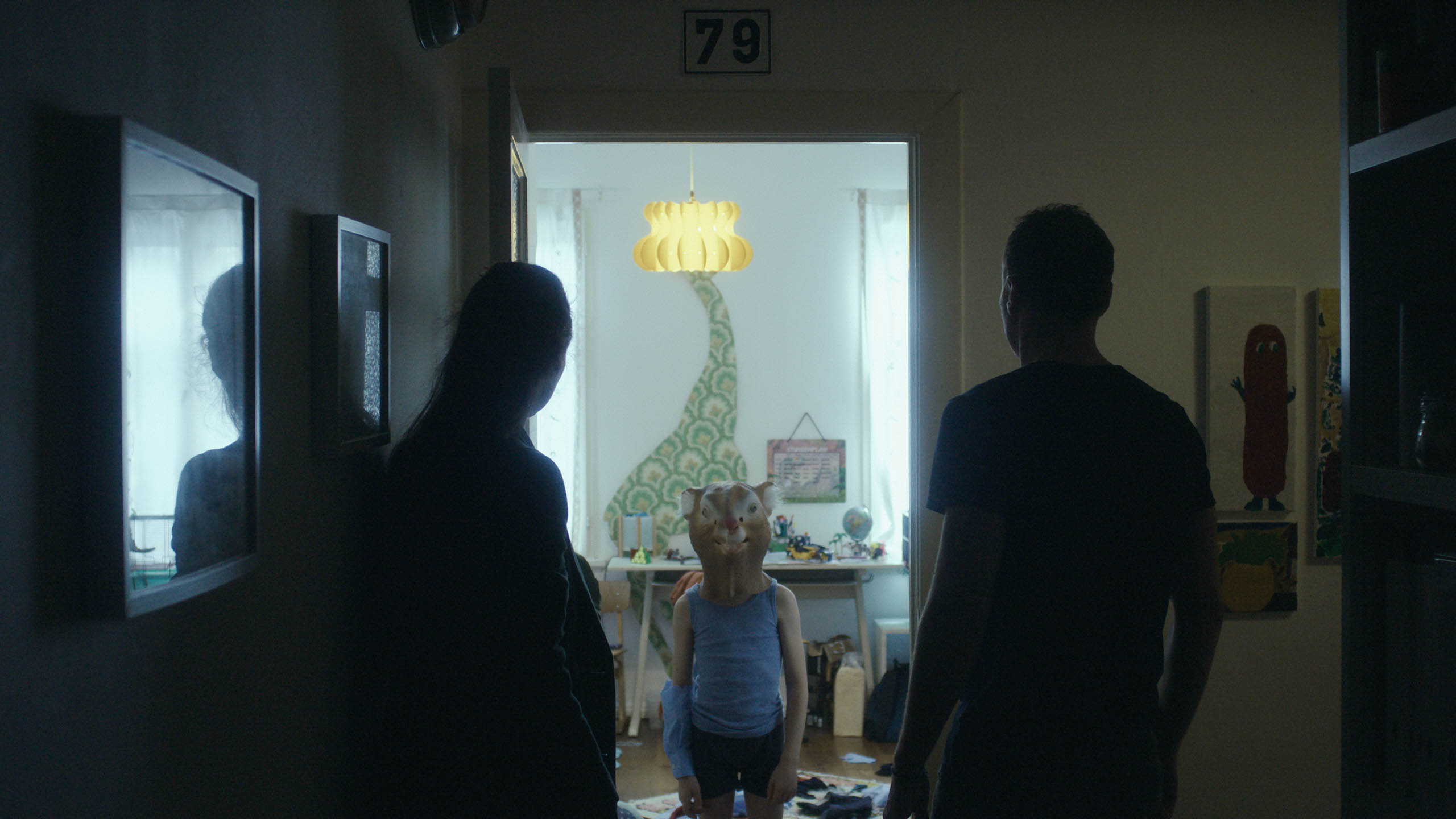
It starts with a home invasion. Jan (Mark Waschke) and Nina (Sabine Timoteo) have taken their family to their vacation home in a coastal town where the trouble awaits. Jan is outside on the phone when he hears a scream. When no second scream is forthcoming, he resumes his call, unaware that his wife has just encountered people in the house, who flee before anyone else spots them. Rattled, Jan and Nina share their bed with their two children that night, a young son named Max (Wanja Valentin Kube) and teenage daughter Emma (Jule Hermann), their restful weekend getaway already shattered.

Forging on with the weekend in an attempt to put the incident behind them, it would seem their shaky nerves aren’t the only thing troubling this suburban family. Everything is off-balance. Jan hates that Nina has called her brother, who swoops in to the rescue. Nina hates that Jan has made a huge decision at their mutually owned and run business by himself. Jan suspects the break-in is a product of Nina’s nervous imagination, since she’s the only witness. And son Max accuses his father of “hiding” during the incident. Seeds of doubt and mistrust have been sown this weekend, and soon these weeds are growing out of control through the cracks of their family’s core. This has been a triggering event that challenges our notion of truth and of perspective. There is no one narrative, only shifting lenses that reveal the fragility of familial bonds.

Though I admire writer-director Ronny Trocker’s film thematically, I found the viewing experience to be less than ideal. Not because it’s brutally tense, though it is. And not because the characters aren’t particularly likeable, though that’s true too. The incident in question, whether or not it happened, was fairly trivial, and of no real consequences. Yet this relatively small stone thrown into the family puddle creates unexpected ripples whose effects are long-lasting. It’s really just a trigger point to expose already-existing fault lines, and then we sit back and watch this family quake. My problem with the film is that it was simply a boring watch. I wasn’t compelled by this characters, and didn’t much care about the aftershocks or the outcome for this family. Human Factors means well but asks for too much patience in exchange for too little pay out.