What a fucking movie, eh?
Chris Nielsen (Robin Williams) dies in a car accident and wakes up in an afterlife of his own making. The world he constructs is based on his wife Annie’s painting; everything is made of gobs of paint that squish beneath his feet as he walks and explode with colour when he grabs them. An old friend, Albert (Cuba Gooding Jr.), appears as his spirit guide, though he looks much younger than Chris remembers. It takes a little getting used to, but it starts to feel like home, especially when he reconnects with his children, who died years previously. The only thing missing is his precious Annie, but Chris finds out that the two will never be reunited. Annie committed suicide – she’s in hell, and there’s no coming back from hell. But Chris tries anyway, because heaven isn’t heaven without her.
What Dreams May Come is preachy even if you believe in this stuff, and if you don’t, well, it’s a hard message to swallow. We never get a glimpse of God yet we’re left wondering what kind of deity would kill all of Annie’s loved ones – her husband and both her children, in two separate accidents – and then judge her when the pain is just too much. It seems monstrous and unfair and is even harder to watch in light of Robin Williams’ own suicide.
 But visually – well, even now, 20 years on, it’s unlike anything you’ve seen. While the heaven-scapes are vivid and sometimes downright magical, it may be the visions of hell that haunt you. Robin Williams tiptoes through a carpet of faces – anguished people buried up to their necks, barely more than the holes necessary for breathing left exposed. The faces are pale and full of yearning. It’s awful – and it’s really awful when there’s nowhere for him to walk but over them.
Colours can be quite dominant – a blue tree a sad link to Chris’s past, the bright yellow of an eternal sunset, the red flames of hell. What Dreams May Come was one of only a few films shot on Fuji Velvia (RVM) film stock. Velvia is a type of film used most frequently for still photography of landscapes and other subjects because of its very high color saturation. It is only rarely employed for cinematography, usually when special effects are required – and boy were they! But these shocks of colour always mean something, whether in the afterlife, of simply through a flashback.
The “painted world” sequence is glorious. By building upon computer software developed by technical advisor Pierre Jasmin, a team devised a method of applying paint strokes to moving images captured on film so portions of the movie look like a three-dimensional moving painting. There are brush strokes that looks like you could reach out and touch them – and your hands would come away wet if you did. Live-action scenes were turned into living paintings with the optical flow technique, by which you track every single pixel in a moving image – in the end, it amounts to a layering of perhaps 10 different depths onto one image. See below for a comparison, before and after the effect is added to a scene:


This film was both breath-taking and ground-breaking; many of the programs used had to be written specifically for the film. One of the most moving images is of a particular tree that almost serves as a connection between the soul mates, though one is living and the other dead.

Rendered using L-System software, a program for defining the algorithmic development of plants and branching structures, the tree was designed with thousands of branches and 500,000 leaves, all of which are blown off and scattered in the wind. It is spectacular and heart breaking to see.
What Dreams May Come won the 1999 Oscar for Best Visual Effects.

 shit without her. The only reason he hasn’t committed suicide yet is the damn neighbours, who need constant monitoring and discipline, and who else would take it upon themselves to mete it out?
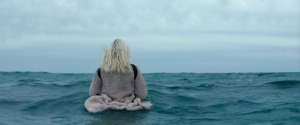 Another son, Will (Jason Segel), estranged from his father since the discovery, returns home. On the return journey he meets a woman named Isla (Rooney Mara) who has her own reasons for questioning the afterlife.
 The exact opposite of what Adam seemed to intend? He hopes the show will give a voice to the disempowered, raise awareness for their plights, maybe even raise money for their widows and orphans. But you can probably guess that this idea is a monster, and once fed by ratings, it will take on its own gruesome agenda.
 Journalist Bitsey Bloom (Kate Winslet) is brought in to do one last interview with him before he’s put to death, but what he tells her isn’t a straight forward of guilt or innocence, but rather challenges her notions of justice and the legal system. But can she trust what she’s being told, or is David Gale just a smarter-than-average killer?
 unintentionally, somewhere in the convoluted mess, it might actually manage to do the complete opposite. The Life of David Gale certainly traps some very worthy actors in a mess they can’t act their way out of. Kate Winslet is pretty Winsletty, although she does a fair bit of running just to show how urgent, how life-and-deathy this whole thing is, but Spacey: man. That guy did not get the good end of the salami here. He’s particularly bad acting opposite the kid playing his young son. It’s just uncomfortable to watch.
 of people who are grieving even as she still lives, dealing with a loss that is still happening before their very eyes.
 started turning things around. But Molly Shannon was a break-out, and some of her characters even got movie deals. I just didn’t like them. I thought she was brash, over the top, and obnoxious. I still do. But in this movie, as they dying mother, she’s none of those things. I still don’t like her, but she was easier to stomach when he’s mostly occupied evacuating hers. Is that a terrible thing to say? Yes it is. But it’s the truth.
 picking up the pieces of her middle age and trying to formulate some acceptable version of the future for herself. She’s disconnected from her youth and perhaps her old passions, but she’s not done, far from it. The film, and Huppert’s performance, has a stiff upper lip: she submits to a series of diminishments with cool detachment, but we watch as these changes slowly affect her relationships, even the one she has with philosophy.
 Marnie has a little bit of money and an awful lot of time, so she packs up her New Jersey home and finds herself a condo in L.A. where her daughter Lori writes for television. Marnie’s California awakening is intoxicating. She loves all the things that most of us hate about L.A. But shopping at The Grove and volunteering only fill up so many hours. The rest are spent calling or visiting her daughter. Her daughter is not impressed.
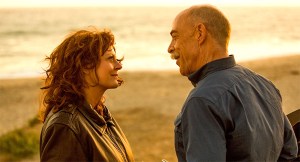 encouraged her to set boundaries with her mother, Marnie sees the therapist herself. And when that doesn’t go as expected, she finds other people to mother, like the ‘genius’ she overuses at the Apple store, and a friend of her daughter’s who’s more receptive to advice and well-intended intrusiveness.
 father is working at keeping what’s left of the farm running. Clover, meanwhile, is trying to piece together what would make her young, whole-life-ahead-of-him, brother put a gun to his head. Neither is mourning in a conventional way, and they’re certainly not doing it together.
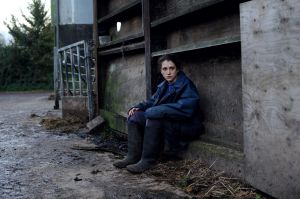 When death is part of business, part of the lifestyle, part of every day, what toll does it take, and at what remove do they experience more personal brushes with mortality?
 ASSHOLES WATCHING MOVIES