
This movie is almost exactly like a great number of other musicals from the same era: a successful song-and-dance duo meet and fall in love with a sister act. But this wasn’t just another musical, this was Bing Crosby in White Christmas, and it became the highest grossing film of 1954, even though it’s “just” a Christmas movie.
The film also puts Rosemary Clooney and Bing Crosby on the screen together, which is a delight. Too bad you can’t hear them together anywhere but in the movie: Clooney’s record company wouldn’t let her on the soundtrack for a competing company, so Peggy Lee replaces her there. She released her own version of the songs, some with her actual sister playing the sister part. Danny Kaye and Vera Ellen round out the cast, though Vera Ellen mysteriously does very little of her own singing. But who cares? You came for Bing Crosby anyway!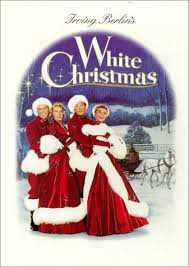
As usual, no expense is spared with set and costume. Or, for the numbers anyway – you’ll never see a sorrier excuse for a brick wall during the war bit at the beginning. I loved the tiny little pointe shoes on the tiny little ballerinas. I also loved Crosby’s unsuppressed (and unscripted) laughter during his and Kaye’s “drag” scene.
What I really enjoy about this movie though is the war aspect. We see Crosby doing a Christmas Eve show as a captain in the army. His fan and supporter (Kaye) saves his life, and when the war is over, the two team up and become quite famous performing their act all over the country. But the war is never really far from our consciousness. The plot is propelled by “favours” for old army buddies (well, that, and Kaye deciding that his buddy Bing really needs to get laid married). And when they find their general down on his luck, they rally around him in a touching tribute. This speaks to me because it’s clear that the war theme was still resonating with audiences in 1954.
We’ve of course forgotten the true meaning of White Christmas, the song, but it was beloved and popularized by the boys in the Pacific over a decade earlier, in 1942. Irving Berlin, the composer, realized that the soldiers were truly the ones dreaming of a white Christmas, and so he built this show (and then the movie) around the song. And while the movie has great big production numbers, this song is given a very simple treatment, just Bing accompanied by a wind-up music box, in front of the soldiers who loved it most, on a lonely Christmas Eve.
It’s interesting that during the movie, the characters make reference (through song lyrics) to USO performers going overseas to entertain the troops on Christmas. They sing “Jolsen, Hope and Benny all for free” but the original lyric was “Crosby, Hope and Benny” – obviously a change was necessary to maintain the integrity of the fourth wall – but it’s important to remember that this cause had long been dear to Crosby’s heart.
It’s incredibly touching to me at the end to see all those men in their uniforms saluting their general and all that he stands for. It’s a great representation of the camaraderie and the unconditional support that was birthed in those trenches (while ignoring the horrors of war, true, but this is a Christmas movie after all).
Vote for your favourite all-time Christmas movie in our poll!
 ASSHOLES WATCHING MOVIES