
Kane’s been missing for a year when he suddenly turns up at the home he shares with his wife, Lena, hemorrhaging blood. He’s been deployed on a top-secret mission that Lena can’t fully understand even as she’s recruited to join the next one. Of the dozens of men deployed, Kane is the only one to return, and he’s just waiting to die of organ failure.
Three years ago, something mysterious happened to a nearby lighthouse, which has been enveloped in a “shimmer”, a danger zone inside which terrible things are happening and from which no one returns. The zone is growing daily, and their own city will be overtaken if they don’t figure it out soon. So Lena (Natalie Portman) joins the next mission, the first one to be all-female, an expert biologist but also just a wife wondering why her husband would sign up for a suicide mission. She joins a group of women (Jennifer Jason Leigh, Gina Rodriguez, Tessa Thompson, Tuva Novotny) highly trained but with nothing to lose as they enter what is likely to be their last mission.
 Inside, every living thing has been transformed. Mutations have made some things astonishingly beautiful, and other things the stuff of nightmares (imagine an alligator-shark hybrid). And now those things are also taking on human DNA.
Director Alex Garland took on human uniqueness in Ex Machina and further explores the subject here. When they are reflected back on us in other living things, which of our traits make us truly special, truly human? It’s a scary question. Garland continues to excel in the creepy, quiet moments between the splashier, gorier stuff. His style throws us off-kilter even as the visuals delight. The audience is continuously confronted with questions to chew on while scary monsters breathe down our goose-pimpled necks. Alex Garland is clearly a talented sci-fi film maker, and even if you leave the theatre confused, you won’t be able to let it go.
For fans of the novel, by Jeff VanderMeer, don’t go in too attached. Garland chose not to re-read the book before embarking upon the script, so the movie turns out more a distant cousin of the book rather than a faithful adaptation. In fact, the details I remembered most from the book were absent; clearly Garland and I latched on to different themes. But the essence remains, the terror remains, the curiosity remains. Annihilation doesn’t exist just to scare you, it wants to challenge you. This is a bold film that doesn’t fit inside any comfortable Hollywood mold. The studio is crapping its pants because it think the movie’s too “cerebral” for us folk. But you know what? Embracing the unknown can be freeing. And exploring these concepts with women as our protagonists, free from macho bullshit, allow us to also experience these things for their beauty and their terror at the same time. Portman’s character is remote, unreachable. Rather, Thompson and Rodriguez provide the most emotional heft as their characters contemplate the most gorgeous and familiar of mysteries.
I left this movie shaken.



 home top prize for Outstanding Directorial Achievement in Feature Film for his brilliant work on
  producers, that kind of thing, fixed costs that no matter what scene is cut or special effect is scrimped on will still be paid the same. The UPM gets tasked with the less glamourous crew, the “below-the-line” costs, contracting with gaffers, makeup artists, sound engineers, all the “little people” who turn up and work hard to actually turn good ideas into reality. Plus he or she will be negotiating deals for location, equipment, etc.
 sure everyone’s safe. The first assistant director (1AD) is directly responsible to the director and runs the floor or set; they have to accurately estimate how long it will take to film a scene – whether several pages will be shot quickly, or one emotional paragraph may take all day. The 1AD is the communicator on set: all directions to the rest of the crew from the director will run through him or her. The second assistant director (2AD) creates the call sheets and then makes sure that all the cast is ready to follow through,
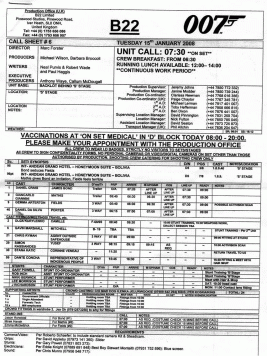
  putting them through make-up and wardrobe. The call sheet tells cast and crew what scenes and script pages are being shot today, and where. They will provide exact start times (which rarely turn out to be all that exact), and addresses of shoot locations, and transportation arrangements so everyone can actually get there and maybe even park legally. It should also have contact info for the important crew, safety notes, maybe weather reports, sunrise\sunset times, and where to find the nearest hardware store when you inevitably need another extension cord. The second
  second assistant director (22AD) (yes, that’s their real title) comes on board when the production is big and\or complicated. You can be sure the 2AD is checking on Brad Pitt’s mustache while the 22AD is making sure there’s a dozen ladies in hoop skirts behind him, or a thousand extras in zombie makeup, or that all the parking meters are fed. This really frees up Alejandro Iñárritu to laze about in his director’s chair fantasizing about Leo’s frosty breath, or Wes Anderson to deliberate between Egyptian blue and Ultramarine, or Steven Spielberg to play another practical joke on Tom Hanks.
 I’m also crazy excited to tell you that Alex Garland won for Outstanding Directorial Achievement of a First-Time Feature Film Director. Recognize his name? He’s the man behind 2015’s break-out indie success and seriously one of my favourite films of the year,
 achievement. Thewlis worked under Martin Scorsese on The Age of Innocence as a DGA trainee. She worked on the Tupac Shakur movie Above the Rim as the key second assistant director and under director Jon Avnet as second second assistant director on Up Close & Personal and then spent a lot of years at Law & Order originally as Second Assistant Director and eventually First Assistant Director. Kudos to her, and may she be an inspiration and example of hard work to aspiring young film makers everywhere.
 ASSHOLES WATCHING MOVIES