Tag Archives: documentaries

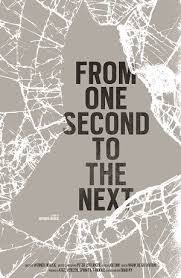
From One Second to the Next

From legendary documentary film maker Werner Herzog comes Frome One Second to the Next, an unflinching look at the consequences of texting and driving.

This documentary is really about content. Herzog tries to jazz it up with some stylized shots of people kneeling thoughtfully beside crash sites, or the empty hand of someone who was once holding on to a child for safety, but these shots are glaringly unnecessary in a film that already has an impactful message.

Of course we hear from victims, or victims’ families, but these accounts are as predictable as they are tragic. It sounds like testimony, like victim impact statements. We find more connection in other moments, like a police officer choking up over an infant’s fatal injuries, or the blank stare of a woman so traumatized she registers no emotion hearing her sister list the extensive damages incurred to her both physically and financially, but suddenly engages when recalling her dog, also a victim in the acciddent, who flew violently threw the air before landing where he would ultimately die, but not before seeing his owner into an ambulance.

I was glad to hear from a couple of the perpetrators (and angry to not hear from all). Their regret is palpable even if their sentences are underwhelming. For the most part, the film keeps its focus appropriately on the victims, always with the distinct undercurrent of the complete preventability of their deaths.


from

This film is available on Netflix.

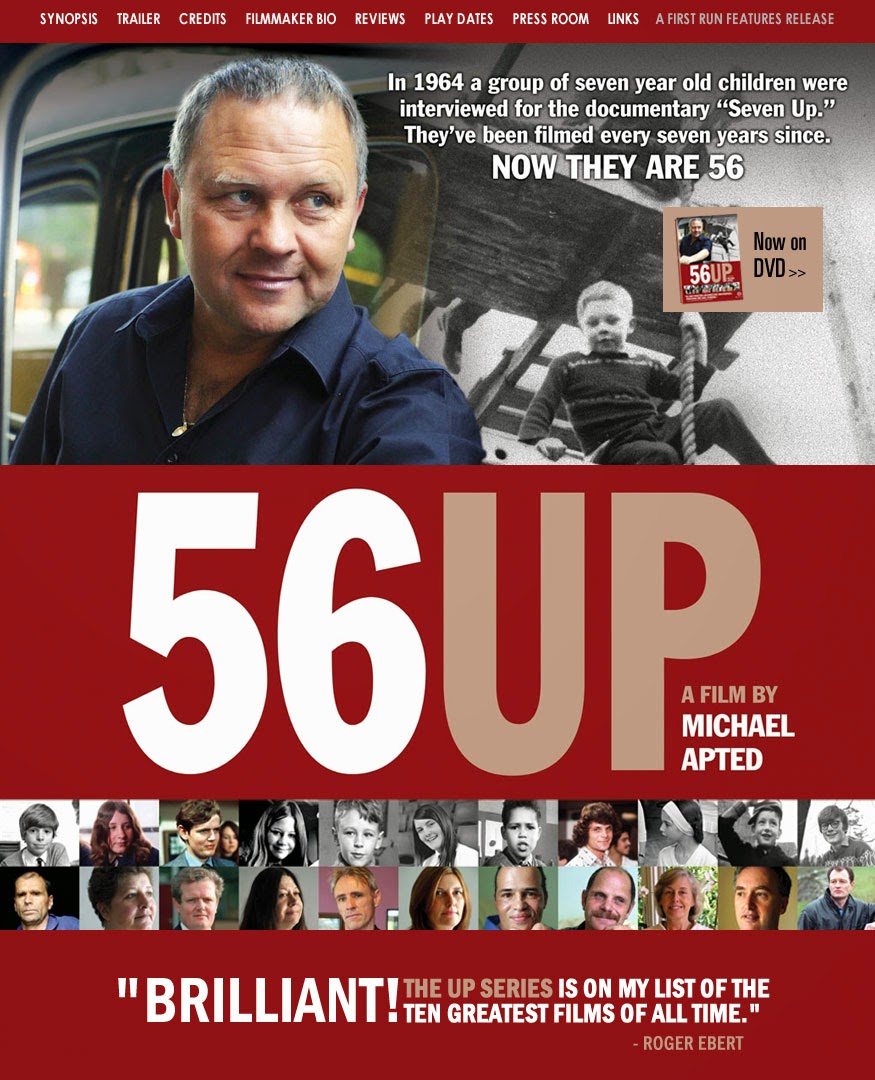
56 Up

I learned about this documentary through watching Life Itself , the ode to Robert Ebert.He was apparently quite a champion of this series and I was curious to find out why.

In 1964, the movie’s producers assembled 14 “diverse” (meaning 1 biracial kid, 4 girls, and 2 kids from the country) seven year olds and asked them a whole bunch of questions about what it was like being them, and what they saw for themselves in the future. The premise was taken from a Jesuit motto “Give me a child until he is seven and I will give you the man.” It was thought that at the time that these 7 year-olds would be heralding civilization into the next millennium (ie, they’d be grown up and leading us into the year 2000). The film has checked back in with the group every 7 years since, with this last installment, the group at age 56, filming in 2012 and airing in 2013.

What we get to watch is a decades-long social science experiment. These are very much ordinary people updating us on the minutiae of their lives. What have they become? Are they fullfilling their own prophecies? Living up to their potential? The director makes no bones about his original thesis – he assumed that each child’s social class would predetermine their future.The kids were apparently selected from different backgrounds (though like I said, they all seemed to come from the same end of the colour wheel). And the director himself admits that he didn’t anticipate “feminism” – he deliberately only followed 4 girls because it was sort of thought – who cares? They were never supposed to “become” anything anyway.The children were not held under contract so every 7 years since, they can volunteer (or not) to do the update. Though many express apprehension and sometimes even animosity toward the series, all but one have continued to make appearances.

Watching this, I wish I had started at the beginning. We see glimpses of previous interviews, we see the child, and the middle-aged adult, but I would have liked to have seen more. Each person presents us just a slice of their true picture, but we do pick up on divorce, unemployment, miscarriage, aging and ailing parents, the struggles of parenthood, and everyone’s changing (or static) politics.

The original hypothesis being that their life paths should have been set at birth has proven surprisingly (depressingly) true – most who started in the working class have remained there. But the interesting bit is not judging their success by the class which they inhabit, but rather by watching them judge it for themselves, over time. Are they happy? Satisfied? Do they feel they’ve wasted their lives? Contentment spreads over all the classes, as does doubt and regret.

I won’t summarize each of the subjects because that’s the point of the movie. One who really caught my eye though, I believe his name was Neil, was a sweet and charismatic little boy, not the one you might have guessed would grow up with mental health issues, only to battle thoughts of suicide, and spend time both jobless and homeless, but that’s what this film uncovers. These are not always pretty truths, but that’s exactly what we need to see. A little bit of reality before “reality TV” was ever a thing.

The exciting thing about watching this rather banal update is that it makes you question yourself. You wonder what you would have been telling the producer when you were 7. What job did you believe your future self would hold? I think when I was seven I wanted to be a teacher, which rather disgusts me now. My nephew (still a few years shy of 7) wants to be a green dragon when he grows up. Did your seven year old self think you’d ever get married? Or travel? See outerspace? Work a dead end job? Be a single parent? Are we failing our inner child’s dreams for us? Have we settled? Should we be happy with the compromises we’ve inevitably made? Are we learning from our mistakes? How do we really measure happiness, and what exactly is “success”?

Whatever experiment this started out as, it’s now become a question of existential proportions. And while I enjoyed watching this, I wished I was watching it with someone, maybe even some of you assholes, because I wanted to ask you these questions. Who did you think you would be when you were seven? Who do you think you’ll become in the next seven years? And at what point in your life can we really take stock, and declare it a success or a failure?

This movie is available to watch on Netflix.

Life Itself

Our first meta-review, guys! Because how do you review a documentary made about the man who made movie reviews famous? Roger Ebert wasn’t the first film critic, and probably not the best, but he’s the one I grew up with, him and his thumb, and whichever way he was wielding it, it had power.

This film, made in the months immediately preceding his death, is an ode to love of film, and love of life. Indeed, we are privileged to meet the love of Ebert’s life, and she is brave enough to share their story with us. For that reason alone, this film is worth the watch.

It also gave a fascinating glimpse of the relationship between Siskel and Ebert. With some behind the scenes outtakes from their early days of television, we see the two not just butting heads but activiely disliking and dismissing one another. The animosity is awkward and seething and you can only imagine what it must have been like to work on the set of that show. At one point we hear Siskel refer to Ebert as an asshole, and though that’s not the origin of this blog’s title, we are the Assholes Watching Movies, and that little bit of trivia caught my breath. By the end of their tenure they seemed to have grown into genuinely respecting and even caring for each other – Siskel later said that Ebert was an asshole, but “he’s my asshole.” The film pays no mention at all to Siskel’s replacement, the comparatively bland Roeper, and most people felt the zing went out of the show when Ebert lost his favourite sparring partner.

Life Itself (although the title of Ebert’s memoir) explores the nature of Ebert’s criticism. He was a populist who wanted to like every movie he saw, and he saw an enormous amount (although probably not as many as we watch – we don’t technically get paid to watch movies, but we mostly get paid while watching them, which is almost as good). He took his job seriously and defended his position vehemently. He sometimes introduced new voices to the world. He championed Scorsese, who probably didn’t need it but seemed to really value it nonetheless, is his early, unknown days as a budding film director. Werner Herzog says of him “He reinforced my courage.” He measured movies against his own moral code and if they violated it needlessly, he could be ruthless. But he also believed in reviewing movies within a context, which is something I hope we’ll replicate here. We’re part of the fan culture that he helped create with his accessible reviews. We aren’t trained critics, but neither was he (he started out as a sports writer, apparently). He wanted his reviews to be only the starting point, and that’s what we’re hoping for here too – to have a conversation with whomever wanders in and reads the blog. Write us comments. Let’s discuss.

Roger Ebert’s disease was eating away at him. Without a jaw, he still managed to not only be witty, but infectiously so. He could still be expressive even without his voice. It was when words started failing altogether, when he could no longer type nor communicate that he seemd to lose his will to live. It hurts to watch this decline but it helps a bit to see this film as a celebration of a man who lived for movies, and lived as if he was in one.

Rest in peace.

Frightfest 2015 Double Feature: The Shining and Room 237

Die-hard fans of Stephen King’s harrowing 1977 novel of the same name will likely disagree but, to many, Stanley Kubrick’s The Shining delivers two of the most frightening hours in the history of American horror.

the shining

Jack Torrance (Jack Nicholson), an out-of-work writer who is desperately in need of a job, drags his meek wife Wendy (Shelley Duvall) and eight year-old son Danny (Danny Lloyd) to the historic and secluded Overlook hotel where Jack is to act as caretaker for the long lonely winter. The hotel manager warns Jack that some caretakers in the past have experienced some cabin fever as a result of the isolation, resulting in (at least) one murder-suicide. Jack (Torrance), with that famous Jack (Nicholson) grin, assures the manager that this will never happen to him but we as the audience already aren’t so sure. We’ve already learnt from Wendy that Jack has a bit of a temper and once dislocated Danny’s shoulder in an accident that “could have happened to anybody”. What’s worse, Danny has a special ability to see both the past atrocities of the hotel’s history and all all the horrors to come but, despite his frequent chants of “Redrum”, no one will listen.

the shining 2

King famously hated Kubrick’s adaptation of his cherished novel. Kubrick took what was useful from the book and scrapped the rest, in favour of a more surreal, ambiguous, and visceral version of the story. As a fan of the novel, It’s a chilling, exceptionally well-made horror film that so many have embraced over the years and can easily be enjoyed as such. The Shining is most unsettling, however, for those who are willing to dig a little deeper and continue to reflect on the film’s mysteries as it continues it’s work on you.

Which brings me to Room 237, a 2012 documentary by Rodney Ascher about people who have room 237never been able to stop delving into the mysteries and symbolism of The Shining. Six participants share their elaborate theories through voice-over almost entirely over footage of the film. The choice of brands in the pantry, posters on the wall, faces in the clouds, missing chairs, impossible windows, and hidden erections are all under intense scrutiny.

The theories of Room 237 run the gamut from thought-provoking to just plain silly. Some examples you’ll wonder how you yourself could have missed while other are almost painful to see as people who are clearly obsessed seem to be grasping so desparately at straws. So many who were involved in the making of The Shining have insisted that there are no answers to be found in Room 237 but, one way or another, it is sure to change the way you experience Kubrick’s classic.

Tim’s Vermeer

Johannes Vermeer was a Dutch painted from the 1600s. He was only moderately successful in life. He painted mostly domestic interiors – in fact, mostly the same two rooms of a house, with the same furniture, and women inside them. Years after his death he was rediscovered and renowned for the astonishing use of light in his paintings. His great masterpiece is Girl With A Pearl Earring.

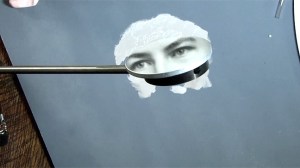
Tim Jenison is a very successful inventor and engineer – he worked in computer graphics and 3D modelling software. He’s also an art enthusiast who fell in love with Vermeer and traveled the world to stalk his artwork. And he came up with an interesting theory: that Johannes Vermeer mastered light by using the technology MagMag-Spring14-Film-TimsVermeer_2available to him at the time. What’s that, you ask? And I’m glad you did. It’s astonishingly simple: a mirror. A fucking mirror. It becomes possible to project a living image directly onto a canvas and to match colour and light exactly. Exactly! It’s astonishing to see Jenison whip up an oil painting using this technique. So Jenison, who has a whole lot of money, decides to reconstruct one of Vermeer’s most-used rooms to see if you can reproduce one of his paintings. And Penn Jillette (of Penn & Teller), a personal friend of his, becomes his documentarian.

Film critics love this movie, calling it entertaining, fascinating, and profound. And indeed, it is compelling to watch a millionaire and his latest obsession; the lengths he’ll go to, the time he’ll devote to simply testing out a theory when he doesn’t even have a horse in the race. Art critics, however, are less enamoured with the film, which makes sense. Jenison is, after all, sticking it art world. He’s taking talent and genius off the table and claiming that, given the right tools, anyone could reproduce a masterpiece. And while that’s heartening for those of us lacking in the talent department, I’m guessing it stings quite a bit for those trying to follow a calling, or make a livelihood out of it.

Possibly because I am not myself an artist, I don’t really feel like it takes anything away from Vermeer even if he did use technology. Is it less impressive that we landed on the moon because we used technology? Of course not. So maybe Vermeer was less an artist-genius and more of a genius-genius. Good for him. Good for figuring it out, for developing techniques that allowed him to paint light years beyond what anyone else was doing, then or now. Good for him for making beautiful, impactful, lasting artwork. And no one is saying this method is easy, or any easier, than any other kind of painting. It just allows for camera-like accuracy. The bottom line hasn’t changed, we’ve just maybe discovered that Vermeer was even more interesting than we thought.


Truth or Dare

During Madonna’s 1990 Blonde Ambition tour, she was filmed nearly constantly and the footage was strung together to make this behind the scenes documentary. At the time it was both lauded and condemned for being wild (she exposes her breasts!) and lewd (a gay kiss!). 25 years and a whole lotta Madonna later it almost seems whimsical but it still works as a nostalgia piece.

In fact, watching Truth or Dare, I can’t decide what lights up my nostalgia more – the costumes, or the dance moves. And it definitely makes me wonder how Madonna feels about them looking untitledback. If you were a fan of Sex and the City, you may remember a certain episode towards the end where Carrie was tasked with cleaning out her closet. She tries on various costumes that fans recognized instantly from the series, while her friends yayed or nayed them. It was a perfect send-up to the whole era of SATC but should Madonna do the same I think the whole world might implode. Of course we all remember the cone-bras and that’s something that doesn’t really age because it’s iconic. The bustier layered on top of wide-legged trousers, however, feel like a much bigger mistake in retrospect, but one I’m glad to relive (as long as she’s the one caught on camera wearing it!).

There’s also a fair bit of celebrity gossip on hand because Madonna was of course dating (and breaking up with) Warren Beatty at the time. Beatty is definitely not fond of the constant cameras and you’ve got to wonder if they weren’t partially responsible for their parting (although Madonna’s hectic schedule and near-constant touring when health permits can’t have been easy either). Despite it being Warren in the picture, when Madonna is asked who the love of her life has been, she names Sean [Penn]. How much would you wager she’d answer the same today? Madonna herself doesn’t seem to court a lot of celebrity friends and she’s muchenhanced-buzz-30479-1378239971-15 too busy working to be out partying. A fair number do stop by to watch her concert and bump fists with her afterward, and the best cameo goes to Kevin Costner – no, to Kevin Costner’s mullet – who proves he’s beyond square by calling her show “neat” and acting rather bored.

Instead of partying, she stays in to baby her failing voice, and is often cuddled up with her dancers, decked out in fluffy hotel bathrobes. She and her dancers grow quite close during the tour, and she often talks about an intense mothering instinct that’s brought out in her. She ‘s only 32  or so, not so very much older than the dances, but in experience she’s already ancient.

There are lots of terrific Madonna moments, from being threatened with arrest for “indecency” at her Toronto Skydome concert, to reminding God that “she’s here” should he need her services during a pre-show group prayer.

I watched this as a companion piece to a more recent documentary called Strike A Pose – catching up with the dancers made famous by this documentary and her Blonde Ambition tour. Both are worth checking out, although Truth or Dare is clearly the classic.


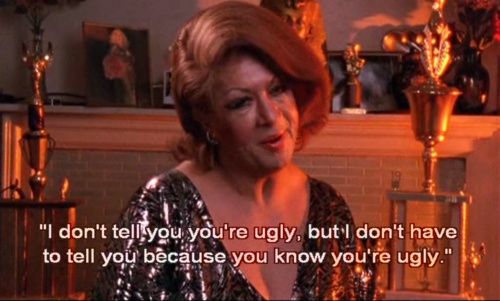
Paris Is Burning

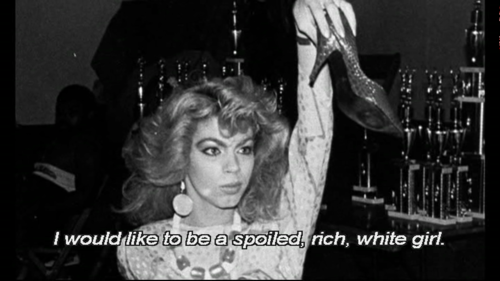
Shot between 1985 and 1989, Paris Is Burning is a documentary that explores the “ball culture” of New York City. These balls were beauty pageants of sorts, for drag queens certainly, but categories for competition tended to make room for black people, latino people, gay people, and transgendered. These categories and sub-categories are so structured that I could never explain them all to you, but people competed in “executive realness” (how well you can “pass” for a business person), for example, or showed off their catwalking skills, elaborate costumes, or dance moves.

Competitors grouped together in “houses” (like the House of Chanel), which were substitute families in a community that really needed them. Director Jennie Livingston spent years untitledinterviewing people and putting this thing together, and it’s given me insight into a world I never knew existed. Drag isn’t just a subculture here, it’s a complex thing of race and class and gender identity that allowed for a pretty wonderful self-expression.

The film brought voguing into the mainstream although it was actually just a small part of the movie. What I’ve gleaned is this:

First, reading: to get a good ‘read’ on someone, you find their flaw and you come up with a good insult about it. But the truer the flaw, the better the read. It’s not just about being mean, it’s about being shrewd I think.

Then, shade: to throw shade is to slyly insult someone. You disrespect them with trash talk.

ce88fc3c9f794ffee427b2d604b854d5And finally, voguing: which is the dance equivalent. I never knew that all these concepts were somehow interconnected, but yes, voguing is part of a dance battle where you freeze repeatedly in glamourous positions (as if you’re a model on the cover of Vogue magazine), trying to outdo each other. A few years later Madonna will bring this trend to the mainstream, white-washing it and losing its flavour, but it’s actually a pretty cool thing to watch the real stuff go down.