
“I don’t make motion pictures. I make EMOTION pictures”.
I can’t promise that the great Pedro Almodóvar actually said this but this quote was how my film teacher introduced me to the filmmaker’s work before showing us All About My Mother. As a 19 year-old college student, the only EMOTION I felt with any sincerity while watching Almodóvar’s 1999 classic was boredom.

I’m glad I gave him another chance. I’ve seen many (though certainly not all) of his films and have re-watched Mother at least twice and have come to appreciate the focus on genuine human emotion that make up his films as well as the beautiful colours that are signatures of his cinematography.
It’s a beautiful thing when a work of art can transport you back to your youth and Julieta is that rare film. It’s the kind of film that reminds you what it’s like to be 19 and bored beyond belief by a Pedro Almodóvar film. So bored that I was willing to risk the glares of my fellow theatergoers by momentarily turning on my cell phone just to see how much more of this I had to sit through.

Which isn’t so say that Julieta is a bad movie because it’s far from it. It’s script is inspired by three interconnected short stories from renowned Canadian writer Alice Munro, a fact that I am somehow irrationally a bit proud of as a Canadian. As a teenager, Julieta has a flirtation and affair with a mysterious man on a train. As a young mother, she visits her parents only to discover her mother doesn’t seem to be getting the care that she needs. And as an aging widow, she tries to reunite with her estranged daughter who left in search of spiritual enlightenment and never returned.
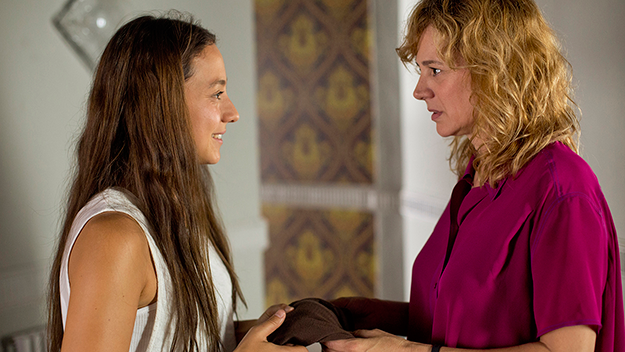
The mother-daughter segment is the strongest of the three stories and Almodóvar is smart to use his somewhat non-linear structure to tease it throughout the film. As usual, he favours emotion over motion and the feelings always ring true and the film is always lovely to look at. Despite his fascination with the feelings and inner lives of his characters though, he’s usually much more generous with plot. While my favourite Almodóvar films tell riveting and unpredictable stories, there isn’t enough to connect the three parts of Julieta to feel like one story. Ironically for a film with three stories, there doesn’t seem to be enough story in Julieta to fill a full movie. It’s not bad but I’ve come to expect better.
 mother. She has exes, lovers, and erotic fixations. Some of them may surprise you. She reminds us that there are many ways to respond to this kind of violation, and none of them are necessarily wrong. But victimhood does not sit well with Michèle; Michèle plots revenge. Michèle’s complexity is a welcome layer to this psychological thriller, and it’s superbly executed by Isabelle Huppert. Huppert won the
 just showing up and being this weird alternate personality. He more or less stalks his daughter and endangers her career by showing up at her office and various work functions. If he was your father, you’d either die of embarrassment, or you’d kill him. No two people should survive a relationship like this.
 picking up the pieces of her middle age and trying to formulate some acceptable version of the future for herself. She’s disconnected from her youth and perhaps her old passions, but she’s not done, far from it. The film, and Huppert’s performance, has a stiff upper lip: she submits to a series of diminishments with cool detachment, but we watch as these changes slowly affect her relationships, even the one she has with philosophy.
 Cafard is the French word for cockroach. But make no mistake, the animated film Cafard is not the French version of A Bug’s Life. It’s a bleak, adult tale about the horrors of the first World War, from the perspective of a world champion wrestler who enlists in the Belgian army in 1914 after his daughter is raped by German soldiers. Unfortunately for all involved, that terrible event is only the start of the awfulness.
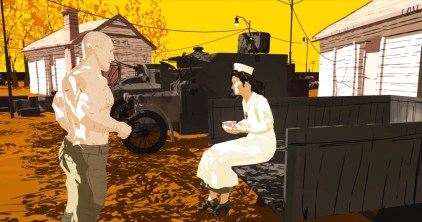 coat any aspect of war’s horrors. While that approach is commendable, it is that much more difficult to embrace Cafard. I would have liked for the film to have offered something to offset its harsh subject matter, but there is no joy to be found in this world. Any hint of happiness feels fleeting, like a consolation prize at best.
 diverse. One, Sam (Malik Zidi), or “red beard” as they call him, is an honestly devout Muslim but also an undercover journalist hoping to get a juicy story on jihadism. His Muslim buddies are all young guys like him from a range of backgrounds, easily mistaken for a group of soccer-loving 20 somethings. But one of the gang, Hassan (Dimitri Storoge), leaves France because he’s ready to make holy war. When he comes back, he tells his friends they’re charged with forming a terrorist cell right there in Paris.
 desert and gives us female soldiers for company. Some of them have been given jobs in name only (Daffi is a “Paper and Shredding NCO” who spends most of her time beating the high score in Minesweeper) and most are counting down the days until they return to civilian life. Their officer, Rama, however, is trying to make this her career…
 ASSHOLES WATCHING MOVIES