Tag Archives: whoa there what the fuck just happened

Cold In July

Michael C. Hall plays a mulletted family man and devout Texan, circa 1989, which means when his wife wakes him up in the middle Michael C Hall Cold in Julyof the night because she heard a strange noise in the house, it’s his job to grope around for his bedside gun and tip-toe towards intruders. You always hope it’s just the cat, or a gusty tree branch, or water in the pipes, but when Richard finds a stranger in his living room, it’s a matter of mere heartbeats before that stranger’s brain is splattered on the ugly painting behind their ugly couch.

Richard feels awful. He didn’t really mean to kill anyone. The cops are quick to assure him that it was self-defense, and besides, the intruder is known to them, a criminal with an extensive rap sheet, no one worth being upset over. Except the dead criminal’s father (Sam Shepard) happens to disagree. He’s fresh out of prison himself, and his new project is stalking and threatening the young family of the man who just gunned down his son.

The cops are useless, of course. At first they brush Richard off, but when the threats become unignorable, they use a maneuver I can maxresdefaultonly hope is more Hollywood than handbook, and use the family as bait. Shit goes down and just when you think maybe Richard can go back to sleeping through the night, he discovers that the intruder he killed is likely not Sam Shepard’s son at all – but why would the cops deliberately misidentify him?

Are you thinking what I’m thinking? That’s right: Don Johnson in a tall white cowboy hat. He’s the only one who ccold%20in%20july%203an help us now!

And that’s where I lost the thread. This movie is gritty and seedy, but it may be too intent on delivering twists and curveballs for its own good. You get in deep with this one, and things keep going from bad to worse. They stir the plot, and it thickens accordingly, with lots of shifts in tone, imagesCA49WFS5sometimes going from noir to comedy and back again within a few lines of script. Richard is the one who’s supposed to steer us, the audience, through all of these changes, but it’s hard to keep making excuses for why he’d let himself get involved in this increasingly shady stuff, as a sidekick to a man who just minutes ago wanted to revenge-kill his whole family.

This movie has a lot to say about masculinity and though it’s set 30 years ago, in our house it’s still Sean’s job to go confront the things that go bump in the night. In other houses? Apparently 1 in 5 men are happy to send their wives down toinvestigating scary noises at night do their own investigating, with 25% of men willing to feign sleep in order to avoid the duty. Sean is not so lucky. If left to his own devices, he’d absolutely sleep blissfully through a home invasion, and possibly also a portal to hell tearing a thunderous opening right underneath his pillow, if I wasn’t there to forcefully shove him awake. I’m not much of a nervous nellie, and since I’m an killerinsomniac, I’m used to the moans and groans a home makes when it thinks its occupants are asleep. But I have woken up Sean and sent him down to “check things out.” And guess what? It’s never a baddie. And if I really thought it was, I’d never sacrifice my best guy. I’d also never want to be left alone! I have seen a Wes Craven before: safety in numbers. What’s the middle of the night protocol like in your house?




Paprika

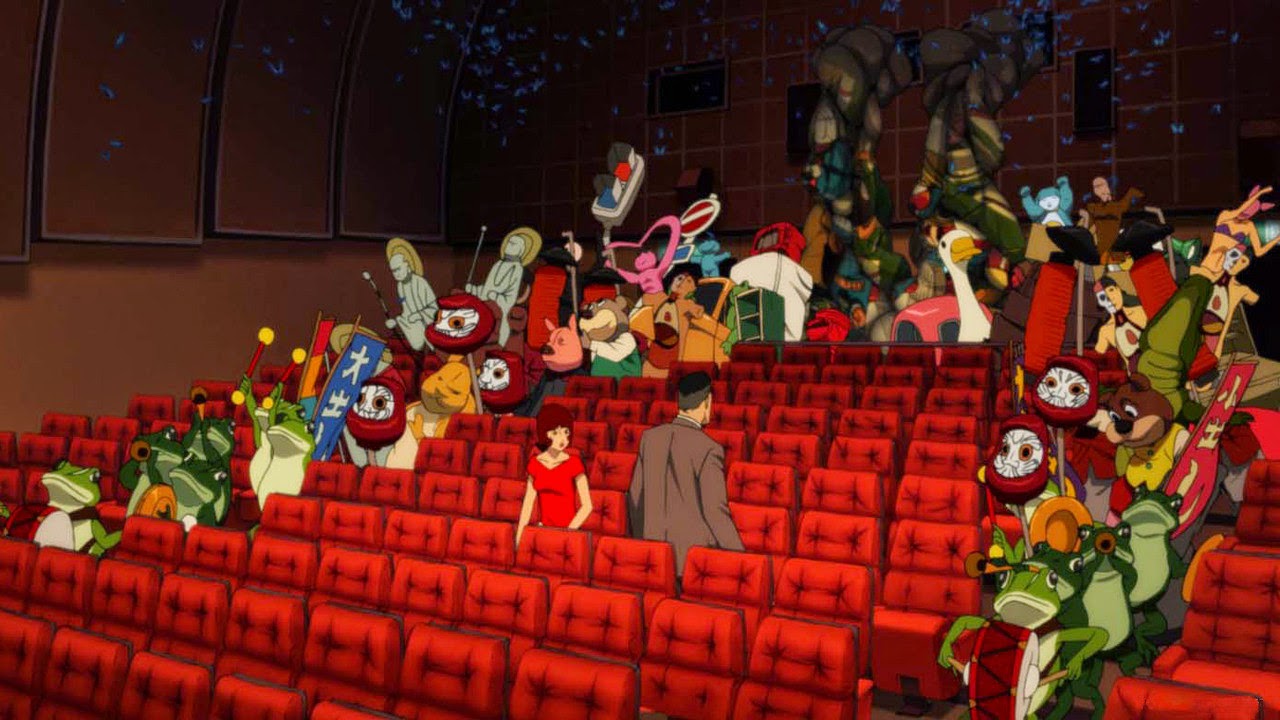
paprikaIn the near future, a device called the DC mini will allow a new kind of psychotherapy, whereby a person wearing the device during sleep will allow his or her therapist to view their dreams. The DC minis aren’t quite ready yet, but Dr. Chiba is already using them outside the facility to help her patients, like Detective Konakawa, who has recurring nightmares, by assuming her alter-ego Paprika in the Paprika japanimation dream analysisdream world, and guiding him through the source of his anxiety.

Despite secrecy, the lab is broken into, and the DC minis fall into the wrong hands. Still in their early stages of development, the devices lack access restrictions, so when they’re stolen, they allow anyone to enter anyone else’s dreams. Soon the scientists at the lab seem to be falling prey to dream invasions – bad dreams being implanted by the thieves of the device – whimageich have real-world consequences.

As dreams and real life start to merge, does the film get confusing? You betcha: kind of like the best dreams do. It’s surreal, of course, fresh and fantastic, but trippy, and rife with the problems of translated-from-Japanese dialogue. You might get a brain bleed trying to make sense of this movie, which I suspect is meant to be experienced more than understood anyway. If it Paprika_07sounds a little like Inception, you’re not wrong. Christopher Nolan was influenced by Paprika, but while Satoshi Kon’s film is able to play with the fluidity between dreams and reality more recklessly, Nolan’s film irons out the incongruities and presents something a little easier to follow and swallow.

Satoshi Kon is not just a film maker, but a film lover as well, and he Paprika (4)uses the dream sequences in Paprika, now watchable and movie-like, as an homage to his own favourite films. There’s a parrallel between dreams, movies, and how we use both to construct narrative in our own lives. The imagery is truly like nothing you’ve seen before, and paired with a very unique soundtrack, it lifts you out of, and beyond, the usual movie going experience.

The Congress

Have you ever watched a movie and thought – I need someone to tell me whether I liked this or not. Or better yet, I need someone to show me how to like this. Or even why.

It’s possible I lack the mental acuity to even describe this movie to you, despite the fact that I’ve seen it very recently, discussed it very recently, and have Wikipedia, Rotten Tomatoes, and IMDB right at my fingertips. Still this movie eludes me.

The Congress: a deceptive title if ever there was one. Robin Wright plays Robin Wright – an aging actress who was once a bankable sex symbol as the Princess Bride, but after a series of bad choices and focus on her family, has been out of the public eye and is much less in demand. Her agent Al (Harvey Keitel) has landed her one last meeting with the Miramount studio where executive Jeff Green JPCONGRESS-articleLarge-v2(Danny Huston) offers to save her from herself. The movie industry is in the middle of a revolution: actors are being digitally scanned into a studio’s bank, and Robin is urged to join up now while she has any cachet left at all. The studio will own the character of ‘Robin Wright’ and the real Robin Wright must never act again. She takes a lump sum and a 20 year contract, and she and Keitel share a powerful scene – while she stands in a sphere where a cinematographer is now employed to be her scanner, Keitel recounts a story that takes her from laughter to tears. This is Robin Wright at her absolute best. The years fade away. She is radiant. It feels a travesty that this will be her last performance; she bares her soul even as she sells it.

We jump ahead 20 years. About to renew her contract, Robin now an older woman goes unrecognized since her famous digital self is timeless. She attends Miramount’s Futurological Congress, located in the animation zone, where everyone entering must take an ampoule to become an animated avatar. So this is when the live action movie becomes a cartoon.

The studio executive cartoon tells Robin Wright the cartoon that they’ve now developed the technology where Robin Wright the character can now become Robin Wright the chemical. Still following? People will be able to sprinkle her compound into a milkshake, drink it, and become her. They can use her likeness in their fantasies. They can think up any scenario. They can fuck  Princess Buttercup or be chased by zombie-Jenny from Forrest Gump or get spanked by Claire from House of Cards. Movies are “old news – a remnant from the last millennium.”

Robin is supposed to give the keynote speech at the symposium but has a change of hThe-Congress-stills-17eart, instead railing against the technology, angry that they haven’t used it instead to cure real disease. “I am your prophet of doom” she says.

Then things get crazier still. Still animated, she gets caught up in a rebellion and is saved, ironically, by the former “head of the Robin Wright department,” an animator who knows her so intimately he’s a little in love with her (voiced by Jon Hamm). She’s unable to distinguish reality from hallucination in this state, so they freeze herthe-congress-movie-photo-8 for many years until she wakes up in a time when in fact hallucination can become reality, with a pill. The real world is bleak, its inhabitants leached of colour, dysfunctional. The only ones still able to cope hover above the earth in airships, the last of a dying breed.

This is obviously a very ambitious film, adapted from and loosely based on a novel by Stanisław Lem. Director Ari Folman, of  Waltz with Bashir, is no stranger to ambition, but this little mindfuck takes the cake. Using a political allegothe-congress-wright-bw-planery to savage the increasingly degrading and dehumanizing movie industry is not a perfect fit, but it does inspire some interesting questions, though Folman is, as ever, light-handed with those. He doesn’t like to beat us over the head with ‘message’ so we’re left to make of this hybrid what we will.

The people in the film are duped by pharmaceuticals into believing their dystopia is actually utopia, and we feel the contrast acutely, jumping from lush animation to miserable cinematography. I felt a 75lot, actually – I reacted viscerally to the emotional undercurrent even when I was struggling to identify what was real and what was dream and what was my own projection. It’s provocative and introspective but not particularly cohesive, even factoring in an allowance for a certain amount of “trippyness”. There’s a vision here that isn’t quite pulled off, and I more or less felt abandoned during the final chapter of the film.

Do I regret tacongressking this on? Not in the least. Attempts can be inspiring. I only regret that I didn’t take someone along with me, because when you’re lost among lofty ideas and niggling questions, it’s best to have a hand to hold.


TIFF 2015: The Lobster

The LobsterI was scratching my head about The Lobster before one of many orange-shirted TIFF volunteers had ripped my ticket. All I knew was that it had better be good. Taking our seats only minutes after Demolition (our first screening of the Festival), the Lobster had some big shoes to fill.

I found it hard to tell how the audience in general reacted to yesterday‘s North American premiere. Their applause and questions seemed more courteous than the more rapturous reaction to Demolition and Eye in the Sky. I, for one, immediately congratulated myself for gambling one of my precious 10-pack tickets on this wonderfully bizarre movie.

In what I believe is his first English-language feature, Greek co-writer-director Yorgos Lanthimos told us that he and co-writer Efthymis Fllippou got to talking about how they’d like to make a movie about relationships and so…they made this.     In a world where pressure on singles to partner up has reached a whole new level, recently dumped Colin Farrell is forced to check in to a hotel where he has 45 days to find a mate or he’ll be turned into an animal of his choice (a lobster in his case). The rules of this world are weird but oddly familiar, with hotel residents desperately seeking oddly specific things they can have in common with their dates (beware the nosebleeds scene, as well as so many others). It’s weird, but as the survivor of many bad dates, I sort of understood this world.

The Lobster is a laugh-out-loud funny movie, especially in the increasing absurdity of the situation and the Wes Andersony matter-of-factness with which the cast (Farrell, Rachel Weisz, John C. Reilly, and Ben Winstan) deliver their absurd lines. It’s also, as Lanthimos and Weisz kept insisting, strangely romantic (albeit in a perverse way). It’s one-of-a-kind and I can’t wait to see it again.

Mr. Nobody

The last living mortal, age 118 years, is telling his story from a hospital bed in a future where everyone is now “semi-immortal.”

mr-nobody-movieThis man, Mr. Nobody, explains that before the big bang, there were 10 dimensions: 9 of them spatial and 1 temporal, and all were balled tightly together. When the big banged, 4 of these expanded: 3 of them spatial (we know them as length, width, and depth) and the fourth, temporal (time). The rest of the spatial dimensions remained bound up – but what if one of t hose six was actually temporal?

This movie explores the possibility of parallel universes existing for different choices that we 4make. Mr. Nemo Nobody (Jared Leto) remembers all of these universes as if he’s experienced them all. He remembers choosing to live with is mother AND choosing to live with his father. He remembers marrying and having a family with each of his childhood sweethearts. We see snippets from all of these lives as he recounts them as an old man to one very confused journalist.

The movie is experienced a little like a dream, non-linear sequences spliced together, recurring sounds and images, the visuals imaginative if not always convincing. The movie is big on the butterfly effect (something as small as a butterfly bMr_Nobody_(film)eating its wings can have a profound effect somewhere, anywhere down the line) and is too heavy-handed with his theme. It did raise lots of mind-melting questions, which I always love, because they allow me to annoy the shit out of my husband at bedtime, when he’s just about to drop off into la-la land and I’m wide-eyed and salivating.

If there are infinite possibilities, which one is “real”? Or can anything be real? Which actions will have universal consequences? How will your past decisions, even seemingly miniscule ones, shape your future?

To help us distinguish between Nemo’s various lives, the time periods are colour coded, and shot in different countries with different styles and musical cues to point the way. Which still mr-nobody-mr-nobody-27-05-2009-1-gdoesn’t make it easy to contend with. The web is messy and tangled, and maybe that’s the point, but it still makes for difficult viewing. Each scene is a tiny cinematic event in and of itself, but sometimes it’s hard to imagine them as a whole. The narrative doesn’t always do its job holding things together, but Leto’s performance tries really hard to be up to the task, providing an emotional gooey centre to all of this philosophizing.

Director Jaco Van Dormael drops so many clues into his film that watching Mr. Nobody is like going on a treasure hunt. He may not always be sure of what he’s trying to say, but he’s ambitious nonetheless, and you’ve got to admire him for it.

To The Wonder

Oh, they’re in love. Terribly, terribly in love. They’re that gross couple you roll your eyes at because they think they’re the first ones to be so over the moon with each other. Ugh.

To-the-WonderThe movie opens with obligatory montage of just how very happy Marina (Olga Kurylenko) and Neil (Ben Affleck) are. It reminds me a bit of a french, pretentious (redundant?) version of how Eternal Sunshine of a Spotless Mind begins, which immediately makes me feel like this won’t end well. Marina and her daughter move from Paris to Oklahoma and for some reason nobody suspects that this will be a jarring downgrade. I visited both within 2 months ago and yeah, not comparable no matter how much Affleck peen you’re getting. The only thing worse than her syrupy narration is his whispery one. Careful you don’t strain your eyes from rolling them deep backward into the dark recesses of your brain.

And then she burns the dinner! Oh, should I have said: spoiler aleart! Spoiler alert, the reality of every day life together starts to cool their ardour a bit. And the further apart they drift, the more she turns toward fellow exile and Catholic priest (Javier Bardem) and he gravitates toward an old flame (Rachel McAdams).

Is now a good time to mention that this is a Terrence Malick film? It was released just a year after Tree of Life (only his 6th feature in 40 years) and is also semi-autobiographical, the first of his films to be set entirely in modern day. There was no script, just pages and pages of thoughts. The actors were simply told to play the emotions without speaking and while there’s plenty of voice over, there is hardly any dialogue.

What can I say about Terrence Malick other than he’s a polarizing film maker. He’s certainly a visionary but critics can’t seem to agree if he’s  a genius or a bit of a dullard. When it played at the Venice Film Festival, it was met with both boos and cheers.

Malick must commit tonnes of footage to film. In post-production he creates and hacks in equal measure, sometimes losing entire characters (Kurylenko made him promise that Marina would remail in the film, but supporting roles featuring Rachel Weisz, Jessica Chastain, Michael Sheen, Amanda Peet, Barry Pepper and Michael Shannon all ended up on the editing room floor). His imagery is beautiful, and this particular cake is frosted with generous dollops of religion. He’s exploring love in different ways and settings. This isn’t a narrative, it isn’t a story, it’s more a philosophical treatise on love. If you know Malick, then you’re used to the stylistic montages, though this one feels more fragmentary than most.

tothewonder22Just between you and me, I think Malick’s movies are getting increasingly masturbatory as we go along. He loves his long, meandering shots, and who cares whether they’re actually pertinent to the “plot”? Plot? Hahaha. Plot. Is this meditation or pretension? There’s a lot here that can be only experienced intuitively, which makes it quite demanding of its viewer.

This was the very last movie review that Roger Ebert submitted before his death; it was published posthumously 2 days later. Ebert was in his last days and must have known it (have you seen Life Itself?). His reading of the film is a rather spiritual one:

“A more conventional film would have assigned a plot to these characters and made their motivations more clear. Malick, who is surely one of the most romantic and spiritual of filmmakers, appears almost naked here before his audience, a man not able to conceal the depth of his vision.

“Well,” I asked myself, “why not?” Why must a film explain everything? Why must every motivation be spelled out? Aren’t many films fundamentally the same film, with only the specifics changed? Aren’t many of them telling the same story? Seeking perfection, we see what our dreams and hopes might look like. We realize they come as a gift through no power of our own, and if we lose them, isn’t that almost worse than never having had them in the first place?

There will be many who find “To the Wonder” elusive and too effervescent. They’ll be dissatisfied by a film that would rather evoke than supply. I understand that, and I think Terrence Malick does, too. But here he has attempted to reach more deeply than that: to reach beneath the surface, and find the soul in need.”


Looper

After reviewing Mysterious Skin yesterday, I was inspired to buy and rewatch Looper. I think this movie was high profile enough for me not to bother with my usual summary of the plot so I will just offer a reminder that this is the one where Joseph Gordon-Levitt (the connection to Mysterious Skin in case you were wondering) plays a specialized hitman who must hunt for his future self (Bruce Willis) who has been sent from the future for assassination.

If you haven’t already seen it, I highly recommend it. Director Rian Johnson (Brick) creates a version of the future that is different enough from our present to be interesting but similar enough to be relatable. Because people are sent from the future just to be executed, not to change the past, Looper even avoids most of the logic problems that are usually par for the course with time travel movies. Okay, there are still a few “yeah, but wouldn’t…” moments but maybe that’s even part of the fun. JGL apparently spent a lot of time watching old footage of a younger Willis and, with the help of some talented make-up artists, the two actors do a better job than you might expect of being convincing as the same guy. Oh, and you have Jeff Daniels playing a gangster. So, see it.

But I’m mostly writing this not to the people who haven’t seen it but to those who have. Or at least to those who have either seen it enough times or seen it recently enough to remember what I’m talking about. Please, please, explain that ending to me! When I first saw it back in 2012, I promised myself that if I saw it again, I’m a smart guy- I could figure it out. But I just rewatched it and I still don’t understand how the last five seconds could possibly fit. So, if you have any thoughts, please leave them in the comment section.

Killer Joe

I’m so shell-shocked from this movie I’m having trouble writing about it.

When Chris, a not so great guy from a not so great family ( Emile Hirsch) has a stash of drugs stolen from him by his mom, he has to come up with cash quick, or he’s dead. He and his father, Ansel (Thomas Hayden Church) hatch a plan to kill the mom and collect on her life insurance policy. texasAnd Chris knows just the guy to do the job – Killer Joe, a Dallas detective who happens to be a hit-man on the side.  Too bad they can’t afford to pay his retainer…until Joe spots Chris’s sweet little sister Dottie (Juno Temple) and decides that sexual collateral will do just the trick.

This film is trash. Trash trash, not trailer trash. Don’t be fooled by the actual trailer park. These people aren’t just hicks, they’re actual filthy, morally bankrupt people. This fact is established very very quickly – it’s immediately vulgar, over-the-top vulgar, and that’s before the beaver gets flashed in your face. Chris’s stepmom (Gina Gershon) has no boundaries and apparently no pants. Letts, the playwright, is adept with fucked up families (think August: Osage County) but this one takes the cake.

So I was repulsed by this movie, and this from the girl who didn’t blink once while watching Sin City a few weeks ago. My revulsion was knee-jerk and I went straight for the “bad movie” label – bad, bad movie. But I didn’t turn it off. And as I watched more, I realized that the badness is on purpose. It’s the point. You’re not supposed to like these people. This film is showing us a very dirty, seedy class of people. The badness is actually pretty expertly done, which doesn’t mean it’s easy to watch.

Enter Matthew McConaughey, a southern gentleman and a breath of fresh air. His demeanor is calm, his drawl is polite. He injects the movie with a much-need hit of stillness that lets us catch our breath after all the frenetic coarseness. The audience wants to eat him up which is a very effective device because it turns out he’s just as morally reprehensible and probably the most soulless character yet. He just has a more polished facade.

There’s so much tension in this movie that occasionally a giggle will bubble up, guiltily, without relieving even an ounce of the tension. This movie will make your jaw ache. It’s brutal. It’s sadistic. There so much fetishistic sexual cruelty that you won’t know where to look. If you’re comfortable exploring dark, nasty, demented sides of people without every really scratching the surface, then by all means, you won’t do better than this movie. I sort of hesitate to call it exploitation cinema, but isn’t that what it means? To be a voyeur in this condemnable underworld and enjoy watching the bloody violence and perversion vicariously? But Killer Joe has the capacity to really catch people off guard, and not in a good way. (You won’t ever eat fried chicken again.) It’s provocative but doesn’t really attempt to teach us anything. The characters are not remotely redeemable, but neither is the movie. Galling, outrageous, and ultimately superficial. And as polarizing as the movie is, just wait til you get to the end.


(And if by chance you’ve landed on this site just needing to talk about what you’ve seen, then please take the chance to do so in the comments. Assholes Watching Movies is providing a public service: vent, ask questions. Others be forewarned that there may be spoilers.)

The One I Love

loveOn the brink of separation, Ethan (Mark Duplass) and Sophie (Elisabeth Moss) are referred by their therapist to an idyllic vacation house for a weekend getaway in an attempt to reconnect and save their marriage. What begins as playful and romantic soon becomes surreal. 

And at first this weird, creepy little twist is interesting. What does it mean? What are the rules? How does this affect the relationship? But since the movie lacks the balls to actually answer or even address any of these questions, you might just find yourself losing steam because the encounter is monotonous by its very nature.

I didn’t really know what I was getting myself into with this movie. I saw Mark Duplass and hit play (LOVE him in the The League!). Elisabeth Moss? Bonus. Ted Danson? Weird, but okay. I’ll buy it. Duplass and Moss give great performances, luckily, and the little relationship microcosm can be explored almost without limit – but to what end? I love the questions the movies seems to ask of us – Can happiness be sustained long-term? Do we marry a perfect but ultimately false partner and then feel let down when reality is revealed over due course? – but though this movie has potential and great bones, those bones lack meat. I wanted something I could sink my teeth into and ended up unsatisfied.

Escape From Tomorrow

The great thing about Netflix is that you get to watch free movies online. Okay, maybe not exactly free, but once you’ve paid your negligible monthly fee, there’s a whole buffet of movies just waiting for your fat ass to partake – and it’s all you can eat! Some movies are more salad bar, and some are more sundae bar, but if you take a little of each, you’ll end up with a nicely rounded meal.

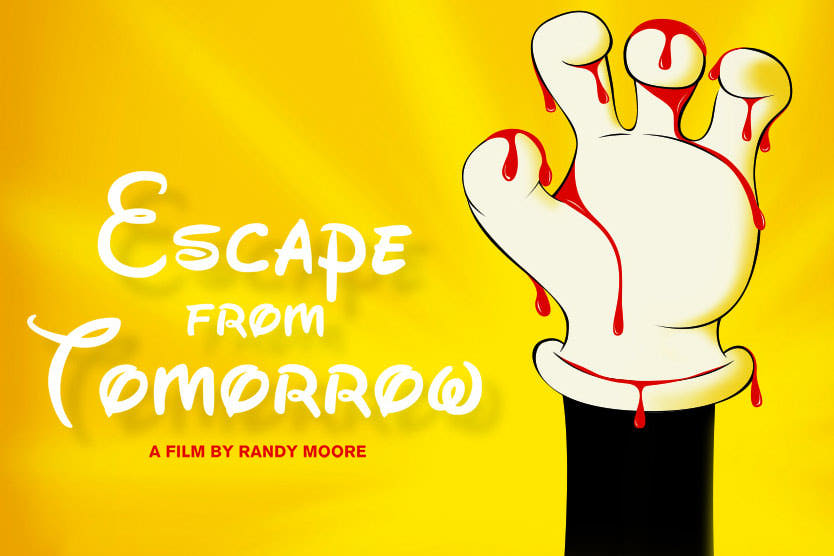
Escape-From-Tomorrow-PosterI happen to have a soft spot for independent film, but those are like the shrimps of an all you can eat buffet in Vegas. Tempting, but dicey. You never know if you’re going to score with cheap and delicious seafood, or win a free trip to the nearest toilet, where you’ll stay for the rest of your vacation. But since I like to live on the edge, I gave Escape From Tomorrow a go.

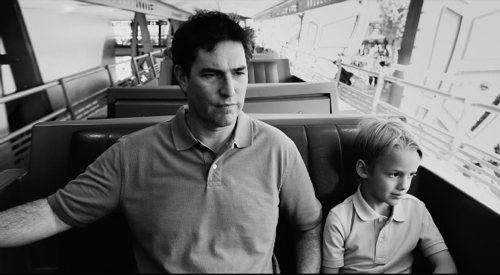
A debut for writer and director Randy Moore, it’s a black and white fantasy horror that recounts the last day of a family vacation where the father has just learned that he’s lost his job. It was shot guerrilla-style in the Disney World park without Disney’s knowledge or consent. They kept scripts eft2hidden on iPhones and used only handheld cameras that other tourists might use. They were never discovered.

The family vacation is not like a trip to Disney that I’ve ever been on. The rides and animatronics are familiar, they seem the same parades of characters, but poor unemployed dad starts to have some really disturbing visions. Like, super disturbing.

The film makers plotted the sun’s positioning weeks in advance since they knew they couldn’t bring it lighting, but chose to render it in black and white to help ease the issue. To avoid detection, Moore escape-from-tomorrowfelt he could risk 3 or 4 takes of any given scene at most, and he had his actors wear digital recorders taped to their bodies rather than have visible mics. The cast and crew bought season passes to both Disney World and Disney Land, and despite the fact that they rode It’s a Small World over and over wearing the exact same clothes, they never attracted attention from park staff.

Moore was so paranoid about Disney finding out, he took the film to South Korea for editing. It debuted at Sundance under shrouds of secrecy – and you can understand that a film that shot illegally in its parks and depicted the princess characters who pose endlessly for photos with your maxresdefaultkids as high-priced hookers for Asian businessmen might be frowned upon by the house of mouse. Reviewers encouraged people to “see it while they could” but a Disney lawsuit never materialized. They have widely ignored the film, choosing not to add to the hype machine that was quickly gaining steam.

At the end of the day though, I think this movie is more fun to discuss than to watch. Yes, it’s audacious and ballsy and possibly the future of film-making. But it’s only sometimes successful in its execution, and the surreal stuff pushes the boundaries a little too far. There’s an intermission an hour in (I could have sworn it was more like 3) – and I was ready to be done. Turns out, the worst was still to come. So did this little Netflix experiment turn out to be bad shrimp? It may have made me a little queasy, but I’m glad I gave it a chance.