Sweden’s official submission for best foreign language film at this year’s Oscars is a real doozie.
A big thanks to Ottawa’s Bytowne Cinemas for bringing it here. This film is not an easy one to catch, but worth every effort.
A beautiful blonde family is on a ritzy, picturesque ski vacation in the French Alps. The workaholic father Tomas (Johannes Bah Kuhnke) is taking some much-needed “family time” – that is, until the second day, when an avalanche threatens the family and he saves his own hide, leaving his wife and kids for dead. Luckily, the avalanche was controlled and everyone’s fine – well, everyone’s uninjured. Physically uninjured. But everyone’s hurt.
This film is a fascinating look at what happens to this family now that it’s been confronted with an awful truth. What are these primal instincts? Can we blame them for our actions? Can we count on them? Who can we count on?
After the movie, a small group of Assholes met up at Maxwell’s Bistro on Elgin to debrief, and boy did we need it. The director, Ruben Östlund, is a master at manipulating tension. The fallout unfolds slowly. He uses blank spaces to let the tension mount. It sometimes feels pressurized, unbearable. But every uncomfortable scene is worthy of comment. Together they piece together a larger portrait of a relationship that is being redefined quickly.
What happens when your spouse lets you down so profoundly? What happens when you let yourself down, when you fail to live up to your own values? Can a relationship really be measured by a split-second decision?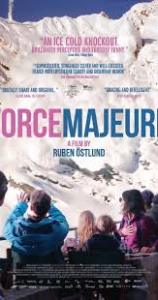
The film holds a mirror up to our own relationships, and we ask ourselves what we would have done. And if we’re asking honestly (because of course in our guts we all hope we’d do the right thing) we have to wonder: at our most base self, our most primal self, are we heroes, or are we survivalists?
There are flaws to this movie. The children, though clearly shaken and probably scarred, are hardly dealt with. They intuit that something is wrong with the family unit, and they want to comfort and protect their father from whatever he’s going through. But their own confusion and anger is never given a voice. Focus remains on the couple, and we are constantly reminded of just how intimate our eavesdropping is, although the wife, Ebba, ( Lisa Loven Kongsli) seems to find it easier to voice her disbelief and criticism in public rather than in private.
It’s awkward. Oh man is it awkward. Imagine being at this dinner party. Your friend of many years, it turns out, is a huge coward who saved himself and abandoned his children for dead. You feel sorry for him. Do you comfort him? Comfort her? Make excuses for him? Identify with him? Question your own motives?
This movie is unafraid. It’s not pretty, but we aren’t allowed to look away. It’s not enough just to break the marriage open, now we have to go inside and poke around. It’s terribly invasive. It’s provoking. It’s exactly the kind of movie I adore – one that makes me question everything.
Because whether we collectively condemn or forgive Tomas, our judgments are based on what, exactly? Gender stereotypes? Expectations of filial duty? Idealization of romantic love? Physical bravery? Basic instincts?
This movie is a much better look, psychologically, into the makeup of a marriage than Gone Girl. The characters are more relatable. But that’s also why it’s so much more difficult to sit through. It’s not just a movie. It’s a mirror.
(I hope many of you get the chance to go see it, and I hope you all come back here to chat about it in the comments. If you haven’t seen it, beware – comments may contain spoilers.)



 ASSHOLES WATCHING MOVIES