Monthly Archives: June 2019

Here And Now

Vivienne (Sarah Jessica Parker) is a New York singer grateful to have made her living with music. She’s got a new album coming out and is embarking on a new tour, even if tickets aren’t selling as briskly as they used to. But a grim diagnosis from her doctor has her wandering around the city, lost in thought.

The whole movie takes place on this one bleak day. She’s introspective, pinballing between gratitude for the life she’s lived and regret for all the sacrifices she’s made in order to live it. A teenager daughter who’s been left in the care of her father (Simon Baker) is first among them. A visit from her critical, overbearing mother (Jacqueline Bisset) is ill-timed. Updates from her manager and her only real friend (Common) keep things in perspective.

I actually kind of love movies like this, where we get to know a person very intimately on such a significant day. And New York City is such a great place for wandering souls, a beautiful backdrop for anguish and analysis. The pace is deliberately slow as Vivienne meanders around, mentally struggling to balance the demands in her life now that she’s staring down the barrel of her own mortality.

The film works best when its female characters are interacting, and evaluating the bonds between them. Other stuff works less well, which makes for a frustrating experience, since the movie is just too slow to allow for scenes that don’ work. But Parker is committed, and Renee Zellwegger makes a surprising and crucial appearance, so it’s not all bad. It’s just terribly uneven, which, in fairness, is probably true to any day on which you’ve just been told you’re facing an untimely death. But since you and I are going to go on living, we deserve to do it with better stories better told.

Yesterday

The inconceivable has happened. Struggling singer-songwriter Jack (Himesh Patel) has a terrific fan and manager in Ellie (Lily James), but nothing else. His dismal track record and the complete lack of interest from absolutely everyone else on earth has inspired his recent retirement from the scene. He’s done. Ellie isn’t totally keen on his giving up, but there you have it.

And then a bus hits him. And when he wakes up, the world is a slightly (enormously) different place: The Beatles never existed. They’ve been completely erased from history, and it seems Jack is the only one who remembers them. So he gets down to the business of recalling as many of the songs and lyrics as he can, and starts performing them as his own. And he’s lauded as a hero! Even poor Ed Sheeran feels inadequate in his presence.

He blows up. Turns out, some of those songs still hold up, can still impress our jaded 2019 ears. Yesterday, Hey Jude, Let It Be, Here Comes the Sun. Director Danny Boyle secured the rights to so many Beatles songs that it was easier for Sean and I to name the ones that weren’t included than were – you could make a pretty comprehensive Bingo game out of this if you were so inclined.

But the movie doesn’t touch on other important aspects. Wiping out The Beatles would do much more than negate their own catalogue. They’ve had a profound and immeasurable impact on all the music that’s come after them; pop music simply would not have evolved as it has without their contribution. And yet the movie features Ed Sheeran as himself, a singer-songwriter who names The Beatles as his own primary influence.

Himesh Patel is quite exceptional and an excellent choice for Jack. His voice is velvety and buttery – not an imitation of John or Paul, but one that does them justice, allowing the songs to feel familiar while still letting us hear them again for the first time. Still, despite the film’s obvious charm, it doesn’t quite explore all the juiciest nooks and crannies, nor can it reasonably reach the expectations set by the world’s most important and significant band. The film is a strange mash-up of parallel universe and a rom-com. It makes some strange and distracting choices. But it’s still worth a watch, because let’s face it: it’s hard to go wrong with The Beatles.

Anima

A man (Thom Yorke, of Radiohead) is one of many people riding the subway in a dazed state, nodding off, sleep walking through life. Only his sighting of a beautiful woman (Dajana Roncione) sets him on a divergent path, going against the usual drudgery to return a forgotten lunch box to her.

Paul Thomas Anderson directs Thom Yorke in a 15 minute musical short, though Yorke isn’t exactly breaking into song, it’s more like an extended music video, a visual piece accompanied by hypnotic music that to be honest is really working for me.

The choppy, physical choreography has Yorke literally going against the grain, and it’s only when he finally reunites with the woman from the subway that the dance, choreographed by Damien Jalet, becomes playful, fluid, more intimate. The two carve out a private space in a world that is monotonous and homogenous. It’s hard to say if this world is dystopian, or if it’s meant to be interpreted on a more metaphorical basis, but images of competition and subjugation abound.

The piece ends with the two boarding a streetcar. Yorke again nods off, and it’s unclear if the whole that came before it was meant to be a dream, but even if it is, it’s taken him from the underground darkness (or artificially lit at best) of a subway and left him above ground, seated in a beam of sunlight.

You’re darn right it’s weird, unlike anything else you’ll find on Netflix. But that’s what I can easily love about it, and about Netflix. Netflix is a lot of things, and not all of them good, but it’s creating space for experimentation. With the sheer volume of output, it can afford to take risks, and it does, something that is increasingly rare if not already obsolete for movie studios. Not very long ago it would be nearly impossible for most of us to catch a short film, other than the ones that routinely screened before Pixar films (although I can’t be the only one to notice this absence before Toy Story 4). But Netflix now hosts, and in fact is creating, a whole host of out of the box content. How wonderful to let PTA do his thing. And no, Thom Yorke is no actor, but I can’t help but admire someone who will go out on a limb for art. It gets all of our creative juices flowing to see new and boundary-pushing things, which is what Anima is. At worst, all it costs you is 15 minutes, but it’s a literal tunnel out of oppression, an exploration of conformity, and ultimately, an expression and rejoicing of freedom.

The Kid (2019)

So Rio and and Sara Cutler are a couple of old-timey kids living in a cabin with their folks, listening to their dad beat their mom to death as she pleads for the kids to run and hide. They do not. Rio (Jake Schur), though only 14, pulls a gun on his dad and kills him. That buys them only a few minutes because pretty soon their uncle Grant (Chris Pratt) is kicking in the door, ready to murder his little nephew in turn. This family has some major issues.

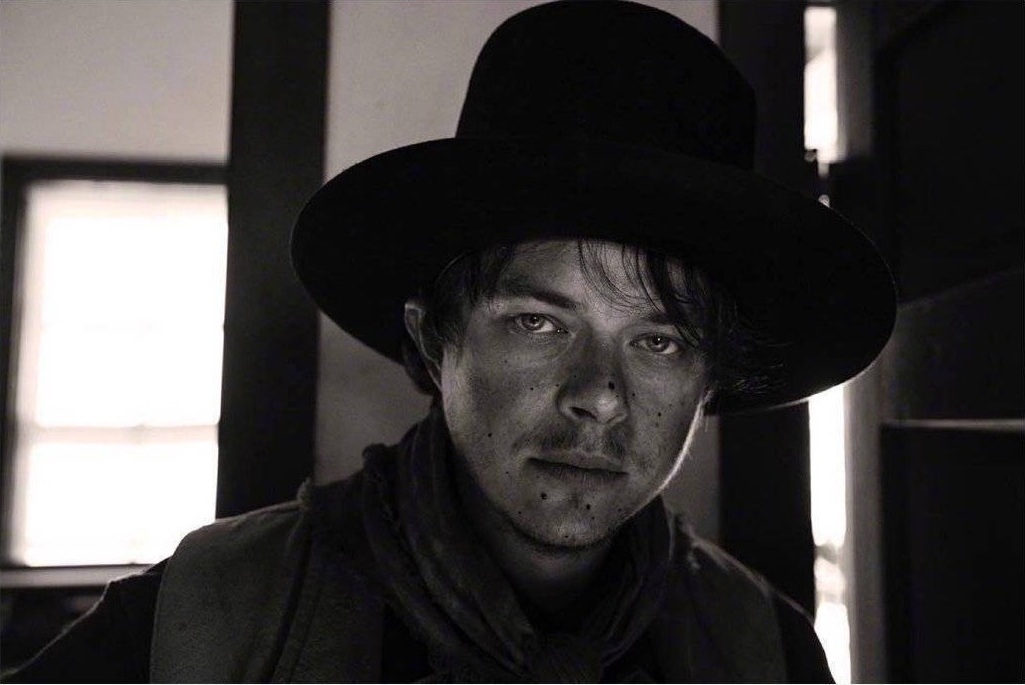
Stabbing him in the face buys Rio and Sara a little time: they go on the run. But trouble finds them yet again when they wake up having spent the night in a shared hideout with Billy The Kid. (Dane DeHaan). Billy The Kid was an outlaw and a gunslinger, wanted for theft and murder and other fun things like that. But if having a known murderer sharing your pillow isn’t bad enough (just kidding: they didn’t have pillows), Billy has also attracted the attention of a local sheriff, Pat (Ethan Hawke). Pat’s a little obsessed with bringing Billy to justice, and after shooting an innocent horse in the head he gets Billy to surrender, and he gets two orphans with a questionable back story as a bonus (Rio and Sara are understandably a little reluctant to confess their crime to the long arm of the law).

Cue a road trip via horse and buggy, half filled with orphans hitching a ride to their nearest known relative, and half filled with outlaws on their way to the gallows. Billy shows the kids more kindness than the sheriff does, and an uneasy alliance shifts the power dynamic in curious ways.

Which actually makes it sound not half bad, and that’s true. It’s not half bad. It’s all bad. Okay, so technically it’s well-framed enough that it looks like a series of Louis L’Amour cover shoots. If your grandpa is more literary-minded than mine, you might not know that Louis L’Amour is the male equivalent of a romance novel. They’re country western novels with cowboys who spit and grunt and ride off stoically into the sunset. And instead of Fabio on the cover, it’s tough looking cowpokes with 5 o’clock shadow and a piece of wheat chaff between their lips.

The movie sidelines female characters and has mixed messages about whether we should look up to Billy The Kid or de-mythologize about him. But aside from a few nice moments, this movie is just blah enough to get away with its flaws because I’m quite confident this film will go unwatched with or without my help. But for the record: do not.

The Hummingbird Project

Not that the world needed another ode to American greed, but here goes.

Vince and Anton are cousins who work in high-frequency trading for Eva Torres. Eva (Salma Hayek) is interested in finding an even higher frequency: on the stock market, traders who could get into the best deals even a fraction of a fraction of a second faster would ultimately have a huge cumulative advantage worth billions of dollars over time. Vince (Jesse Eisenberg) thinks he can one-up her, so he leaves, taking coder cousin Anton (Alexander Skarsgard) along with him.

Their scheme involves digging a fiber-optic line in a straight shot between Kansas and New Jersey. And I do mean straight: through mountains and rivers and Amish country if necessary. Their plan means buying land and thwarting government agencies and raising millions in funding from greedy investors. It also means staying one step ahead of ex-boss Eva, but don’t think for a second she’s going to let them get away with this.

Alexander Skarsgard is nearly unrecognizable as a socially inept, worrywart brainiac who must be micro-managed by his bolder cousin. Jesse Eisenberg continues his one-note symphony, bringing the same manic chipmunk energy he brings to everything because he literally can’t do anything else. And to be honest, not only am I over it, I don’t have room in my life for being bombarded by a neurotic asshole. It’s too much.

The script isn’t doing much for me either. It’s single-minded in its pursuit of success, and boring as hell. All this wheeling and dealing: haven’t we seen this a hundred times before? And it ain’t exactly subtle. For every shot of aggressive drilling and invasive construction, there are literal scenes of both amber waves of grain and purple mountain majesties. You can practically feel an anthem swelling somewhere. But the characters are in fact caricatures: Vince is the hyper-achiever, Anton is the Beautiful Mind, and Eva is the Bond villain.

There is no such thing as cinematic drilling. Or fascinating drilling. Or interesting drilling. It’s just drilling. So unless you’re into some weird engineering porn, this movie is really not suitable for viewing. I think there might have been some potential for satirical commentary buried deep in there somewhere, but in this one case they didn’t drill deep enough. The Hummingbird Project is ultimately shallow, and you only wish its runtime was operating at a higher frequency so you could put this one to bed already.

The Nutcracker And The Four Realms

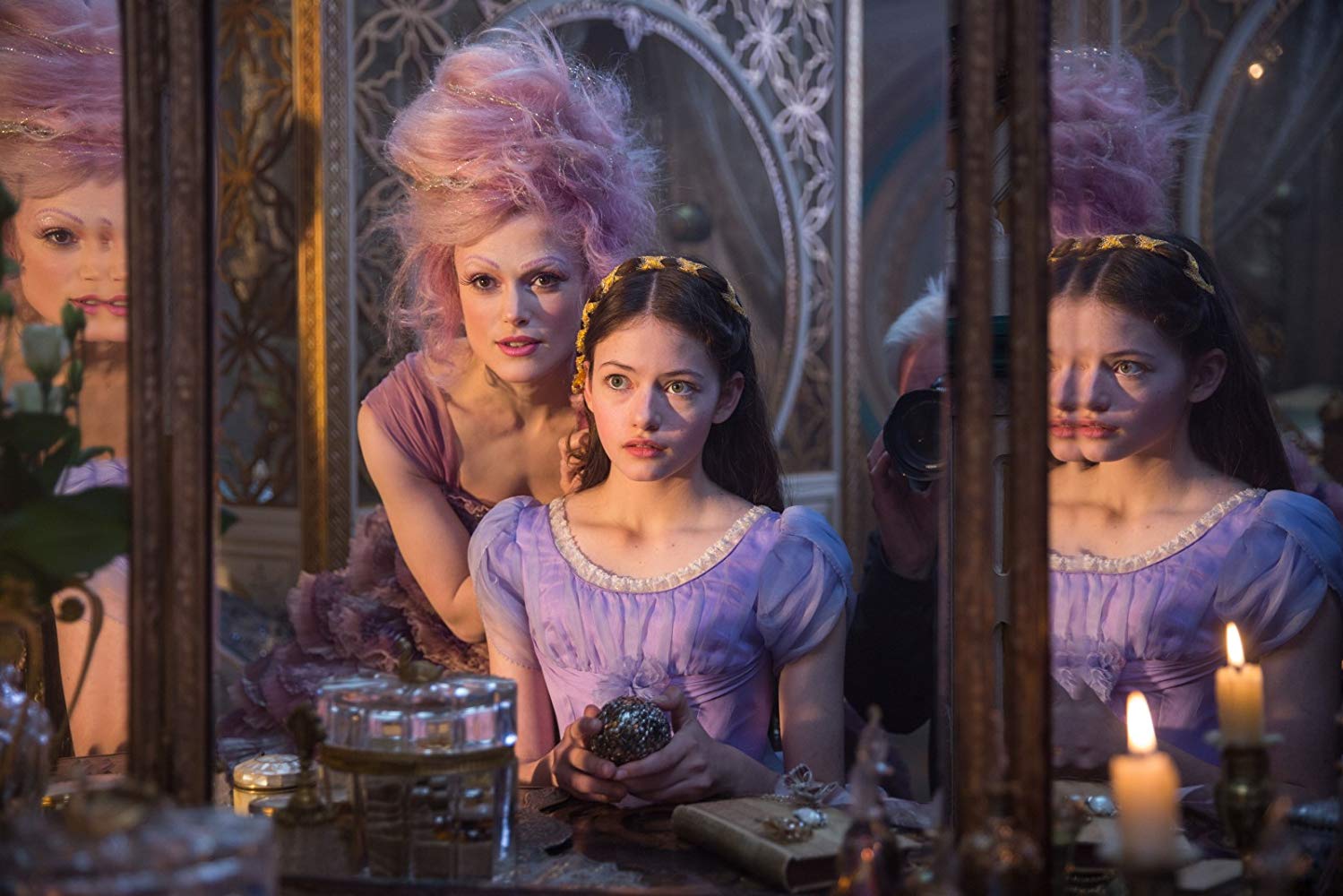
You’d think I’d have more of an affinity for this, as I once played Clara myself, in a school production. But I suppose any kinship I felt with the role died when I saw film-Clara flopping around in one sumptuous, gauzy, beaded gown after another, while I spent the whole play in a floor-length flannel nightgown.

Clara (Mackenzie Foy) has recently lost her mother, Marie. She is further aggrieved to find that the “one last Christmas gift” her mother has left each of the children is for her rather useless without a key to open it. Her godfather (Morgan Freeman) would seem to hold the answer, but just as she finds the key at his home, it is squirreled away (or perhaps I should say moused away) into a parallel world – into which of course she follows, without a second thought to the state of her beautiful dress, which she clearly doesn’t deserve.

Anyway, this other world is apparently one of her mother’s making, imaginatively speaking. There are four realms, and she meets 3 of the 4 regents right off the bat: Shiver (Richard E. Grant) of the Land of Snowflakes, Hawthorne (Eugenio Derbez) of the Land of Flowers, and of course the Sugar Plum Fairy (Keira Knightley) of the Land of Sweets. These three regents worship Clara as the daughter of their beloved Queen Marie, and wail upon learning news of her death. They confess that the Queen has not been around in sometime, and these 3 realms are at war with the fourth: Mother Ginger (Helen Mirren) of the Land of Amusements.

Sugar Plum (Keira Knightley, using a grating Mickey Mouse voice and sporting drag queen eyebrows for unknown reasons) explains that they can use Marie’s machine, which turns toys into people, to win the war, but they need the key. Yes, the very same key that Clara is already hunting, the key stolen by the legion of mice and now in the possession of evil Mother Ginger. Clara must retrieve the key with only the help of a kind nutcracker named Philip (Jayden Fowara-Knight).

The Nutcracker is of course famously a ballet, and there is but a single scant scene of dance, starring the ephemeral Misty Copeland, which is probably the best stuff in the movie. The rest is really nothing special. It’s almost as if, the more they inflate it with CGI effects, the more magic leaks out. It’s drained of the life and wonder you may have come to expect from The Nutcracker. This one is clunky – often quite mesmerizing to look at, but the directors are depending on literal hypnotic focus on the visuals since the story, which diverges wildly from cannon, just doesn’t hold up. It’s almost amazing how unexciting a land of imagination can be made to feel, and I wouldn’t mind if co-directors Lasse Hallström and Joe Johnston both had their directors cards revoked for such a failure. It’s toys come to life: the wonder is baked right in!

The Nutcracker has been around since 1892 and now accounts for 40% of a typical ballet company’s annual revenues. It’s been done to death in both movies and television: Barbie did a version. The Care Bears did a version. Mickey and Minnie did a version. Tom and Jerry did a version. And they were ALL more successful that this one, which cost over $120M to make, but you can’t put a price on heart, and this movie just didn’t have it.

Running For Grace

Hawaii is truly one of the most beautiful places on Earth, but its history hasn’t always been so.

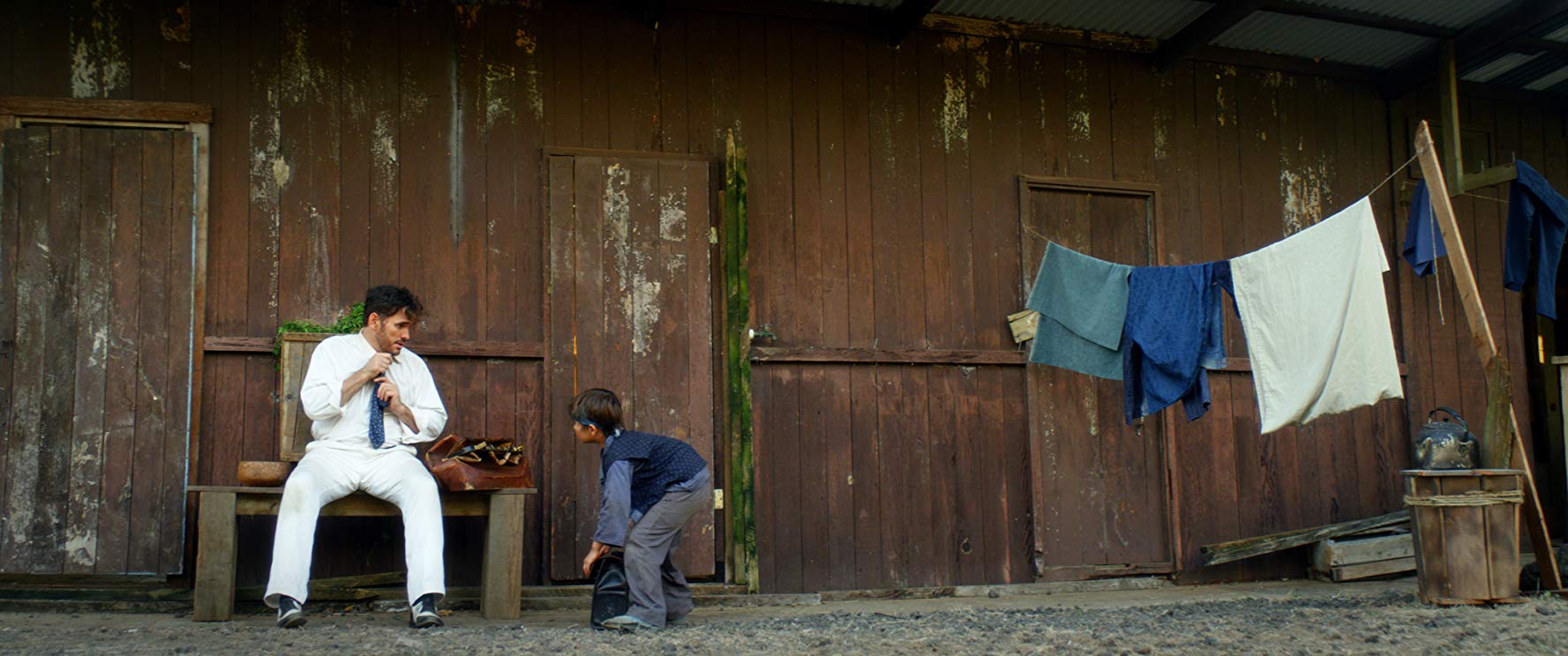
A new doctor (Matt Dillon) arrives at one of Hawaii’s coffee plantations just as the Spanish flu is indiscriminately taking life left and right (circa 1920). On one bad day, two women succumb: the wife of the plantation owner, leaving her daughte rGrace motherless, and an unmarried Japanese migrant worker, leaving her mixed race son Jo motherless. Jo was the kind of kid who brought shame at the time, so they thought, so Jo’s mother had always hid his existence from the other workers, from everyone. Now there’s no one to care for him; he’s alone in the world. Until the doctor shows up, and has these crazy notions that children should be fed and such.

Turns out Jo is pretty useful to the good doctor. Although the workers still fear the kid, he’s a useful translator and ingratiates himself to the community. Fast forward to: Jo is now a young man (Ryan Potter), and a fast one – “the medicine runner,” they call him, useful, perhaps indispensable as a conduit between the migrants and the doctor. One day, while Doc is in town, ostensibly on a pharmaceutical run, but actually petitioning yet again to adopt Jo despite stringent, racist laws that would have otherwise, the owner’s daughter Grace (Olivia Ritchie) is injured, and Jo offers up his own services as the doctor’s apprentice. The owner is not having it, but then, he doesn’t even approve of the white “country doctor” either, and it’s only the memory of his wife’s death that allows the appointment to take place. Pretty soon erotic temperature-taking is taking place, and all the flirting that can be mustered from either side of a muslin curtain. But the owner soon dispatches a “proper” doctor, Reyes (Jim Caviezel), who of course is a big white jerk.

Running For Grace is an ironic title considering what a slow burn it is. No, wait, burn implies it ever gets some heat, but even Hawaii’s volcanoes do little to light a fire under this story. Ostensibly it’s a forbidden romance between two young people who could never be together, but that’s only a superficial disguise for yet another white saviour movie. Jo, though he has proved his worth tenfold, is still an illegitimate bastard with no last name. Doc, though unsuccessful in adopting him, insists that they are family, and that’s enough. Which is a nice sentiment, except the implication is that Jo would not be enough without him, that Jo’s mother was not enough, that his actual biology and parentage are not enough, and that only his association with the white doctor has legitimized him.

You mustn’t even feel torn about this movie because it’s not good no matter how you look at it. The script is as awful as Jim Caviezel’s charleston: truly, deeply terrible, unpolished, embarrassing, even. It’s best if you just cut a wide berth around this stinker, lest its stench permeate your reasonable standards.

Wonder Park

June and her mother (Jennifer Garner) have expansive imaginations. Together they created a pretend theme park called Wonderland, a special place that peopled by June’s favourite toys: a warthog named Greta (Mila Kunis), a hedgehog named Steve (John Oliver) a blue bear named Boomer (Ken Hudson Campbell), and brought alive by the pictures and blueprints that June and her mother draw together, wallpapering June’s room with their designs.

But then June’s mother gets sick, and June can’t bring herself to play their favourite game without her. June’s dad (Matthew Broderick) thinks it’s a good idea that she spends her summer at math camp, but halfway there, she gets cold feet and heads back. But she gets so turned around she ends up in – Wonderland? But how is the amusement park in her imagination a real place? And how are her toys talking, breathing characters?

One thing’s for sure: Greta the pink warthog and friends feel abandoned by the “voices” who inspired their adventures and brought life to their home. June realizes that she’s been so afraid to lose her mom that she’s somehow lost herself. But in the meantime, saving Wonderland presents itself as a real thing. We don’t know how June has wandered into the actual iteration of the park, but she’s there, and must contend with the consequences of her neglect. Luckily, as the inventor of Wonderland, there’s no one better to fix it up and save it from the darkness.

It’s hard to make a movie with colourful, talking stuffed animals in a fanciful amusement park address grief, so the script does not, not in any meaningful or profound way, even though grief is the catalyst for June’s neglect, and her need for escape, and for pretty much 80 of the film’s 85 minute runtime. It also talks about the nature of play, and what happens when you shut down an integral part of yourself, but without really saying anything about it. The movie is really content just to a diversion for kids than to be something with a moving story or a plot that makes sense. But it’s fun and full of energy and perfectly likable if you’re 5 and think bendy straws are the shit.

Sidebar: it’s shocking how many animated kids movies have erection jokes in them. Like, it’s pretty much all of them. This one’s no exception. In fact, it’s not exceptional in any way.

Men in Black: International

When did aliens become so boring? In Men in Black: International, everyone is trying to out-deadpan Tommy Lee Jones, and succeeding. There is no excitement, no awe, just a bunch of bored white men joined by a bored diversity hire, all bumbling around England, Paris, and Morocco trying to save the world from an unseen alien menace after an alien prince is killed but not before delivering a MacGuffin to MiB’s newest agent (Tessa Thompson).

As the first three MiB films showed, it can be fun to have one disinterested agent in our lead duo. But those films worked because Will Smith’s junior agent brought enough energy and wonder for the two of them. They worked because Smith’s Agent J was the audience’s stand in, who marvelled and freaked out at the marvelous and freaky stuff onscreen. And also, they worked because for all his surface gruffness, Agent K was actually quite an interesting character, and Jones let us see that just enough to make us invest in him. Unfortunately, MiB:I’s H (Chris Hemsworth) and M (Thompson) both have seen it all before, and even worse, so has the audience. So everyone ends up being disinterested, including the viewer.

The aliens and events in MiB:I simply don’t measure up to what the franchise has previously offered us. The aliens are bland and the stakes are surprisingly low consindering our heroes keep telling us their job is to save the world. Basically, it’s the opposite of what is expected from a summer blockbuster. The only joy in the film comes from Kumail Nanjiani’s pint-sized sidekick, who has all the best lines and whose hilarity highlights the disappointing blandness of everything else.

MiB:I simply has nothing to offer and no reason to be. That’s a particularly damning critique when this franchise’s defining trait has been ridiculousness. MiB:I didn’t need to be a good movie, but it did need to be silly, loud, and campy. Instead, it’s forgettable and unoriginal to the point that I’d have been better off rewatching any of its predecessors. I’m sure they’d have offered more surprises on a rewatch than MiB:I did on my first (and undoubtedly only) viewing.

The Garden Left Behind

The Garden Left Behind is about a woman and her grandmother, both undocumented immigrants, living together in New York City. Abuela Eliana (Miriam Cruz) dreams of returning to her beloved Mexico while Tina (Carlie Guevara) dreams of the day she can complete her transition. Without papers, money is scarce and medical insurance unheard of, so it’s been a long path for Tina. But she has a second family in the trans community, and a strong circle of fiercely protective women surrounding her, so you want to believe she’ll be all right.

Director Flavio Alves situates Tina in a city filled with love and support, but also hatred and violence. Even the slightest decisions she makes may threaten her personal safety, not to mention her mental health. Meanwhile, her gender identity must be performed for an elderly doctor (Ed Asner) who ultimately gets to decide whether or not she’ll get to be a candidate for transition. Not that his pronouncement either way would save her from judgment or brutality if it came to that. Which is why Tina takes to the streets in protest for a friend beaten by police. Her status makes activism risky, but her very existence is a risk in a world where cruelty is an answer to otherness.

As much as I admired the greater context offered by Alves, it was the grandmother-granddaughter relationship at the heart of the story I responded to most. Abuelita does not understand, but she learns she doesn’t need to. She learns that her love is enough. It’s also relatively rare in this kind of story, so it’s as remarkable and inspirational as it is welcome.

The cast, made up of actual trans people, is refreshingly authentic, and I believe this casting is what really sells the story. What also really works is that Tina is at peace with herself. The world may have problems with her, but the conflict is never internalized. She knows who she is, and while perhaps feeling resentful at having to demonstrate it, she never wavers. But the outside world brings more than enough conflict to make up the difference.

Carlie Guevara, like Tina, is a young trans woman of colour. She is a target for hate but also a symbol of hope; she, and others like her, persist. Guevara is luminous and magnetic. But what makes this movie feel really truthful on top of watchable is that it’s not just hardship and struggle. It rises above the bleakness to deliver pure authenticity.