Category Archives: Jay

Berlinale 2021: Albatros (Drift Away)

Laurent is a good cop in a small town in Normandy, where little ever happens. The police work may be on the dull side but his recent engagement to Marie means his personal life makes up for it. Laurent (Jérémie Renier) and Marie (Marie-Julie Maille) have already been together long enough to share a home and a daughter, Poulette (Madeleine Beauvois), who was excited to be part of the low-key proposal. But then things take a turn for the more interesting.

A local farmer goes missing, armed with a rifle and seemingly suicidal after a series of failed inspections that threaten his livelihood. This being a small town, the farmer is known to Laurent, a friend. Laurent is obviously very motivated to have this man found safely, but does his familiarity cloud his judgement? When the farmer is eventually located, it leads to an altercation, resulting in Laurent discharging his weapon in an effort to prevent the farmer from taking his own life. Laurent kills him.

The aftermath is as messy as you’d expect. Everyone agrees it was an accident, but was it reckless? Negligent? The farmer’s sister obviously thinks so; she’s suing both Laurent and the force. Thrown into self-doubt, recrimination, and emotional turmoil, Laurent takes off on a journey he must take alone. Which, honestly, is where the film lost me. Up until it veers off into a very different direction, I was enjoying this slow-burn character study. Renier kept things dignified, stoic but just expressive enough to hint at upheaval behind the façade. Unfortunately, director Xavier Beauvois muddies the water with some confusing and unnecessary subplots, taking away from the power and potency of Renier’s performance.

Albatros’s final moments redeem some of its earlier mistakes but there’s no way the film needed to be two hours long, which seems to dilute the urgency and impact of what should have been the movie’s central themes. Albatros is a good idea unevenly executed, not quite saved from a stellar star performance.

Jiang Ziya

In the war, fierce warrior Jiang Ziya’s mission is to take down the fox spirit clan leader who instigated it, but before he can execute that nine-tailed fox demon, he finds an innocent child possessed by the fox spirit and won’t let her be killed. As punishment, the Grand Master banishes Jiang Ziya to the mortal world, because everyone knows gods shouldn’t show kindness, they’re all about the greater good. In the mortal realm, Jiang Ziya spends ten years despondent, because ugh: Earth. Major bummer. Anyway, he makes friends with the little amnesiac fox spirit girl, and a Tiger God, and together they go on an adventure to figure out how to save the kid’s mortal soul.

The nine-tailed fox demon, though, threatens the very fabric of humanity. Ooooh. Tough decision, folks. Should he follow the will of heaven, killing the demon thus condemning the girl, or find his own path to redemption. Any bets?

The animation in Jiang Ziya (also called Legend of Deification) is pretty stellar, with excellent world-building. It’s almost reminiscent of a video game, all spastic violence and not a lot of character development. That’s not necessarily a problem if you love big thunderous punches though.

Jiang Ziya is a popular Chinese mythological figure; the plot is loosely based on the novel Investiture of the Gods by Xu Zhonglin. It is a follow-up to 2019’s Ne Zha (but don’t worry, it’s nowhere near as complex) and the second installment of the Fengshen Cinematic Universe, which have been pretty consistent so far, a nice way to celebrate Chinese culture, and a cool exploration of what makes a true hero.

Fans of this style of animation will certainly be pleased. Jiang Ziya gives non-stop action and stunning visuals, and a story you just won’t get anywhere else.

Sophie Jones

Sixteen is already a difficult age, with lots of challenges to navigate, but Sophie Jones has just lost her mother, so the regular rhythms of adolescence are tinged with grief and loss, which somehow makes normal rites of passage seem more trivial, yet each holds the potential power to make her forget, even for a moment, her deep sadness. Sophie (Jessica Barr) is throwing herself rather recklessly from one milestone to another, hoping to pierce through the numbness of grief and feel something, feel anything.

Sophie’s nervous giggle belies the fact that she’s still a young girl, lacking the maturity to handle all that life has dumped in her lap, not that she’s got a choice. Barr herself is still a young woman, a convincing teenager, playing the role with a natural authenticity. She and cousin Jessie Barr co-wrote the script, and Jessie Barr directs, informed by their own experiences with grief.

Sophie’s primary means of coping is boys, of course, who mostly offer comfort mostly of a physical sort. Trying her best to wear a brave face at school and at home, grief sneaks out in unpredictable ways, heightening emotions that are already fully charged. We float through time as if in a fog; the film is mostly muted, visually and emotionally, enveloping us in a very specific, highly intimate universe.

Some may find Sophie Jones to be a slow watch, maybe not the most exciting, but it’s honest in its portrayal of mourning, raw in its loss of innocence, in more ways than one. The Barr cousins prove themselves to be immensely talented, and if you don’t mind a slow-burn character study, this is a very good one.

Berlinale 2021: Petite maman

Nelly (Joséphine Sanz) is eight years old when her grandmother dies. Nelly and her mother (Nina Meurisse) are both sad as they empty her room at the nursing home and say farewell to her elderly friends. Next they meet Nelly’s dad at Nelly’s mom’s childhood home, which also needs to be packed up. Nelly and her grandma were quite close, and the death has taken a toll on them all. But the next day, Nelly’s mom is gone, and only her dad (Stéphane Varupenne) is left to box up an old woman’s life. The sadness was too much for mom, Nelly is told, though mom is often sad, and Nelly is worried that mom might not come back.

While her father works diligently, Nelly explores the outdoors in search of a cabin her mother constructed out of sticks as a child many years ago. In the woods she finds something even better: a playmate. Marion (Gabrielle Sanz) is also eight years old, and is devoting her time to building a little cabin out of sticks. Nelly knows right away who Marion is; it’s her mother, as a child. When Marion brings Nelly back to her house, grandma is alive and well, and 20-some years younger. The girls, who look like they could be twins (and are indeed played by twins), are immediate best friends. Being eight, Nelly doesn’t much care how or why this time anomaly has permitted her such an intimate new playmate, she just takes it at its face value and enjoys the time with her little mother.

Imagine, if your old brain still has any magic left in it, encountering your own mother as a child, when you yourself are also a child. This is such a beautiful, innocent thought experiment I can’t believe I’ve never seen it done before.

Nelly takes full advantage, asking her mother things that are much harder, and sometimes impossible, to broach between mother and child under normal circumstances. And Marion has questions too. “Did I want you?” she asks in all innocence. “Yes,” comes the reply. “I’m not surprised,” Marion responds, while gently stroking Nelly’s cheek, “I’m already thinking of you.”

Writer-director Céline Sciamma infuses this film with such tenderness that I constantly feel like weeping, though the film is not particularly emotional or fraught. The two young actresses are absolute perfection, like little dolls who are made for each other. It helps us to understand that his manifestation is somehow essential to Nelly’s grief and loneliness during a painful time. This is next-level self-soothing and the whole thing is coated in such a thick layer of loving kindness that I’m pretty sure I want some too.

Coming 2 America

It’s been 33 years since pampered African Prince Akeem (Eddie Murphy) first came to America, and in 2021, he will return.

King Jaffe Joffer (James Earl Jones) is getting older, and as he prepares his son Akeem to take his place, he reveals that he has tracked down Akeem’s bastard American son, a son Akeem didn’t know he had, a little souvenir from that trip to Queens more than thirty years ago. Akeem and Lisa (Shari Headley) have three daughters, but women can’t inherit the throne in Zamunda. Fearing instability upon his passing, particularly from General Izzi (Wesley Snipes), King Joffer urges Akeem to go to America and bring home his first-born male heir in order to keep their kingdom peaceful.

As you can imagine, learning that you’re a prince is a bit of surprise, and it’s a bit of a culture shock when Lavelle (Jermaine Fowler) does indeed return to the palace with the dad he never knew, with Mom Mary (Leslie Jones) and Uncle Reem (Tracy Morgan) in tow to add a little…flavour to the royal proceedings. Akeem has selected a bride for his son, the alluring and diplomatically wise choice, Bopoto, daughter of General Izzi. But it is the palace groomer Mirembe (Nomzamo Mbatha) who catches Lavelle’s eye. As every man becomes his father, Akeem finds himself in the position of forbidding Lavelle’s love match and enforcing the political one. Akeem was supposed to be different when he was king but it looks like he’ll follow in his father’s footsteps, for better of worse.

This movie isn’t a remake but it’s awfully close, following the events of the first film like they’re identical twins, even repeating a lot of the same jokes. Murphy reassembles the entire team and there’s no denying this sequel is an extreme act of fan service and that Eddie Murphy himself is having a grand old time reliving his youth and revisiting a pivotal time in his life and career. The result is surprisingly watchable. Is it great? No. But it’s fun and familiar improving on the first, delivering a more modern and more quickly paced comedy. Murphy and director Craig Brewer work well together, but since both are mega fans of the first film, they’re content to coast on its fumes. Ultimately Coming 2 America is 110 minutes devoted to remembering how great Coming To America was. It’s a cast reunion with some great costumes and some fun cameos. It’s a celebration 33 years in the making and if you were a fan of the first, you’re walking away happy.

Raya and the Last Dragon

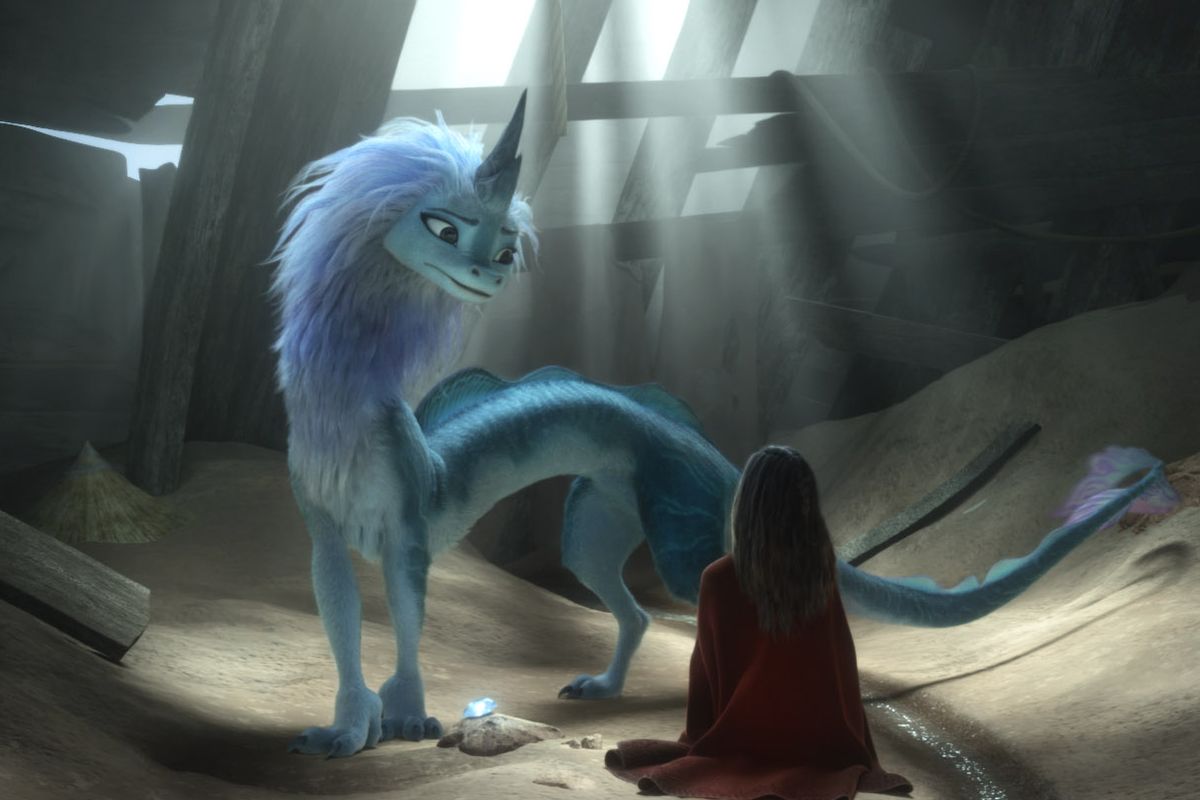
Once upon a time, in a kingdom called Kumandra, people lived peacefully alongside dragons, who brought them water and protected them. But when a sinister plague known as Druun threatened the land, turning its people to stone, the dragons pooled their power, sacrificing themselves to save humanity, leaving behind only a gem to represent their faith and trust in the people they’d saved.

500 years later, the realm of Kumandra is no more. This last drop of dragon magic proved too tempting, and factions broke off, each desperate to hold the gem themselves. An attempt to steal it breaks the gem into pieces, unleashing the Druun plague monster once again. Raya, a young warrior, goes on an adventure to retrieve the broken pieces of the gem and resurrect the last dragon. It’s going to take more than just magic to heal the world, but trust and cooperation might be even harder to come by.

This is Disney’s latest animated offering, available to stream (at a premium) on Disney+, and if Raya is their most recent addition to the Disney Princess lineup, she’s a good one. Raya (voiced by Kelly Marie Tran) is courageous, and adventurous. She plots to save herself, and her people. Sisu (Awkwafina) the dragon also has beautiful female energy, more giving and trusting than Raya, who, though brave, is also flawed, making for a far more interesting protagonist and princess.

The realm of Kumandra may be fictional, but Disney animators were inspired by Southeast Asian countries of Thailand, Vietnam, Cambodia, Myanmar, Malaysia, Indonesia, the Philippines, and Laos when establishing its unique culture and aesthetic. The film looks stunning, proving that Disney animation is back on top, with or without Pixar. The stellar voice cast includes Gemma Chan, Daniel Dae Kim, Benedict Wong, Sandra Oh, and Alan Tudyk, but the greatest interplay is between Kelly Marie Tran and Awkwafina, who share a wonderful, warm chemistry, emphasizing the film’s respect for female friendship.

The best part of Raya and The Last Dragon may be its subtle but timely message. Raya is a strong and skillful warrior, full of conviction and a sometimes impetuous desire to run straight into battle. Success in her mission, however, will depend more on conflict resolution; people who have long considered themselves enemies will have to put aside their differences in service of the goal they all have in common. Someone will need to be the first to cross partisan lines because the real threat is never the outside force, it’s the cracks sown between the people within. Raya’s fighting style is based on the Filipino martial art Kali but victory won’t require her weapons, she’ll need to arm herself with empathy and diplomacy instead.

Berlinale 2021: The Scary of Sixty-First

Worst movie EVER. Not to brag, but there are 2485 reviews on this site, and this one is the worst by a LARGE margin.

Noelle (Madeline Quinn) and Addie (Betsey Brown) are best friends, supposedly, who have just moved into a shared apartment in Manhattan. Not only do they move in immediately, they use the furnishings left behind by a previous unknown tenant. I’m developing sympathy scabies just thinking about the used bedding situation, which is reason enough to have given them nightmares on their first night, but this is a horror movie, not a hygiene movie.

The next day a young woman (Dasha Nekrasova) wrestles her way into the apartment, revealing to Noelle that it used to belong to Jeffrey Epstein. Together they deep dive into the conspiracies surrounding his pedophilia, arrest, and “suicide.” Noelle, clearly an impressionable young woman, is immediately 100% on board. They imagine that the apartment was used for orgies, rapes, human trafficking, the whole lot. Addie, meanwhile, seems to have been possessed by the spirit of a small child. She sucks her thumb while masturbating to images of Prince Andrew (who is alleged to a close friend of Epstein’s, and/or a pedophile himself), and by ‘masturbating to,’ I of course mean rubbing magazine images of his face against her crotch and inserting commemorative items from his marriage to Fergie into her various orifices, while squishing oranges between her toes. None of this seems pleasurable, in case you were wondering.

The acting in this movie is very, very, exceptionally, terribly bad. I realize no one with an actual career or future in the movie business would ever, in their right minds, consent to be in such a film, but even considering that it’s total amateur hour, it’s still unbelievably bad, across the board. In fact, the only thing worse than the acting is the “writing” which I’m confident was simply copied and pasted from the dregs of Reddit. Dekrasova and Quinn share writing credit and it’s mystifying that anyone would put their names on this thing. Even the sweaty Reddit trolls hide behind anonymity.

Dekrasova is also the director responsible for this mess, and it’s impossible to tell if she’s got any talent because she hasn’t got any taste. I’m mostly afraid to ask how this thing got financed because I have a feeling I know exactly how, and I’m deeply uncomfortable in having been involved in this even tangentially. Did these girls pick this topic because it was the only way they’d ever get significant screen time and they were willing to sell their souls for it…or worse, do they actually believe this stuff and are willing to serve as mouthpieces?

Whatever the answer, I’m not sure how this was chosen to screen at the Berlin Film Festival. Film Festivals absolutely have a duty to push the boundaries of the art form and challenge us to step outside of our cinematic comfort zones, but this movie isn’t that. It’s just a piece of trash that’s in very poor taste. After all, Epstein was a real man, a real pedophile, with real victims, and this film only serves to trivialize it in the most disturbing and disappointing way.

Kid 90

Soleil Moon Frye starred on an 80s sitcom called Punky Brewster when she was just 7 years old. When the show ended, she’d had a strange and abbreviated childhood. Only a wild and weird adolescence could possibly follow, but this one she would spend behind a camera rather than in front of it.

She and her friends, all of them young Hollywood royalty, had the money and access to do whatever they pleased. It was the 90s; the internet wasn’t a worry yet, going viral meant something else entirely, they could do what they wanted with no consequences. And they were young: they hadn’t learned yet to be jaded or guarded or filtered. Among friends, they let it all hang out, and it didn’t matter that one of them constantly hauled around a camcorder because behind it was Soleil’s friendly face. Thirty years have gone by, and Frye is only now taking this footage out of the vault to share with us. She’s created a living portrait of a lot of famous faces, but also of a time and place that no longer exists.

Frye’s famous friends include Stephen Dorff, David Arquette, Mark-Paul Gosselaar, Jonathan Brandis, Charlie Sheen, Balthazar Getty, Jenny Lewis, Brian Austin Green, and briefer appearances by Robin Thicke, Leonardo DiCaprio, Joey Lawrence, Mark Wahlberg, Sara Gilbert, Corey Feldman, Mark McGrath, Kevin Connelly, and way more besides. Hard-hitting topics covered include Brian Austin Green’s misguided rap album, Soleil Moon Frye’s breast reduction, a live Bronco chase watch party, and the meteoric rise of House of Pain. And more seriously, suicide, a subject that comes up much more often than average within Frye’s set.

Soleil Moon Frye, who is the documentary’s subject as well as its director, constantly challenges the notion of memory – does she remember these heady days correctly? The same as everyone else? Does it even matter? It’s an act of remembering and remembrance – sometimes wistful, sometimes painful, sometimes playful, sometimes tinged with regret. Fry had hundreds of hours of footage but crafts something that is very watchable, and that serves a greater narrative. It’s fun to see some famous faces de-aged, it’s fun that so many of her famous friends were musicians who contribute to the soundtrack. But this, for a young woman who didn’t have a normal high school experience, is her yearbook. Many of the faces she’s lost touch with over the years, others she’s grieved and lost. But these images live on, telling a story with one common theme: we were here.

Kid 90 will stream on Hulu on March 12 2021; the Punky Brewster reboot is already available on Peacock.

Moxie

I feel old, I feel embarrassed, and I feel inspired. In that order.

To the young women of today, I’m sorry. I’m sorry we didn’t get the work done. I’m sorry there’s still work for you to do. I’m sorry we didn’t break the patriarchy but got broken by it, bit by bit.

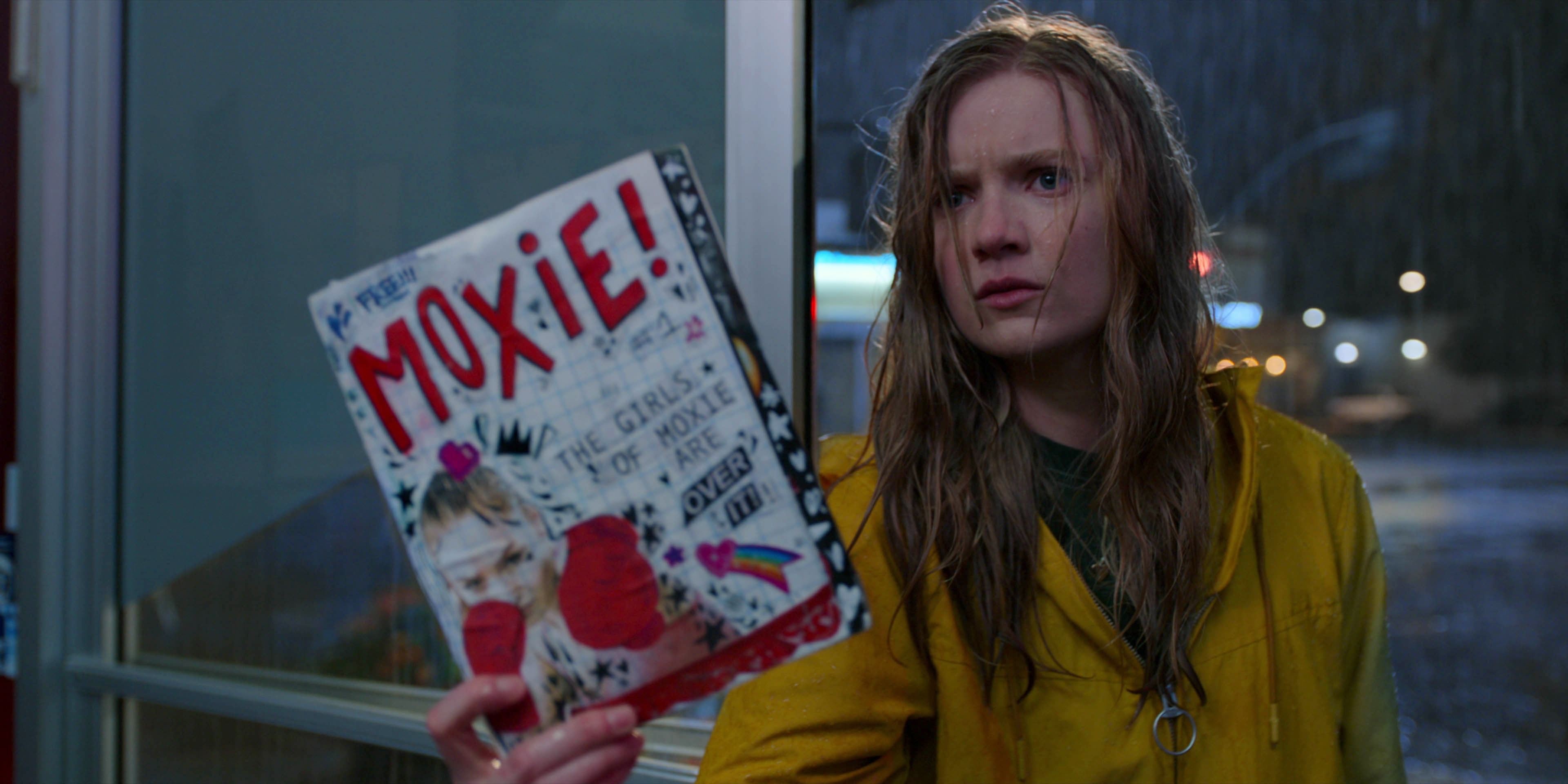
Vivian (Hadley Robinson) and best friend Claudia (Lauren Tsai) are introverts. They’re good students, quiet kids, girls who don’t make waves. But on the first day of school, Vivian is inspired by the new girl in class. Lucy (Alycia Pascual-Peña) challenges English teacher Mr. Davies (Ike Barinholtz) on his syllabus of all white men. Lucy is interrupted by star quarterback Mitchell (Patrick Schwarzenegger), who, being a white male himself, sees nothing wrong with maintaining the status quo, and belittling her simply for having an opinion different from his. Based solely on this, he starts a campaign of harassment against her, because females who speak their minds need to be put in their place. Vivian, who witnesses much of this, is quietly outraged, but it’s not until the football pep rally (when the whole school worships Mitchell jointly, despite the fact that the football team literally never wins), when the boys’ annual ranking of the girls in their class blows up everyone’s phone and suddenly a switch is tripped in Vivian’s brain. Taking a cue from her mother’s (Amy Poehler) old days of piss, vinegar, and protest, Vivian secretly starts up a zine called Moxie that ends up uniting and igniting the girls in their school (and a few of the more worthy boys). They’re mad and they’re not going to take it anymore.

Amy Poehler, fierce comedian, directs Moxie and shows some of her own. There are few people who can be this earnest and this funny at the same time, but she’s one of them. Although this film is about Generation Z discovering feminism on their own terms, it’s also a love letter to Poehler’s generation, and perhaps to all the women who have come before, women who failed to solve sexism but played a part in moving the needle. It’s also a call-out to adults who value obedience over truth and justice; Marcia Gay Harden plays the school principal who would rather look the other way than be responsible to resolving the actual issues presenting in her school. Madeleine Albright (and Taylor Swift) once said “There is a special place in hell for women who don’t help other women” and I think it’s important to remember that today, womanhood and its consequences starts earlier and earlier. The patriarchy isn’t going to smash itself.

This movie is about a movement, but it’s also about friendship. These girls, who have been taught to see each other as rivals, realize they have a cause in common. They’re outgrowing the simplicity of childhood friendship and developing empathy and understanding. Moxie brims with hope and optimism. These young people aren’t waiting to inherit the Earth, they’re not afraid to bring change now.

Amy Poehler’s schtick is something like ‘sincere dork’, and there are plenty of those vibes in Moxie. She’s outfitted the film with a genuinely wonderful cast, including Robinson, Tsai, Pascual-Peña, Nico Hiraga, Sydney Park, Anjelika Washington, Josie Totah, Sabrina Haskett, Josephine Langford, and Emily Hopper, who can carry the film’s uplifting message while still seeming like ordinary high school students. Streaming on Netflix just ahead of International Women’s Day, Moxie is the feel-good film of the month.

Berlinale 2021: Ted K

Ted Kaczynksi, more popularly known as The Unabomber, lived in isolation in a 10×12 cabin in the woods of Lincoln, Montana. Arguably that might be enough to have driven anyone crazy, but director Tony Stone puts together a more detailed and intimate portrait of one man’s descent from loner to terrorist.

Focusing primarily on the seven years before his arrest while Ted (Sharlto Copley) was living that hermit life off the grid in the middle of a forest, Ted K doesn’t provide much context or insight into who Ted was before he left society completely, or what might have driven him to do so. Filmed in the same woods where he lived and using the 25 000 pages of his coded diary as its basis, the film tries to remain impartial, merely eavesdropping on our subject while he mutters to himself, shakes his fist at planes overhead, begs family for money over collect calls made from a phone booth. He rails against the industrial system, sometimes generally, sometimes more specifically (leaf blowers, snow mobiles), the destruction of nature, the proliferation of technology, which he predicts will be our downfall.

Bomb making becomes just one of his daily tasks in his cramped cabin. More angry than evil, more sick than disturbed, Ted exists on the margins of society in more ways than one. As his mental health frays and unravels, he seeks to soothe his pain with vengeance. Unable to engage in any meaningful way, anonymously sending violence through the mail to imagined adversaries feels like such an on-the-nose characterization of Ted’s particular psychology that if it was fiction rather than fact, you wouldn’t quite believe it.

At times I felt alienated by the film, which does its job a little too well painting Ted K as an unknowable type, but Sharlto Copley’s performance kept drawing me back in. His exact recipe is known only to him, but its ingredients include neuroses, coiled anger, desperation, internal grand-standing, loneliness, disconnection, superiority, inferiority, and more. Yet Stone chooses to show him in mostly banal circumstances, even his terrorism reduced to ordinary little tasks performed in ramshackle shed by a solitary, mumbling man. The film is Copley’s alone; other people are mere footnotes and even his victims are spared little thought. He is the subject of the largest manhunt in FBI history, but of that we have no sense. The film has no sense of urgency or drama. Ted K is just a sad and lonely man going about his business. The movie asks for no mercy, no sympathy, it just tries to get inside his head, and sometimes even succeeds in doing so.