You were looking to have a cry today, weren’t you?
Sam and Tusker are driving around England in an RV, and I suppose that’s not technically the sad part, but honey, it is. The sad part is that it’s basically a farewell tour, visiting all their special spots and friends and family along the way. No one’s dying, but Tusker’s thinking about it, while he still can.
Diagnosed with dementia a couple of years ago, Tusker (Stanley Tucci) may not have a lot of good time left, and they’re determined to make the most of it. But with Tusker losing little bits at a time, every moment is tinged with sadness for Sam (Colin Firth), who is losing his great love, and with hopelessness for Tusker, who is powerless to stop it.
Supernova is a quiet and intimate movie, perfect for getting close to these characters – though maybe don’t get too attached. Tusker has a secret plan to avoid the worst of what’s coming. Writer-director Harry Macqueen allows them to explore their grief and loss in a multitude of ways. Tucci and Firth are of course the reason to watch and they’re really terrific. Tragedy is always lurking at the seams but this is really a story about time – the time they’ve shared, and the time they have left. It’s bittersweet, deeply moving, but never maudlin. The film is restrained and subtle, allowing Tucci and Firth to shine until it breaks your little heart.
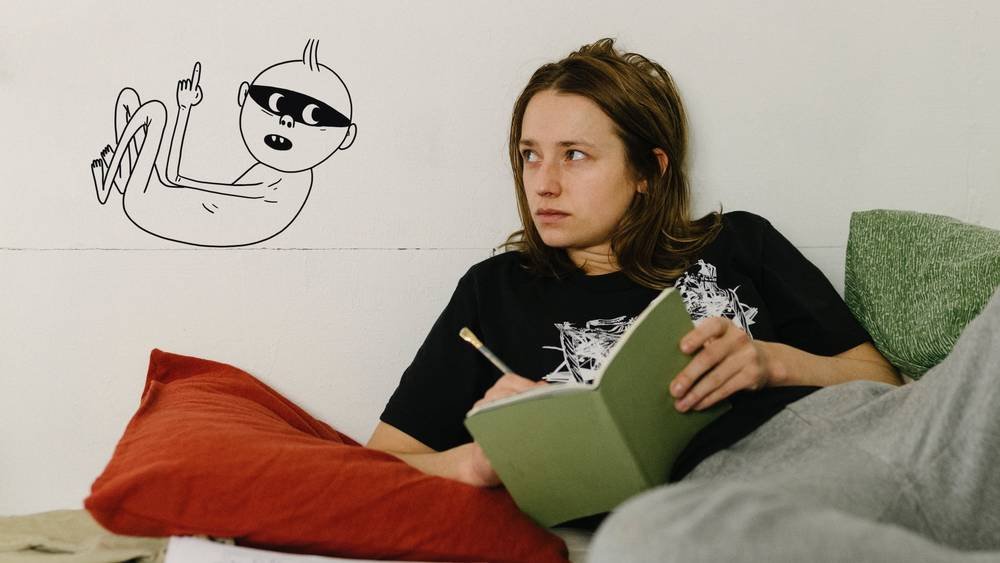
Rakel is a young woman with her whole life ahead of her: astronaut, forest ranger, comic book writer. She’s not sure which path to follow but enjoys contemplating her options. One thing that’s definitely not on her list: motherhood. Which makes her pregnancy highly inconvenient. Worse still, the abortion clinic won’t perform the procedure because it turns out Rakel (Kristine Kujath Thorp) isn’t just pregnant, she’s 6 months pregnant, and this thing is really happening, whether she likes it or not.
Ninjababy is the fetus comic book character she starts drawing in order to sort out her feelings. Pretty soon Ninjababy is off the pages and interrupting her real life with his own thoughts, needs, complaints, and suggestions. Director Yngvild Sve Flikke brings the character to life with selective animation, and we’re treated to the unusual screen representation of a young woman speaking directly to the baby she doesn’t want. The baby’s daddy, a booty call situation Rakel calls Dick Jesus (Arthur Berning) isn’t exactly an ideal candidate for fatherhood either, and Ninjababy (voiced by Herman Tømmeraas) objects pretty heartily.
Rakel is not your typical protagonist. She’s rough around the edges, reckless and youthfully arrogant. She doesn’t have it together, and not in a cutesy movie way, in a very real, slovenly, rudderless, impoverished way. Ignorant of her pregnancy, she’s been drunk, stoned, and slutty. Yet Flikke manages to balance her wildness with warmth and humour, resulting in perhaps not the most sympathetic of characters, but a realistic and resilient one, grounded in tough choices and a growing attachment.
Ninjababy has some laugh out loud moments and some truly heartbreaking ones. It’s an honest look at unwanted pregnancy, told through the young mother’s perspective as well as the unborn fetus’s, who will not be ignored. Ninjababy is a cool and almost magical take on the situation, but the real treasure is that the film isn’t afraid to put Rakel first, to let her really explore her own wants, needs, and ambitions, and to choose her path accordingly. Thorp is up to the task, showing flexibility and range as she transitions from earnest to sardonic, even skirting among emotional landmines with dexterity. Ninjababy isn’t breaking new ground thematically but its tone and execution are refreshing and unique and exciting to watch.
Sixteen is already a difficult age, with lots of challenges to navigate, but Sophie Jones has just lost her mother, so the regular rhythms of adolescence are tinged with grief and loss, which somehow makes normal rites of passage seem more trivial, yet each holds the potential power to make her forget, even for a moment, her deep sadness. Sophie (Jessica Barr) is throwing herself rather recklessly from one milestone to another, hoping to pierce through the numbness of grief and feel something, feel anything.
Sophie’s nervous giggle belies the fact that she’s still a young girl, lacking the maturity to handle all that life has dumped in her lap, not that she’s got a choice. Barr herself is still a young woman, a convincing teenager, playing the role with a natural authenticity. She and cousin Jessie Barr co-wrote the script, and Jessie Barr directs, informed by their own experiences with grief.
Sophie’s primary means of coping is boys, of course, who mostly offer comfort mostly of a physical sort. Trying her best to wear a brave face at school and at home, grief sneaks out in unpredictable ways, heightening emotions that are already fully charged. We float through time as if in a fog; the film is mostly muted, visually and emotionally, enveloping us in a very specific, highly intimate universe.
Some may find Sophie Jones to be a slow watch, maybe not the most exciting, but it’s honest in its portrayal of mourning, raw in its loss of innocence, in more ways than one. The Barr cousins prove themselves to be immensely talented, and if you don’t mind a slow-burn character study, this is a very good one.
Nelly (Joséphine Sanz) is eight years old when her grandmother dies. Nelly and her mother (Nina Meurisse) are both sad as they empty her room at the nursing home and say farewell to her elderly friends. Next they meet Nelly’s dad at Nelly’s mom’s childhood home, which also needs to be packed up. Nelly and her grandma were quite close, and the death has taken a toll on them all. But the next day, Nelly’s mom is gone, and only her dad (Stéphane Varupenne) is left to box up an old woman’s life. The sadness was too much for mom, Nelly is told, though mom is often sad, and Nelly is worried that mom might not come back.
While her father works diligently, Nelly explores the outdoors in search of a cabin her mother constructed out of sticks as a child many years ago. In the woods she finds something even better: a playmate. Marion (Gabrielle Sanz) is also eight years old, and is devoting her time to building a little cabin out of sticks. Nelly knows right away who Marion is; it’s her mother, as a child. When Marion brings Nelly back to her house, grandma is alive and well, and 20-some years younger. The girls, who look like they could be twins (and are indeed played by twins), are immediate best friends. Being eight, Nelly doesn’t much care how or why this time anomaly has permitted her such an intimate new playmate, she just takes it at its face value and enjoys the time with her little mother.
Imagine, if your old brain still has any magic left in it, encountering your own mother as a child, when you yourself are also a child. This is such a beautiful, innocent thought experiment I can’t believe I’ve never seen it done before.
Nelly takes full advantage, asking her mother things that are much harder, and sometimes impossible, to broach between mother and child under normal circumstances. And Marion has questions too. “Did I want you?” she asks in all innocence. “Yes,” comes the reply. “I’m not surprised,” Marion responds, while gently stroking Nelly’s cheek, “I’m already thinking of you.”
Writer-director Céline Sciamma infuses this film with such tenderness that I constantly feel like weeping, though the film is not particularly emotional or fraught. The two young actresses are absolute perfection, like little dolls who are made for each other. It helps us to understand that his manifestation is somehow essential to Nelly’s grief and loneliness during a painful time. This is next-level self-soothing and the whole thing is coated in such a thick layer of loving kindness that I’m pretty sure I want some too.
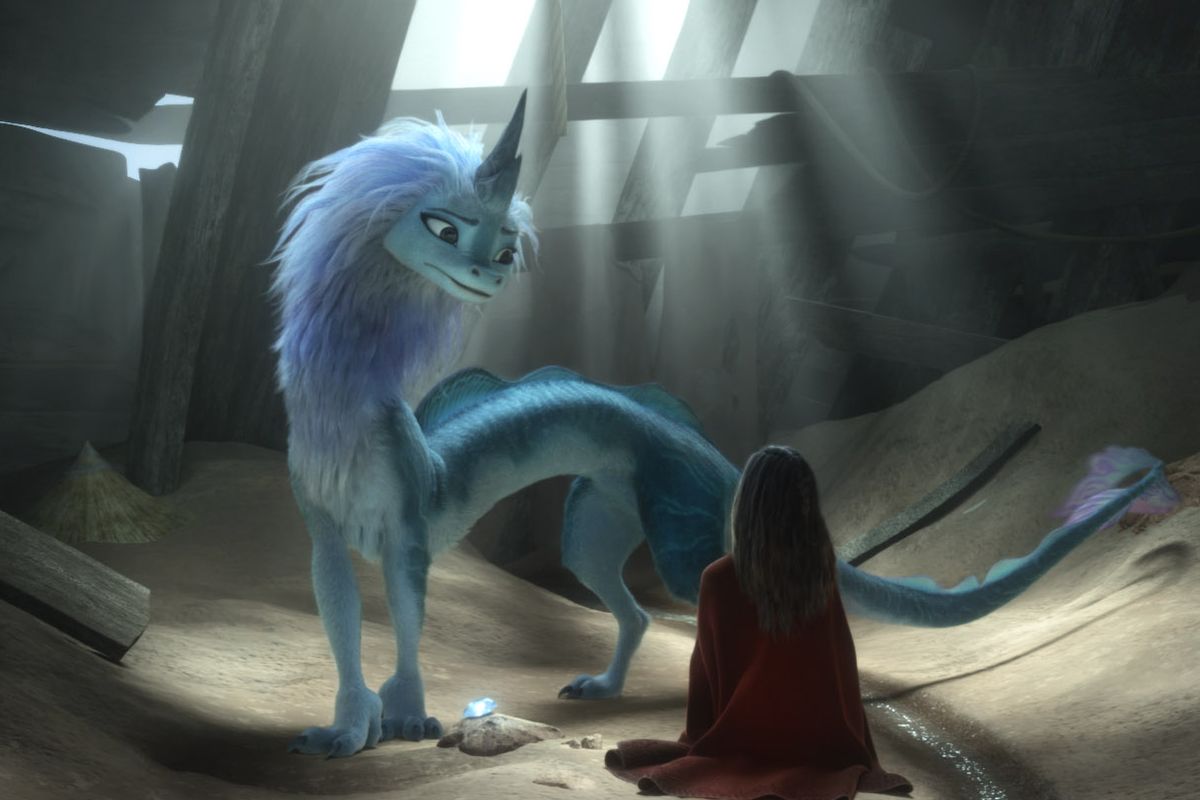
Once upon a time, in a kingdom called Kumandra, people lived peacefully alongside dragons, who brought them water and protected them. But when a sinister plague known as Druun threatened the land, turning its people to stone, the dragons pooled their power, sacrificing themselves to save humanity, leaving behind only a gem to represent their faith and trust in the people they’d saved.
500 years later, the realm of Kumandra is no more. This last drop of dragon magic proved too tempting, and factions broke off, each desperate to hold the gem themselves. An attempt to steal it breaks the gem into pieces, unleashing the Druun plague monster once again. Raya, a young warrior, goes on an adventure to retrieve the broken pieces of the gem and resurrect the last dragon. It’s going to take more than just magic to heal the world, but trust and cooperation might be even harder to come by.
This is Disney’s latest animated offering, available to stream (at a premium) on Disney+, and if Raya is their most recent addition to the Disney Princess lineup, she’s a good one. Raya (voiced by Kelly Marie Tran) is courageous, and adventurous. She plots to save herself, and her people. Sisu (Awkwafina) the dragon also has beautiful female energy, more giving and trusting than Raya, who, though brave, is also flawed, making for a far more interesting protagonist and princess.
The realm of Kumandra may be fictional, but Disney animators were inspired by Southeast Asian countries of Thailand, Vietnam, Cambodia, Myanmar, Malaysia, Indonesia, the Philippines, and Laos when establishing its unique culture and aesthetic. The film looks stunning, proving that Disney animation is back on top, with or without Pixar. The stellar voice cast includes Gemma Chan, Daniel Dae Kim, Benedict Wong, Sandra Oh, and Alan Tudyk, but the greatest interplay is between Kelly Marie Tran and Awkwafina, who share a wonderful, warm chemistry, emphasizing the film’s respect for female friendship.
The best part of Raya and The Last Dragon may be its subtle but timely message. Raya is a strong and skillful warrior, full of conviction and a sometimes impetuous desire to run straight into battle. Success in her mission, however, will depend more on conflict resolution; people who have long considered themselves enemies will have to put aside their differences in service of the goal they all have in common. Someone will need to be the first to cross partisan lines because the real threat is never the outside force, it’s the cracks sown between the people within. Raya’s fighting style is based on the Filipino martial art Kali but victory won’t require her weapons, she’ll need to arm herself with empathy and diplomacy instead.
Soleil Moon Frye starred on an 80s sitcom called Punky Brewster when she was just 7 years old. When the show ended, she’d had a strange and abbreviated childhood. Only a wild and weird adolescence could possibly follow, but this one she would spend behind a camera rather than in front of it.
She and her friends, all of them young Hollywood royalty, had the money and access to do whatever they pleased. It was the 90s; the internet wasn’t a worry yet, going viral meant something else entirely, they could do what they wanted with no consequences. And they were young: they hadn’t learned yet to be jaded or guarded or filtered. Among friends, they let it all hang out, and it didn’t matter that one of them constantly hauled around a camcorder because behind it was Soleil’s friendly face. Thirty years have gone by, and Frye is only now taking this footage out of the vault to share with us. She’s created a living portrait of a lot of famous faces, but also of a time and place that no longer exists.
Frye’s famous friends include Stephen Dorff, David Arquette, Mark-Paul Gosselaar, Jonathan Brandis, Charlie Sheen, Balthazar Getty, Jenny Lewis, Brian Austin Green, and briefer appearances by Robin Thicke, Leonardo DiCaprio, Joey Lawrence, Mark Wahlberg, Sara Gilbert, Corey Feldman, Mark McGrath, Kevin Connelly, and way more besides. Hard-hitting topics covered include Brian Austin Green’s misguided rap album, Soleil Moon Frye’s breast reduction, a live Bronco chase watch party, and the meteoric rise of House of Pain. And more seriously, suicide, a subject that comes up much more often than average within Frye’s set.
Soleil Moon Frye, who is the documentary’s subject as well as its director, constantly challenges the notion of memory – does she remember these heady days correctly? The same as everyone else? Does it even matter? It’s an act of remembering and remembrance – sometimes wistful, sometimes painful, sometimes playful, sometimes tinged with regret. Fry had hundreds of hours of footage but crafts something that is very watchable, and that serves a greater narrative. It’s fun to see some famous faces de-aged, it’s fun that so many of her famous friends were musicians who contribute to the soundtrack. But this, for a young woman who didn’t have a normal high school experience, is her yearbook. Many of the faces she’s lost touch with over the years, others she’s grieved and lost. But these images live on, telling a story with one common theme: we were here.
Kid 90 will stream on Hulu on March 12 2021; the Punky Brewster reboot is already available on Peacock.
I feel old, I feel embarrassed, and I feel inspired. In that order.
To the young women of today, I’m sorry. I’m sorry we didn’t get the work done. I’m sorry there’s still work for you to do. I’m sorry we didn’t break the patriarchy but got broken by it, bit by bit.
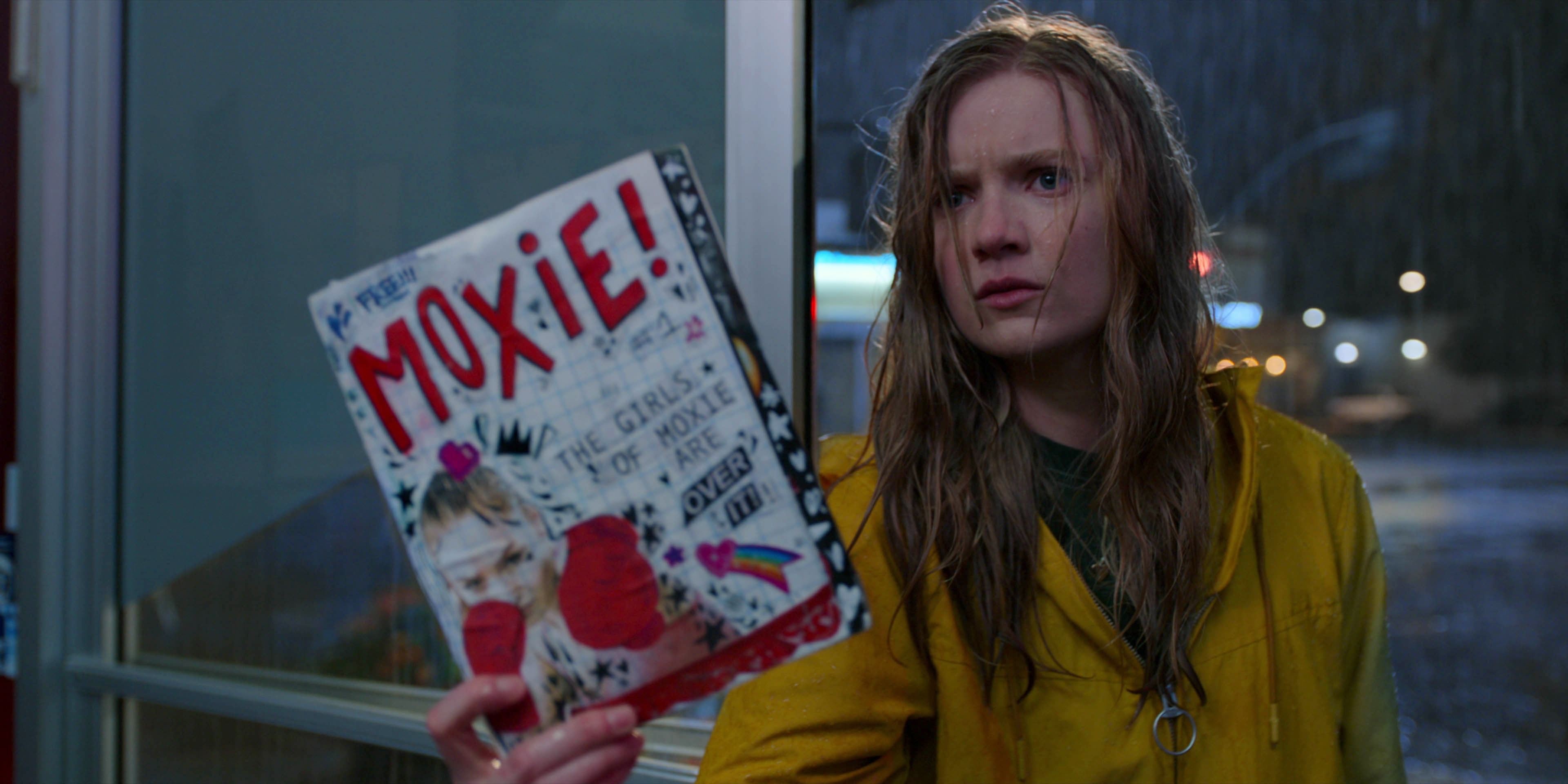
Vivian (Hadley Robinson) and best friend Claudia (Lauren Tsai) are introverts. They’re good students, quiet kids, girls who don’t make waves. But on the first day of school, Vivian is inspired by the new girl in class. Lucy (Alycia Pascual-Peña) challenges English teacher Mr. Davies (Ike Barinholtz) on his syllabus of all white men. Lucy is interrupted by star quarterback Mitchell (Patrick Schwarzenegger), who, being a white male himself, sees nothing wrong with maintaining the status quo, and belittling her simply for having an opinion different from his. Based solely on this, he starts a campaign of harassment against her, because females who speak their minds need to be put in their place. Vivian, who witnesses much of this, is quietly outraged, but it’s not until the football pep rally (when the whole school worships Mitchell jointly, despite the fact that the football team literally never wins), when the boys’ annual ranking of the girls in their class blows up everyone’s phone and suddenly a switch is tripped in Vivian’s brain. Taking a cue from her mother’s (Amy Poehler) old days of piss, vinegar, and protest, Vivian secretly starts up a zine called Moxie that ends up uniting and igniting the girls in their school (and a few of the more worthy boys). They’re mad and they’re not going to take it anymore.
Amy Poehler, fierce comedian, directs Moxie and shows some of her own. There are few people who can be this earnest and this funny at the same time, but she’s one of them. Although this film is about Generation Z discovering feminism on their own terms, it’s also a love letter to Poehler’s generation, and perhaps to all the women who have come before, women who failed to solve sexism but played a part in moving the needle. It’s also a call-out to adults who value obedience over truth and justice; Marcia Gay Harden plays the school principal who would rather look the other way than be responsible to resolving the actual issues presenting in her school. Madeleine Albright (and Taylor Swift) once said “There is a special place in hell for women who don’t help other women” and I think it’s important to remember that today, womanhood and its consequences starts earlier and earlier. The patriarchy isn’t going to smash itself.
This movie is about a movement, but it’s also about friendship. These girls, who have been taught to see each other as rivals, realize they have a cause in common. They’re outgrowing the simplicity of childhood friendship and developing empathy and understanding. Moxie brims with hope and optimism. These young people aren’t waiting to inherit the Earth, they’re not afraid to bring change now.
Amy Poehler’s schtick is something like ‘sincere dork’, and there are plenty of those vibes in Moxie. She’s outfitted the film with a genuinely wonderful cast, including Robinson, Tsai, Pascual-Peña, Nico Hiraga, Sydney Park, Anjelika Washington, Josie Totah, Sabrina Haskett, Josephine Langford, and Emily Hopper, who can carry the film’s uplifting message while still seeming like ordinary high school students. Streaming on Netflix just ahead of International Women’s Day, Moxie is the feel-good film of the month.
Hello from the Berlin International Film Festival, streaming live from my bedroom for the first time ever. I’ve got a full slate of great movies ahead of me this week, or they better be after the very first one set the bar extremely high.
Adam’s husband Will gifts him with Spanish lessons. Two years worth of Spanish lessons! Hope you like them, Adam, because this is quite a commitment. Adam (Mark Duplass) is still getting used to the lavish lifestyle Will’s success affords them, and the time and freedom to pursue such projects at leisure. Cariño (Natalie Morales) is the Spanish teacher, beaming in from Costa Rica. Over the next two years, they’ll come to know each other very well through the miracle of conversation. Adam’s Spanish grammar may leave something to be desired but when you spend dedicated time in simple conversation with another human being, over time a relationship is cultivated almost as if by magic. Bonding over their own personal tragedies, the two are perhaps a little surprised by the friendship that seems to grow organically between them. They’ve never been in the same country let alone the same room, but their bond feels genuine and strong. Is it real, can it be trusted?
Natalie Morales directs the story she and Duplass wrote for themselves. It’s an interesting exploration of human attachment and what it means to connect authentically. We experience their relationship solely through the split screen of their online connection. I worried this conceit may wear thin over the course of a feature-length film, but these two share such compelling chemistry, and go to such lengths to entertain and stimulate each other, I found myself not minding it at all.
Perhaps most amazingly, this spontaneous friendship is allowed to remain platonic throughout the film. Adam and Cariño have shared pain and grief in their backgrounds, and the fact that they can find a way to reach out despite it is a tenuous little miracle it feels a privilege to witness. Trust is of course one of the most universal human hardships, and it feels elemental to watch it be birthed and nurtured on screen. Adam and Cariño are an endearing but flawed pair; their simple humanity is what’s touching. Language Lessons is disarming in the most delightful way.
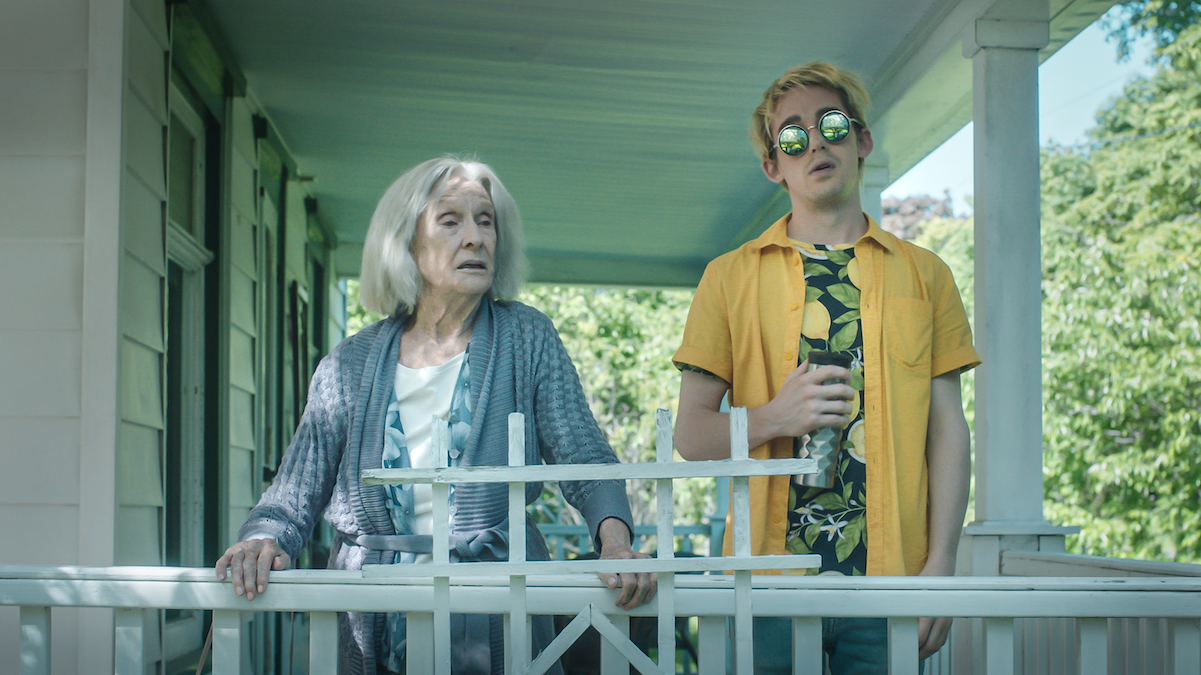
What do you do when you you’re reeling from a break-up with no place to stay and no money to make things happen? To grandmother’s house you go, of course. It’s what Russell does. Russell (Thomas Duplessie) has decided to pack up his wigs and fishnets and lick his wounds in the country, at his Grandma Margaret’s place. Grandma (Cloris Leachman) is delighted to have him, not least of all because it’ll help her avoid the local nursing home, which she adamantly and steadfastly refuses to go to despite it being well established that she’s really no longer able to care for herself at home.
Russell has, until recently, pursued acting, but has dropped that passion for another – drag – which may have contributed to his breakup. His mother Ene (Linda Kash) drops in from time to time and hardly seems to know who to be most exasperated with – her stubborn, sickly mother, or her waffling, still-dependent son. Equally inefficient with both, she seems just to pop in to be a bummer and then leave again. Meanwhile, neither housemate is doing well. Russell is stagnant, torn between leaving, which means restarting, which is terrifying not to mention the whole abandoning Grandma thing, or staying, and quietly extinguishing an important part of himself. Grandma, meanwhile, is rapidly declining, but no less unwavering in her resolve to live at home. But this together time means they’re both learning about each other’s lives, their secrets, their dashed hopes, things many grandma-grandson duos may never normally exchange. Their relationship is unconventional but sweet.
Director Phil Connell keeps things simple, allowing the relationship to be the film’s primary focus. Newcomer Duplessie pours his whole self into the role. On the other end of the spectrum, this is Cloris Leachman’s final role. She died in January of this year, a talented lady to the very last, and though she seems as feisty and vibrant as ever, physically the years were taking a toll and it’s hard not to think of her demise while watching her declining mental state in the film. Still, such a meaty, involved role for a woman this late in her life is a rarity (she was 94 when she died), and Leachman was such a gem. This film isn’t her best, but it’s a great way to say goodbye to a legend.
A caveat: although I enjoyed this movie, and I enjoy drag as a whole, I do have one problem with both, and that’s the use of the word ‘fish.’ In drag, ‘fish’ is a compliment. It means the queen is looking particularly feminine, perhaps even passing as female. But fish is a dirty word, a derogatory word. I don’t mind anyone dressing up as a woman or performing as a woman but I do mind the offensive language, and I’m pretty sure you can guess where the term fish comes from. It’s a word that’s been used to shame women about the scent of their sex, as if a natural odor is somehow wrong. As a term it’s been co-opted by the drag community, the very people who apparently admire femininity so much they want to emulate it, but at the same time insult the people they’re imitating. It seems strange to put on heels and wigs and corsets and makeup and then sling sexist terms like this, but the patriarchy is pretty strong and even the marginalized will oppress those beneath them. The word is unnecessary, easily scrubbed. Let’s make that happen.
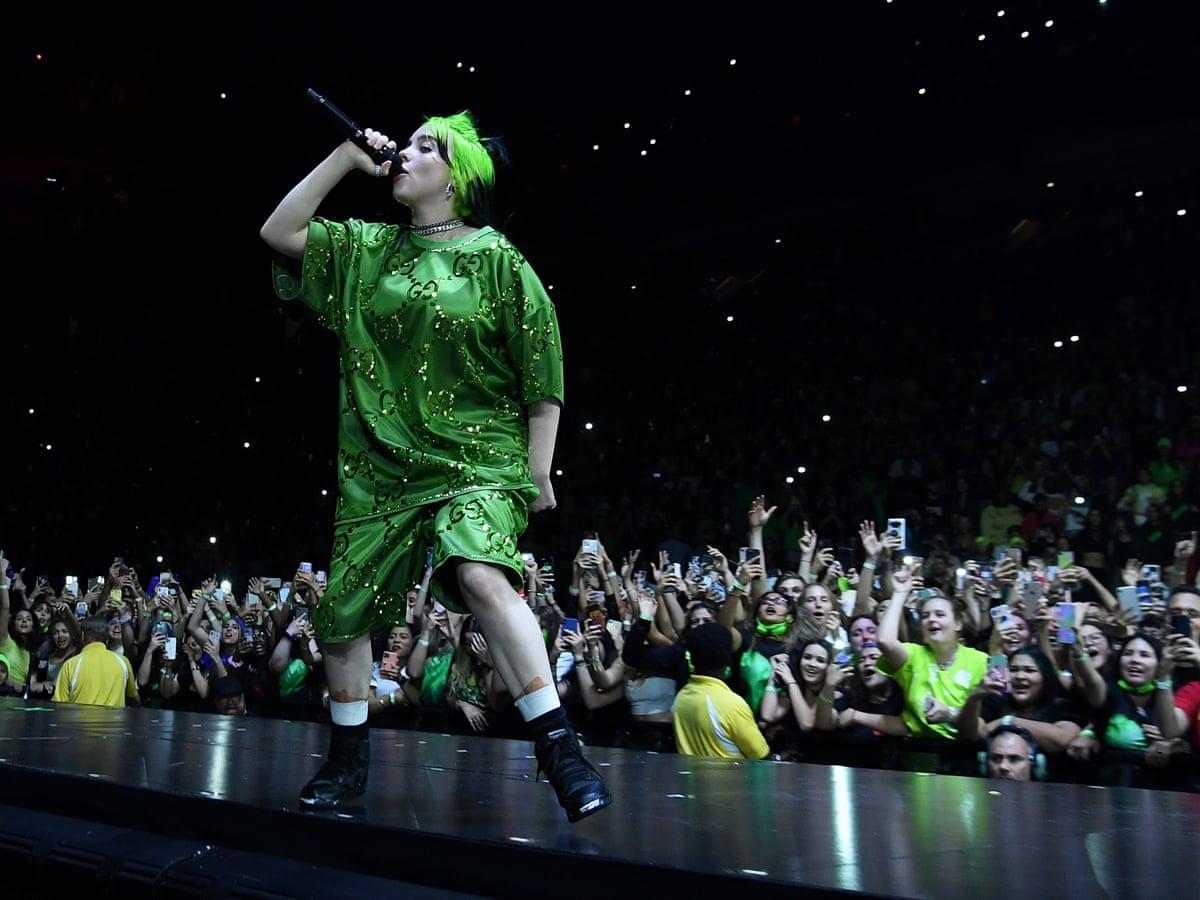
Whether or not you’re a fan of Billie Eilish, you should probably watch her documentary. The music industry has a habit of chewing up and then spitting out female artists and Eilish’s meteoric rise to fame at such a young and tender age would normally be an immediate red flag. Couple that with her seemingly dark personality and you might be tempted to put her on your worry list, but Eilish surrounds herself with a tight-knit family who don’t just care for her – they care for each other.
RJ Cutler’s Billie Eilish documentary has a tremendous amount of access. We get to see her from the young woman first tasting success on SoundCloud to, almost instantly, a global superstar weighted down with Grammy awards. The film follows her while she writes her first album, whether she’s on the road, or at home, or even up on stage, performing to hundreds, then thousands, then tens of thousands of people. And yet Billie, still a kid, doesn’t seem to love the attention, or being looked at, or being treated like an idol. She struggles to write songs, she struggles with quality vs. quantity when touring non-stop takes a toll on her body and she’s unable to deliver the top-notch performance that only she expects of herself. For such a young kid, her work ethic is remarkable, but even more so is her ability to stay grounded. Clearly mom Maggie, dad Patrick, and big brother Finneas have a lot to do with this. Mom will be helping Billie do the blocking for her next music video in the backyard while dad obliviously picks up dog poop. Finneas delivers sitcom-quality pep talks, psyching up his sister as only he can, and only he understands she needs. The two are clearly close, he her writer and producer, as much responsible for her success as she is. They are a team, often together, never seen squabbling, delighting in each other’s success.
Maybe because this documentary is being shot so early in her career, Eilish in her family seem totally authentic and filter-free, not that they have anything to hide. They’re a surprisingly wholesome family, Billie’s biggest complaint that Maggie drives a minivan, an unappealing thought for a teenager about to get her first driver’s license, and her parents’ main concern seems to have been a tweenage obsession with Justin Bieber that’ll really come full circle by the documentary’s end.
Eilish is a massively talented woman with a solid lime green head on her shoulders and her Nikes firmly on the ground. She is a different kind of pop star, not divorced from her image, but not co-opting it either. She’s protective of herself without being jaded. You will hope, while watching this, that she can continue down this path, continue to make healthy choices, and to blaze a path for a new kind of entertainer – the kind that doesn’t have to sell her soul to get what she wants and deserves.







 ASSHOLES WATCHING MOVIES