Category Archives: Movie Reviews

Our reviews and thoughts on the latest releases, classics, and nostalgic favourites. Things we loved, things we hated, and worst of all, things we were ambivalent about.

The Humans

There were bigger films at TIFF this year, buzzier films, films with hype and hope and high expectations. The Humans, though? That one was for me. An intense, talky film, character-driven, with an interesting cast: sign me up and sit me down! Stephen Karam adapts his one-act play (finalist for the 2016 Pulitzer Prize for Drama, Tony winner for Best Play) for the big screen, a risky DIY move that pays off in surprising ways.

The Humans takes place in Brigid and Richard’s new apartment, “new” being a misleading word in this case as it’s a crumbling pre-war duplex in downtown Manhattan, but it’s new to Brigid (Beanie Feldstein) and Richard (Steven Yeun), who are moving in together for the first time, and playing host to her family for Thanksgiving. Just one problem: the furniture hasn’t even arrived yet. Haha, just kidding. In-laws for Thanksgiving? There’s gonna be drama, folks.
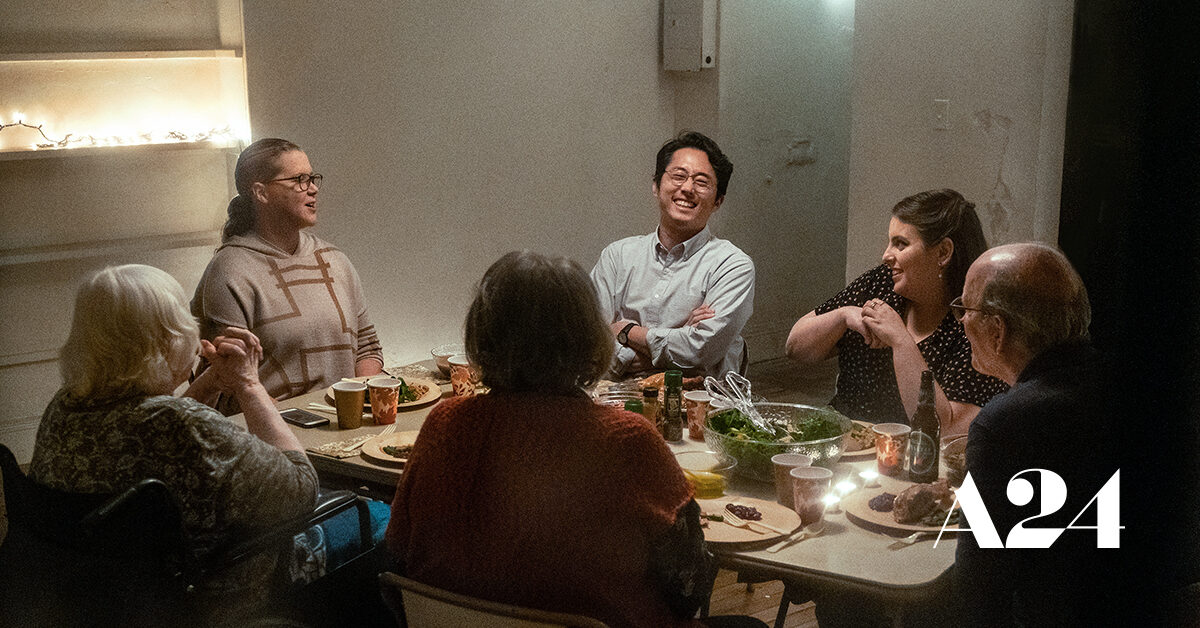
But not the loud, yelly kind. Sister Aimee (Amy Schumer) arrives first, from Philadelphia, mourning her recent breakup and dealing with an intestinal rebellion. Mom Deirdre (Jayne Houdyshell) and dad Erik (Richard Jenkins) arrive next, in from Scranton, toting grandma ‘Momo’ (June Squibb), physically confined to a wheelchair and mentally confined by Alzheimer’s. With an apartment full of people instead of furniture, the holiday celebrations begin, but I’m afraid you won’t find them very jolly.

The passive-aggression starts almost immediately. There’s no one quite like family for such precision the button-pushing, and nary a scene goes by without adding to the tensions of the night. Everyone’s got a secret, and as if the house knows, it starts to bump and burble around them. As darkness falls, the apartment closes in, feeling all the more claustrophobic as director Karam finds nooks and crannies to hide his camera and catch his subject in awkward positions. Aimee hides a trembling lip, and makes unadvised calls from the bathroom. Dad Erik eyes the apartment’s many flaws, distress flashing across his features, tongue firmly bitten. He sees every loose doorknob, every bubble in the paint, every single water damage stain dotting the ceilings. Is he evaluating the apartment’s worthiness, or lamenting that he can’t provide better for his daughter? With a panic attack always encroaching, he’s a tough character to crack, but Richard Jenkins is second to none, and he’s rarely, if ever, been better than this.
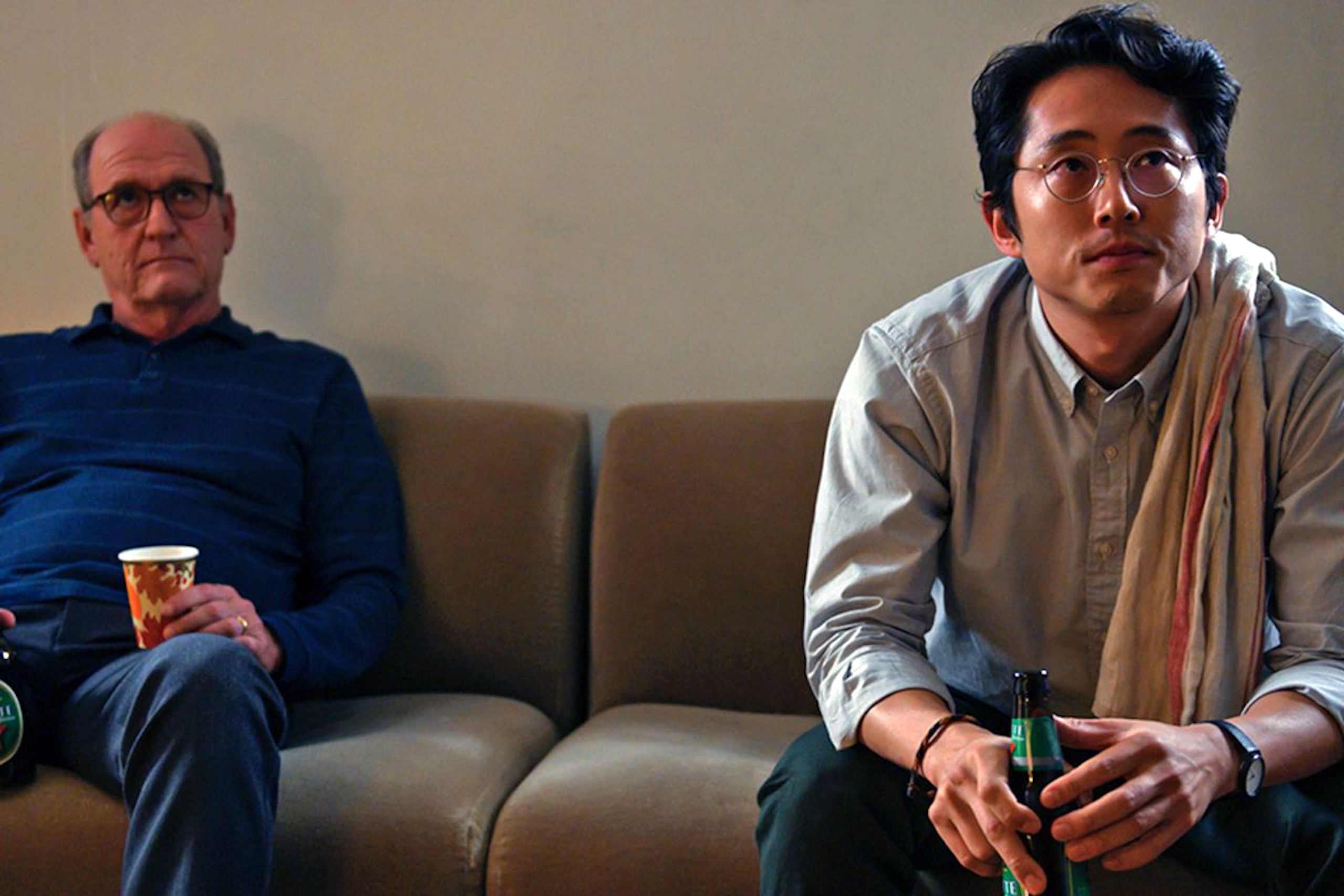
Intimate and meticulously observed, Karam has an ear for dialogue and a knack for finding the authenticity in human interaction. Completely free of artifice, this feels like an absurdly typical American family fumbling their way through another holiday dinner. They love each other and they drive each crazy.

Houdyshell, having originated the role of Deirdre on Broadway, plays her like a second skin, so comfortable in the role she wins our empathy with the very smallest of hints, her anguish just barely visible yet undeniable, her every flinch present and accounted for. Feldstein and Yeun are each as good as we’d expect them to be, flawless parts of a flawless whole. Schumer’s the real surprise, holding her own alongside them, Aimee’s role within the family instantly identifiable and relatable.

The Humans gets to the truth in this family dynamic, eschewing melodrama for raw honesty, leaving the members of this family open and exposed. They are laid so bare it feels almost embarrassing to be eavesdropping, yet it’s so compelling it hurts to look away. Karam is confident enough in his material not to muck it up with cinematic tricks. He relies on strong writing and excellent acting, and both here are beyond reproach. He holds a mirror up to us, and like all humans before and after us, we are fascinated by our reflections. Our very natures, the best and worst of us, revealed in one turkey dinner around a rickety folding table with mismatched chairs, Momo snoring softly from the corner. A compelling story is more than enough.

I loved every bit of this movie, how it moved me, how I felt I knew and understood these characters instinctively, winced when they winced, held my breath when they held theirs. The Humans is among the best of the many excellently curated titles at TIFF this year, and how I wished I was watching it with others, able to debate the merits of its title, the meaning of those blackened lightbulbs, Karam’s creepy, haunted atmosphere, treating this family drama as if it were a horror – and whether, just maybe, it is.

The film will simultaneously be released in theaters and aired on Showtime on November 24, 2021.

Everyone’s Talking About Jamie

This movie is based on the true story of Jamie Campbell, a 16 year old boy from Sheffield, England, who dreamed in drag, and attended prom in a dress.

In the film, the 16 year old boy is called Jamie New (Max Harwood). Jamie is out, and proud, and knows in his blood he’s meant to be a drag queen. He’s bullied at school, rejected by his father, but at home he finds support with mother Margaret (Sarah Lancashire), who doesn’t just love and accept him, but encourages him to be his true self. She even buys him his first pair of heels.

Worried the film wouldn’t be gay enough, directors Jonathan Butterell, Dan Gillespie Sells, and Tom MacRae add singing and dancing, adapting it from the West-End stage musical.

Stifled at school, especially by Miss Hedge (Sharon Horgan), Jamie resolves to attend prom in a dress. Emboldened to finally create the drag persona of whom he’s been dreaming, he makes a friend with crucial experience. Hugo (Richard E. Grant) doesn’t just run a fabulous dress shop, he’s a queen himself, and his wisdom extends beyond just brows and breasts. He teaches Jamie (with an all-new song) about drag’s revolutionary history.

Grant prepared for the role by binging 11 seasons of RuPaul’s Drag Race in just 3 weeks (which sounds like a dream job to me), and is particularly fitting since season 6’s winner, Bianca Del Rio (Roy Haylock), makes a cameo appearance (as do the real Jamie Campbell, and several cast members of the stage musical).

If you like heart warming stories about being your true self, Everyone’s Talking About Jamie is about to be talked about you, too. If you like queer stories with a happy ending, please sing and dance along. If you like stories about outsiders overcoming obstacles to rise above, then find this film on Amazon Prime, sparkly heels optional but encouraged.

The Suicide Squad

We actually saw this movie a few weeks ago, and like a good sport, I left it to Sean to review. You may have noticed it’s almost always Sean who reviews the super hero genre, and that’s me being my magnanimous self, giving these films a fair shake by not reviewing them myself. But Sean seems to have very little to say about this one, an indictment in itself, so it’s up to me to save the day.

I didn’t like it.

I really didn’t care for the first one either. I thought the music was both the best and worst part, the constant stream of pop songs perking me up, but their overuse indicative of weak writing and poor editing. This one doesn’t even feel as memorably bad, it was just a movie that failed to interest me despite a bevy of recognizable names and some enjoyable James-Gunn-isms.

Yes, the man has a way with manic expression, and away from Marvel’s PG-13 cage, he explodes with violent glee, shooting off confetti cannons loaded with human flesh, painting the scene with guts and gore. And while I welcome the sanguineous spectacle, I wish it splattered an actual story.

So we all know that Belle Reve is the prison where all the very worst super villains are kept, and that shady Amanda Waller (Viola Davis) is at it again. When she’s got a job that’s so high-risk only the most expendable will do, she assembles Task Force X, a gang of villains chosen from the prison’s population. They’re promised freedom if they survive the mission, and no one expects them to survive. That’s why they call them the Suicide Squad.

We’ve got some new faces and some familiar faces in this particular squad: Harley Quinn (Margot Robbie), Bloodsport (Idris Elba), Peacemaker (John Cena), and King Shark (Sylvester Stallone), among others, and Rick Flagg (Joel Kinnaman) to keep them all in line. Armed and dangerous, they’re dropped into the jungle of Corto Maltese, an island that’s overrun by enemies, including militaries, guerrilla forces, super villains, and a Big Bad that’s very Big and very Bad, threatening to take over the entire island – and then the world!

Much like the first, the only character worth watching is Harley Quinn, and that’s largely due to Robbie. Suicide Squad’s Harley Quinn isn’t nearly as compelling as Birds of Prey’s, but she’s charming, manipulative, and unpredictable, an irrepressible combination, And though Robbie’s boxed in by the male gaze and the narrower interpretation of her character, she still brings a psychotic empathy to the role that’s a lot of fun to watch. Unfortunately, with such a large ensemble, she can’t be on the screen at all times. More the pity. Once again, DC bites off more than it can chew, padding out the squad with forgettable villains who are ill-used and badly introduced, if at all. Since they don’t care, neither do we, which is the most disappointing part of this film. The first Suicide Squad didn’t get this right either, but considering James Gunn was able to galvanize a bunch of unknown galaxy-guarding losers into crowd-pleasing heroes, we hoped he’d be able to do it again. No doubt DC was counting on him for this as well, but instead this movie doubles down on stacking the deck with mostly filler – not enough to engage the audience, but just enough to steal time from the few things in the film that do work. Bummer.

I think this movie was relatively well-received because we’ve been living in a blockbuster drought. If you’re thirsty enough, you’ll drink muddy puddle water gratefully. James Gunn’s Suicide Squad is muddy puddle water: it will do in a pinch. People will drink it during a time of scarcity, but given any choice at all, they’d rather drink anything else. It’s already on its way to being forgotten with other drinks that ultimately flopped despite lots of hype and fanfare: Crystal Pepsi, New Coke, Suicide Squad.

Elulu

Elulu is Gabriel Verdugo Soto’s passion project. He worked on it solo for 8 years, pouring it out directly from his heart to the movie screen.

Primarily animated, Elulu mixes real photo backgrounds with animated 2D effects and 3D characters. It has no dialogue to speak of. it is an exploration of grief and goodbye like you’ve never seen.

A man returns to his childhood home after the death of his mother and finds that mourning her is complex and non-linear. In between every day tasks like feeding his cat and pursuing a career in theoretical physics, this man is grieving, inspired by the objects and spaces last occupied by his mother. Her spirit seems to live in them, as if her consciousness had somehow been absorbed by them, a shadow of her life and memories remaining, leaving a gateway for the man to remember and celebrate her. His thoughts devolve into memory, revisionism, and fantasy, the stories recalled from childhood resurfacing, and his mother herself found living in one of his paintings (I did warn you this was going to be different).

As for Elulu, you’ll find that he is a magical caterpillar come to ask something of a grieving man. But he also inspires the man to discover love, connection, past and present from different angles. Elulu is a physical manifestation of string theory. You heard me: a string theory magic caterpillar. Don’t be intimidated; Elulu, the film, is meant to be felt more than understood. It’s like the wind. And while I won’t pretend to define string theory for you, let’s just agree that it at least posits the existence of more than just the dimensions we’re familiar with (length, width, breadth, time). String theory contends that elementary particles aren’t just mathematical points but tiny strings which require not 3 but 10 spatial coordinates in addition to time, but most of these, sometimes interpreted as ‘alternative universes’ are simply too small to observe. But Elulu seems to navigate these, and helps the man drift between physical and metaphysical worlds, finding that his deceased mother still exists in some of them.

I don’t mean to make this sound complicated, I only want to give you a tast4e of Soto’s ambition and the borderless, limitless world in which his protagonist exists. With flashbacks and magical realism, we make the jump between the observable universe in which his mother is dead, into pockets of time and space where she might never die. It’s a comfort and a salve. But the film itself isn’t complicated at all as long as you treat it like a dream in which rules simply don’t exist. The narrative is what we make it, the story can change without notice, the images aren’t necessarily direct representations. It’s what you feel that matters, what the stories and images evoke for you. Elulu is both emotional and cerebral, operating on a higher plane than most other films, but it still feels accessible and looks beautiful and strange. Soto’s meditation on consciousness and grief will have different meanings for each viewer, making it a unique film experience and a wondrous exploration of life’s mysteries and the nature of existence.

Elulu is an official selection of the Ottawa International Animation Festival.

Nobody Has To Know

Phil arrives home in a cab, a home he no longer recognizes as his own. He’s been in hospital, had a stroke, lost his memory. He doesn’t know where home is or who he is, but luckily Millie knocks on his door the next day to remind him. She’s his boss’s daughter. She brings him to work, shows him around, lists his likes and dislikes, and informs him they were (are) secret lovers. Their chemistry is undeniable, his hands seem accustomed to the work, his mattress conforms to his body, yet there’s a dog he can’t account for, and his memory remains slow to return.

Furthermore, Phil (writer-director Bouli Lanners) is a foreigner, a Belgian farmhand working on a remote Scottish island. Why is he so far from home? Why isn’t his family looking for him? His strangeness makes him seem more vulnerable, a crack in his gruff exterior. Millie (Michelle Fairley) enjoys a prominent seat in the island’s social hierarchy but is shy and reserved. They make a complementary pair as they navigate the losses due to his amnesia, and the minefield of memory as it returns. The real secret waiting to be unlocked isn’t that they were lovers, but that they never were. Millie has simply taken advantage of this unique situation to make something happen that neither had the courage to do beforehand.

Their relationship, and his footing in the community, becomes a story of identity. Who Phil is depends on who he’s with, who that person perceives him to be, wishes him to be, which side of himself he revealed to them, what they remember, what they value, what they project onto him. It’s like he’s a slightly different person to everyone he encounters, which makes assimilating his personality a difficult task. Without memory, we rely on other people’s stories to make sense of who we are. The stories Phil is told about himself vary, and some are flat-out made up. Who is he deep inside, regardless of these stories? Time would tell, if only Phil had much of it.

Nobody Has to Know is a small and gentle film that took me by surprise. It’s tender and beautiful to behold, well-acted, well-told, well-considered. Although it must be terrifying to depend on others to learn about oneself, director Lanners acknowledges that a beautiful Scottish backdrop always makes things better. The island’s remoteness gives us a sense of Phil’s isolation, his urge to hide, but also his his appreciation for beauty. You’ll find yourself wondering just how well you would fare should you wake up tomorrow in a room you don’t recognize, in a home that feels alien. How to re-assemble your ‘self’? Where to find the truth, who to trust to tell it, how to treat the things that don’t feel authentic. And let’s not forget that Phil is also in the throes of romance, either one rekindled or ignited for the first time, but either way mired in history and context that he doesn’t know. If your hands and mouth and heart say yes, is that enough, or should you wait for your brain to catch up?

Watch Phil pick up the pieces in this quiet and gentle film; Nobody Has to Know premiered at TIFF and heads to the Chicago Film Festival October 15 before its December release.

Lakewood

Some movies come out of TIFF as clear front-runners for this year’s Best Picture race at the Oscars (Belfast, The Power of the Dog), but others may stick with you for other reasons entirely. Lakewood is one of two movies I just can’t stop thinking about this year (Silent Night is the other, if you’re wondering).

Amy Carr (Naomi Watts), bereaved widow and mother of two, puts her young daughter Emily on the bus to school, tries unsuccessfully to rouse teenage son Noah, and then hits the trail for a beautiful autumnal run. It’s supposed to be self care, only Amy doesn’t dare disconnect, fielding calls from work, from mum, from the mechanic, and that’s before her whole world shifts.

Amy learns her daughter’s school is on lockdown. In fact, the whole town, small as it is, is pretty much on lockdown to do an active school shooter situation: a parent’s worst nightmare. Amy is miles from home, and as her worst fears play across her face as she struggles to catch her breath, realizing only her cellphone connects her to breaking news, both good and bad. The shooting is not at her daughter’s school. Emily is shaken, but safe. The shooting is at Noah’s school, but luckily Noah is still home in bed, or so Amy thought. The one time her teenage son listens to her and it’s to go to school on this day, the very worst day of days. Frantic calls to anyone who can help. Pleas for people step up. Pleas to the universe to keep her son safe. Frequent checks with Google Maps to try to navigate her way into town. Obsessive calls to her son, who never answers. Reaching out to friends, family, the mechanic, a 911 operator, the detective already on the case.

This is Naomi Watts’ show. Her hope, her anguish, her desperation. She is every emotion, a spectrum of feelings, cycling rapidly, overlapping constantly, reacting to the changing circumstances like an emotion chameleon. Fear. FEAR. Gripping, panicky fear. Fear that maxes out, subsumes everything, yet still finds room to grow when Amy learns consideration for her son have shifted from potential victim to potential perpetrator. Devastated, her urgency doesn’t relent. Still determined to reach him at any cost, Amy’s beleaguered journey forward is further complicated by flashbacks: her son being bullied, her son’s growing detachment, her son mourning for his father.

The gun in their home.

This role is every actress’s dream, requiring every tool in the toolbox, a chance to showcase talent and skill. It takes confidence to pull off; reaching such a vulnerable place also highlights flaws. Only the very best could properly execute it, and fortunately for us, Watts is among the very best. She doesn’t just pull it off, she plays it with considered subtlety. Melodrama is easier, hard to resist, even harder to avoid, but Watts finds the truth of her character: a mother gets shit done. She’ll fall apart later. Right now, for these 90 minutes, her son needs her, and nothing is going to stop her getting to him.

Sundown

Neil (Tim Roth) is just another millionaire on vacation in Mexico with his sister Alice (Charlotte Gainsbourg) and her children when his (well, their) mother dies. Alice of course returns home immediately to start making arrangements, but Neil fakes a passport emergency to stay behind. Why would Neil do that? Well, Neil’s not much of a talker, and believe me, his sister asks, REPEATEDLY. But all Neil wants to do is sit on the beach and drink Coronas out of a never-ending, tourist-priced bucket.

Well, drink beer, and fuck the locals, if we’re being perfectly frank. Bernice (Iazua Larios) in particular. She’s pretty happy to sit and drink beers with him, but the life he left back home is a little more exigent. If he was rich before, he’s now much richer; his wealth comes from some big company back home that’s now officially passed down to the next generation, to his, to him and his sister. Only Neil seems to have opted out. He hasn’t said it out loud, he just won’t engage and he won’t go home. He’s on perma-vacation.

Writer-director Michel Franco knows that life has a habit of catching up with us all. Even money can’t insulate us forever. Maybe money makes us particularly vulnerable.

Sundown features a very cool Tim Roth, maybe not at his Rothiest, but relaxed into a character stripped down to essentials, editing out the bullshit, but whose background is complex and whose life waiting at home is brimming. Unfortunately, I don’t count this among my favourites at TIFF this year. The writing wasn’t as clear as it needed to be; I spent the first bit of the film sorting out its basic elements, and then reassessing the film once I’d made some rather large adjustments. Crucially, it also lacked proper motivation. Man walks away from life. Okay, sure, that happens, in film as in life. But why? Neil is up to his eyeballs in privilege and wealth; has a very cushy life .He’s trading it in for a simpler one. There must be some reason for this, but Franco doesn’t want us to know it, doesn’t even want us to ask. Neil’s life is further wrinkled by the Mexican justice system. You can be sure he’ll call on all his resources to iron this out for him, but while this does introduce some conflict, it fails to culminate in any sort of reckoning.

Sundown is a movie without a message. Tim Roth can’t find meaning where it doesn’t exist. There are ingredients there, and while I admire a film maker who refuses to follow a recipe, I’d still like those ingredients to be mixed and baked. Franco leaves them raw. Sundown is watchable but ultimately pointless.

Archipelago

Writer-director Félix Dufour-Laperrière presents an animated film unlike any other. On a black background, the outline of a woman appears. Inside the woman’s outline is moving water, a river, la fleuve. I know it well. I grew up on this river. It’s the St. Lawrence, a great river that flows along the provinces of both Québec and Ontario, connecting the Great Lakes with the Atlantic Ocean, a source of food, of commerce, and of dreams. Leonard Cohen sang about it in Suzanne. I’ve swum in it, eaten from it, skimmed its lively surface while sitting (screaming) in a tube, and once, unadvisedly, I attempted to water ski on it. I fished it for years in my grandfather’s little aluminum boat, it’s how we bonded, and where we loved, and every single person mentioned it at his funeral 3 months ago. The St. Lawrence ran in my grandfather’s veins. You can smell it from my mother’s house. I still think of it as home.

Dufour-Laperrière’s film is moving poetry dedicated to a river, to a land, to islands real and imaginary. Tracing a people’s history along the river, chasing their future and their ambitions, Archipelago is always beautiful, often philosophical, hinting at a truth truer than true.

Two narrators, the woman from the beginning (Florence Blain Mbaye), perhaps the voice of the river herself, as well as a man (Mattis Savard-Verhoeven) engage in a verbal waltz, like a pair of figure skaters dancing across the frozen river, sparring in such an elegant and delightful way that it’s impossible to look away.

This strange work, not a documentary but not not a documentary, reflects on time, community, our sense of belonging, our shared memory, our fractured identity. It demands little from us but suggests much more than simply the sum of its words and images. It absorbs you into its own landscape, its own reality. We may not know who is speaking to us, or from what time, or which place, but the effect is absorbing, and hypnotic. Archipelago is not a movie, it’s an experience.

Lo Invisible

Luisa is an elegant woman living in a spacious and luxurious home, surrounded by servants to do her every bidding, including an on-call masseuse to rub her cares away. Luisa and her family have a cushy life, their wealth and status apparent. But that doesn’t mean they never have troubles. Luisa has just returned home from a stay at a psychiatric clinic. Post-partum depression doesn’t care if you have a night nurse or a top-of-the-line stroller. It can happen to anyone. It has happened to Luisa. Back home, she’s expected to rest while the servants take care of everything else (including the baby), keeping Luisa’s struggles an invisible secret.

As Luisa, Anahí Hoeneisen gives a very strong performance, nuanced with grief, guilt, depression, and detachment. It’s very subtle, and doesn’t require a lot of plot, yet her instability and inner turmoil are clearly communicated. Accused of trying to hurt her child, Luisa finds it essential yet nearly impossible to simply reinsert herself into her former life. She tries to perform as if nothing is wrong, but the pressure is too much, perhaps even was too much, and posing as the perfect housewife is no longer an option. Something invisible is stopping her from assuming her old role; everyone assumes this is what she must do, yet they’re also reluctant to let her hold her baby again. Is there any place left for her?

Director Javier Andrade and writing partner Hoeneisen do great work together, making each scene a deliberate step down the slope of Luisa’s quickly unraveling mental health. Privilege has given Luisa almost everything, but as Andrade’s film illustrates, almost doesn’t count.

Lo invisible is an official selection of TIFF 2021.

Dionne Warwick: Don’t Make Me Over

When Dionne Warwick says “Don’t make me over,” what she really means is don’t fuck her over. Don’t you dare underestimate her.

The music industry wasn’t so friendly to people like her when Dionne Warwick came along with that big, undeniable voice of hers. But she wasn’t going to take no for an answer, and with talent like hers, she wouldn’t have to. With tenacity to match her talent, and a savvy way with people, Warwick went from singing in her church choir to international superstardom.

Directors David Heilbroner and Dave Wooley assemble a who’s-who of talking heads: Quincy Jones, Elton John, Gloria Esteban, and of course cousin Whitney Houston, who appears through archival footage. Oh, and don’t forget Bill Clinton, who seems to have dedicated his retirement to appearing in a truly vast array of documentaries. I think he pops up in at least 1 in 3.

The film’s greatest asset is of course Warwick herself, who seems ageless and resplendent, and highly entertaining. As a formative and influential player, she’s got so many great insights into the industry -as an artist, a woman, a person of colour, and the woman tells a hell of a story. She’s been everywhere, won everything, met everyone.

As far as music documentaries go, this one feels essential.

Dionne Warwick: Don’t Make Me Over is an official 2021 TIFF selection.