God’s Acre
You hear the squelching of his boots before you register much else. An older  Aboriginal man is paying his respects at a rustic grave. The mud takes hold of his boots, lets go only reluctantly. He plods back to his humble shack, and sets to work counting stores. His traps are empty. Nothing grows. A way of life very likely already threatened is now near extinction with floods inching ever closer.
Two Mounties shows up to serve him a final evacuation notice; he’s the last hold out. “Even the animals knew enough to get out of here,” they tell him, and though he knows this to be true, he is unable to leave. With less than 15 minutes running time, we can only guess at this man’s bond to the land, why it means so much to him, why he feels so tied to his home that he puts himself in peril just to stay. Likewise we can only guess at what life in the city would be like for him, a man who still finds dinner in a trap he laid in woods he knows like the back of his hand; a man who signs his name with an X.
With very little dialogue, Lorne Cardinal masters the character and gives him dignity as he wrestles with a life-changing decision, with only hinted-at spiritual repercussions. First-time director Kelton Stepanowich shot God’s Acre in Fort Chipewyan, Alberta, and manages some striking imagery within his limited budget. The sound mixing is perhaps not what it should be but this is clearly a film maker with something to say about Aboriginal identity, and his is one of many voices that needs to be heard.
Dig It If You Can
This film by Kyle Bell serves as an introductory piece to Native American artist, Steven Paul Judd. Judd is a mostly self-taught man, whether it be film, Photoshop, even writing for television. The need to create drives him but his Native (Kiowa-Choctaw) ancestry is what inspires him.
 Growing up on a reservation, Judd had limited exposure to outside influences like film and television, and what little he did see never reflected his own image. Today he creates the kind of images that would have comforted his younger self in a style blending pop culture and Native art that’s all his own. Banksy-esque, even Warhol-esque, his art is at once familiar and thought-provoking. His bold, “indigenized” pieces, overtly or covertly political, give people pause. But more than that, they offer his people representation, a chance to see their own culture and identity as a direct influence on the popular culture of today.
Director Kyle Bell (himself Thlopthlocco/Creek) takes a cool approach to the film’s subject, never quite achieving intimacy, unafraid to use up 2 of the film’s economic 20 minutes keeping Judd at a remove. But he accomplishes what he sets out to do: he gives voice to a subversive Indian artist, and thus gives voice to an entire people.
7 Minutes
Marie’s walk home from her campus library is almost exactly 7 minutes. After being aggressively harassed one night, she can no longer help noticing just how vulnerable a young Native woman in Saskatoon can be. Her experience of reporting the incident, to the seemingly uninterested local police, only makes her feel less safe.
7 Minutes, the 7-minute documentary short from Tasha Hubbard, recreates 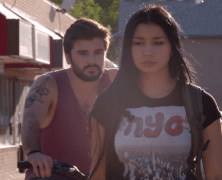 Marie’s experience through a re-enactment narrated using Marie’s own words.
I’m not always a fan of re-enactments in documentaries. Like most people, for example, I was captivated by 2008’s Oscar-winner Man on Wire, but could have done without the fake footage. The recreation of Marie’s walk home, however, serves 7 Minutes quite nicely. First, it spares its subject, who is already brave enough to tell her story, from having to appear onscreen. Second, it is artfully shot, edited and, though I would have rather they tone down the spooky music, does an excellent job building tension. Lastly, it gives us the chance to imagine what it must have been like for her on that very scary night.
As a film, 7 Minutes turns out not to be long enough; Hubbard is very effective at covering the night in question in great and harrowing detail. Marie’s summary in the film’s final minutes about her experience with the police and her conclusions about violence towards First Nations women feel rushed. As a result the film feels like a short segment of an important and thought-provoking feature-length documentary.
Mannahatta
Films like Mannahatta are always tough to watch as a white male. They serve as a reminder that what’s mine has come at someone else’s expense. Manhattan is the classic example of that, a chunk of land “bought” for nothing where the tiniest square of land is now worth millions of dollars, from high-end department stores to small neighbourhood pizzerias.
 Mannahatta focuses on one of those Manhattan pizzerias. The film maintains a tight focus in order to convey its message, and that is a wise choice. Mannahatta is a small story of a new employee at the pizzeria who is haunted by a man that no one else sees. At first he is confused and annoyed by this ghost but eventually he listens to and understands him. It’s a cooperative awakening and we see that a joint effort is required to truly bury the horrors of the past.
The biggest problems are best dealt with by breaking them down into smaller, manageable bits. Mannahatta takes that approach and it succeeds in its endeavour. It is thought-provoking without being preachy, and its message is both obvious and worthy of repetition. We are all in this together, and while we cannot change the past, we can move forward together if we are guided by compassion and empathy. One step at a time.
Check out Cinema Axis for more coverage from the ImagineNative film festival.

 And her daughter Chloe too, as it turns out (Kristin Scott Thomas). His father purchased the apartment some 40 years ago, but bought it en viager, which means he got a pretty good deal on the price, but he had to agree that not only could the current owner keep living in it until she died, he’d have to pay her for the privilege. So for 40 years the father has been paying this old lady to keep living in a home that he technically owns, and now Mathias has inherited a property he can’t sell, and which is actually a debt, with a monthly reverse-rent that must be paid or he forfeits ownership altogether.
 Equity is a cold, unblinking look at Wall Street’s backrooms, through the eyes of a female dealmaker who’s trying to recover from a failed transaction. Her client’s shares traded too low during the initial public offering, and now she’s got a target on her back. Equity throws us into the immediate aftermath and we watch her as she tries to save her career by putting together a bigger, better deal.
 If you have at least a passing interest in finance, Equity’s story will draw you in and keep your attention until the end, avoiding most cliches throughout, at least when it comes to the main females. The male supportung characters fare less well, as they are all thinly sketched stereotypes (e.g., sexist boss, backstabbing boyfriend, and frat boy internet sensation). It is refreshing, though, for women to be the most compelling and realistic characters for a change.

 (John Ortiz), an ex lover, is married with a kid, though his relationship isn’t rock solid. He’s excited to have Anna around again, but you wonder if it’s real friendship he’s after, or the attention she can bring to his flagging career. A play wright, he’s got one ace in the whole: a new script he’s developed that revolves around a character that very closely (and unflatteringly) resembles Anna. Kate (Cara Seymour) is more reluctant to see her old friend. Is it because of the betrayal, or something else?
 girlfriend on Sons of Anarchy), which registers a double impact for every blow the film lands. Literally seen swimming amid a sea of scripts containing empty female parts, Siff is every female actress of a certain age searching for meaningful work. Anna’s opposite, Nadia (Dagmara Dominczyk), has given up her own work to be the rock of her family; her husband, Oscar, depends on her to be the stable one at home. But Nadia doesn’t want to be the rock anymore – “the rock is boring” she says, a line many of you will want to high-five because women are more than just someone else’s support (note to Jax!).
 meandering but not as aimless as it first seems. Adan has a lot of room for self-actualization and self-improvement, but Syeed doesn’t insult us with a quick fix. Instead, the dog is a catalyst for Adan’s adopting a gentler perspective to the unknown. The result is a realistic testament to the immigrant experience. Both Adan and the stray dog are unwanted but the film resists a too on-the-nose metaphor. Instead it chooses to see possibility and understanding, which is a beautiful thing to see in theatres, especially at this particular time when the question of refugees is so urgent, and some people’s response so full of hate and ignorance.
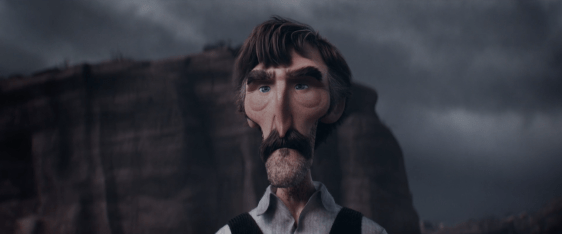 A tired old Sheriff is flooded with disturbing memories at the site of an old accident. Can he bear it? Can you?
 Liam Neeson is a writer doing writerly things in Paris, estranged from his wife (Kim Basinger) after a family tragedy, and making up for lost time with his damaged young mistress (Olivia Wilde).
 weird triangle with an awkward “third person”? Or something a little more…literary? I found this flick on Netflix and wondered how such a monstrously recognizable cast had flown under the radar.
 ask your partner “Okay, what?” Haggis’s gimmick overwhelms the movie, and the cracking chemistry between stars just isn’t enough to make up for it.
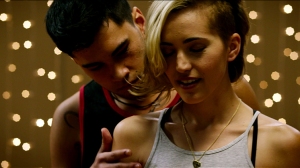 To Dance. The premise of Born To Dance is an overfamiliar coming of age tale. Tu is a young man born to dance. His disapproving father forbids it. Tu is perhaps a couple of years older than we’re used to in this role because instead of being threatened with military school, he’s threatened with the military, full stop. If Tu doesn’t get his act together during the summer post-high school graduation, the army awaits him. It occurs to me as I write this that Born To Dance might be
  off, director Davis gives the performers time and space to really show off their talent. This is a dance movie after all, and the moves are there to prove it. Choreographed by the legendary Parris Goebel, Born To Dance is the real deal. The movie’s smaller budget means there aren’t a lot of wires or camera tricks at play, just real dancers doing their thing. P-Money provides a stellar soundtrack with tracks that embody kiwi culture.
 ASSHOLES WATCHING MOVIES