Rosewater

The Daily Show’s Jon Stewart makes his directorial debut in this drama based on the memoir by Maziar Bahari, an Iranian-Canadian journalist who, after a Daily Show appearance that was misinterpreted (perhaps intentionally) by the Iranian authorities, was imprisoned for four months on suspicion of being an American spy.

This is not at all the kind of film I would have expected from first-time director Stewart and, as an admirer of his show, I am proud of him for making it. Unfortunately, the road to a bad movie is all too often paved with good intentions and it really is too bad that Rosewater isn’t very good.

Bahari, played by Gael Garcia Bernal, is locked up, beaten, and tormented but even when depicting such obvious injustice, Rosewater rarely inspires much outrage or any emotional reaction at all. Not that it doesn’t have its moments. Bernal actually plays the part quite well. In an early scene, Bahari, at first reluctant to rock the boat too much when in Tehran to cover the 2009 elections, reaches a turning point when he makes a decision to continue filming as authorities open fire on a group of angry protesters. For a second, you can see that his instinct is to make a run for it but, with a look on his face that says “okay, I’m a part of this now” and raise his camera to continue to bear witness. It’s a nice moment and there are others like it, where Bahari continues to make decisions to speak the truth that could put him at risk, even though we can tell that he’s scared.

But way too often, the flow is disrupted and the impact is lessened by amateurish flashbacks and scenes of Bahari alone in his cell having imaginary conversations with his father. Worse though are Stewart’s frequent attempts to lighten the mood with some humour, which suggest a lack of confidence as a first-time filmmaker. These scenes feel more like the jokes I make on a first date that I’m afraid is not going well at all than the political satire I would have expected from the host of The Daily Show. Stewart’s heart seems to be in the right place and he clearly has a lot to say so, with a little more confidence and experience, who knows what he can accomplish as a filmmaker?

Force Majeure

Force Majeure is a fascinating movie and a great conversation starter.  Basic spoilers will follow but I’ll try to rein myself in as much as possible.

I saw Force Majeure with Jay and Matt yesterday.  We talked about it for at least an hour afterward, discussing what we would have done and how we would have reacted (as one of the leads and as their dinner guests), what Tomas could have done differently (once he abandons his family in a moment of panic), and what might have happened after the movie cuts to the credits.  Any movie that is this thought-provoking is a worthy watch.  Force Majeure definitely excels at drawing the conversation out.

This film also takes great pleasure in making us extremely, extremely uncomfortable.  After their disastrous outdoor lunch where disaster (almost) strikes, our interactions with Tomas and his family consist almost entirely of awkward silences, anguished wailing, and/or passive aggressive attacks on each other at group dinners.  All these interactions are extremely hard to watch because their relationship has gone so bad so quick (though I liked the inclusion of some hints that it might not have been that good in the first place).

I am told this is Sweden’s candidate for the Academy Awards’ best foreign language film.  It’s very worthy of consideration for that award.  It makes you think, it makes you feel, and it makes you want to talk about everything you’ve gone through.  The inclusion of some scenes was a puzzle to figure out as I was watching, though in discussing many of them with Jay and Matt afterward I was able to understand their relevance more, as each scene tries to show us something about our characters’ feelings or mindsets.  That puzzle element, in hindsight, is a neat aspect of the movie, providing insight into these characters’ fragile states and letting us experience for ourselves the devastating consequences of Tomas’ split-second decision.  This is not an easy movie to watch but it is one to seek out and experience for yourself.  And once you do, come back and let us know what you thought!


Interested in hearing what another asshole thought? Read Jay’s review here and Matt’s over here. Which asshole got it right?

Force Majeure

Sweden’s official submission for best foreign language film at this year’s Oscars is a real doozie.

A big thanks to Ottawa’s Bytowne Cinemas for bringing it here. This film is not an easy one to catch, but worth every effort.

A beautiful blonde family is on a ritzy, picturesque ski vacation in the French Alps. The workaholic father Tomas (Johannes Bah Kuhnke) is taking some much-needed “family time” – that is, until the second day, when an avalanche threatens the family and he saves his own hide, leaving his wife and kids for dead. Luckily, the avalanche was controlled and everyone’s fine – well, everyone’s uninjured. Physically uninjured. But everyone’s hurt.

This film is a fascinating look at what happens to this family now that it’s been confronted with an awful truth. What are these primal instincts? Can we blame them for our actions? Can we count on them? Who can we count on?

After the movie, a small group of Assholes met up at Maxwell’s Bistro on Elgin to debrief, and boy did we need it. The director, Ruben Östlund, is a master at manipulating tension. The fallout unfolds slowly. He uses blank spaces to let the tension mount. It sometimes feels pressurized, unbearable. But every uncomfortable scene is worthy of comment. Together they piece together a larger portrait of a relationship that is being redefined quickly.

What happens when your spouse lets you down so profoundly? What happens when you let yourself down, when you fail to live up to your own values? Can a relationship really be measured by a split-second decision?force

The film holds a mirror up to our own relationships, and we ask ourselves what we would have done. And if we’re asking honestly (because of course in our guts we all hope we’d do the right thing) we have to wonder: at our most base self, our most primal self, are we heroes, or are we survivalists?

There are flaws to this movie. The children, though clearly shaken and probably scarred, are hardly dealt with. They intuit that something is wrong with the family unit, and they want to comfort and protect their father from whatever he’s going through. But their own confusion and anger is never given a voice. Focus remains on the couple, and we are constantly reminded of just how intimate our eavesdropping is, although the wife, Ebba, ( Lisa Loven Kongsli) seems to find it easier to voice her disbelief and criticism in public rather than in private.

It’s awkward. Oh man is it awkward. Imagine being at this dinner party. Your friend of many years, it turns out, is a huge coward who saved himself and abandoned his children for dead. You feel sorry for him. Do you comfort him? Comfort her? Make excuses for him? Identify with him? Question your own motives?

This movie is unafraid. It’s not pretty, but we aren’t allowed to look away. It’s not enough just to break the marriage open, now we have to go inside and poke around. It’s terribly invasive. It’s provoking. It’s exactly the kind of movie I adore – one that makes me question everything.

Because whether we collectively condemn or forgive Tomas, our judgments are based on what, exactly? Gender stereotypes? Expectations of filial duty? Idealization of romantic love? Physical bravery? Basic instincts?

This movie is a much better look, psychologically, into the makeup of a marriage than Gone Girl. The characters are more relatable. But that’s also why it’s so much more difficult to sit through. It’s not just a movie. It’s a mirror.


(I hope many of you get the chance to go see it, and I hope you all come back here to chat about it in the comments. If you haven’t seen it, beware – comments may contain spoilers.)

Killer Joe

I’m so shell-shocked from this movie I’m having trouble writing about it.

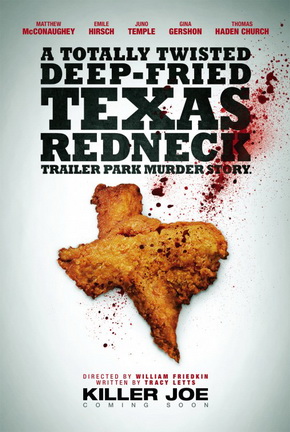
When Chris, a not so great guy from a not so great family ( Emile Hirsch) has a stash of drugs stolen from him by his mom, he has to come up with cash quick, or he’s dead. He and his father, Ansel (Thomas Hayden Church) hatch a plan to kill the mom and collect on her life insurance policy. texasAnd Chris knows just the guy to do the job – Killer Joe, a Dallas detective who happens to be a hit-man on the side.  Too bad they can’t afford to pay his retainer…until Joe spots Chris’s sweet little sister Dottie (Juno Temple) and decides that sexual collateral will do just the trick.

This film is trash. Trash trash, not trailer trash. Don’t be fooled by the actual trailer park. These people aren’t just hicks, they’re actual filthy, morally bankrupt people. This fact is established very very quickly – it’s immediately vulgar, over-the-top vulgar, and that’s before the beaver gets flashed in your face. Chris’s stepmom (Gina Gershon) has no boundaries and apparently no pants. Letts, the playwright, is adept with fucked up families (think August: Osage County) but this one takes the cake.

So I was repulsed by this movie, and this from the girl who didn’t blink once while watching Sin City a few weeks ago. My revulsion was knee-jerk and I went straight for the “bad movie” label – bad, bad movie. But I didn’t turn it off. And as I watched more, I realized that the badness is on purpose. It’s the point. You’re not supposed to like these people. This film is showing us a very dirty, seedy class of people. The badness is actually pretty expertly done, which doesn’t mean it’s easy to watch.

Enter Matthew McConaughey, a southern gentleman and a breath of fresh air. His demeanor is calm, his drawl is polite. He injects the movie with a much-need hit of stillness that lets us catch our breath after all the frenetic coarseness. The audience wants to eat him up which is a very effective device because it turns out he’s just as morally reprehensible and probably the most soulless character yet. He just has a more polished facade.

There’s so much tension in this movie that occasionally a giggle will bubble up, guiltily, without relieving even an ounce of the tension. This movie will make your jaw ache. It’s brutal. It’s sadistic. There so much fetishistic sexual cruelty that you won’t know where to look. If you’re comfortable exploring dark, nasty, demented sides of people without every really scratching the surface, then by all means, you won’t do better than this movie. I sort of hesitate to call it exploitation cinema, but isn’t that what it means? To be a voyeur in this condemnable underworld and enjoy watching the bloody violence and perversion vicariously? But Killer Joe has the capacity to really catch people off guard, and not in a good way. (You won’t ever eat fried chicken again.) It’s provocative but doesn’t really attempt to teach us anything. The characters are not remotely redeemable, but neither is the movie. Galling, outrageous, and ultimately superficial. And as polarizing as the movie is, just wait til you get to the end.


(And if by chance you’ve landed on this site just needing to talk about what you’ve seen, then please take the chance to do so in the comments. Assholes Watching Movies is providing a public service: vent, ask questions. Others be forewarned that there may be spoilers.)

The Christmas Consultant

This year, Sean and I are getting on a plane pointed south for Christmas. We are fleeing snow and obligation and we’ll be sipping daiquiris instead of eggnog on a sandy, sunny beach.

This doesn’t really let us off the hook, though. Unwilling to forgo seeing our precious niece and nephew’s gleeful faces on Christmas morning, we’re hosting a pre-Christmas at our place before we leave. Sean’s birthday is in December, which means we’ll only have about a week between it and our little gathering to do the decorating, the baking, the shopping, the wrapping, the writing and sending of Christmas cards, cleaning the house finding the perfect tree, cleaning the house again of all the pine needles we’ve dragged in, the event planning. The event planning. Parties at our house aren’t some relaxed affair. They involve more courses than people, games with prizes, presents galore, and confetti cannons at the least. Luckily our jobs go on hiatus for the month of December. Ha. In fact, lots of jobs, including mine, go haywire for the holidays. And work brings its own obligations: office Christmas parties, and white elephant gift exchanges, and avoiding Linda’s fruit cake. So who among us couldn’t use the services of a Christmas consultant?

That’s what workaholic Maya (Caroline Rhea) figures when her new job is incredibly demanding, a dozen rogue relatives are on their way, and a big party has been promised in order to impress an important client. So she hires Christmas consultant Owen (David Hasselhoff) who oozes Christmas out his pores. He probably leaks Christmas carols out his butt. He grows tinsel out of his head. He’d really like to remove the reindeer antlers up Maya’s butt, but listen: she’s a working, harried mom trying to do it all and in swoops an obnoxious overgrown elf trying to mansplain her family’s Christmas to her. He’s getting lots of credit while also creating lots of havoc. Not to mention resentment, though come to think of it, resentment is kind of like a holiday staple. So maybe you should invite David Hasselhoff over for dinner this year. He can’t be much worse than your aunt Theresa.

The Goodbye Girl

In 1977. A 30 year-old Richard Dreyfuss became the youngest ever to win the Oscar for Best Actor, a record he held until 2003 when a slightly younger Adrien Brody dethroned him. He was awarded this honour not for Close Encounters of the Third Kind, which was released that same year and still considered a classic, but for this rom com (I hate this movie already for making me use that term) from playwright Neil Simon. Marsha Mason plays Paula who arrives home to discover that, not only has her actor boyfriend left her, but he’s also has sublet the apartment to another actor named Elliot (Dreyfuss), leaving her and her ten year-old daughter homeless. Paula and Elliot reluctantly agree to share the apartment and they clash for awhile before falling in love.

What it’s lost with age. As soon as The Goodbye Girl begins, it ffeels old. The score, dialogue, and hammy acting all seem to come from a 70s cheesy sitcom rather than a Hollywood classic. I’ve always admired Simon as a writer and, when I don’t feel like cooking, I can sometimes be found in my local Indian restaurant reading one of his plays while I eat- often laughing out loud. But his lines are too often fumbled by the actors here and it’ll only be when playing some of them over in my head moments later that I realize that it was actually a great line.

What still holds up. Honestly, not much. Things pick up a llittle when Elliot shows up and, whether or not the performance is Oscar-worthy, Dreyfuss has a lot of fun with the dialogue and is almost always interesting to watch. Even he, though, is sometimes a little over-the-top for my taste. The funniest lines and the funniest moments are all his though. Watching him attempt to reluctantly play Richard III as flamboyantly gay is probably the highlight.

Bottom line. I hate to pick on a movie that is so old and inoffensive but I can’t see The Goodbye Girl having much to offer a modern audience. I don’t disagree with the Academy for giving Dreyfuss the Oscar that year, I just wish it was for Close Encounters.

The Raid 2

To sum up my review of The Raid: Redemption, I loved pretty much every minute of it. Even after seeing it, I had no idea that it would even be released in North American theatres, let alone become so successful that they would make The Raid 2.

The sequel is, in many ways, a very different movie from the first. Having finally fought it’s way out, the series is no longer limited to the confines of a broken down high rise and we get to follow Rama through the streets of Jakarta as he continues his mission to take down the local underworld. Rama is now deep undercover and in completely over his head. While The Raid used the simplicity of its claustrophobic story to its advantage, The Raid 2 tries to be an epic crime story as Rama gets caught in the middle of turf wars and double crosses from within the crime family he’s investigating. Director Gareth Evans has a lot more characters to juggle this time around.

With all of Jakarta at its mercy this time, The Raid 2 is predictably even more outrageous this time around. If there aren’t enough hammer-wielding hot deaf female assassins for you in the movies you’ve been watching, you’re in luck! And- bonus!- her interpreter is a baseball bat-wielding hitman!

Evans has not lost his touch directing the fights and he proves just as capable with car chases and uses more elaborate set pieces that would not have been an option before, given the limitations of the first film’s settings. You can make a strong argument that this is the better of the two movies. It’s more ambitious, more violent (which is saying a lot), and left me feeling even more exhilaratied by the end. More conservative fans may find some of the final fights about a minute too long (unlike in The Raid, which was careful not to overstated it’s welcome) but you won’t hear me complaining. Movies that are as well-made as this are almost never this much fun.

The Raid: Redemption

It was September 2011 and it was my first time at the Toronto International Film Festival.  I decided to take a chance on an Indonesian martial arts film that was then just called The Raid. It wasn’t like any of the other premiers that I had been to. It started at midnight with an energy that felt like  we were waiting for a concert – not a movie-  to start. When the film’s stars took the stage to introduce it, many audience members were more eager to see them fight than speak, with some calling for them to “kick him in the head”.

The plot of The Raid: Redemption, as it’s known now, is as simple as it gets. A Jakarta Swat team raids a high rise crack house where an untouchable drug dealer is hiding out. Things- who would have guessed-  go horribly wrong and the building’s residents kill all but a few cops, including a rookie named Rama, who will need to fight their way out with machete, axes, feet, fists, and elbows. (Everyone seems to run out of bullets quickly in this movie).

It’s not much but it’s all the story we need. The movie spends almost all its time dedicated to some of the best fight choreography I’ve seen in a long time. More importantly, director Gareth Evans knows how to shoot it. I’ve seen way too many action movies from disorganized directors who don’t known where to put the camera or editors who cut away too quickly to the point where it’s hard to tell who’s roundhousing who. Not here. Evans knows exactly what’s going on in every fight and wants us to too. It pays off. The bloodthirsty crowd at the world premiere cheered for every broken bone, every face smashed into a wall, and every throat that’s slit.

Many will be turned off by the violence. But for those with a bad case of bloodlust, first- if you get the chance to catch a Midnight Madness screening at Tiff, take it. Second, see this movie. The adrenaline will stay with you all day.

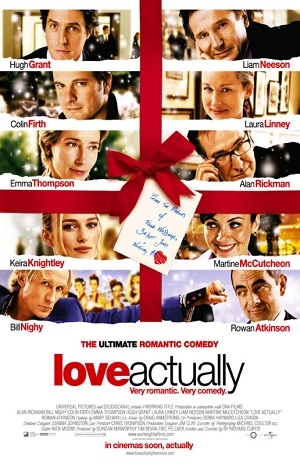
Love Actually

I’ve actually started packing away my copy of Love Actually with my Christmas decorations every year, which limits my viewing of it to just once, annually. This is a necessary precaution because it’s way too easy for me to get swept away in this movie.Love_Actually_movie

It feels like the ultimate romantic movie, possibly because in this movie Hugh Grant AND Colin Firth both get the girl. But for every frenzied makeout session, there’s also a cold, awkward peck on the cheek. Your heart breaks as much as it soars. There’s grand gestures, and well thought-out lingerie, slow dancing cheek to cheek, and enough first kisses to charm even the more cynical hearts.

But for me, this movie excels not in its romantic tropes, but in the darker corners. You don’t need this movie to tell you that Emma Thompson is superb, but it does confirm it. The scene when she’s in the bedroom, having just unwrapped Joni Mitchell instead of jewelry, is moving and real. Only a few moments (and even fewer tears) are devoted to her broken heart and we watch her pull herself back together to give her children a smiling, overbright Christmas. Only an extended hug for brother David belies just how much she’s hurting. This movie happens to take place in the weeks leading up to Christmas, and while the magic of the season seems to heighten the romantic aspects, and give courage to those who need it, it also highlights the loneliness, the forced joviality, the false cheer.

There’s probably some sort of personality test about which couple your root for in this movie, but I must confess, I also adore the non-romantic-couple bits: the sweet and silly bromance between Billy Mack (Bill Nighy) and his fat manager, the sacrifice of Sarah (Laura Linney) for her institutionalized brother, the shared grief and renewed bond between Daniel (Liam Neeson) and his young stepson.

I’ve been watching this movie for a decade and I still squeal at all my favourite parts: the papier-mache lobster head, the Rowan Atkinson gift wrapping, the Beatles sendoff, Hugh Grant dancing unselfconsciously, the falling in love by subtitles between Jamie and Aurelia, Martin Freeman warming up his hands for “the nipples,” Rick Grimes taking a break from zombies. This movie has it all, and I’ve certainly heard it criticized for being over-stuffed, but personally I wouldn’t know which subplot to cut. Sure it’s self-indulgent, but watching this movie every year is a gift I give myself.


The assholes will be reviewing their favourite holiday movies all December long, so stay tuned!

The One I Love

loveOn the brink of separation, Ethan (Mark Duplass) and Sophie (Elisabeth Moss) are referred by their therapist to an idyllic vacation house for a weekend getaway in an attempt to reconnect and save their marriage. What begins as playful and romantic soon becomes surreal. 

And at first this weird, creepy little twist is interesting. What does it mean? What are the rules? How does this affect the relationship? But since the movie lacks the balls to actually answer or even address any of these questions, you might just find yourself losing steam because the encounter is monotonous by its very nature.

I didn’t really know what I was getting myself into with this movie. I saw Mark Duplass and hit play (LOVE him in the The League!). Elisabeth Moss? Bonus. Ted Danson? Weird, but okay. I’ll buy it. Duplass and Moss give great performances, luckily, and the little relationship microcosm can be explored almost without limit – but to what end? I love the questions the movies seems to ask of us – Can happiness be sustained long-term? Do we marry a perfect but ultimately false partner and then feel let down when reality is revealed over due course? – but though this movie has potential and great bones, those bones lack meat. I wanted something I could sink my teeth into and ended up unsatisfied.