Tag Archives: Bill Murray

St. Vincent

Nominated both for Best picture and best actor (musical or comedy in both cases) at this year’s Golden Globes, St. Vincent stars Bill Murray as a lonely old alcoholic who just wants to be left alone until, needing the money, he takes a job as a 10 year-old kid’s babysitter. During their time together, Bill introduces him to a lady of the night, teaches him how to fight and gamble, and takes him to a bar. The two also develop an unexpected (at least to each other) bond while we ponder the true meaning of sainthood.

There’s almost nothing in the script or the direction that deserve the charm or emotional payoff of the finished product. The credit really has to go to the actors. The kid, played by Jaeden Lieberher, is too smart and grown up. The kind you only see in movies. But played by Lieberher, we can almost believe it. I don’t know where they found this kid but the way he plays Oliver as a kid learning to be more comfortable in his own skin is believable even if the lines he has to read aren’t. His troubles fitting in at his new school should be a chore we have to sit through while we wait for more misbehaviour with Murray but, because Chris O’Dowd is so likable as his teacher, they are some of my favourites in the whole movie. Melissa McCarthy as Oliver’s mom plays it refreshingly straight.

But none of this would be nearly enough if not for Bill Murray. At this point in his career, Murray can play sad and aging with about as much effort as it takes Morgan Freeman to play old and wise or Johnny Depp to play Jack Sparrow but in the last half of the movie, he even shows aspects of his talent that we haven’t really got to see yet. It’s a performance that makes his Best Actor nomination a no-brainer, even if the Best Picture nomination is bizarre. I blame Murray for the lump in my throat I had at the end, with emotions that this script just didn’t earn.

See Jay’s review of St. Vincent.
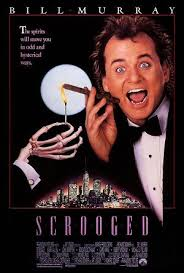
Scrooged

If you’ve seen Scrooged then you might know, and if you’ve never seen it you still may have billguessed, it’s not a great movie. It’s not bad, but there are better Christmas movies out there. In fact, there are better Dickens-inspired Christmas movies out there. But do you know what this movie has and others do not? Bill Fucking Murray.

The man’s a legend, so any movie he deigns to appear in has immediate cool factor. And in Scrooged, you get 4 Murrays for the price of 1: three of his brothers appear in this movie with him, one playing his brother, and another playing his dad! (The third plays “party guest” – you can’t win em all).

Murray plays the would-be-Jacob-Marley character, and there’s no one better suited to play such a depraved, misanthropic, crotchety role. That’s him at his best. So why then did director Richard Donner muddy it up with gimmicks, forced laughs, and production values that nobody asked for? It feels like Donner didn’t trust his leading man, but this movie would have been a heck of a lot funnier if Murray had been allowed off his leash.


In the holiday mood? Feeling Christmassy? Read Jay’s review of Love Actually here, and be sure to cast your vote for all-time favourite Christmas movie. Expect more Christmas reviews in the days and weeks to come.

The Grand Budapest Hotel

Full disclosure: I am Wes Anderson’s twin sister, and thus, incapable of impartial movie reviews.

Fuller disclosure: That was a bold lie. I’m just an uber-fan, but upon reflection I don’t want to accuse myself of impartiality. Yes, I love his movies fervently, I wish to live in them, but my esteem is earned. Wes Anderson never takes a night off. He earns it every time.

I was going to watch something new, and maybe I was going to like it, but this little delicacy presented itself as an alternative, and therefore it was the only alternative.

budapestWes Anderson introduces us to Gustave H, a legendary and well-perfumed concierge at the famous Grand Budapest Hotel, and Zero Moustafa, the humble lobby boy who becomes his most trusted friend. The story involves the theft (and recovery) of an invaluable painting and the battle over a will and a vast family fortune.

Immediately Anderson’s aesthetic draws you into this world, the colour palette is sumptuous and alive, and it’s like stepping into someone’s well-appointed dream. As always, the details are meticulously executed: the hotel’s shabbiness, the gritty grout, the choice of fonts, the embroidery, the mustaches, both real and drawn-on, the crest worn by Edward Norton and his army men of a little fox head greatly resembling a certain Fantastic Mr. Fox.

The movie is shot with three different aspect rations to help the audience differentiate between the time periods. The adventure is rapid-fire and the dialogue is virtually spat out.  In fact, the rapid gunfire of dialogue is a problem when viewing the movie in a theatre: the laughs are so close together it’s sometimes hard to hear whatever comes next.

The characteres are vividly drawn and always so much fun to get to know – in this case, Ralph Main Quad_AW_[26611] Grand BudapestFiennes plays a character playing a character who makes pretension feel absolutely charming. Tilda Swinton makes a grand dame indeed in her voluminous old age spots, old lady lipstick, and ridiculously piled hair. There are actually so many stars jam-packed into this movie that I’ll never be able to name-check them all. The enjoyable thing is that these cameos rarely (if ever) feel forced, instead it’s intoxicating and energizing.

It’s a caper-y type film and the plot covers a lot more ground than most of Wes Anderson’s films. But the crime is nestled within a sumptuous frame work and the whole film eats like one of Mendl’s delicious little cakes that are turned our so perfectly that Saoirise Ronan, who plays Agatha, said that making those little pastries convincingly was by far the hardest stunt she’s performed in any movie.

I’d like to say that this is possibly Wes Anderson’s best movie to date, but I feel that such an assertion would be a betray of sorts, like choosing my favourite among my dogs (which reminds me – great little Anderson in-joke moment: after killing a dog in nearly every other movie, Anderson finally sticks it to a cat in a manner so abrupt and cruel it can’t help but get a big, suprised laugh). It’s hard to find a movie that’s this entertaining, this varied and layered, and even if you watch it as a George Clooney edition of Where’s Waldo, you can’t go wrong.


Stay tuned for more Wes Anderson reviews – I won’t be able to resist.

Lost In Translation

Two Americans in Tokyo. Charlotte (Scarlett Johansson) is there for work – her husband’s work. Neglected, she spends er time gazing down upon the city from the cloisters of her hotel room. Elsewhere in said hotel, Bob (Bill Murray) is suffering the indignity of doing foreign commercials ow that his movie work has dried up. It’s a nice pay day but a blow to his ego. His wife nags him long-distance, via middle of the night faxes.

When Charlotte and Bob meet, they are immediate kindred spirits. Lonely and 0-JQ8-nKevwyF6_c5L.pngAmerican, they form a bond that mimics intimacy. In their glowy little bubble, they experience the quirks and sights of Japan; its foreign-ness feels less daunting and more adventurous when they’re together. When they’re apart, it emphasizes their aloneness. But they always revert to the comfort and familiarity of their luxurious but non-descript hotel. In he hotel, they could be anywhere. They develop such a strong sense of we vs. them that even other Americans seem wrong to them, are laughable. Of course, their friendship is a little dangerous: it won’t be good for either of their marriages.

Bill Murray is good – Oscar-nominated good. His improvisations are so good you can literally see extras cracking up in some scenes. Scarlett Johansson was only 17 when this was filmed, so she’s more of a blank slate, having not yet picked up a lot of the acting crutches and mannerisms upon which she’s come to rely. Actually, in 2018, Lost in Translation is 15 years old, which is almost as old as she was when she made it. That’s something to think about, isn’t it?

Writer-director Sofia Coppola probably made her biggest splash with this film. It pulses with life because she threw so much of herself, her own insecurities and worries, into it. Both of these characters travel to an alien land to truly realize how isolated they’ve become. They are disconnected from their spouses, and communication back home is sporadic and brief. There’s a longing for connection that’s an evident, live thread woven into the tapestry of this film. So many small details add up as proof of their passionate friendship, which is far more effective in this context than a sexual relationship would have been.

The film’s sparsity of dialogue speaks volumes to language not being the greatest barrier between people. Communication happens on all levels, and Coppola signals this in her final scene, with that elusive yet beautiful ending in which Murray whispers something unintelligible to Johansson, and they share a tender kiss. What did he say to her?  We may never know the words, but ew unddertand the meaning.