
The Circle is THE company you want to be working for. It’s a blatant stand-in for Google; the ‘The Circle’ campus and work space looks identical, comes with all the crazy perks we’ve been jealously-not-quite-believingly hearing about for years: sushi bars, yoga workshops, nap pods, etc, etc. Mae (Emma Watson) is ecstatic when she’s hired for an entry level position – the salary is generous, room and board are included, the health plan is fabulous – it’s more than any millennial has the right to expect these days. The only thing The Circle asks for in return is a complete lack of privacy.
And in fact, The Circle doesn’t just ask that of employees, but of everyone joining their network. The Circle is a platform that would link all of your online accounts. You’d have one account, one username (your own, your real one), one password that links to everything, all your aps, your bank, your email, your work, social media, etc, etc. The  dream come true starts to feel a little…invasive to Mae. There’s no turning off, no going off-grid. Everyone participates in everything all the time! Horray! So the dream is turning out to be a bit much, but with her father (Bill Paxton) suffering from MS, it’s extremely hard to turn down.
Most of her The Circle colleagues are drinking the kool-aid but she finds a kindred spirit in skeptical Ty (John Boyega). He’s worried about how every single piece of our lives are being accessed and stored, analyzed and monetized, by The Circle: personal data is being mined to make a few people very, very rich. And if you have any presence on the internet at all, there’s nothing you can do about it.
The Circle is a terrific book by Dave Eggers. It’s an urgently fascinating story because our reality is probably only about one and a half paces behind what’s depicted in The Circle, and that’s just what we know about. We’re creeping closer and closer every day. Unfortunately it seems that Eggers’ brilliant books are not that easily adapted into films; A Hologram for the King was also a bit of a flop and that’s too bad because there’s some really thoughtful and thought-provoking material in there that’s getting lost.
The film asks more questions than it answers. In truth, it sort of lets some of the issues it raises fall away without doing them any justice. So that’s unfortunate. I still thought the movie was compelling and watchable, and Tom Hanks is of course irreproachable. I think it’s worth your time. But the book is even more worthy of your time, and if you read it, you’ll see the changes that Hollywood makes to make a story more ‘palatable.’ But I’m pretty confident that you can handle the truth. Right?
This was Bill Paxton’s final film. He died before it was released; a dedication in the closing credits reads ‘For Bill.” Glenne Headley, who plays his wife, died in June. She’s got a couple more movies in post-production.
 nd so of course this book was immediately on my nightstand and then devoured into my brain and then shelved politely to await its fate. Little did it, or I, know that just a few years later it would be turned into a movie, prompting Sean to finally give it a read as well (don’t judge him too harshly, he’s mostly literate).
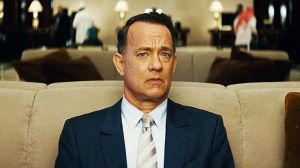 struggled to picture Hanks as Alan Clay. Alan is a loser. He’s beaten down by life, but not in Hanks’s usual sad-sack way. He was too pathetic. But Tom Hanks is not only starring, he’s producing, which means he really likes this project, and he knew what he was getting into.
 to be a fish out of water – not just the cliched culture clash crap of an American abroad, but of an aging salesman with an old bag of tricks in a newfangled world of young, tech-minded colleagues. The world is shrinking, and moving quickly, and Alan is getting left behind. Movie Alan has more verve than Book Alan, which sounds like a strange thing to complain about, but the truth is, the world already had enough of these Alans. For a movie that could have been refreshingly unHollywood, it sure made some safe choices and went for the audience-friendly ending that smacks of missed opportunity.
 ASSHOLES WATCHING MOVIES