Tag Archives: documentaries

TIFF18: Quincy

Quincy Jones is an icon, a man who needs no introduction from the likes of me. He’s worked with the best because he is the best – not just at composing music or creating trends, but at transcending them, and transcending culture itself. If you listen closely, this movie is about a man who consistently allows his talent to break down barriers. He’s accumulated a lot of “firsts” in his life (the first African American to be nominated for an Academy Award for Best Original Song – and the first African American to be nominated twice in one year as he was also named in the Best Score category; the first African American to hold the position of vice president of a white-owned record company;  the first African American to be the musical director and conductor of the Academy Awards ceremony) but as far as I’m concerned, he’s also a man with a lot of “onlies” to his name – the first, and the only, because this man is a trail-blazer of incomparable talent and drive.

With his daughter Rashida Jones co-directing the film, they skate lightly over the more scandalous periods of his life and focus on his love of family and his impressive musical career. He composed for Frank Sinatra and for Sidney Lumet. He MV5BYzZhMTY1YjQtNWRjNi00YzVkLWEwODAtNzk1MjMzNzZiMWE1XkEyXkFqcGdeQXVyNTc5OTMwOTQ@._V1_wrote movie scores and TV theme songs. He traveled the world making music, and he’s given back to the community by mentoring young musicians and passing the baton, literally, to new composers. He met Michael Jackson while working on The Wiz, and went on to produce Off The Wall, Thriller, and Bad with him. Oprah credits him for ‘discovering’ her for The Color Purple, which he scored and produced. He also composed the music to Will Smith’s Fresh Prince theme song – he was a show producer, and Will Smith auditioned for and signed a contract at Quincy’s 57th birthday party.

Between his art and philanthropy, there isn’t a corner of culture the man hasn’t marked and this documentary offers an excellent overview of his accomplishments while also providing insight to the life he lives at home. I love the many Quincy-isms up for grabs in this doc. There aren’t many topics where he doesn’t offer some bit of wisdom. But neither he nor his daughters (he’s got 6 – it’s almost biblical) believe him to be without flaws, but perhaps at the age of 85, we can afford to concentrate more on his activism and artistry, and the terrific impact he’s had on music and pop culture. You can check Quincy out right now on Netflix.
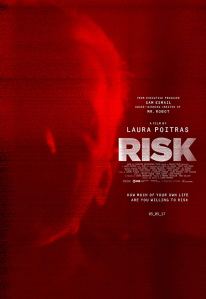
Risk

Julian Assange, as you may know, is the founder of WikiLeaks, a website that publishes secret information contributed by anonymous sources in the name of truth. Laura Poitras is the Oscar-winning director of Citizenfour, the documentary about another famous leaker, Edward Snowden. Filmed over a period of 6 years, Risk is Poitras’ documentary about Julian Assange.

Early on in the documentary, WikiLeaks is attempting to contact Hillary Clinton regarding some secret documents that are about to get leaked – not intentionally by them, but because their password got “exposed.” This is the least of their trouble. As MV5BMzIzNzYzMDM0NF5BMl5BanBnXkFtZTgwNzA1OTgwMjI@._V1_SY1000_CR0,0,687,1000_AL_you may know, they go on to publish a document dump leaked by Chelsea Manning, which earns them a criminal investigation by the American government. Shortly afterward, Sweden issues an arrest warrant for Assange over allegations of sexual assault and rape. He denies guilt but is more concerned that he’ll be extradited to the U.S. So, he breaches bail and flees to Ecuador where he’s been living at the embassy ever since
I didn’t really love Citizenfour and I think I like Risk even less. Laura Poitras has a knack for inserting herself into documentaries, and going easy on her subjects. I feel like I didn’t learn much about Julian Assange, though this documentary isn’t much more than a character portrait. He does say some crazy stuff about women that reminds us that though he’s got high and mighty principles when it comes to freedom of information, his morals to do extend to people, or their freedom to say no.

My takeaway from Risk is that if we’re looking to Assange for a saviour, we’re fucked. Dude is not a good guy. His ego and self-righteousness are astounding. Poitras comes off as being cowed in his presence, and fails to temper his own unreliable narration with any counterbalance. It’s uneven, and frustrating in that it lacks any meaningful commentary on more contemporary events. After all, WikiLeaks worked hand in hand with Russia to release the info they hacked which shaped the U.S. presidential election. And Assange has admitted that a Trump win was his preference. So while WikiLeaks pretend to be about ‘freedom of information’ it’s actually about curating that information in false and misleading and one-sided ways, for their own benefit or for others. And while Edward Snowden did what he did at least in part because he believes that every individual’s privacy is something to hold dear, WikiLeaks has destroyed personal privacy, releasing social security numbers, medical history, and credit card numbers of private citizens.

I wish this documentary had the balls to paint this dubious hero as the true villain that he is, but Poitras doesn’t quite commit. The finished work feels compromised. And as usual, I find her work to be without point of view. Risk feels like a bunch of footage, some of it revealing, some of it interesting, some of it randomly and inexplicably featuring Lady Gaga, but it never really comes together. Is there a movie in there somewhere, I wonder? But mostly I don’t care.

Kedi

My mother had a paper route when she was a little girl. For all you Millennials, that means our precious natural resource the tree was turned into pulp, and news was reported by journalists instead of Twitterers, wastefully printed onto paper that only served to smudge ink all over your peanut butter thumbs, and was delivered to your door before dawn by some sweet little kid whom you routinely stiffed and forgot to tip. My mother, in pig tails, was approaching a door when out of nowhere, a cat attacked her. Bleeding and dazed, she sobbed her way through the rest of her route and never trusted a cat again. Not once, not ever. Her fear of cats was communicated MV5BYzllZTgzMTUtMzk3OC00MWJjLWIyYjUtMmE3ZjczZGVjYmQ5XkEyXkFqcGdeQXVyNDg2MjUxNjM@._V1_SX1777_CR0,0,1777,999_AL_to all of her daughters in the womb. While I’m not petrified of them as she is, I do not trust them, I think they’re probably evil, and we’re firmly and avowedly a dog family. This is obviously the worst kind of generalization, allowing one rogue cat to colour our opinions of an entire species even though no cat has harmed me personally. Still, no cat has won me over, either, and they seem to actively or passively do the opposite of that 9 times out of 10.
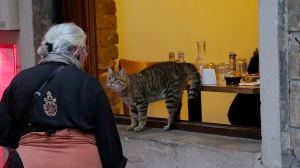
Istanbul, then, would be hell on earth for my mother, and this documentary is therefore akin to torture for the poor woman (and I’m honestly not trying to give anyone ideas).

Istanbul is overrun with cats, who are very much a part of the culture. They don’t belong to anyone, they go where they please and forage whatever food they desire. Most (human) subjects interviewed for the film confess to occasionally being quite annoyed by them, but the cats aren’t giving anyone a choice.

The cats are fickle, too. As the filmmakers follow a couple in particular, we see that they hang around several different people, each of whom believe they are special, singled out. Lots of these people have even named the cat, not knowing that the cat is slutting it up with others who have also named her. Still, it’s kind of nice to see a whole community coming together to care for cats they don’t personally own. This shared responsibility must have an effect on the people, a unifying obligation\resentment\relationship that’s starting to sound a lot like family to me. And indeed, when you hear the people describe them variously as “a vicious housewife,” “jealous,” and “my first child” it would seem that this relationship is as fraught and complicated as any extended family.

Cats have existed on this island not just for centuries but for empires. However, times are a-changing and modern city architecture may not have a place for these creatures.

This documentary didn’t quite win me over. It was filled to bursting with cats! But if you’re more open-minded than I am, this might be just the thing for you. In fact, I already know some of you are crazy cat people, so check this out and let me know what you think.

p.s. My mom’s also afraid of buttons.

Recovery Boys

So in my other life, I’m a crisis counselor. Which is different from the type of therapist you see once a week. I come in when someone is thinking urgent thoughts of or is planning or attempting suicide. Sometimes I only talk to clients once, on the worst day of their lives, in order to make sure it’s not their last. Other times they might become a regular, someone I’m in contact with very often, sometimes every day, because every day is a struggle. As you can imagine, I’ve heard and seen everything. EVERYTHING. But that doesn’t mean shit doesn’t get to me. I’ve been the recipient of every graphic disclosure you can think of about 70 billion you can’t even imagine, but something rather innocuous struck me last week: a client told me he’d recently met someone who claimed to have never had an addiction problem in their life. And my client couldn’t believe it. Had never encountered such a person before. Declared he must either be a liar or a rarity. Imagine not knowing a single sober MV5BMTk1NDY0OTE0OV5BMl5BanBnXkFtZTgwNjg0MjI0NTM@._V1_SY1000_CR0,0,1498,1000_AL_person. In my life, and probably in yours, addictions are the exception and not the rule. But for people who are in different circumstances, life is hard as fuck, and living sober can feel impossible. And that’s not even factoring in genetics. I felt so sad for this client of mine who has never known anything else.
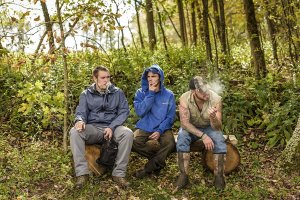
So this is my mindset, I’m either in the best place to watch this documentary, or the worst. It’s about a group of men in a farming-based residential rehab facility.

Jeff is the rehab’s first ever client, and arrives straight from jail. He’s very young but he’s got two kids in foster care, awaiting either him or their mother to get straight and reclaim them. They’re at the forefront of his mind, and visitation makes it clear that he is a loving and doting father. So the fact that he keeps fucking up proves how deeply the addiction monster’s got his claws in him.

Adam receives a loving letter from his grandmother and it unravels him because he can’t reconcile her affection with his behaviour. She works at a goodwill to stave off homelessness because of all he’s stolen from her, but still she loves him. He knows he would never be so forgiving. He’s undone.

As a staff member of the rehab facility points out, these men are facing a “menu of shitty options.” I know that addictions are a disease, one that gets almost zero sympathy, but it’s not unlike heart disease. Sure there’s a lifestyle component, but there’s also genes and compulsion. But no matter how many hamburgers you continue to eat after your first and second heart attacks, society will continue to weep for you around your hospital bed. Not so with drug relapses. Those people we revile for their “weakness” and “bad choices.” If only it were so easy.

This is not an episode of Intervention. No one’s trying to dramatize or glamourize anything, and it doesn’t get wrapped up neatly in the end. It’s clear that director Elaine McMillion Sheldon knows something about addictions, understands that your first trip to rehab is rarely your last. We don’t learn anything about addictions in this film. Instead, we live briefly in their shoes. We see the struggle. We know there is no cure, that recovery is an every day commitment, and we should be really honest with ourselves about how hard that would be for any single one of us. But some of us win the genetic lottery and some of us lose. The least we can do is show a little compassion, which this documentary engenders rather well.

Circles

Eric is a Katrina survivor who has built a new life for himself and his son Tre in Oakland, California. From his own childhood, he knows all too well the importance of fathers and father figures, particularly in the lives of young African Americans. That’s not the only reason he’s a restorative justice warrior in a really rough high school, but it just might be the reason he’s so good at it. Restorative justice tries to understand the circumstances which contribute to crime. Its emphasis is on the rehabilitation of offenders through reconciliation. In terms of Eric’s work, his bottom line is to keep kids in school, to keep them from getting expelled, and maybe circles_2even graduate. He sees a lot of himself in his students, and even though the staff and school board often feel at odds with his work, he perseveres and fights hard for them.

But during the making of this documentary, Eric’s own son is arrested for a crime he didn’t commit. So you can imagine that Eric’s ethics and beliefs (not to mention patience) are tested, and his son is about to be his toughest case. That’s what so great about documentary film – sometimes the movie you set out to make ends up morphing into something else entirely. You couldn’t really have planned this if you tried, but over the course of two years, director Cassidy Friedman has incredible access to this collision between Eric’s personal and professional lives.

Eric’s work is in impoverished neighbourhoods. His students are largely people of colour, vulnerable, with unstable family situations. He’s fighting racial discrimination, the insidious, every day kind, even if that’s not explicitly stated. He connects to the kids because the tragedies of his own life are so similar, and he’s not shy to relate them. But when things disintegrate for his son, he starts to really question himself, his efficacy as a teacher and as a father.

What Circles becomes is a sad, honest, difficult portrait of a man who is desperate to be the father his own could never be.


Behind The Curtain: Todrick Hall

Dear Todrick Hall,

I’m sorry. As a film reviewer at a festival, we have dozens and usually hundreds of choices to make, and a tight schedule to keep, and we just cannot see them all. This documentary was available to me and I didn’t make time for it because I had no idea that it would blow me away. I’d have to wait to discover that for myself on Netflix. So I’m late to the party, but I brought tequila and nachos. Peace?

You may or may not know Todrick Hall as a Broadway and Youtube star. Having found the roles for gay African-American men to be quite limited, he simply started creating his own. He re-wrote other people’s songs and created short films to accompany them, and gained huge notoriety on Youtube because of it.  But Todrick Hall is no flash in the pan; his talent is of such cosmic, galactic proportions that of course he would burst out of MV5BNDY3YmM4OTUtYjRiMy00ODMyLWI1OTEtM2ZjNmRiNzJiMjEzXkEyXkFqcGdeQXVyMTI4MjIwMjQ@._V1_SY1000_CR0,0,666,1000_AL_Youtube and make a scene wherever he landed. But one of his absolute greatest accomplishments is a musical that he wrote and produced himself. Biographical, and inspired by The Wizard of Oz, Straight Outta Oz is an all-original production that covers the yellow-brick road he followed from being gay in small-town Texas and the struggles and hurdles that led to fame and acceptance and being fabulously gay anywhere he goes, including but not limited to small-town Texas.

Hall is enormously talented and handsome enough to coast on his looks, but what makes this documentary great is that he’s transparent and genuine. Behind The Curtain means actual access. And director Katherine Fairfax-Wright’s skill is for setting her subject within real social context. This musical was being mounted in a time when young black boys were being gunned down by police, a fellow Youtube star by the name of Christina Grimmie was murdered by a “fan”, and Hall’s old stomping ground, Pulse nightclub, was terrorized, a hate crime that left 49 dead. Both Todrick Hall and this documentary operate within this very real world, but both manage to remain optimistic and inspiring.

I hope one day I’m lucky enough to sit in his audience, but until then we can content ourselves with some of the amazing Youtube content he’s created.

I’m sorry we still live in a world that couldn’t immediately recognize the glittery, amber rays emanating from this shining star, but this kind of light cannot be contained under a bushel for long. Todrick Hall is destined for success because he knows the value of friendship, which is evident by the tight crew he keeps around him and the family that he’s made of his own choosing. And because of his voice, which is strong and knowing. And because he actually has lots to say with it, and the means to write it down, coherent and catchy. And because he wants it. He wants it so bad he’s not going to sit down and wait for it, he’s going to go out there and create it, and god damn do I admire that.

Barbra Streisand, Becoming An Icon

Barbra Streisand is a woman who needs no introduction. Movie stars were not generally cut from her mold but her talent was so sweeping and undeniable that it couldn’t help but be recognized.

Barbra Streisand, Becoming An Icon doesn’t delve deep into her background or her psyche. The only words we hear from her are recycled from previous interviews. But all stacked up together, the archival footage and rich performance history will be a delight to fans and a fantastic reminder of her incredible artistry.

But talent aside, Streisand was always cut from a different cloth. She was a proud w-barbra-is-the-best-012215-1425553757feminist and “uncompromisingly Jewish”, inspiring a generation of women and showing America her own brand of stardom. Unapologetically ambitious, aggressive, and outspoken, she started a new wave of female businesswomen in Hollywood, blazing her own path and doing it with style, elegance, and dignity.
This documentary offers to critique, no shade, no bombshells. It’s just a straight-up love letter to a woman who’s been earning it for 5 decades.


Barbra Streisand, Becoming An Icon screens as part of the Toronto Jewish Film Festival. You can attend a screening May 10, 3:30pm at Cineplex Cinemas Empress Walk 9, or make it a mother’s day event on Sunday May 13, 2:30pm at Hot Docs Ted Rogers Cinema.

TJFF: Another Planet

Over 70 years later, we’re still trying to make sense of the horrors of Auschwitz. Architects, historians, game designers, and prosecutors have started using 21st century virtual reality technology to help see history in new ways but, to paraphrase the great prophet Jeff Goldblum, just because you can do something doesn’t mean that you should.

I’m not necessarily saying that you shouldn’t. I am saying that it’s unnerving to see VR Auschwitz. We begin with a tasteful black and white recreation designed by an architect and a historian for a VR museum exhibit. They mention that the museum wanted it to be in black and white so that it doesn’t look like a comic book.

Cut to an unsettling full-colour model designed to aid in the prosecution of a Nazi war criminal. The defendant claims, as many apparently do, that he didn’t actually know what was going on at the camp and that he worked as a cook. Using this fancy new technology, forensic experts can estimate what he was likely to be able to witness from his position in the kitchen. They say that they are sure to make sure that their model doesn’t fall into the wrong  hands. What if, for example, someone were to want to make a game using their replica? Wouldn’t that be in bad taste.

Cut to an actual escape from Auschwitz virtual reality game. And this is where things get really weird.

To be fair, everyone interviewed in the film, including the video game designer, has an explanation for how their work is respectful to victims of the Holocaust and none of them are unconvincing. It’s just a little jarring. And it’s fascinating to think of technological advances can change the way we look at the past. It’s a great subject for a documentary that is sure to start some lively conversations.

Slut or Nut: The Diary of a Rape Trial

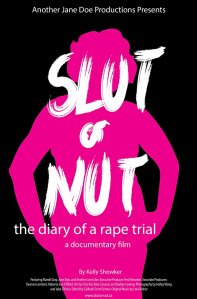
Mandi Gray was raped. She is one of the very rare few to speak up, to pursue criminal charges, to undergo a brutalizing justice system process that seems built for the benefit of perpetrators, not victims. I want to call Ms. Gray strong and courageous for doing so, but I don’t want to imply that women who do not are not. I think Ms. Gray knows better than anyone why women choose to stay silent, or are silenced, and this documentary puts us squarely in her shoes, so we can understand it too.

Only 3 of 1000 sex assaults result in conviction. Most go unreported because even in the era of #metoo, women are categorically not believed. But for the small percentage who do bring an accusation to the police, one fifth will be dismissed as MV5BNzJiY2ZmMWItOGI4My00ZGVlLTljOWMtZGZjNjZhZjBiNjUyXkEyXkFqcGdeQXVyNzQ3MjI5NzM@._V1_SY1000_CR0,0,658,1000_AL_“unfounded” which seems to be a fancy word for the police not believing her, which is hard not to take personally when ‘unfounded’ is used exponentially more often in sex assault cases than for any other crime. If you’re a woman of colour, disabled, or a sex worker, your word is all but meaningless. But if you’re one of the small sliver of people not dissuaded yet, you may find, as Gray did, that your body is now a crime scene. A rape kit is a must for conviction, yet there aren’t enough rape kit nurses to go around. You’ll have to offer yourself, body and soul, as evidence, because for some reason it’s your responsibility to help catch the rapist. But the fun doesn’t stop there: next you’ll be revictimized in court in a discouraging, dehumanizing procedure that never grants any real justice because it’s the victim who seems to be on trial.

This is the reality in which we live, and there’s no dearth of documentaries, well-made, well-researched, passionate, rally-cry, stoke-the-fire documentaries, that point out the inadequacies of this oppressive system. And yet we need another. And another. Because as often as women have said it before, it’s clearly still not sunk in. The system is broken.

Kelly Showker puts together a documentary that doesn’t just plead for social change and justice, it shows us quite plainly just how badly it’s needed. Ms. Gray could be your roommate or your sister or your friend. Stand beside her as she relives the worst night of her life, followed by the worst year. This documentary doesn’t preach, because it doesn’t need to. It shows you the callous reality of a rape trial, and watching it, there’s really only one conclusion you can draw. Seek out this documentary. Watch it, share it, talk about it. Change only happens when we unite, and a documentary such as this has the power to make advocates of us all.


This documentary screens as part of the Hot Docs film festival; this review was first published at Cinema Axis.


Cornered in Molenbeek

Few things are more ubiquitous than a group of old men chatting about life in a local barbershop.  Cornered in Molenbeek starts innocently enough as it drops us, seemingly randomly, into one of those barbershops.  Sure, the customers are speaking Arabic, but they are also speaking about things that I might talk about with my barber (sorry, stylist).

The shop closes for the day and then, in an instant, everything changes.  News breaks of a terrorist attack on Paris.  It’s November 13, 2015 and when the cornered_in_molenbeek_1dust settles, 130 people are dead and 413 more are injured in a series of coordinated attacks at a number of locations throughout the city.  The investigation quickly determines that the attackers are from Molenbeek, Brussels, the very neighbourhood where this barbershop is located.  Of course, the attack becomes the main topic of conversation here, just like it was everywhere else.

Not surprisingly, this barbershop collective has no real answers as to what made the attackers do what they did.  Because guess what?  I have no real answers either.  The lack of answers here is revealing, though, particularly as the collective’s attempt to find an explanation weaves through a wide variety of possible causes, often looking for someone or something to blame, such as government, poverty, and the attackers themselves, with one notable exception: these people do not try to place blame Muslims as a group for these attacks, because they are Muslims themselves.  Contrary to the torrent of right-wing nationalist propaganda that is so often shouted at me online by a host of faceless idiots (oh, and also by the President of the United States), this group of Muslim acquaintances in this barbershop are just as innocent, just as angry and just as confused about the attacks as the rest of the world, and maybe more so because their religious and geographical association with the attackers draws them personally into the aftermath, exposing them to significant consequences that most people don’t have to worry about.

The phenomenon of terrorism is worthy of examination, and it was a refreshing approach to do so through the familiar lens of this barbershop, which otherwise would be functionally closed to me as a uni-lingual white Canadian (Arabic and French are the only two languages being used in these conversations).  The film’s structure serves to enhance the fly-on-the-wall feeling by letting us experience the barbershop’s normal environment before the attack happens.  The stark contrast in what is being discussed before the attack as opposed to afterward clearly shows that these types of attacks affect everyone regardless of their religion or native language, and really, we all need to be involved in this discussion on terrorism in order to stop it.  Cornered in Molenbeek does its part to start the conversation, and it’s up to us to keep it going.