Tag Archives: foreign films

Kasane – Beauty & Fate

Kasane is a young, talented woman prevented from pursuing the “family business” – she, like her mother, is a fabulous actress, but she’s held back by a prominent scar on her face. But when her mother dies, she leaves Kasane a magical tube of lipstick – one that, when conveyed through a kiss, allows her to swap faces with the kiss recipient for 12 hours. So you can bet your Mac and Sephora that Kasane finds herself an attractive but middling actress named Nina and literally kisses her face off.

I had some problems with this movie, namely, the blatantly sexist stuff. Like, there’s no reason that this magic has to be transmitted via kiss except the director clearly likes to linger over whatever lesbian\girl-on-girl situations he’s orchestrated.

I think the premise has potential, but right off the bat I bet you can recognize some challenges and when the script runs into them,  it’s like running into a brick wall. I wish MV5BOTdhOGY1MmQtNzQwZC00NTBiLWI2ZjEtNTdkZjIyZTM1ZjhjXkEyXkFqcGdeQXVyNDQxNjcxNQ@@._V1_SY1000_CR0,0,707,1000_AL_some script writer would have made even a half-assed attempt at circumventing the obvious pitfalls, but no, Kasane runs into them face first, and the camera caresses her smudged lipstick. I mean, you can understand what Kasane (Kyoko Yoshine) gets out of the equation – but Nina (Tao Tsuchiya)? What can she possible stand to benefit?

And, okay, let’s address the scar – a significant one covering half her face. I won’t pretend it’s easy to be so marked, but I can’t forgive this movie for constantly reinforcing that scar = ugly. In fact, the older I get, the less I see ugliness, period. And I can’t really fathom why we’d ever need to use that word. But this girl, though clearly paranoid about her scarring, is not ugly. But if you’ll allow me for just one moment to pull back the curtain a little, let’s say for the sake of argument that she is ugly. Isn’t the lipstick a little cruel? Wouldn’t things have worked out better if it was a magical tube of cover up? A nice thick foundation with a side of pancake pressed powder? Julia Roberts has at least four tattoos that we know about, but have you ever seen them? No. Because makeup. Makeup IS magic. I have a tube of Christian Louboutin red lip stick that cost a car payment, but it’s worth it because it makes me feel like TWO car payments. But you know what? Makeup is fun because colour is necessary but changing yourself is not. Scars are just a reminder that you survived. And it feels awful to be complicit in this movie’s messaging, because scars don’t make you ugly, but being shallow and superficial does. Which is not to say it would be easy for a young woman to confront our looks-obsessed world with a scar that looks so angry and cruel, but there has to be some middle ground between total isolation and stealing someone’s face.

This movie claims to challenge our notions of beauty and superficiality but I felt it did the opposite. It’s adapted from a popular manga but I’m unfamiliar with its source material and I wonder if I would feel differently if I knew it. For me, parts of this movie felt uncomfortably fetishistic, and though I tried to take it light-heartedly, and just enjoy the twisted nature of the film, I couldn’t quite buy into it, nor did I want to.


The Vanished

When director Chang-hee Lee saw Oriol Paulo’s 2012 film, The Body, he enjoyed it, but he also saw how he would make it differently, and perhaps more importantly, how he could inject it with some Korean spice. Chang-hee Lee introduces the film to us at Fantasia Film Festival, and appears overwhelmed to have traveled all this way for his first feature film, awed at the reception, abashed at the applause. After greeting us in French (garnering immediate rock star status), he reassures us that this is not so much a horror film as a thriller, and so of course the opening scene causes me to pee just a teeny, tiny, barely perceptible bit. It was hella scary.

OF COURSE it’s scary: a night security guard goes down to the basement DURING A BLACKOUT on a rainy night BY HIMSELF armed with only a flashlight TO A MORGUE where he sees – what? a woman? a body? a ghost? We don’t know, because someone (or something) shadowy gives him a crack on the head, and when the police arrive it’s not really the security guard who grabs their attention, but the empty drawer in the morgue.

Yoon Seol Hee, newly dead, formerly a young, successful CEO, has gone missing. Well, her corpse has. Bad-boy detective Woo Joong Shik is on the case, and he’s cynical as hell and casts an accusatory eye at her “trophy husband”, Park Jin Han, although he’s more concerned with murder than mere body snatching. Of course, since Park and Yoon run MV5BOTk0ZDAzOTMtMTg3NS00Y2Y3LWI4ZDYtNjE2MGU3NTRkNTc4XkEyXkFqcGdeQXVyNzI1NzMxNzM@._V1_with an elite crowd, the higher ups are cautioning Detective Woo to back off – but he’s much too much a loose canon to respect authority, isn’t he? You know he is. Meanwhile, if Park is looking inadequately grief stricken, he’s overly concerned about his wife’s missing body. And pretty soon he’s frantically claiming that she’s responsible for her own disappearance, and is somehow still alive.
The cool thing about this movie is that it takes place over the course of just one night, which gives it a real sense of urgency. Movie detectives are often of this variety, the old “renegade cop” trope, the guy who plays by his own rules. He’s tough, a bit of a cowboy, a definite anti-hero, often with a side of alcoholism or anger (mis)management. But there’s something about seeing this Detective among his much more restrained, polite, effacing, perhaps more stereotypically Korean colleagues that’s intriguing and fresh. No one quite knows what to make of him, and he definitely shakes up the investigation.

Even if you’ve seen the original Spanish version, you’ll still get a kick out of The Vanished; the Korean setting of course makes for quite a change, but circumstances and even outcomes have been rearranged as well, for your viewing pleasure. And to be honest, it was quite a pleasure. I can’t believe this is a first feature for the director. It looks slick and cool and there are lots of visual details to admire, we get a sense of his style and aesthetic and the whole thing just glows. The cinematography is beautiful. As I mentioned, this film takes place over the course of a single night, so DP Lee Jong-youl coats it in a cold blue wash that lends just a touch of creepiness to an already creepy scenario. But in flashbacks he floods us with warm, natural lighting, which is a bit cruel actually – it gives us a false sense of comfort when really we should never let our guard down.

The thing about The Vanished is, it’s a very compelling puzzle. And even if you’re very clever and you manage to slot all the moving pieces into just the right places, you’ll find it’s one of those trick puzzles that only look complete – actually it just unlocks like 3 more puzzles to solve! The veteran cast (Kang-woo Kim, Hee-ae Kim, and Sang-Kyung Kim as the rumpled Detective) close ranks and draw us in with their institutional politeness – but something stinks in this morgue, and it’s certainly not the dead body. Because, you know, it’s missing. And maybe not even dead.

I Have A Date With Spring

South Korea is in a Renaissance of film. Powerhouse directors like Park Chan-wook,  Bong Joon-ho, and Yeon Sang-ho have produced exciting, glossy blockbusters that made the leap from Asia to Hollywood, but the truth is, some of the greatest stuff being produced in Korea are genre films, and Montreal’s Fantasia Festival is just the place to see them. We’d previously seen movies about fake pregnancy, and an animated zombie movie at the festival, to name a few, but this year we’re seeing even more, and they’re crazier than ever.

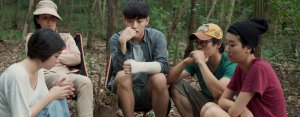
I Have A Date With Spring is about a young director, alone in the woods on his birthday, resolved to camp out until he finally completes his script. It’s been 10 years since his last 201806-IHADWS-16film, and 3 years since the script started haunting him, and he just wants to bang it out. Instead he’s visited by strangers, and finding a fan among them, he divulges what he’s got so far:
It’s the day before the end of the world. Aliens decide it’s now or never in terms of visiting the Earth, so they choose 3 sad sacks and do their best to befriend them and learn their worldviews. Each story is told in its own separate vignette.

One, a young schoolgirl, is a bullied outsider who has no place to go when school is suddenly evacuated. She unadvisedly gets in the car with an alien (who looks like a normal Korean man but doesn’t act like one – red flag!) and spends the day with him, driving deserted streets and narrowly escaping his awkward advances. She’s got a pretty bleak outlook, hates her mother and classmates, and spends her time drawing violent and creepy things.

A second is a middle-aged professor, alone in the world except for an elderly mother who calls him from half a world away. It’s a beautiful, young alien who visits him – except for the hacking cough and the unfortunate boils. Will that be enough to stop him kissing her?

The third, a harried and unappreciated housewife who goes to the market one day to find it devoid of shoppers or staff. Instead she plays a crane game with a mysterious young woman who claims to know her (hint: it’s another alien!) and she follows her back to her marijuana hothouse for some relaxing gun play.

The aliens all leave their new friends with a last gift. And that’s when things get twisted.

Writer-director Seung-bin Baek has a dark and wonderful mind. You won’t be able to guess where he’s going so just sit back and enjoy the ride. Aside from some unnecessary voice-over narration in the young director scenes that bookend the film, he strikes a resonant, deeply disturbing chord that’s interesting and fresh and unlike anything else I’m going to see at the movies this year. His characters have loneliness, isolation, and outsider status in common, so when the aliens decide to grant them their innermost wishes…well, that takes us to an unexpectedly sinister and surprisingly philosophical place. The movie is horrific in many ways, but where it most succeeds is in pointing out life’s every day horrors – things that you or I might relate to. Things that might you or I wish for Earth’s destruction also. And that, friends, is why we make our way to Fantasia Fest year after year. We do it for weird.


Buffalo Boys

You might associate Indonesian cinema with Pencak Silat, a local martial art featured heavily in fight movies like Merantau and The Raid. Mike Wiluan knows we have a thirst for violence as he’s produced the likes of Headshot and Macabre, but his first directorial effort, he eschewed martial arts for barroom brawls, embracing the old spaghetti western but giving it some Indonesian spice: a “fried rice” western, if you will.

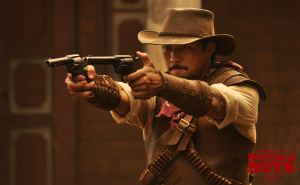
Buffalo Boys is the story of 2 brothers and their uncle, who were violently chased out of Java and exiled to America, but have returned to their homeland for revenge. The Dutch are occupying their village, forcing farmers to starve their families while growing poppies instead of rice. And those are the lucky ones: others are enslaved, tortured, and put to death, corpses left hanging on the outskirts of towns to promote obedience, MV5BODM2MDczYzItYTMyZi00Yjc1LTllMDktM2FjNTY0NTA5YTg1XkEyXkFqcGdeQXVyNTExMzQ3Ng@@._V1_SY1000_CR0,0,1614,1000_AL_severed heads displayed prominently just to rub salt in the wounds. Still the Javanese endure. But when Jamar (Ario Bayu) and Suwo (Yoshi Sudarso) reappear, they breathe a little bit of hope into air that’s been fetid with oppression for years.

Buffalo Boys is raucous and fun, with action scenes abundant, bursting with call-backs to John Ford movies of yore, but with unexpected little twists that only come with taking America out of the equation. While most cowboy movies live for the machismo true-blue American experience, this one flouts those patriotic pastiches in favour of a colonialist indictment. But while oppression breeds villains, it also cries out for heroes. In Buffalo Boys, two legends are born. And Mike Wiluan knows how to teach a history lesson while satisfying our violent urges. His camera loves finding new ways to land a punch, even as it reveals flashes of Sergio Leone, and even Tarantino.

I’m going to tell you what I loved about the movie in just a minute. First, I’m going to complain. Because the movie sets up a female character who’s a badass. She rides a bull better than any boy. And she’s deadly accurate with a bow and arrow. Sinfully refreshing from your typical damsel in distress. But then the movie fails to really use her. The role languishes, and sure the story’s a bit bloated with badassery, but this is the one I really wanted more of and was frustrated to see less. But okay, screw her. Because that last act, the glorious shoot out, it’s what we’re really all here to see. And boy gee! The fight choreography is impressive, like whoa. So Wiluan slows it down and parades it in front of us; you can practically feel the bloodspray on your face. It’s a thing of beauty, and if you’re a fan of sloppy, intense show downs, then this one is going to be straight up your alley.

To Each, Her Own

Simone and Claire are celebrating their 3rd anniversary together. Simone promises that should she blow out all the candles at once, she’ll finally come out to her family. She gives good blow, but can she keep her word?

Simone (Sarah Stern) insists that she’s ready, in fact beyond ready, to come out: the problem is her family. And when we meet them, well, it may be true. Her mom already treats her like an odd duck because she’s a non-practicing Jew. Of course, all the idiosyncrasies that Simone nitpicks about her mother are also true of her, she just can’t see it yet. Give it some time. We all turn into our mothers, ESPECIALLY the crazy ones. And it turns out there’s already a disappointment in the family; Simone’s brother is gay, and her father is very clear on the “fact” that homosexuality is a IMG_20180624_123946disease, one that he does not want brought into his home. Simone fears that a second coming-out will prompt a heart attack, but her father’s health concerns seem, frankly, a bit brought on by himself. Perhaps worst of all, her oldest brother operates a Jewish dating site, and neither he nor his mother can think of a better way to marry her off, with or without her consent.

Does all of this create problems for poor Simone? Of course it does. But, um, so does the handsome Senegalese chef (Jean-Christophe Folly) at her favourite restaurant. The way things are going, Simone may not have a Claire (Julia Piaton) to come home to for much longer. Is this movie merely masquerading as queer cinema? It feels a tad, I don’t know, homophobic at times, like it really doesn’t respect lesbians or their relationships very much at all.

What To Each, Her Own boils down to is a lot of stereotypes and a lot of ideas that don’t quite amount to much, and certainly not to a very satisfying conclusion. If this is a comedy, it isn’t an overly comedic one, but it’s certainly not super romantic either, so it kind of waffles about in the farcical gray zone, sort of toying with stepping over the line in racial, religious, and sexual spheres, so in that way it’s a real triple threat. Or a triple non-threat. A triple mistake. A triple cringe. I guess this is me not really recommending this movie at all, unless you’re that rare, self-hating gay Jew who enjoys taunting fathers into cardiac arrest.


The Ornithologist

Ornithologists: a strange bunch. Imagine being so enthralled by the mere sight of a bird that you allow your kayak to get sucked into life-endangering rapids. Obviously there are lots of branches of zoology and people get off on studying all kinds of weird and wonderful creatures. I just have a hard time imagining an entomologist (a person who studies insects) getting half as nutty and obsessive about ants as the average bird watcher is about anything.

Fernando (Paul Hamy) is an ornithologist who seems to relish the solitary aspects of quietly pursing winged friends. But one day his quest to lay eyes on a black stork MV5BNzdiOTM4MjctN2VhOS00M2FiLTg0OGUtNjgxNDMzYTRhMzNjXkEyXkFqcGdeQXVyMjAyMzAyMw@@._V1_SX1777_CR0,0,1777,999_AL_goes too far and it gets him into serious trouble. I have trouble feeling sorry for him, because if he was going to half the effort to watch an ex-girlfriend, we’d call it stalking and throw him in jail. Am I really to believe it’s any less creepy when the subject of his intensity is a bird? In my book, that makes it worse. Luckily for him, a) I’m not the bird police, and b) a couple of lady hikers rescue him when the bird poop hits the fan.

The Ornithologist sets a strange tone right away. I don’t trust it because the camera focuses on certain things and I don’t know why. It sets me on edge straight away. Before the story has even begun, this movie is talking to me. Its angles, and especially through his binoculars, give such a restricted view it makes me nervous.

Unfortunately, the slightly odd, “good Christian” Chinese hikers are lost, and they beg Fernando to stay with them as they are quite afraid of the forest. I concur, ladies. These woods are scary – though perhaps not half threatening as the people in them.

The Ornithologist is a deeply strange movie and it absolutely will not appeal to everyone. Director João Pedro Rodrigues mixes Catholic symbolism with Portuguese mythology to make a muddy, opaque picture that will allow you to discover new facets of yourself, even as Fernando does the same on screen. Personally, I developed a new mantra while watching The Ornithologist. I was at the 1h16m mark when I realized I was quietly chanting whatthefuckishappening over and over. I still don’t know the answer but I do know I have an impressive capacity for audacious meditation.

The Laws of Thermodynamics

The actual laws of thermodynamics, in case you need a refresher:

  • energy cannot be created or destroyed
  • the entropy of any isolated system always increases
  • the entropy of a system approaches a constant value as the temperature approaches absolute zero

Manel, a neurotic scientist, is out of his depth when he dates his dream girl, Elena, a MV5BNDdmOGMyNzUtY2JjMi00OGIzLThmYmItNWJlMTg3ZGU5Nzk0XkEyXkFqcGdeQXVyMTA0MjU0Ng@@._V1_beautiful model. So he seeks comfort in his precious laws of thermodynamics to reassure himself that love is just another quantifiable thing, an equation he can puzzle out and make sense of. But the more that real life seeps in, the harder he has to spin things to keep the laws working for him.

Using the rules of thermodynamics as a construct for “solving” love is interesting, at least at first. Eventually it involves more shoe-horning than any script worth its salt really should, and the effort becomes tiresome.

Vito Sanz and Berta Vazquez are perfectly charming and thanks to them, I can kind of see how a playing, witty movie like this might have worked. But whatever lightning bot of creativity struck at the outset, it faded quite quickly and it fails even at sustaining what it started with. I was unconvinced and unimpressed by this film unfortunately – maybe it works in theory, but the proof is kind of painful to watch.

TJFF: Another Planet

Over 70 years later, we’re still trying to make sense of the horrors of Auschwitz. Architects, historians, game designers, and prosecutors have started using 21st century virtual reality technology to help see history in new ways but, to paraphrase the great prophet Jeff Goldblum, just because you can do something doesn’t mean that you should.

I’m not necessarily saying that you shouldn’t. I am saying that it’s unnerving to see VR Auschwitz. We begin with a tasteful black and white recreation designed by an architect and a historian for a VR museum exhibit. They mention that the museum wanted it to be in black and white so that it doesn’t look like a comic book.

Cut to an unsettling full-colour model designed to aid in the prosecution of a Nazi war criminal. The defendant claims, as many apparently do, that he didn’t actually know what was going on at the camp and that he worked as a cook. Using this fancy new technology, forensic experts can estimate what he was likely to be able to witness from his position in the kitchen. They say that they are sure to make sure that their model doesn’t fall into the wrong  hands. What if, for example, someone were to want to make a game using their replica? Wouldn’t that be in bad taste.

Cut to an actual escape from Auschwitz virtual reality game. And this is where things get really weird.

To be fair, everyone interviewed in the film, including the video game designer, has an explanation for how their work is respectful to victims of the Holocaust and none of them are unconvincing. It’s just a little jarring. And it’s fascinating to think of technological advances can change the way we look at the past. It’s a great subject for a documentary that is sure to start some lively conversations.

Cornered in Molenbeek

Few things are more ubiquitous than a group of old men chatting about life in a local barbershop.  Cornered in Molenbeek starts innocently enough as it drops us, seemingly randomly, into one of those barbershops.  Sure, the customers are speaking Arabic, but they are also speaking about things that I might talk about with my barber (sorry, stylist).

The shop closes for the day and then, in an instant, everything changes.  News breaks of a terrorist attack on Paris.  It’s November 13, 2015 and when the cornered_in_molenbeek_1dust settles, 130 people are dead and 413 more are injured in a series of coordinated attacks at a number of locations throughout the city.  The investigation quickly determines that the attackers are from Molenbeek, Brussels, the very neighbourhood where this barbershop is located.  Of course, the attack becomes the main topic of conversation here, just like it was everywhere else.

Not surprisingly, this barbershop collective has no real answers as to what made the attackers do what they did.  Because guess what?  I have no real answers either.  The lack of answers here is revealing, though, particularly as the collective’s attempt to find an explanation weaves through a wide variety of possible causes, often looking for someone or something to blame, such as government, poverty, and the attackers themselves, with one notable exception: these people do not try to place blame Muslims as a group for these attacks, because they are Muslims themselves.  Contrary to the torrent of right-wing nationalist propaganda that is so often shouted at me online by a host of faceless idiots (oh, and also by the President of the United States), this group of Muslim acquaintances in this barbershop are just as innocent, just as angry and just as confused about the attacks as the rest of the world, and maybe more so because their religious and geographical association with the attackers draws them personally into the aftermath, exposing them to significant consequences that most people don’t have to worry about.

The phenomenon of terrorism is worthy of examination, and it was a refreshing approach to do so through the familiar lens of this barbershop, which otherwise would be functionally closed to me as a uni-lingual white Canadian (Arabic and French are the only two languages being used in these conversations).  The film’s structure serves to enhance the fly-on-the-wall feeling by letting us experience the barbershop’s normal environment before the attack happens.  The stark contrast in what is being discussed before the attack as opposed to afterward clearly shows that these types of attacks affect everyone regardless of their religion or native language, and really, we all need to be involved in this discussion on terrorism in order to stop it.  Cornered in Molenbeek does its part to start the conversation, and it’s up to us to keep it going.

I Am Not An Easy Man

Damien is a chauvinist and a womanizer. He’s developed an app to enable his douchiness, and that of others: it tracks how much sex you’ve had, and an ever-growing penis marks the progress. It will not surprise you to know that Damien is disgusting to all the women in his life – personal and profession. He’s such an irrepressibly flirty bitch that one day he walks straight into a pole, incurring a head injury that’s going to send this film straight into Freaky Friday territory.

When Damien wakes up, it’s in an alternate universe – one in which women have always been the dominant sex. Suddenly women are treating him the way he treated them – and he doesn’t like it! Not one bit. Everything is backwards – his colleagues are mostly female, and it’s not even fun because they talk openly about periods and don’t shave and are condescending, and the men have to eat quinoa and watch their figures.

At times I could hardly tell whether this film was subversive or offensive, and I suppose i-am-not-an-easy-man-2018they were toeing a very thin line. Still, it was hard for me not to be offended by some of the stereotypes, and I’m sure that men would feel the same. But it’s not until you’re fully submersed in this alternate world that you start to appreciate how ridiculous it all feels, and how the inverse, which is the world in which we live every day, must be equally ridiculous. Except we accept it because it’s what we know. It’s not just about income equality, or splitting household chores – it’s both bigger and smaller and more all-encompassing than that.

The movie is occasionally quite funny, the satire intelligent and well-aimed. But it’s not always so successful. And the truth is, neither protagonist is likeable or even sympathetic. Damien has woken up in a different world but it doesn’t change him, and he doesn’t seem to learn from it. He’s appalled to be treated like the weaker sex but has no sense of irony regarding his previous (and frankly, current) behaviour. In fact, he has the gall to reminisce about being the oppressor. Of course he does.

Je ne suis pas un homme facile is a French film streaming on Netflix right now, and besides the laughs it’s got a pretty blatant message – let it hit you like a penis slap to the face. As if you needed one.