Tag Archives: Hot Docs

Hot Docs: Living the Game

The biggest change between grade 8 and grade 9 was that once I started high school I was allowed to leave school property on lunch. And leave I did. Every weekday from noon to 1, my friends and I walked to the nearest arcade. When I had quarters, I spent them, and when I was out, I watched others feed the machines. Many different games came and went during that year, but one of the mainstays was Street Fighter 2, in one flavour or another (it seemed every three months there was another version of it, from Champion Edition to Turbo to Super to Super Turbo). There was always a crowd around the Street Fighter console, and it seems that 20 years later, the crowd has only grown.

What is the appeal of watching others play video games? It’s hard to explain. The closest I can come is this:

Evo Moment #37, as it’s called, is an iconic moment in competitive gaming. If you have ever played Street Fighter, you know how insanely hard it is to parry one hit from a super move, let alone 15 in a row.  If even one of those kicks had landed then the match would have been over.  What a remarkable display of timing and hand-eye coordination!

The two players in that match were Daigo Umehara and Justin Wong. Living the Game is a documentary that follows them and a few other top players over the course of a pro gaming season. It’s fascinating to see this unique spectacle where two headset-wearing players look at a small screen while a thousand or more boisterous spectators watch on and cheer wildly.

These top players are doing well for themselves, earning sponsorships and salaries, supplemented by cash prizes of $100,000 or more for a big tournament win. Despite their success they are remarkably aware that this gravy train will not run forever and that their chosen profession is not well-regarded. That sort of honesty should make Living the Game an interesting watch even for those who are baffled by pro video gaming, elevating it beyond its subject matter. While there is no big revelation to be found within, it is interesting to get to know the players through this film, who as it turns out are not much different than you or me, except they happen to be ridiculously good at video games.

Living the Game screens as part of the Hot Docs Film Festival on May 2 at 8:30 p.m., May 4 at 8:45 p.m. and May 7 at 6:15 p.m.

Hobbyhorse Revolution

I was excited to review this film for Hot Docs because I’d heard of and was mystified by ‘hobbyhorsing’ and needed to know more about it.

Hobbyhorsing is a lot like the horse competitions you’re used to seeing on TV, or in Olympic events.  Dressage, an equestrian sport, is the highest expression of horse training. In the events, you’ll watch horse and rider perform a sequence of events from memory, including piaffe (a special kind of trot), and pirouette (a 360 degree turn). In the obstacle event, the horses will jump over poles. Horse and rider are judged on how smoothly they go through the movements, and how willingly and with minimal cues the horse performs.

In hobbyhorsing, the competitions are similar, except – NO SHIT – performed with a fake horse. A hobbyhorse: those toys for small children which consist of a horse head on a broomstick.

Hobbyhorse Revolution is a documentary that sheds light on this burgeoning community, and on the people who compete (they’re older than you’d think).

Competitors “train” extensively, but don’t forget it’s their own two feet doing all the work. The ‘horses’ get off pretty lightly but are still given starring roles. Their ‘riders’ talk about them as though they are real: this one is ‘energetic’, this one ‘well-schooled.’ They are ridden with whips and put away with stable blankets. You know, in case they get fake cold.

The teen-aged girls interviewed for the film are almost all troubled in one way or another and I can’t believe that’s a coincidence. Playing make-believe with toy horses is a blatant extension of childhood. In this light, hobbyhorsing is perhaps not simply a curiosity but a disturbing trend – 10 000 “hobbyhorseists” in Finland and growing. Unfortunately, the film maker fails to answer that most obvious of questions: why? What is happening to these girls that they’ve left their peers and retreated to the safe but immature world of racing fake horses? Interesting but superficial, Hobbyhorse Revolution is a hollow look at a surprising new safety blanket.


[Between you and I, I can’t really watch a 17 year old young woman prancing around with a stick between her legs and not wonder if it’s somewhat sexual. Or entirely sexual. Either way, something here is messed up.]


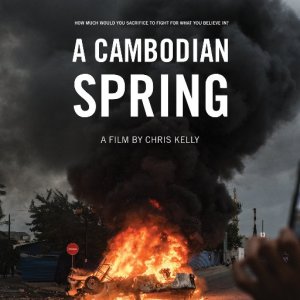
Hot Docs: A Cambodian Spring

Land rights are a super contentious issue in Cambodia, where the communist Khmer Rouge regime banned private property in the 1970s, destroying tonnes of land documents in the process.

As a result, at least two thirds of Cambodians, most of them poor, of course, don’t have proper deeds for the land they live on. Over the last ten years or so, thousands have been evicted and forcibly removed from their homes in various land-grabbing schemes, mostly perpetrated by their own government, referred to in his film as a “fake democracy.”

1L6PdFeXFilm maker Chris Kelly follows three people over the course of 6 years to get a grip on their experiences. Toul Srey Pov and Tep Vanny are two young mothers who allowed their land on the Boeung Kak Lake to be measured by the government, supposedly to receive accurate land titles. Instead, the government leased their land to a private company, Shukaku, which “happens” to have ties to the Prime  Minister. Shukaku is dumping sand into the lake, flooding the streets of Boeung Kak, forcing people from their homes. These women are too poor to abandon their homes. The compensation offered by Shukaku is laughable, insufficient to start over elsewhere. But those who stay risk their lives – already 3 have died by electrocution alone.

A Cambodian Spring shows how corruption and oppression still rule in Cambodia, but more than that, it highlights our own role in this: the failure of the World Bank to enforce its own resettlement policy, and the international complicity in allowing this to happen to regular people who believe they should be able to live in the homes they have purchased.

Although a bit overlong, A Cambodian Spring is an eye-opening and intimate portrait of citizens-turned-activists, and the cost, both personally and politically, that comes with fighting back.


Hot Docs: Tokyo Idols

What saved a 43 year old man from depression? What is he so devoted to he refers to it as a religion? What is so intoxicating he’s blown through his life’s savings? Sad-sack middle-aged men in Japan are flocking to ‘pop’ concerts performed by underage girls. They’re called Idols in Japan, they perform in ‘girl groups,’ and to date there about 10 000 of them.

They’re providing a coveted if creepy role in modern Japanese society: comfort to men MV5BOTk0OTQ1NjYzNV5BMl5BanBnXkFtZTgwODA4NzE5MDI@._V1_SX1777_CR0,0,1777,999_AL_who have very little else going on. In a tanking economy, middle aged men find themselves with poor jobs, little money, and even less confidence. It’s no wonder they’ve stopped dating real women and have shifted their fantasies toward little girls, who run no risk of rejection. The Idols host “meet and greets” where their fans will of course pay a lot of money to have a minute’s worth of childish conversation and a handshake – in a culture where the handshake still has a sexual component to it, having been completely taboo between the sexes until only a few decades ago.

Yes, watching these stunted middle aged men fawn over children is uncomfortable. They worship virginity, prefer girls who are “still developing,” and believe that 17 is past prime. Their worst fear is that these girls will grow up to be strong women. Sapped of self worth, many men in Japan have quit dating ‘real’ women altogether. The birth rate is falling. Idol culture is proliferating. The men who adore them beyond all reason are called ‘Otaku’. These super fans would put even the most fervent Justin Bieber fan to shame. Not long ago, Otaku were considered failures, some song lyrics even called them filthy pigs, but they are becoming more and more mainstream.

The Idols, meanwhile, are on constant parade, never far from a judging eye. Every year there are Idol elections, where the men pick their favourite girls to perform for the next calendar year. For the girls it becomes about winning male adoration, and they become conditioned to want it from an alarmingly young age. The men can spend thousands (monthly!) attending concerts, accumulating merchandise, and buying time with the girls. If this sounds like prostitution to you, you’re not wrong. It’s even creepier than prostitution, isn’t it? There’s no intercourse taking place, but money changes hands for its substitution.

Director Kyoko Miyake does an excellent job absorbing her audience into this obsession. I almost felt like a voyeur, that’s how intimate her access is. And as morbidly fascinating, as this phenomenon is, Miyake expertly nestles it within a social context that deepens our understanding of it. While I was discomforted watching these transactions take place, it’s clear that the lines are blurrier in Tokyo. Miyake carefully shows both sides, the good with the bad, finding what sympathy she can in the humanity of it. Tokyo Idols is a really interesting watch and my only complaint is that I wanted even more. I’m positive there are even darker themes here to explore (what happens to the past-prime girls, for example?) and I can only hope that we’ll see more from this director in the future.


Hot Docs: Ask The Sexpert

When Dr. Mahinder Watsa was starting out his career as a doctor, he wrote a medical column in the back of a ladies’ journal. At the time, young women were dying from back-alley abortions while others committed suicide, unwilling to let their prospective husbands know they were not virgins (due to sexual abuse). Dr. Watsa knew then that there was a problem in India. He wasn’t particularly specialized in human sexuality, but through research, hard work, and years of experience, he made himself so. He was a pioneer of human sexuality education in India, a position still necessary today when many provinces still ban sex education in schools, and a position that he still occupies at _76446807_panos00178357x624the age of 91. With teachers unable and parents unwilling to discuss sexuality, there’s a huge chasm of ignorance in India, and Dr. Watsa is still doing his best to fill it.

I find it utterly impossible not to be charmed by Dr. Watsa and by extension, by this documentary by Vaishali Sinha. A newspaper sex column, seen as a lark in the lifestyle section of our newspapers, a laugh on late night TV, is vitally important in a country like India. Dr. Watsa writes plainly, even conversationally, to his readers with honesty, openness, and precision – three things otherwise completely missing from the field, which is astounding considering they are confronted by the same internet porn and HBO programming that we are, and yet are completely in the dark about even the basics of reproduction let alone pleasure. What a 10 year old Canadian could answer here, a mother of 4 may be mystified with over there. Of course, it isn’t just ignorance but shame and fear that keep this subject deeply shrouded. It’s discouraging to see the mountain yet to  be climbed, but Sinha instead heartens us with the people at the forefront of this movement toward education.

Dr. Watsa is a humble figure, unassuming and prone to humour.  He knows his work is important but seems a little struck by his own inadequacy, likening his column to a “drop in the ocean.” In a country of over a billion in population, sex is definitely happening if not openly discussed – or admitted to. Dr. Watsa is a bright light. As a good director, Vaishali Sinha knows that every hero needs a good villain, and he has one: a woman hellbent on inflicting her own “moral” standards on everyone else, and not afraid to take the matter to the courts. Indeed, at the age of 91, both Dr. Watsa and the newspaper he writes for, the Mumbai Mirror, are charged with obscenity, with Dr. Watsa possibly facing jail time if convicted.

This is a fascinating documentary. Sinha has found a brilliant subject and has the good sense to stick with him. I’m positive that he will endear audiences near and far.

Hot Docs: Sunday Beauty Queen

Hong Kong, like many cities around the world, benefits from the help of underpaid Filipino workers. A local domestic worker would cost $8 an hour, but a Filipina in the same role works round the clock, 6 days a week, for just $500 a month. There are strict rules for these poor workers, who aren’t allowed to maintain their own residences (if they could even afford them). They often sleep in the kitchen, which is also where they eat, alone, after having served the family. These are the people who care for the elderly or nurture the very young. Away from their own families, often even leaving young children behind, they pour love and care into their duties while receiving very little in return.

sunday_beauty_queen-4Sunday Beauty Queen examines these workers, and the pastime they enjoy in their very limited time off: beauty pageants. Every Sunday they gather in events they organize themselves, strutting their stuff in costumes equal portions prom dress and cardboard accoutrements.

This well-intentioned documentary by Baby Ruth Villarama sheds light on important issues faced by migrant workers but lacks real depth, raising more questions than it answers. These women run themselves ragged serving others, sending all of their money back home to the families they left behind. They reclaim their dignity and their personhood on Sundays, competing in made-up beauty pageants. If the awarding of crowns and sashes runs late, they could lose their jobs on the spot for coming in past curfew. Instantly homeless in a foreign country, they have 14 days to find new employment or they are forced to leave. Many can’t even afford to leave, due to fees charged by both Hong Kong and the Philippines coming and going, on top of airfare and the shame of going home empty-handed.

I loved getting to know the women in this documentary, but I wish I knew them better, had a fuller sense of their stories. Sunday Beauty Queen is an excellent start, but these workers deserve a bigger piece of the pie, both in life and on film.


This review first appeared at Cinema Axis.

Shiners

Shoe shiners: at the airport, a busy subway station, a kiosk in your local mall, even on the street corner. There they are, every day, providing a service to the people walking by. Yet this humble profession is often overlooked. Who goes into shoe shining, and why? Director Stacey Tenenbaum gives us a documentary that gives us the answers by putting us in the shoes of shiners around the world.

Filming in cities as diverse as New York, Hong Kong, Tokyo, Sarajevo, La Paz, and more, shoeshining-640x480Shiners gives a good sense of the universality of pride in one’s work. However, it is also clear that the profession is not viewed the same from one country to the next. In America it is being reclaimed by hipsters who deride the neglect of older crafts. In Japan we see a lot of honour in the skill, in making something old new again. But in other places, it’s seen as degrading work, and the shiners work on the street, earning little money and even less respect.

In that way, Tenebaum quietly addresses poverty and social justice without quite mentioning it directly. Shiners is a character-driven documentary, the shiners speaking for themselves. A mother of young children barely earns enough to feed her family; she refuses to be shamed for her position but insists that her children will be ‘professionals.’

Don, a.k.a. the shoe dude, working a street corner in Manhattan, has a vibrant personality. A former accountant and pastry chef, he’s chosen shoe shining for the sense of freedom it gives him. He talks candidly about the racist connotations of shoe shining, and the satisfaction he’s derived from telling “uppity people” their shoes are dirty.

Shiners excels at providing an insider’s view. It cracks the humanity wide open, and guarantees that you’ll never walk by these people without seeing them again.


This review first appeared at Cinema Axis.


Hot Docs: Do Donkeys Act?

Did you ever have existential questions about donkeys? No? Well, move on.

Or not. The truth is, you haven’t seen anything like Do Donkeys Act? It’s a documentary about donkeys (a donkumentary?), made reputedly by humans (Ashley Sabin and David Redmon), for the enjoyment of – donkeys? There are no talking head interviews in the film, very little input from people, period. There are, however, extended shots of donkeys just “being.” Filmed on a few different donkey sanctuaries where tired and abused donkeys go to live out the last years of their lives, there are no donkey facts, no never-before-seen donkeys in the wild. What the film does offer is plenty of space to contemplate the life and death of these beasts of burden.

Do_Donkeys_act_1How do donkeys cry? Do they tremble inside? Do they dream? These are the types of insights and reflexive cues provided by poetic narration provided by Willem Dafoe. We might spend several minutes just gazing upon a bunch of donkeys eating communally from a trough. We may consider the different utterances we hear and attempt to interpret each one. The donkeys are communicating – are you listening?

The documentary takes the humble donkey and elevates him to the star of his own movie. I started to wonder, listening to them honk and hee-haw, if they were perhaps translating the poetry we were hearing from Dafoe. But then, in a mind-bender, I wondered: is it maybe we who are translating their poetry? Mind blown.

Although its run time is brief and it takes a while to get into its unique rhythm, Do Donkeys Act? has an embracing kind of empathy that came to be quite moving. I’m not sure I’ve come away with specific meaning, but I’ve just spent 72 minutes thinking about donkeys, which is 72 more than I’ve ever given them before, and there’s a kind of grace in that,  triumph for the film makers, dignity for the film’s brave subjects.


This review first appeared at Cinema Axis, where you can find lots more excellent Hot Docs coverage.

Aim for the Roses

“It’s going to be a long 102 minutes”. This was my first impression of Aim for the Roses, which made its world premiere at the Hot Docs Film Festival in Toronto.

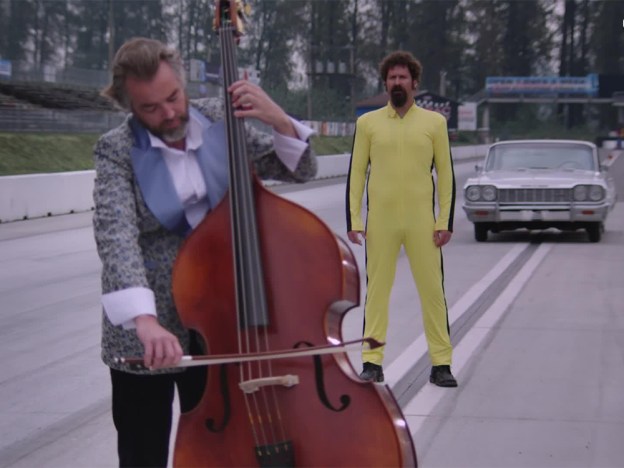
John Bolton’s documentary opens on a reenactment of Ken Carter (played by actor Andrew McNee with a yellow jumpsuit and terrible 70s beard) proclaiming his destiny to become the greatest of all daredevils. I was disoriented at first by the double bass player standing next to Carter on the fake ramp but his presence would still be explained.

Apart from a single reference to a Roger Waters concept album, Aim for the Roses is about as Canadian as it gets. In 1976, Montrealer Ken Carter declared his crazy ambition to jump over the Saint Lawrence River (literally from one country into another) in a rocket-powered car. In 2008, Vancouver-based composer Mark Haney got the crazy idea to make a double-bass concept album to pay tribute to “the daredevil stunt to end all daredevil stunts”. Finally, filmmaker John Bolton got the crazy idea that all this would make a good documentary. Basically, Aim for the Roses is a movie about Canadians doing crazy knuckleheaded things.

Visually, Bolton (the filmmaker) has a bit of a problem. There doesn’t seem to be nearly enough archival footage of Carter (the daredevil) to fill a whole movie and, as interesting as Haney’s music may be to listen to, it obviously doesn’t give us much to look at. Bolton’s solution is inspired. He turns Haney’s album into a music video, playing it over a reenactment of Carter’s feat filmed on a reconstruction of his takeoff ramp.

Bolton’s reenactment is bizarre. Maybe a little too bizarre. Haney’s soundtrack doesn’t help. His concept album has already been called “utterly amazing and completely fucking ridiculous” by the Georgia Straight. Passing off exposition as song lyrics, his music- as haunting as it is- can seem a little silly. But featuring McNee in that costume on a fake takeoff ramp with Haney playing base behind him is a little too much.

Fortunately, you don’t have to like Bolton and Haney’s musical to be fascinated by this documentary. Aim for the Roses is about the people who come up with crazy ideas and stubbornly pursue those ideas no matter how many puzzled looks they get. Haney , who is interviewed extensively in the film, is quick to point out the parallels he sees between his own life and that of Carter’s. He suggests that making the most ambitious concept album of your career is a lot like jumping a rocket-powered car over a river. It doesn’t matter what your ambition is. The best daredevils are artists and the best artists are daredevils. I wouldn’t be surprised if Bolton feels a certain kinship with these two men himself.


“Nuts!”

Nuts: a pejorative term indicating insanity; a slang word for testicles. In the case of “Nuts!”, it’s both.

nuts-documentary-1J.R. Brinkley was a doctor in small town Kansas who, through the grace of his revolutionary goat-testicle transplant surgery, cured many men of impotence and infertility while bringing vitality and prosperity to the town. Brinkley had to build hospitals just to deal with the growing demand, and almost accidentally became a radio pioneer simultaneously, broadcasting ads for his services and answering write-in medical questions between blasts of good ole country music. Despite exponential interest and a horde of faithful followers, the American Medical Association accused Brinkley of “quackery.” Just as they set out to discredit him, he came out with an elixir just as 3suknzs_7ZdkkSzSTUmjXyzJGnOxJrFPD4GX9-ypnY4 (1)effective as the goat-testicle procedure but with much less risk. And then he ran for governor, with a slogan borrowed from a laxative commercial. True story.
How have you never before heard of this broadcasting maven and trailblazing doctor? Whatever the answer, Nuts! director Penny Lane will make sure you never forget him. Her mixed-media documentary uses his official biography as a jumping-off point, and whatever archival footage and modern day interviews can’t cover is brilliantly animated. And I do mean brilliantly: not only is the animation a perfect match for this strange and whimsical tale, it’s also impeccably timed and used judiciously. Different animators are nuts.0.0used for each segment, but there’s a uniform style that injects a lot of kinetic energy into a story hilariously but dryly narrated. You won’t believe how quaint goat fucking can look.

Eventually the film moves from eyebrow-raising to downright subversive, with enough old-timey euphemisms for erections (or the lack thereof) to keep you in patter for your next hundred dinner parties. Lane has already shown herself to be a thoughtful and engaging filmmaker (Our Nixon) but with Nuts! she proves herself worthy of a Brinkley-esque empire. You can’t help but admire the way she weaves the story together; she examines what amounts to an American folk tale but she does it with modern tools that turn the story on its head. Penny Lane is her own brand of documentarian, and quite possibly on to becoming this generation’s best. Nuts! is not to be missed.


This post was first published over at Cinema Axis, where you can find lots more great Hot Docs coverage.