Tag Archives: queer cinema

The Jinkx and DeLa Holiday Special

I couldn’t call myself a fan of RuPaul’s Drag Race if I didn’t gallop over to BenDeLaCreme’s site to rent The Jinkx & DeLa Holiday Special just as soon as I could. BenDeLaCreme (DeLa for short) was one my all-time favourites on Drag Race, except for the fact that she left in disgrace – not because she lost, but because she chose herself for elimination. Criminy!

DeLa and Jinkx Monsoon work together often (including in the recent Happiest Season) and have a wonderful chemistry. They’ve written the script together and they’ve got their flavour stamped all over it, which is probably why it’s so sticky.

The premise: DeLa wants to give Jinkx the perfect Christmas, with winter wonderlands, sugar plum dreams, and plenty of good old fashioned Christmas traditions. Jinkx, however, is not so keen on the whole Christmas scene. She grew up much less privileged; Santa never spoiled her and the holidays never seemed all that great. Plus, aren’t traditions those things upheld by people who don’t like gays or drag queens? DeLa can’t believe it: did she not even have a family eggnog recipe?

I didn’t grow up with a family eggnog recipe either, to be honest. Not everyone is into salmonella punch, especially not the kind animated by dead grandmas. Which DeLa’s is. Nana Nanog is still deeply invested in seeing DeLa carry out the family traditions, and luckily, our favourite drag queens have a variety of musical numbers planned for us to increase the merry and turn up the jolly.

Numbers like ‘Passive Aggressive Christmas’ and ‘Everyone Is Traumatized by Christmas’ indicate the kind of inclusivity this special is aiming for: the holidays are hard, might as well drink until they go away. Or until you see the Baby Jesus bopping around in a pair of sunglasses and a diaper.

Walt, our miniature dachshund who will be 6 months old on Christmas Day, seemed to love Santa Fa La La (he barked at all the fa la las), but I had a super fun time with their new twist on classics like Baby It’s Cold Outside, the popular holiday song with rape vibes, now rewritten to recount how God convinced Mary to put his baby inside her, and the Nativity Twist, which reclaims the birth of Christ as a feel-good, dance-heavy, nice time.

As you would expect from such drag professionals as Jinkx and DeLa, the looks are on point, the wigs are big, the shoes are high, the makeup is excessive, the costumes are spectacular and numerous. It is most certainly NOT a family-friendly affair if you don’t want your kinds finding out what rhymes with ‘bare-backing’ this Christmas, but for the rest of us, it’s exactly the celebration we deserve this year.

Find The Jinkx and DeLa Holiday Special on Hulu if you’re in the U.S., and for rent on their site if you’re not.

The Christmas House

Phylis (Sharon Lawrence) has finally joined husband Bill (Treat Williams) in retirement, and she’s finding it’s not all it’s cracked up to be. With time on their hands, though, they decide to call their grown sons home and throw one last Christmas House, just like they used to do.

What is a Christmas House, you ask? Fair question. They literally empty the house of all useful contents and stage every nook and every cranny with Christmas decor, inside and out, and then invite the whole neighbourhood over to enjoy, along with cookies and cocoa of course, and even some live entertainment.

Youngest son Brandon (Jonathan Bennett) and husband Jake (Brad Harder) are able to come because their bakery is under renovation but it’s not great timing since they’re waiting to hear whether their adoption will go through – it’s been a long journey and they’ve been disappointed before. Oldest son Mike (Robert Buckley), an actor in LA, is also able to get away because his show Handsome Justice has just wrapped its first season. If the brothers are surprised to learn the Christmas House will return after a two decade hiatus, they’re even more surprised to learn that their parents plan to sell the house after Christmas – and take some time apart.

Much has been made of Hallmark finally including some LGBTQ storylines in its holiday lineup, but this isn’t much of a bone to throw the gay community, to be honest. As you can tell, Brandon and Jake are not going to be the focal point of the story; their love’s already a done deal. This is really about single (and handsome) Mike, who grew up with his eye on the girl next door, Andi (Ana Ayora), who is also convenient back next door for the holidays. Will their spark rekindle? Of course it will. But some painful memories from the past will threaten to put those flames out. Plus, mom and dad’s divorce and Brandon and Jake’s baby worries are kind of romantic bummers. But the Christmas House! That’s what’s important now, even if it’s also the only thing actually catching fire.

Oh Hallmark, how do I love thee? You’re pumping out these holiday cheese balls with such enthusiastic precision. And yet, with an impressive slate of about 40 new Christmas movies a year, this is still the first first movie produced by Hallmark to feature a same-sex married couple and a male gay couple. It’s been a long time coming and yet still manages to disappoint – give the gays their romance!

Stage Mother

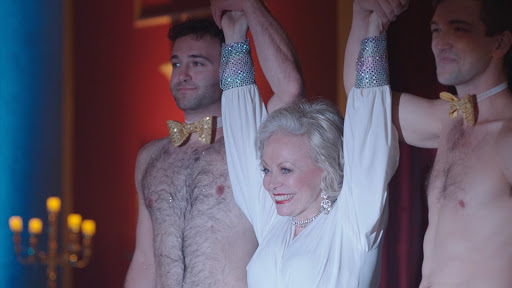
Maybelline Metcalf (Jacki Weaver) is pretty much what you imagine when you hear the name – conservative, christian, Texan. She’s the church choir director, a good friend, dutiful wife, and what the hell, a little catty. She’s also shocked and heart broken to learn that her only child is dead – a gay son who’s been estranged and battling addictions since he left for San Francisco years ago.

Though husband Jeb is determined to continue on as if they never had a son at all, Maybelline’s grief and regret lead her to San Francisco where she finds Rickey’s funeral is not quite to her taste. Her son’s drag family is performing their tribute to him and it’s all a little much for this mother who has never before claimed her son in public. Her clear disdain makes a bad first impression with her son’s grieving and offended boyfriend, Nathan (Adrian Grenier), who is suspicious of her sudden appearance. He suspects she’s come sniffing around for an inheritance, and indeed there is one since Nathan and Rickey were never married – the drag bar where everyone performs. The bar isn’t doing well with Rickey gone, so instead of going home, Maybelline inexplicably stays and not only whips the bar into shape, but nurtures the acts of Rickey’s drag family.

There is a heart ache to this film as Maybelline is clearly transferring the love and acceptance she was never able to show her son unto the surrogates she finds at the bar. And what a tragic comment on society that so many at the bar are indeed in need of mothering, even if it’s from someone else’s mother.

Director Thom Fitzgerald chooses not to have Maybelline wallow in self-recrimination; instead, she rolls up her sleeves and gets to work. Perhaps being useful and creating ties to her son’s chosen family is the only way she can cope. But overall, the film doesn’t carry a dark or heavy tone, it capitalizes on drag’s new mainstream status and concentrates on making things pretty and tuneful. The other drag performers are not much more than caricatures, but this is not about the resilient queer community of San Francisco, it’s about a traditional wife rejecting her husband’s bigotry and learning to judge based on the values in her own heart instead. Stage Mother is a bit old-fashioned, perhaps a bit dated in tone, but the movie’s upbeat feel combined with a terrific performance from Weaver makes Stage Mother a worthy watch.

Queer Japan

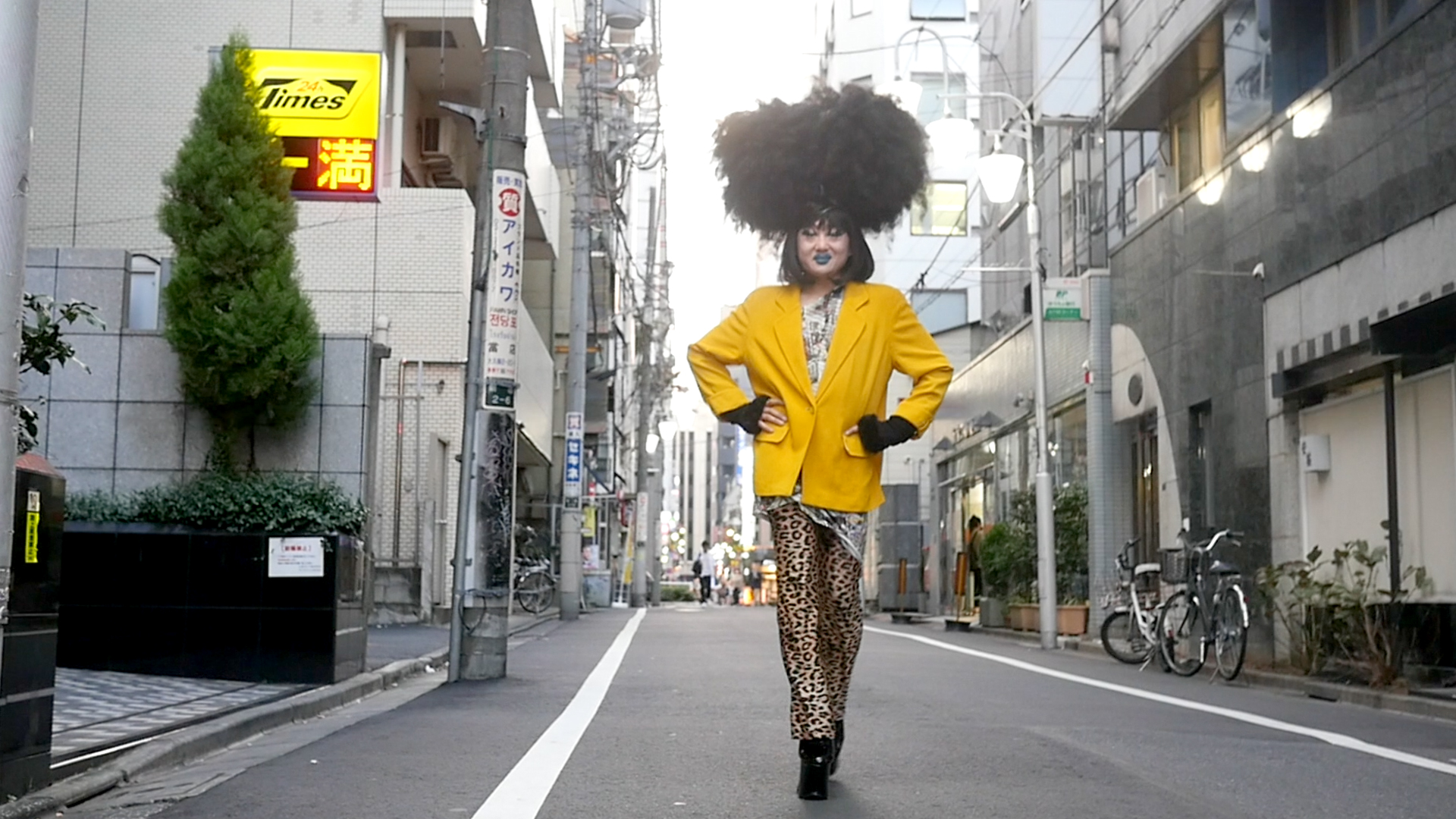
Director Graham Kolbeins’s Queer Japan has a big, open heart. The documentary examines the multi-faceted queer community in Japan with a generous cross-section of its members. Tomato Hatakeno is a transgender activist and video game guide book author; Gengoroh Tagame is a gay erotic artist known internationally for his hardcore BDSM-themed manga; Vivienne Sato is a famed artist and drag queen. But despite the film’s depth of  trailblazing artists and activists, it punches most heavily when it’s sitting with everyday people, people who are making compromises and taking risks just to live some part of their truth. One young person, a misfit, a gender outlaw, commented at a pride parade “I don’t give a shit about love, I need toilets” – a brutally honest reminder of a hierarchy of needs and rights that are not addressed equally within the community (or, I suppose, without).

Curating from over a hundred interviews conducted over 3 years in various locations across Japan, Kolbein has more than enough colour to paint a rainbow. We get a back stage pass to the glossy parties and the seedy underground, meeting people living boldly in all walks of life. It’s truly a prismatic view of Japan’s deliciously diverse queer culture, and a glossary of terms is helpfully provided so we enjoy as immersive an experience as possible.

Queer Japan is a celebration of non-conformity, of alternative thinking, of living life without apology. But this party is also well-informed by that same community’s hardships, struggles, and minority status. While much of it is still lived in the margins, the documentary’s hopeful, irrepressible tone makes it clear that change is coming, and this vibrant, resilient community is not just ready for it. They’re making it happen.

Queer Japan is available in virtual cinemas and on demand December 11.

The Prom

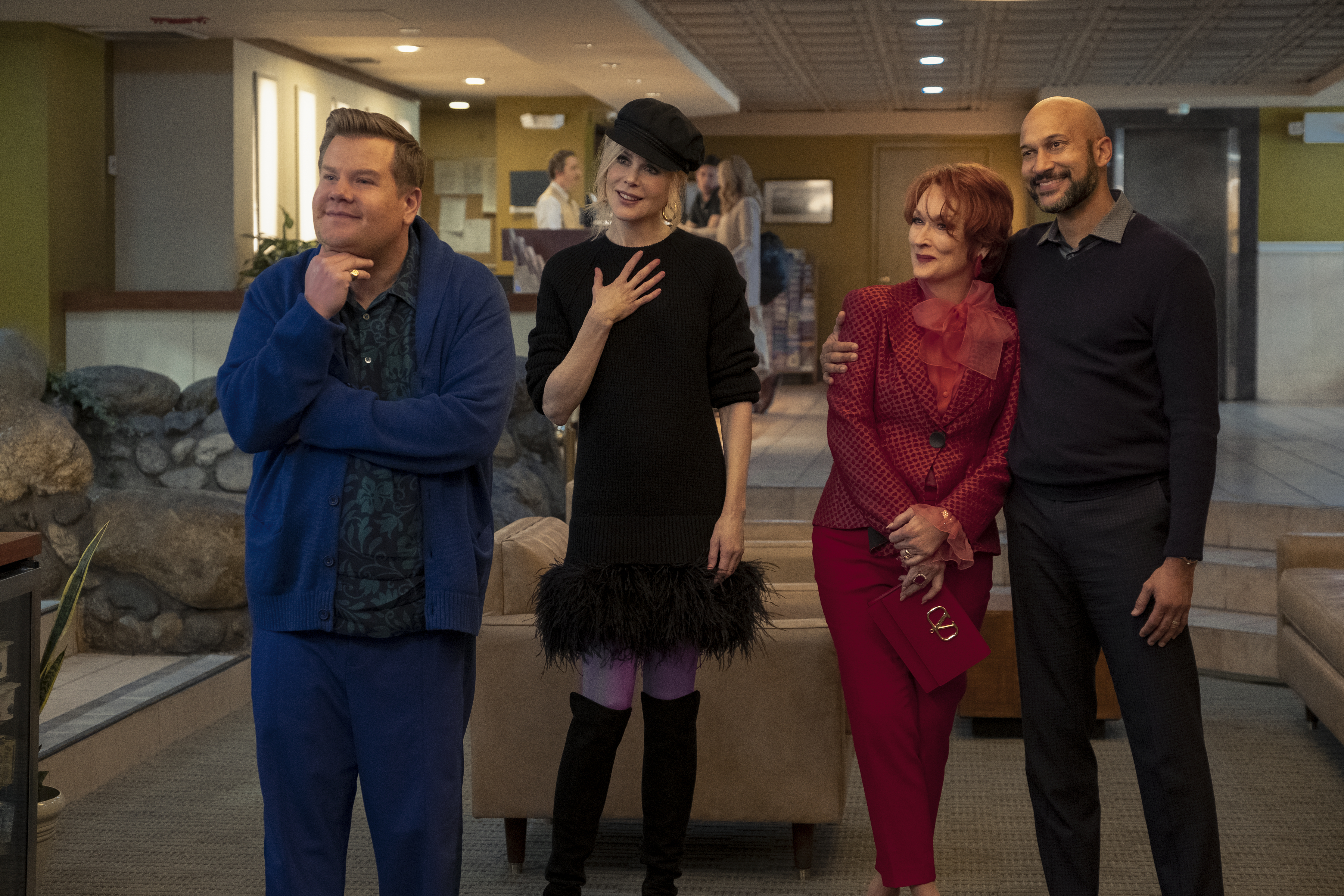
The Prom is a new movie on Netflix based on a Broadway musical of the same name about a handful of Broadway stars looking to clean up their image by taking on a random cause. The cause in question is a prom in Indiana that the PTA would rather cancel than allow a gay student to attend with her girlfriend. It’s a pretty gay musical that Ryan Murphy manages to make bigger, better, and gayer than ever, with boatloads of sequins and buckets of wigs, and the shiniest, sparkliest cast he could assemble.

Dee Dee (Meryl Streep) is a veteran stage actress, a Broadway phenom with a Tony in her purse and an outsized sense of entitlement. When we meet her, she’s starring in the opening night of Eleanor, a musical about Eleanor Roosevelt. Co-starring as FDR is Barry (James Corden), a Broadway mainstay who’s still chasing that first Tony, and hoping this might be it. Unfortunately, a bad review pretty much shuts them down on that first night, and someone has the temerity to point out that it’s not so much that the show is bad as that the two of them are so disliked. They’re narcissists, they’re told, though they’re not convinced that’s such a bad thing. But in the best interest of their careers, they decide to rehab their reputations by support a cause (a cause celebre, they specify) along with Broadway actor “between gigs” Trent (Andrew Rannells) and inveterate chorus girl Angie (Nicole Kidman), who ride the next bus out of town toward homophobic Indiana.

Emma (Jo Ellen Pellman) is the sweet teenage girl who just wants to take her girlfriend to prom. Alyssa (Ariana DeBose) is her closeted girlfriend and the daughter of Mrs. Greene (Kerry Washington), the “homosexual prom’s” #1 opponent. Principal Tom (Keegan-Michael Key) does what he can to mitigate the damage but he’s pretty powerless with so much opposition. Plus, now he’s start struck on top of everything else – he’s Dee Dee’s biggest fan.

As our Broadway do-gooders get to know Emma and her situation, what started out as a charitable act of self-interest turns into something a little more genuine, although the unironic, attention-hogging performance of It’s Not About Me had its charms. Both the songs and the film are uneven, but they’re also so much fun, who cares? I didn’t particularly buy Nicole Kidman as a mere chorus girl either, but do you hear me complaining? No. Because singing and dancing have put so much joy in my heart I should feel ashamed to ask for anything more.

The Prom is not a great movie, but it is boisterous, glittery good fun, full of beautiful costumes, beautiful voices, and a totally stacked cast. Ryan Murphy doesn’t do subtle, but he does have an eye for a fantastic musical number and this movie has north of a dozen. Though the feeling may be flitting, you can’t help but feel good while watching it, and what a perfect way to spend an evening near the holidays. The Prom is pure indulgence – tacky, campy, cheesy, and unforgivably feel-good. So feel it.

Uncle Frank

Growing up in Creekville, South Carolina in the 1970s, Beth (Sophia Lillis) has always felt like an outsider, even especially in her own family. The only relative to whom she relates is Uncle Frank (Paul Bettany), who seldom attends the various family functions meant to bring them all together. She feels surrounded by small minds and limited experience, and she’s not wrong. Which is why she eagerly follows in Uncle Frank’s foot steps to Manhattan as soon as she graduates.

Between college and the big city, Beth is growing up and expanding her world view, but nothing hits home like finding out that Uncle Frank is gay and that his roommate Wally (Peter Macdissi) is his lover and partner of many years. She’s never known anyone gay before. No; she never knew she knew anyone gay before. As if this wasn’t milestone enough, Frank’s father (and Beth’s grandfather) Daddy Mac (Stephen Root) has died, leaving uncle and niece to get reacquainted in the context of this new information during their road trip home for the funeral. On the one hand, it’s kind of a nice opportunity to meet each other’s authentic selves, but on other hand, they’re driving toward utter disaster and they don’t even know it.

South Carolina wasn’t the happiest place to be a gay kid growing up, and if Frank isn’t exactly choked up by his father’s death, going home does stir up quite a few traumatic memories, threatening his sobriety, his relationship, and even his life. Uncle Frank is both a coming out story of sorts for Frank, and a coming of age for Beth, two misfits from the same people and place finding out whether you can go home again or if you should have stayed in NYC where you belong. Writer-director Alan Ball seasons the script with achingly realistic family dysfunction, layers of hatred as well as opportunities for healing. Young Sophia Lillis has really hit the ground running in her career, starting out already on top with several leading lady roles in a row. She’s fantastic in this, but this movie belongs to Uncle Frank, and it’s Paul Bethany’s stoic and grounded performances that really see us through. Frank has navigated his life with careful precision but his father’s death is the one iceberg he couldn’t avoid. It feels like we’d tread uncomfortably close to melodrama, but Bettany’s performance is quiet, calm, and convincing, with not one shred of over-acting in a career-defining turn.

Uncle Frank has something to say about how things were in the past, but it also implies a lot about us now, 50 years in the future, and yet somehow still living in a world full of prejudice, where in some places and for some people, Frank’s experience is still the norm. For an unspoken statement, it’s pretty profound.

Happiest Season

Someone literally accused it of being the hap-happiest season of all, but that’s not always the case, is it? Edward Pola and George Wyle wrote It’s The Most Wonderful Time of the Year specifically for Andy Williams to have something original to sing on the holiday episodes of his show. The song boasts hosting parties, spontaneous visits from friends, universal social gaiety, spending time with loved ones, sledding for children, and roasting marshmallows as prime causation of holiday happiness, but not only do these things not guarantee joy, rarely does a Christmas song mention the other side of Christmas reality. The dry turkey, the overspending, the cranky kids, the ubiquitous pine needles, the dangerous driving conditions, the kids table, the inevitable disappointment. While the happiest seasons are happy in the way described by Pola and Wyle, the worst seasons are distinctly terrible in their own ways. Happiest Season tells us about Abby’s.

Abby (Kristen Stewart) isn’t that into Christmas, but girlfriend Harper (Mackenzie Davis) is, so Abby makes the effort, pawning off her holiday pet-sitting duties to pal John (Daniel Levy), and spontaneously joining Harper on her trip home for the holidays. Abby’s never met Harper’s family, so this is a pretty big deal. Big enough that Abby plans to propose to Harper over Christmas dinner since the season means so much to her, making it the first of many happy holidays together. Except.

Except it turns out that Harper isn’t out to her family, and she’s been lying to Abby about it. Frantically confessed at the last possible moment, she implores Abby to keep her secret, and to lie about her own sexuality as well, because dad Ted (Victor Garber) is running for mayor in Homophobe, USA, and we wouldn’t want to hurt his campaign. Actually, it seems Harper’s sisters Sloane (Alison Brie) and Jane (Mary Holland) also govern their lives in order to best impress their parents. Ted and Tipper (Mary Steenburgen) make no bones about expecting perfection, playing favourites, and rewarding success with affection. When Harper arrives, mom Tipper literally says “You get more and more beautiful every time I see you. Did you bring concealer?” And Harper’s the favourite! It’s not a great situation to be walking into, but Abby reluctantly agrees with the fateful line “It’s 5 days – how bad can it be?”

You’ll have to tune in to Hulu on November 25, 2020 to find out just how bad it can be – and then be thrilled, surprised and titillated when it gets even worse.

Happiest Season is a comedy but as a rare LGBTQ holiday romance, it also tells a stark reality: that Christmas (and other obligatory family time) can be really hard on queer people whose families aren’t accepting. Kristen Stewart literally gets shoved back into a closet in this movie, which isn’t exactly an uncommon occurrence. Gay members of the family may be forced to suppress foundational facets of themselves, to deny lovers and celebrate separately from partners. And that’s the “lucky” ones who haven’t been outright rejected and ostracized. It isn’t a happy time for everyone, and it gets increasingly unhappy for Abby.

John is the unsung hero of Happiest Season, the friend Abby can call when things get emotionally turbulent, the friend who will always champion her happiness, the friend who will show up for her when things get tough. Daniel Levy, recently named one of People’s Sexiest Men Alive (and how!), is great in this, as he’s great in everything. But truly, this is an ensemble comedy and it succeeds on the backs of many fine performances. Mary Steenburgen plays Icy Snob to utter perfection, Mary Holland is lovably awkward and hopelessly clueless, Aubrey Plaza has a small but sweet part – even your favourite drag queens, Ben DeLaCreme and Jinkx Monsoon have a campy cameo. But most of all: Kristen Stewart. I do believe even Stewart’s harshest critics (and they are harsh) would have to admit she’s natural and lovely and relaxed in this role, but she’s also able to communicate with subtle signals that she’s going through more than she says. As a supportive girlfriend, she understands this is difficult for Harper, but as a woman with self-respect, she’s uncomfortable quashing her authentic self. While Harper and her competitive sisters are clashing in the kitchen, and at the mall, and right into the Christmas tree, Abby’s conflict is internal. And Harper’s dilemma might feel painfully familiar to some – whether to choose Abby, or her family – and the accompanying fear that in trying to have both she might lose both.

Director Clea DuVall wrote the script along with Mary Holland but they aren’t delivering some gay powder puff Hallmark movie. They haven’t shied away from the tough truths of queer Christmas, but they do manage to pull it all together into something that is as entertaining as it is festive.

TIFF20: Ammonite

In 1840s England, acclaimed but overlooked (translation: female) fossil hunter Mary Anning (Kate Winslet) reluctantly agrees to act as a caregiver to Charlotte (Saoirse Ronan), the sickly wife of a wealthy man, prescribed a convalescence by the sea.

Every morning, Mary prowls the beach by her home in Lyme Regis, a town in West Dorset, searching for and carefully unearthing fossils. She dons rough clothes and men’s boots and has permanently roughened knuckles and a rime of clay under her torn fingernails. It is unusual work for a woman; Mary is an unusual woman. She is not exactly pleased when Charlotte joins her on the beach. Charlotte’s health is as dainty as the heels on her boots, her frills and lace a liability, her bonnet as prim as the purse of her lips. No one is more aware of the difference between their class and social status as Mary is, but Charlotte’s ill health and Mary’s careful caregiving put them on more equal footing. At one moment they’re peeling vegetables side by side, the next they’re having frantic sex.

It sounds as abrupt as it felt. Touted as a period lesbian romance, there isn’t actually a whole lot of romance to the affair. The two women are chronically lonely. Charlotte’s primary ailment is probably grief, and unhappiness, while Mary is burdened by a simmering anger. There isn’t a lot of chemistry between the two, nor any passion outside quick (and quiet -mom’s down the hall) trysts in the bedroom. There isn’t a flirtation or a sweeping exchange of intimate secrets. There is toil, there is the unyielding sound of crashing waves, there is a muddy crust at the hems of their skirts.

Of course, in the 1840s, there is no happily ever after for a couple of “opposites attract” lesbians. Charlotte has her grief to get back to, not to mention a husband. Mary has her work, her resentment, her private anguish. Their brief love affair will have certainly changed them, but at what cost?

Writer-director Francis Lee sets his movie against a backdrop as bleak and as muted as the fine performances by Winslet and Ronan, both at the very top of their game. Their brief connection has no bearing on the unrelenting sea, and no comparison to the 195 million year old bones buried in the cliffs. Theirs is the briefest of blips, inconsequential in the face of the endless ocean. Lee tends to introduce the landscape as the third character in his love stories. His style is sparse but tactile, the environment more alive than even the love between Mary and Charlotte.

And of course the ubiquitous ammonite, a particular fossil of extinct cephalopods found in marine rocks. They are so abundant Mary polishes them and sells them to tourists; the shelves of her modest curio shop overflow with them, Lee finding the metaphor quite irresistible. What is a fossil but an organism that has become petrified over time? Mary was perhaps once a vibrant and content organism but life has hardened her, leaving behind only the impression of someone who once lived – really lived. She is briefly reanimated with Charlotte, but a fossil is also something resistant to change, and Mary is nothing if not set in her ways.

Ammonite has much to admire but far less to actually like. With so little to hold on to, it was hard to be invested in such a thin relationship. With no burning passion to sweep us away, I felt oppressed by the heavy skirts, the lack of privacy, the ceaseless work and the grime. It is a long, slow slog with so little reward that even Winslet’s ferocious work doesn’t seem worth it.

A New York Christmas Wedding

Jennifer loves David but her overbearing almost-mother-in-law is pushing them into a high-society Christmas Eve wedding in just a few months that Jennifer doesn’t really want. Having lost both her parents and her childhood best friend Gabby, the holidays have always been hard for Jennifer, and she’s worried her loneliness will be more pronounced. But never mind that: Jennifer (Nia Fairweather) is about to meet her fairy godfather (Cooper Koch) who sends her to an alternate universe to, you know, learn a lesson or whatever.

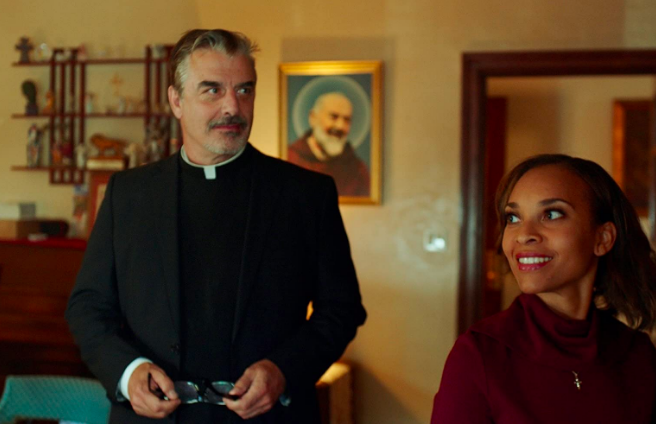
Alternate Jennifer is in a committed relationship with her dead childhood best friend Gabby (Adriana DeMeo), who is not dead in this version of reality, obviously. Neither is her father, which is nice. But instead of an overbearing mother-in-law ruining her impending wedding, they’re now dealing with a heartbreaking rejection from their catholic church. Father Kelly (Chris Noth) has been instrumental in their lives but his hands are tied – the church does not permit or approve of same sex marriage.

Full disclosure: there are no Christmas weddings in this movie. There is no Christmas, period. Writer-director Otoja Abit (he also plays David) seems to be trading on the romantic holiday theme to bring attention to his gay rights in the church movie. Which is a little dishonest, but I guess you gotta do what you gotta do.

It’s a timely film considering a documentary by Evgeny Afineevsky called Francesco that premiered at the Rome Film Festival a couple of weeks ago featured comments by Pope Francis that seemed to indicate his acceptance of same sex civil unions. Not of marriage in the church of course, and certainly not of “homosexual acts” which are of course still very very wrong and very sinful. But hey, if two dudes want to spend a committed life together, raise a family and share a marriage, that’s cool, they can put a ring on it and get the tax breaks as long as they promise to never have sex.

That Father Kelly even considers their request is a work of more fantasy and fiction than the godfather’s alternate universe in which it exists. I guess it’s nice to dream.

If it sounds interesting to you, A New York Christmas Wedding is a tolerable watch. It has that much in common with the romantic holiday movie it pretends to be: it’s low budget and medium quality but don’t mind the genre, then you won’t mind it’s production values. It’ll do.

TIFF20: Good Joe Bell

I don’t know who gave Good Joe Bell his nickname, but they were about as accurate as they were inventive. According to the movie’s log lines, Joe Bell (Mark Wahlberg) is a father from Oregon who sets out on a walk across America in honour of his son, Jadin (Reid Miller). Which is bullshit. I don’t dispute the Oregon part. Or the walking part either. He definitely does some walking, pushing a cart containing whatever camping gear hasn’t been stolen yet today. It’s the whole in honour of his son part that rankles. Joe may believe, or choose to believe, or fool himself that he’s walking for his son, but he’s really walking for himself. He’s walking for absolution. He’s trying to out-walk his guilt.

When his son came out to him, Joe didn’t exactly win any father of the year awards. He thought it was enough to not kick him out. Despite his wife’s pleas (Connie Britton), he didn’t work too hard at acceptance or even tolerance. He hid his disapproval behind thin veils and assumed his son would and should do most of the work to make his father comfortable, presuming this wasn’t some sort of phase, which Joe was of course hoping it would be, right up until Jadin took his own life.

So now Joe is walking across America, neglecting his wife and remaining children, stopping at schools to preach his an anti-bullying message, and at any community even that will have him to warn parents not to reject their gay kids. None of his missives is particularly effective, but blaming bullying is easier than dealing with his own complicity in his son’s suicide. Joe “talks” to his dead son on his walk but never seems to truly understand him – neither does Mark Wahlberg, for that matter, and director Reinaldo Marcus Green seems indifferent. With such a shallow approach, this feels like a movie from 25 or even 35 years ago, so heavy-handed and so proud of itself for so little. I’m sure it’s well-intentioned, but that’s hardly enough, for a message or a movie.

The only thing this movie does well is casting Mark Wahlberg, who is a little too believable as a homophobe and a failure at fatherhood. The rest is a mess. Its broad perspective renders it obsolete, it lacks self-awareness, and I don’t believe anyone involved has truly considered what or who this is actually for and about.