Tag Archives: subtitled

TIFF20: Get The Hell Out

Technically, this film does have a premise and a plot. I mean, it totally and legitimately does. But as a Taiwanese comedy-horror that mixes zombies, martial arts, and politics, it probably didn’t have to go to the trouble. As part of TIFF’s legendary Midnight Madness program, it’s not just a case of fitting in, but establishing a new bar for the kind of oddities the best of genre cinema can offer.

Hsiung Ying-ying (Megan Lai) is so mad the government wants to tear down her father’s house to build a new chemical plant, she gets herself elected to parliament to actually do something about it. But opponent MP Li Kuo-chung (Chung-wang Wang) is a veteran politician and isn’t about to just back down and let her have it. In fact, he instigates a brawl that riles Ying-ying into busting out some badass kung-fu moves, including her signature huracanrana, and then calls for her resignation, having successfully baited her. Bumbling security guard Wang You-wei (Bruce Hung) is the one who broke up the fight, and his corresponding rise in popularity has both camps thinking they can use his seat for their own purposes. But You-wei only has eyes for Ying-ying, so on the appointed day and time of the power plant vote, he shows up to Taiwan’s parliamentary chambers ready for a fight, but not the kind that actually goes down.

Turns out, the Prime Minister himself has contracted a virus and the minute he starts rabidly biting into people’s flesh, hell breaks loose and the building goes on lockdown. A measure normally used to protect the Prime Minister from outside threats, this time it’s trapped his colleagues in chambers with him, and he’s turning fellow politicians into crazed zombies faster than Donald Trump can spout lies to the press. In fact, he’s going through victims quicker than if he was a wood chipper, while his bored security detail looks on, seemingly unperturbed – they’re there to protect him, not protect others from him. Don’t question it, it’s the kind of magical “logic” politicians rely on every day.

As Ying-ying watches from the safety of the press pit, her rival, her protege/love interest, and her father (Tsung-Hua To) all fight for their lives. The blood spatter is voluminous, exuberant. Luckily Taiwanese politicians are exceptionally well-dressed, battle lines drawn vividly between fuchsia and tangerine. Director I.-Fan Wang’s larger than life, cartoonish violence reminds me a little of Edgar Wright circa Scott Pilgrim vs. The World. It’s a monstrous spectacle, but you can’t deny its vigor. I dare you to pass up the opportunity to see someone wield the person they’re giving the Heimlich to as a weapon. Where else on earth are you going to see that?

The comedy is broad, the violence gleeful and gruesome, and the satire unsubtle. Even as they wield axes and nail clippers, anything that might help them get the hell out, they continue to wheel and deal, consummate politicians, the vote never quite forgotten. If their political criticism is to be believed, cowriters Wang and Wan-Ju Yang don’t have a lot of respect for Taiwan’s actual legislative fights. They do, however have a lot of fun lampooning them. It may not be pretty, but Get The Hell Out is loud and exhilarating, and in a guilty pleasure kind of way, it’s actually pretty fun.

Jumbo

I’ve been trying all day to figure out how to break this to you, and I’m no further ahead now that I was this morning, and you’ll see from the time stamp that it very very late in the evening now. Assuming I get something put on the page and hit publish tonight, which is assuming a lot since I still have bupkis. Well, that’s an exaggeration. Not the bupkis, the bupkis is spot-on. It’s just that by “all day” what I really mean is “intermittently, for the past 13 hours, for a total of probably not more than 90 minutes.” Which is still quite a lot as I can usually bang these out with great efficacy.

But this is what you get when you attend the Fantasia Film Festival, a festival dedicated to the weirdest and most wonderful corners of the wide world of cinema. It’s not for blockbusters, and not generally for Oscar bait, although it has hosted its share of contenders, including South Korea’s A Taxi Driver, Japan’s The Great Passage, and our own Tom of Finland. It’s been visited by the finest film nerds, including Ben & Josh Safdie, Guillermo del Toro, Mark Hamill, John Carptenter, James Gunn, Nicolas Winding Refn, Eli Roth, Takashi Miike, Ben Wheatley, and me. It’s funny because it’s true.

I have seen lots of strange stuff at this festival: people pooping out their living, breathing, emotional baggage; humanoid cockroaches; sex cam horror; an impregnated bathtub; a frog-man serial killer; a hunt for bigfoot; cannibal grandparents… and I could go on but won’t, for both our sakes.

But Jumbo…is in a category all its own. It’s about a woman, Jeanne, bit of a weird duck that one. Still lives with her mother. Kind of a loner. Works at an amusement park. Falls in love with a carnival ride. Typical French woman, eh?

So yeah. She calls him Jumbo because his real name (slave name?) is vulgar (and let’s face it, it’s more of a descriptor than a name). It’s one of those tilty-whirly rides that make kids squeal and/or turn green. And it’s dead sexy. Well to Jeanne (Noémie Merlant) he is. He’s very attractive, smart, funny…well, okay, it’s hard to see what exactly she sees in him, other than he’s just about the only one who hasn’t called her a weirdo. At least not to her face. And he does seem responsive: he flashes his lights, he takes her for a spin, he blows smoke and leaks oil…oil that is sometimes good and sometimes bad. It’s a bodily fluid I suppose, which at times makes Jeanne orgasmic and elsewise makes her anxious.

You know who else is anxious? Everyone who knows about Jeanne’s little crush. Suddenly being “a little odd” is seeming a bit more pathological. Her mother (Emmanuelle Bercot) is not exactly lucky in love herself, yet she still feels empowered to criticize Jeanne’s choice of beau. And the human male coworker (Bastien Bouillon) who up until quite recently had a crush on our Jeanne feels a little stupid for coming in second to a garish attraction that plays 80s songs while stirring up puke.

Writer-director Zoé Wittock deserves an award for the pure audacity to take such a story to the screen, to present it to an audience and say “Yes, I made this. On purpose.” But we can’t help who we love. Unless it’s an inanimate object, in which case we should really, really try. I can’t help but admire a movie that subverts even the modern romance, I can’t help but love Jeanne for her genuineness, her sincerity, but I can’t quite get on board with Jumbo. It’s an experiment, a bold one, yet still reminds me of things I’ve seen before (Under The Skin!). Jumbo and I are not a perfect match, which is find and dandy with us both – after all, Jumbo’s already got a girl, and despite what I felt was a marked lack of chemistry, they seem to be quite serious about each other. Quite.

Freaks: You’re One of Us

Wendy (Cornelia Gröschel) is a wife and a mother and a waitress at a German pork chop fast food joint (!?!?). She goes to weekly therapy sessions and wishes she could be more assertive at work. Money is tight and she could use a raise. She is a good mother and generally content in life. One evening, while running some trash out to the dumpster behind her work, she comes across a vagrant man, digging around for scraps of food. She’s decent to him, but it’s he who has a message for her: “you’re one of us,” he tells her. “Follow the mermaid.” It’s exactly the right kind of mysterious and intriguing that she can’t help exploring at her earlier convenience. But what she finds is totally unexpected: not only does she have dormant super powers, the pills she’s been prescribed her entire adult life are what’s keeping these powers sedated, unbeknownst to her. Wendy’s beginning to unravel a vast conspiracy that’s been keeping her and others like her in the dark. But why?

This is a dark, live action version of The Incredibles where the government has medically suppressed super powers as much as possible, and driven outliers underground. Usually such a movie would tend to be sympathetic toward those denied their true potential but this one makes a pretty strong case for government interference, which is interesting, especially because the film itself tiptoes awkwardly around the “Hitler” thing. But even the mostly well-intentioned Avengers leave behind some pretty serious collateral damage.

The first half of the movie, the secret uncovered and the powers tested, is the much better half. The second half falters a bit without a strong stance or identity, and is too often tempted into outright cheesiness. Which is too bad, because I liked how grounded in reality we were, how Wendy seemed poised to embody the meek inheriting the earth. But it seems that neither director Felix Binder nor screenwriter Mark O. Seng is willing to commit to super powers being a net gain or a net loss, a feature or a bug. Are they something to be feared? Controlled? Exterminated? Should the government be legislating ANYONE’s body? Is it okay to ask some people to change who they are for the greater good? And what exactly is the greatest good, how is it measured, and who does the measuring? My mind takes off racing in a thousand directions and unfortunately the movie just stalls out. Missed opportunity.

The Prey

A prison yard fight is instigated, as a group of wealthy men look on. As the prisoners exchange blows, the men watching from above nod at some, shake their heads at others. The men they’ve chosen are hooded and driven out to a field. When the hoods come off, a lineup of shabby prisoners stand before a trio of men, each laden with weapons. It looks and feels like they’re standing before a firing squad, with one important difference: these wealthy men will allow the prisoners to make a break for it. How kind of them! The prisoners will scatter, each trying to reach the relative safety of the woods beyond the field. Very few will survive, but those who do survive only to become the prey.

These rich men have not paid the sadistic prison warden (Vithaya Pansringarm) to play at execution. They have paid to hunt – to hunt the most dangerous prey. The fact that the prisoners are running only makes the game more exciting to those with guns. The chase is on, and prisoners make the perfect prey – no one will miss them, no one will even notice they’re gone. Except: except that right now, 2 police officers have just stepped into the warden’s office. They are looking for their man Xin (Gu Shangwei). Xin is no average prisoner. He’s actually an undercover cop…who is now running for his life in a very one-sided fight that wasn’t part of the job description and sure as heck isn’t reflected in the pay.

Filmed in the jungle of Cambodia, you get a real sense of danger not just from the hunters but from the environment itself. Director Jimmy Henderson is only the most recent in a long and proud history of remaking The Most Dangerous Game but his film certainly has a local flavour that makes it worth seeing – especially if you love martial arts. Fight choreography blends kung-fu with bokator, Cambodia’s own close quarters martial art, to deliver satisfying bone-crunching action. The Prey may not be making any unique contributions to the genre, but it’s a solid effort nonetheless. Under Pol Pot’s regime, Cambodia’s culture was nearly wiped out completely, so it’s nice to see them rebounding, and it’s extra nice that for once the blood is being spilled only on screen.

The Prey is screening in virtual theatres in major cities including Los Angeles and New York, and is now available via VOD on platforms including  iTunes, Amazon, Google Play, Xbox, and Vudu.

Romance Doll

Yeah, I know about sex dolls. Sure. They used to be inflatable, although I believe/hope those were mostly novelty items since I’ve sliced my finger on the vinyl seam of a beach ball and don’t think you’d want to risk more favoured appendages to a similar fate. By 2007 things had improved somewhat, if Lars and the Real Girl can be believed. And earlier this year, a Canadian sex doll rental company expanded its locations to better serve the community. For $189 for two hours or $289 for the night, you can peruse their catalog of “girls” (they each have backstories and personalities) and have them discreetly delivered to your door with a guarantee of cleanliness (hopefully the process is a little more rigorous than the whole spray of Lysol into the bowling shoe scenario).The dolls are incredibly life-like, at least to the touch. They have soft skin, chic wigs, and joints that can accommodate any number of positions. They’re so impressive they’re called love dolls now.

Or Romance Dolls, if too many movies have already been titled the former. Tetsuo (Issey Takahashi) never meant to get into the sex doll business, but he was an unemployed art school grad and money talks. As a sculptor, he is tasked with making as realistic a doll as possible, but his first attempt is ridiculed for not being grope worthy enough. He confesses to coworker Kinji (Kitarô) that he hasn’t seen breasts in years, so the two hatch a harebrained scheme to lure a model to sit for a plaster cast by posing as doctors doing research for prosthesis use. Sonoko (Yu Aoi) is a luminous angel, but her session with Tetsuo perfectly sedate. Sonoko is shy and demure, her coyness inspiring “doctor” Tetsuo to catch feelings. It’s a divine miracle that when he runs after her to profess his love, she doesn’t blow her rape whistle. This girl has very poor creep radar.

Like so many love stories, the fairy tale wears off after the wedding. The Sonoko doll proves quite popular, so Tetsuo works overtime, returning home late, so tired from making sex toys for others that his own sex drive is dead. Pressure mounts even more when Tetsuo starts working on Sonoko 2.0. He’s obsessed with the silicone Sonoko but neglects the actual, real life Sonoko sleeping in his bed. Plus there’s the problematic secret between them; Tetsuo never did come clean about his job, so his wife still believes he’s in medicine rather than erotic toys.

Impressively, Yuki Tanada not only adapts from her own novel, but directs the thing too. And it’s got a lot of good pieces: the objectification of the female body, the ultimate rejection of one’s muse, the cancerous nature of secrets…but like a sex doll (I hope/imagine), you can have all the right parts and they still not add up to a satisfying thing. The husband gets a pass because he’s an artist, his wife makes all the sacrifices, and female sexuality is handled in a rather depressing way. Plus there’s the whole “husband preferring the version of his wife who is undemanding and never talks back.” It’s enough to make a feminist ejaculate anger out of her eyes.

And just a quick head’s up to our Dutch readers: in the making of this review, I learned that sex dolls are often referred to in Japan as “Dutch wives.” You, erm, might want to look into that.

Rising High

Sean called this movie Raising Hell for the first third of it or so, until we paused it and the Netflix screen helpfully cleared things up. Not that it helps to know the title, unless it helps you avoid it. And frankly, Rising High might have been improved with a little more hell raising.

It’s about con men after all. Greedy men who are money hungry and obese with ambition. Viktor (David Kross) is allergic to the poverty he experienced in childhood and is willing to do nearly anything to avoid it. He’s got the motivation and the slick good looks, and he runs into a guy, Gerry (Frederick Lau), who’s got the dirty connections. Once they bring in Nicole (Janina Uhse), a banker who values cash over morals, they’ve got themselves a perfect set-up. They screw over people like it’s going out of business. You only rise that high by stepping over other people. Generally, you have to be both skeevy AND charming to do those things. Just ask Leonardo DiCaprio, who’s cornered the market on playing skeevy yet charming. Before the fall (and there’s ALWAYS a fall guys), there’s usually a certain amount of gleeful over-indulgence. Viktor and Gerry go through the motions of course: coke, hookers, parties. All of it empty and unsatisfying naturally. And it’s not even fun to watch. Mostly because the movie’s just going through the motions too, copy-catting better films in the genre, nothing new to contribute and nothing charismatic in the copy.

This is a German film that’s as joyless as it is pointless. I was so bored that I spent most of the movie playing Dragon Squirrel. Don’t worry if you haven’t heard of it, it’s not the latest Angry Birds or Candy Crush or anything like that. Dragon is my shih-tzu Bronx’s favourite toy, though it’s really just the ripped open empty carcass of a stuffed blue and pink dragon at this point. Squirrel is the last of Fudgie’s (my Yorkie) trio of squeakie toy squirrels, also his favourite toy. The game involves me trying to steal their favourite toy, the dogs playing varying degrees of effective defense, and then some pretty epic tug of war once I have the toy in hand, me gripping the toy’s little ears, and the dogs clamping teeth down on their tails. Repeat, repeat, repeat. Usually I have a limit as to how much Dragon Squirrel I can play, and usually we make the squeaky Squirrel “disappear” about 10 minutes into any given film or series. This particular game of Dragon Squirrel lasted 94 minutes, uncoincidentally the exact run-time of Rising High. Because Rising High never rose above a whimper, never had even a tiny fragment of my attention despite the fact that Dragon Squirrel has now been played so many times the dragon no longer has a single tuft of stuffing left. The movie never gives you a reason to care for the characters, it never justifies its existence, and it never apologizes for being a weak copy of something better. I would have been more firmly engrossed by rewatching Catch Me If You Can for the 100th time, or even by rewatching Wolf Of Wall Street, which I don’t even like. So assuming you don’t have a rousing game of Dragon Squirrel to distract you, I’m going to go ahead and recommend you skip this one.

Pain and Glory

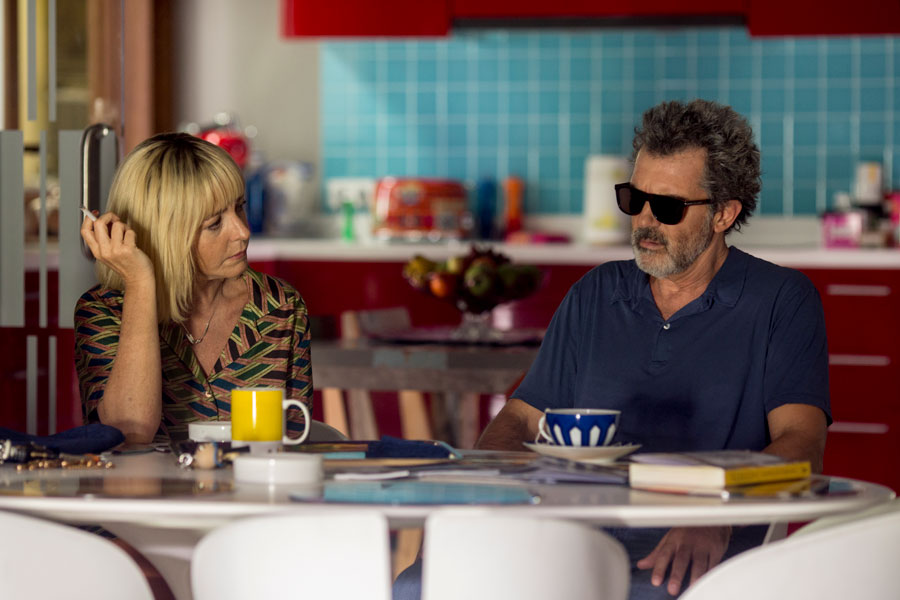
Thirty-two years after his film Sabor (Flavor) came out, writer-director Salvador Mallo (Antonio Banderas) is just coming to terms with it. He hasn’t seen Sabor’s lead actor Alberto (Asier Etxeandia) since it premiered 3 decades ago but the cinemateque has recently restored the film, labelled it a classic, and viewing it with fresh (well, older, wiser, more experienced) eyes, Salvador decides maybe it’s time to bury the hatchet.

It is clear that Salvador is taking stock of his life. He’s not well. But his recollections suggest that his life has rarely been without pain of some kind. As a talented choir soloist, he was educated by the priests and taught his book learning to others. But geography he learned by traveling the world as a successful director. And anatomy he learned through pain and illness. When he reconnects with Alberto we assume he’s making amends but resentments still run hot and what is actually exchanged is heroin.

Antonia Banderas is the picture of a tortured man. Riddled with pain he can no longer make movies. But without shooting, his life has no purpose. To hear those truths is to understand a man who is resigned to the end. His character has come full circle in a lot of ways, a lot of ways that are painfully obvious as a play about his youth is staged and brings out forgotten friends. We learn so much about his fears and motivations and how a man who has made his living telling stories is now grappling with his own. And in many ways, this role brings Banderas full circle from the role that first garnered him attention from American audiences as Tom Hanks’ lover in Philadelphia. This time Banderas is front and centre, earning himself his first Oscar nomination for his restraint, consideration, and tenderness.

Dolor Y Gloria is like a vise on my heart for every shred of his own humanity that master film-maker Pedro Almodóvar pulls from his experience and uses to paint the screen with sorrow and redemption. Using heroin is referred to as ‘chasing the dragon’ but this film chases after so much more: compassion, reflection, grief, making peace. Almodóvar still knows how to engage us, but in this he surprises us, and perhaps even himself, with the authenticity in his unflinching self-examination.

TIFF19: The Sleepwalkers

The Sleepwalkers is about 3 generations of a family spending a holiday at their summer home. The matriarch is contemplating the house, which angers at least one son and pits the siblings against each other. But it is a daughter-in-law, Luisa (Érica Rivas) who has it worst.

Luisa doesn’t want to be there. Unhappy in her marriage, she vents her frustrations to a brother-in-law rather than her husband. There is not enough space in the house for a relationship that’s falling apart. But most of all she’s worried about her daughter, Ana (Ornella D’elía), who is young enough to be getting her first blood, but looks considerably older. She’s already caught the attention of an estranged cousin, Alejo (Rafael Federman), recently resurfaced and apparently without boundaries. Even more concerning, Ana is a sleepwalker like her father. She has recently been discovered sleepwalking nude in her own home, and her mother is understandably concerned about what this may mean in a strange house full of people. But Ana doesn’t take kindly to restrictions, and her moody temperament causes her to lash out at her protective mother, and question just which one of them is truly sleepwalking through her life.

Director Paula Hernández has something to say about the pressure and position of women in the family, but for me it was obscured by camera work that literally made me sick. Almost always, only one main character would be in focus, while everyone else had constant blur. At first it was merely frustrating but after 107 minutes it made me physically uncomfortable – sick. And that’s unfortunate because there were some good bits, some very interesting stuff to be examined, but I felt unable to truly concentrate on it. Perhaps, by taking away my choice in what to look at or concentrate on, Hernández wants to put me in the shoes of a young, stymied woman. But that just makes me feel like she doesn’t trust enough in her script. It left me feeling angry and frustrated and ready to bolt. The two lead female characters keep looking for safe space to unleash, to vent, but I felt denied that myself. I never had the space to orient myself or digest what was happening. I felt like a horse with blinders on.

Luisa and Ana are going through some tense and important times. Their performances are good, restrained, even. Hernández makes their inner turmoil obvious without being obvious. I just wish she could do it without creating so much in me.

Hit-And-Run Squad

Korea is a machine. Honestly, I can’t help but admire the country’s dedication to arts and culture. Decades ago, the government assessed their economic standing and realized that they were vulnerable. If just one of its leading industries failed, it would take down the whole country with it. So they diversified in a way that few if any country ever has: they pumped tonnes and tonnes of money into developing culture – music, television, movies, and video games. South Korea has a population of just over 50 million, but chances are you’ve heard of their boy band invasion (BTS!), you’ve played their games (they’ve mostly developed computer gaming, like Overwatch and League of Legends), and you’ve seen some of their cinema’s best (Bong Joon-ho’s The Host or Snowpiercer or Park Chan-wook’s Oldboy, for example). And this is despite the fact that most of us don’t speak Korean! American audiences have been notoriously difficult to penetrate with foreign languages. They hate subtitles and expect to be able to sing along to everything on the radio. But that’s changing, perhaps in part due to greater inclusivity and appreciation for other cultures, but mostly because the Korean machine is just so damn irrepressible.

That said, it feels like Korea might be poised to take over the world, and I might worry about that a bit if not for this: if the lung cancer doesn’t get them, the misogyny will. According to actual statistics, only about 40% of Korean men smoke (which is objectively pretty high), but in cinema, it’s nearly 100%. But misogyny is definitely 100%. And here’s the weird thing that I’ve been twisting around in my mind. America has a comparable rate of misogyny, it’s just that over here, we have this pretense that abuse should be closeted. We know it happens. If it happens behind closed doors, we can all look away and pretend otherwise. It’s embarrassing when it goes public because then we have to pretend to care. Not actually care. No nonnononono. The justice system makes that clear: we will not intervene until he kills her. Then we will be angry: boo! We’ll put him in magazines and make movies about him, and if he’s handsome then we’ll REALLY shake our heads. But as long as he keeps it quiet and private, we’ll let that shit happen for years. And even if it becomes public, we’re still often sympathetic, and might even vilify the women, for good measure. Mel Gibson, Charlie Sheen, Josh Brolin, Johnny Depp, Alec Baldwin, Michael Fassbender, and Christian Bale have all been accused of domestic violence, and we’ve seemingly given them a pass. In South Korean movies, however, violence against women is a little more upfront. The men are not afraid to toss around a woman like they might toss around any man in a common barfight, or even beat a subordinate who hasn’t done her job well. It’s a lot of equal opportunity violence, whereas over here, we “pride” ourselves on only hurting our wives and girlfriends and daughters in the privacy of our homes. Is that fucked up or what?

Anyway, to the movie. Hit and Run Squad will be a little difficult to summarize, but here’s my lame attempt. Officer Eun Shi-Yeon (Hyo-jin Kong) is investigating government corruption – particularly a case in which a very successful Formula 1 driver, Jung (Jung-suk Jo), is paying off the police commissioner. Tricky. But that investigation gets botched and Officer Eun gets demoted to the hit-and-run squad, where she’s teamed with Seo Min-Jae (Jun-yeol Ryu), an unambitious, spacey looking dude who just happens to be the Sherlock Holmes of hit and runs. And the hit and run squad just happens to also be looking at Jung for an ‘accident’ possibly involving one of his cars.

One thing is abundantly clear: Jung is a very bad dude. But he’s also nearly untouchable. But Eun is persistent and Seo is motivated in his own way; it also turns out that he’s got an interesting past that might start to bleed into the present, with both positive and negative repercussions.

Hit-And-Run Squad is a police procedural, but Korean dramas tend to have it all: comedy, romance, melodrama, highs and lows. South Korea’s primary television export tends to be their soap operas, and a lot of their films feel touched by a telenovela. At one point, this movie was scored overdramatically by a jazzy saxophone accompanied by insistent snapping, and it felt very much Too Much, but you have to look past these foibles in Korean cinema, because it’s not quite how we like to do things here, but if we kept ourselves in the tiny box of American cinema, we’d never have any fun.

The cinematography is pretty great, the car chases feel urgent and dangerous, and it’s fun to see them take place literally anywhere but Atlanta once in a while. The acting was quite good too, or at least the actors were adept at working with what they’re given. While it’s nice to see a female lead, and Officer Eun is undoubtedly the film’s lead and the audience placeholder, she’s the least compelling character, having been given no back story and very little development. She’s overshadowed not just by Jung and Seo, but by a couple of even lesser male protagonists as well. There’s a trio of important women in the film but they’re extremely one-dimensional and depressingly primitively drawn.

Of course, if you’re here for hot cars and top speeds, you likely won’t care that a female officer is reprimanded at work by blows to the head until she bleeds, and that her ability to bleed is one of the few things we know about her. Heck, you might even be into jazzy sax, in which case, more power to you.

The Guilty

How many times in your life have you called 911? I hope the answer is none, but for some of you it will be higher than that, and chances are, it wasn’t exactly a happy occasion. Even if you’re calling on behalf of a stranger, you must believe that it’s an emergency situation, and those tend to be adrenaline-filled and on the harrowing side. I call 911 on a very regular basis, and I’m always grateful for the patient expediency of the person on the other end. Mining someone’s abject panic for important, potentially life-saving information, is not an easy thing to do. Distilling that information into its most salient components while managing someone’s fear and distress takes precision and control. Dispatchers will sound cool and confident on the phone, but that doesn’t mean their job isn’t getting to them. They assist people through the darkest of circumstances. They experience vicarious trauma. The Guilty is one of their stories.

Asger Holm (Jakob Cedergren) is working what seems like a normal shift when he gets a call from what seems like a wrong number. A woman named Iben (Jessica Dinnage) is calling, pretending to be on with her young daughter. Because of his training, Asger manages to ask the right questions in the right way. Iben is making this phone call in front of her abductor, and trying to do it stealthily.

Asger gets more and more attached to the case as he speaks to Iben, to her abductor, to her daughter Mathilde who is not even 7 but home alone covered in someone else’s blood after having seen her mother be dragged violently away. He goes beyond the bounds of his position in order to fulfill a promise to Mathilde to get her mother home safely.

How do you think you’d stack up as a 911 dispatcher? They test for inductive (using specific observations to make broader generalizations) and deductive (using the info you’ve collected to come to a logical conclusion) reasoning, plus memory recall and the ability to read maps and a good old fashioned psych evaluation. And then there’s just necessarily personality quirks like the ability to be still in the face of chaos.

Asger is a flawed hero and not necessarily the best at his job. But he cares about this woman. Tonight, his job goes from hard to nearly impossible. It’s disturbing. The movie will break your heart in a million ways. But if you think it’s hard to watch, imagine how hard it is to live, to take these calls for 12 hours or even 24 hours at a time, day after day, weekends and holidays. It’s a lot to ask of anyone, and Asger is pure proof of the toll this job can take.

Jakob Cedergren is excellent, as he must be, acting almost exclusively against voices over the phone. Through the arc of one telephone call, he experiences a major shift, and almost every high and low on the human spectrum. Director Gustav Moller keeps things very simple and straight-forward, allowing the story’s natural tension to take centre stage.