
On Saturday we brought our sweet little nephews to the Capital Fair, where we watched a stunt dog show, rode rides, played games on the Midway, and visited a petting zoo where the kids and I hand-fed llamas. On Monday I watched a llama get shot, point blank.
Do not confuse The Zookeeper’s Wife with We Bought A Zoo. This is no light-hearted tale. It’s about real-life couple Antonina and Jan Zabinski, who used their posts at the Warsaw Zoo to save hundreds of Jews during the German invasion. Of course I’ve read both The  Zookeeper’s Wife, and We Bought A Zoo, and more recently I was reading another book about a woman who led an underground railroad of sorts to smuggle Jewish children out of the ghetto, wherein the zookeeper’s wife was specifically mentioned. It was an especially brutal place to be during the war. Terrible, unspeakable things happened every day, and it’s kind of a miracle to see\hear these stories about ordinary people who couldn’t live with what was happening, so they didn’t [it’s sort of awful that these words sound very applicable even today].
Glimmers of light do not eliminate all the darkness. The Zookeeper’s Wife is not an easy watch. The film makes the stakes clear, yes for the zookeepers taking enormous risks themselves (they would surely die if discovered), but especially for the people they are helping, who would otherwise be dead – or worse.
Jessica Chastain as the zookeeper’s wife is of course fantastic. There’s no CGI used int he film; those are real lion cubs she’s cuddling, with not a shred of hesitancy. Fitting, I suppose, when she’s sitting in the middle of a war where much scarier things are happening on the streets. WW2-era films always inspire a bout of siderodromophobia in me (the fear of trains).
This movie gets some things right, and some things wrong. In the end, I think it’s just not terrible enough, which I realize is a weird thing to say. What I mean is: it doesn’t have the power to haunt you the way Schindler’s List did (does). It feels a little cold, without the emotional gravitas you’d expect. I expected to cry. What does it mean that I didn’t? Perhaps what this movie needed was a meaningful connection to just one victim. Heroics are all well and good, but they’re only important because they’re necessary. Heroes are only half the equation: both must be compelling.
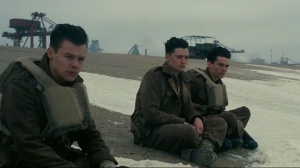 n and must have seemed impossible at the time. That’s more or less what Churchill said, after all: he is not describing a plan to win. He is describing a last-ditch effort to survive when the Nazis try to conquer Britain after they finish in France, and a cry for help to the New World to save the day in that bleak scenario (Canada was, of course, already part of the Allied forces at the time, but the U.S. would not be until
  War is hell, but returning from war is really rough too. As we’ve realized the devastating effects of PTSD and how severely it has affected an entire generation of American soldiers, war movies have more frequently shown us the human effects of conflict. In my view, that is a welcome and long overdue change. I was somewhat apprehensive going into Megan Leavey, because I feared that it would try to glorify or justify the invasion of Iraq. That’s a non-starter for me because there was no legal basis for the invasion or occupation, and no glory to be had over there. You will never convince me that it was a good idea for the U.S.A. (and not just them) to send hundreds of thousands of troops to a no-win situation in the Middle East. Many of those troops didn’t come back and those that did were never the same.
 war, not men in uniform. Politicians run things but don’t bother to check in with the men on the ground, who are operating on the basis of “counter-insurgency”, a losing proposition each and every time. The soldiers can’t distinguish between the enemy and the people they’re trying to protect. The war is a clusterfuck but so is this lazy attempt at satire.
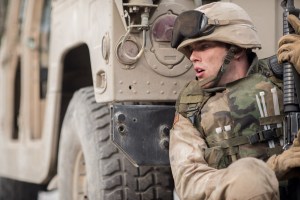 Roessner watched Platoon for the first time in Saddam Hussein’s commandeered palace in Tikrit and it made him want to really pay attention to what was happening around him – it was film school he was hoping to attend, after all. Now he’s among the first of his generation to write a script about his own war.
 decide that since they’re so good at pretending, they may as well get married in real life too. They’re warned that “field romances” rarely prosper, but critics be damned, they marry anyway, with London blitzing away in the background.
 friend Maggio (Frank Sinatra) keeps running into trouble with a stockade sergeant (Ernest Borgnine) with a mean streak. And Prew himself is falling in love with Lorene (Donna Reed). It might seem like normal every day stuff, except you and I know what’s coming: Pearl Harbor. It’s awful to know what’s around the corner for them, how petty all of these problems will seem soon enough, if any of them are left to still have them.
 performances from his cast mates. Burt Lancaster was so nervous to act alongside him he’s visibly shaking in their first scene together. Sinatra was just grateful for the part. You may know that Mario Puzo fictionalized his movie career in The Godfather; a certain studio exec is convinced to hire him after finding his prized horse’s head in his bed. In real life, it was a lot less dramatic: Sinatra was married to Ava Gardner at the time, and she happened to have some pull with Columbia. Or at least that’s the version everyone agrees to.
 lots of naughty projectionists would cut out a slice to keep as a souvenir. Censors demanded that Kerr’s swimsuit be skirted so as not to be too “provocative.” And that wasn’t the only modification made. In the book, the captain’s wife gets gonorrhea from her philandering husband, but that part is conveniently edited out. And in the credits, Donna Reed is credited as a “social club employee” which is 1950s code for hooker. And the military had their own standards to contend with: you couldn’t portray military sloppiness, hypocrisy, brutality…or homosexuality. Not to worry. The gay stuff was also left out, along with all the other juicy bits that led to the novel being called From Here to Obscenity by some. But that scene. The scene on the beach. Makes me want to recreate it when we’re in Oahu today (it was in Halona Cove), but only if I can find a modest skirted swimsuit.
 sure. But beautiful too, in its way. There’s a floating memorial right over top where the USS Arizona lays beneath the ocean. You take a small shuttle boat over to it, and you can walk around on the very spot where it happened. It’s a lovely memorial, sobering as it is built right over the battleship, where 1102 of the 1177 crewmen killed still rest. In aerial shots, you can make out the outline of the ship. Lots of quiet moments to think about this loss of life.
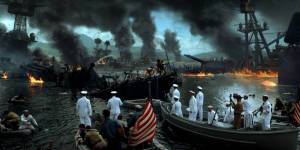 Plus, war and love make us do crazy things. Michael Bay, however, is just the worst choice to convey those things. The 40 minute action sequence: superb. Very Michael Bay. Very explody. It’s even in the Guinness book of records for movie with most explosives used. There’s one shot of 6 explosions in “Battleship Row”, which was staged on real Navy ships. 6 ships, 600 feet each, rigged with 500 bombs on each boat, using 700 sticks of dynamite, 2000 feet of cord and 4000 gallons of gasoline. It took 7 months of coordination, a month and a half to rig them, permission from the government of Hawaii, the EPA, and the Navy, plus 100 extras on hand and 6 planes flying overhead, and 14 cameras to film it and in the end, it was a 7 second explosion that was stretched to 12 seconds on screen. That’s how Michael Bay do.
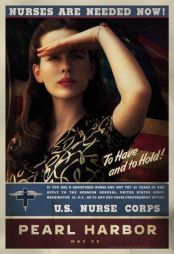 Wouldn’t you like to see Michael Bay and Clint Eastwood in a flag-off? Who would drop first? Pearl Harbor manages to make a spectacle out of a profound moment in history, where blood was shed by real people embroiled in their own acts of love, intimacy, bravery, fear, courage, and duty. But those stories never get told. Instead, Michael Bay offended the Japanese by upping the “barbarism” of the whole thing, which also insults American vets, who would be right in thinking the real event was bad enough. A better tribute to those who died, and those who survived, is found at the memorial, where a 23 minute documentary is shown, and manages in those 23 minutes to be more honest and more informative than Bay’s 183.
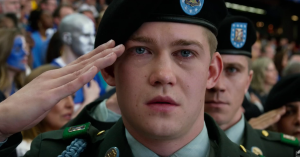 On a snowy Sunday afternoon, Jay and I found ourselves alone in a theatre watching Billy Lynn’s Long Halftime Walk. Having just been reminded on the way to the theatre that this was two time Oscar-winning director Ang Lee’s latest, I thought it was particularly odd for the theatre to be empty, even accounting for the fact that Fantastic Beasts was playing simultaneously on four or five other screens at the multiplex. But by the end of the film I got it. This is just a terrible movie. We shouldn’t have been there either.
 of Destiny’s Child so don’t get your hopes up, Beyhive.
  ASSHOLES WATCHING MOVIES