I can’t even say how sorry I am to see him go.


I can’t even say how sorry I am to see him go.
Slow West tells the story of a young Scot named Jay (Kodi Smit-McPhee doing his best Jay Baruchel impression) travelling across Colorado in search of his lost love Rose (Caren Pistorius). Almost immediately, Jay is saved from bandits by Silas (Michael Fassbender) and from then on, it’s a western version of The Odd Couple, except writer/director John Maclean replaces much of the comedy with despair. The wild west depicted in Slow West (which incidentally is New Zealand standing in for the midwestern plains) is the saddest, loneliest place imaginable. Still, in spite of its melancholy, Slow West manages to be a very enjoyable movie, and even a surprisingly funny one at times.
Going into Slow West, I had one expectation: that the title would have some deep meaning to be revealed during the course of the movie. I was let down in that regard but that was really the only disappointment I had coming out – I still don’t understand the title and feel like there’s something there to get.
Anyway, as far as the movie itself, Fassbender and Smit-McPhee make a very good pair, and that’s fortunate because we spend a lot of time with them as they make their way to Rose. Fassbender gives us a convincing tough guy with a heart of gold silver tin. Smit-McPhee is well cast as the naive, good-hearted foreigner. Ben Mendelsohn, who really impressed me in Mississippi Grind, makes a quick appearance as a scummy outlaw and looks the part. And yes, everything in this paragraph reads like a back-handed compliment, but it’s coming from a good place, I swear.
Slow West climaxes in a shootout. I don’t
think I have to tag that as a spoiler, do I? You knew it was going to happen. The way the shootout plays out, though, is well done and is much different than I expected. It even includes a few surreal moments that worked really well (especially one involving a jar of salt).
Overall, Slow West is a solid, though sad, tale from the wild west. Much like the story told by an old gang member, it entertained me throughout its 85 minute run time with its unusual mix of sadness and death with a hint of offbeat comedy. It’s definitely worth tracking down, and I give it a score of eight wanted posters out of ten.
Like many young Canadians, my first experience of Ryan Gosling (apart from him occasionally

That’s Rachel Wilson in the middle…and Ryan Gosling in the blue suede shoes.
living in my hometown) was not on the Mickey Mouse club but rather an embarrassing teen drama that seemed to only play late at night when anyone who knew better should be in bed. It was called Breaker High and for some reason it was about a high school that just happened to be on a cruise ship. Because that happens! The ship would dock at all kinds of amazing, exotic locations (okay, technically they were all shot in British Columbia) and the kids would get into inoffensive hijinks, like Saved By The Bell, only milder, if you can possibly imagine that (this was, after all, a 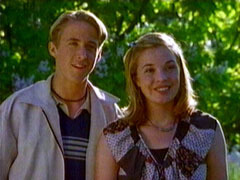 polite Canadian production). It starred Ryan Gosling as a nerdy wannabe ladies’ man – not the heart-throb by any means. And it also starred Rachel Wilson, an actress born right here in Ottawa (not to further the stereotype of all Canadians knowing each other – I’ve really never met her), who I was delighted to rediscover in a movie I just watched called Let’s Rap.
It took me a moment to place her, and I’m sure you know that feeling of…what’s she from? I recently had that very same feeling watching Jewel Staite in How To Plan an Orgy in a Small Town, which makes me think this may be a particularly  Canadian experience, kind of like watching Lost for the first time and realizing Evangeline Lilly finally made it big after a series of embarrassing dial-a-girlfriend commercials.
Anyway, it was nice to see Rachel Wilson all grown up and not playing the “quirky misfit” anymore.
Oh wait.
Well, okay, she may still be playing a bit of a quirky misfit, but in 2016, that’s a title we’re owning and embracing. If skinny Ryan Gosling can grow up to give Brad Pitt a run for his money, then Rachel Wilson will have an easier time of it, having been cute all along.
And in this movie, she proves she’s more than capable of keeping up with a fast-talking script that would wind Aaron Sorkin. Wilson plays opposite Brendan Gall as Melanie and Bo Schnurr, a  brother and sister team who dream of taking their witticisms straight to the big time, carpeting their way to stardom with pop-culture landmines exploding left and right, making puddles out of their Beau’s beer (shout out to Vankleek Hill, hometown of Beau’s beer and my mother’s husband). I’m wary of any movie that credits itself with pop-culture banter, and yet this one won me over quickly. Wilson is too warm and the Schnurr charm proved irresistible – plus, hello, a well-timed Jason Priestly cameo (okay, fine, I admit it: Canada is its own small world).
One of the hands-down best things about this movie is the strong material it’s working with, and that’s a credit to the real-life brother-sister team who wrote it, Jesse and Samantha Herman, who were born and raised in the very city where this film was shot – Toronto.
I asked Samantha a few questions about what it was like to work on this film, and to collaborate with her brother, and she was kind enough to respond.
Jay: Do you think indie screenwriters have to effectively function as a producer in order to get their movie made?
Samantha: Yes, especially for first-time writers. There are so many scripts out there looking for a home and without a proven track record it’s difficult to get other producers’ attention. As your own producer, you also have more opportunity to preserve your material and be involved in the entire production, which is fantastic.
Jay: What would we be surprised to learn is part of your role as producer?
Samantha: I don’t know if you’d be surprised, but since I don’t cook in my real life, I was always shocked by the amount of decision-making, planning and time management pertaining to meals and snacktime. Basically, I learned I should never host a dinner party.
Jay: How did you manage to write this with your brother? Were you in the same room, or were you emailing back and forth from different cities?
Samantha: We started with ideas, jokes and concepts that we could share in person or over  email. But when it came time to actually structure the script and write dialogue we always did that in person. The style of our banter, which can be pretty fast-paced, is simply not conducive to an email exchange. We had to capture the flow together. Plus it’s just more fun that way.
Jay: What’s it like to give up control of your baby to a director?
Samantha: There was a bit of anxiety going into it because the director takes over the driver’s seat with the project. But, we had extremely positive conversations with our director, Neil Huber, during pre-production so that alleviated all the concern. Knowing his sensibility for our style and hearing his great ideas, I knew he would capture the comedy we wanted to achieve. Since I have no aspiration to be a director myself, I was happy to entrust the job to Neil.
If you’re interested in checking this movie out, and you should be, the good news is: it’s available everywhere! It’s now online on iTunes, Amazon Video, Google Play, Vimeo & Xbox; here are a couple of the links-
https://itunes.apple.com/us/movie/lets-rap/id1056898946
https://vimeo.com/ondemand/letsrap
And because Samantha is a particular brand of sweetheart, she included a link to check out a delightful short film produced by the same team called Street Meet – for free: https://vimeo.com/105094852
This was my David Bowie.
Who was yours?
Before Christmas, I questioned Gaspar Noe’s choice to film Love in 3D. While the gimmick of real sex in 3D managed to satisfy my moribid curiousity in a couple of scenes, the feeling that we could reach out and touch them couldn’t change the fact that the characters didn’t act or talk like real people. Love was a dull, lifeless, depressing, and badly translated drama. But it had lots of sex.
Director Wim Wenders (whom I tend to like), also hit the 2015 festival circuit with an inexplicably 3D drama. Like Love, Every Thing Will Be Fine is dull, lifeless, depressing, and badly translated but doesn’t even have the decency to throw a little 3D ejaculate our way. What we DO get- and any Canadians out there might enjoy this- is Rachel McAdams doing a Quebec French accent. Despite the film being set in Montreal, why she would go out of her way to play Quebecoise, I have no idea. There are, after all, lots of English people living in the Canadian city. (I used to be one of them). Whatever her reasons, I’m willing to bet that the Screen Actors Guild did not see this movie or they would have never made the already questionable decision to nominate her for Best Supporting Actress in Spotlight.
Struggling writer Tomas’ (James Franco) relationship with Sara (McAdams) is already not going so great even before his life is changed forever by accidentally running over and killing a small boy with his car. The boy’s mother (Charlotte Gainsbourg) immediately makes it clear to Tomas that she doesn’t blame him but forgiving himself isn’t so easy for Tomas, even after he begins to profit from becoming a much more inspired and successful writer after the trauma.
My favourite Wim Wenders films (Wings of Desire and Paris, Texas) are understated and haunting but Every Thing Will Be Fine slows the pace down to a whole new level. Unsure of exactly, what the director’s looking for, Franco plays it safe by avoiding emoting at all costs. Probably aiming for restraint and subtlety (two qualities I admire most in an actor), he succeeds only at being wooden. He’s not burdened with an ill-advised accent but his performance is almost as embarrassing as McAdams’.
Gainsbourg and real-life Montrealer Marie-Josee Croze (The Barbarian Invasions, The Diving Bell and the Butterfly) don’t come out looking so bad but even they don’t have anything interesting to do. Wenders seems especially committed to losing our interest by constantly disrupting the narrative to jump ahead a year or two, or sometimes even more, whenever there’s even the smallest risk that someone in the theater may find themselves caring even a tiny bit. And the dialogue from Norwegian screenwriter Bjorn Olaf Johanessen feels badly translated into English and is already being compared to Tommy Wiseau’s The Room.
I was not able to catch a screening of Every Thing Will Be Fine in 3D so I have no idea exactly what Wenders was going for by shooting in 3D. I do know that I’ve seen 3D summer blockbusters that had more heart than Wenders’ painfully dull drama.
If you’re recovering from surgery like Jay is, it’s nice to have Netflix available to pass some of the time. The trick is finding something worthwhile among all those options.
Last night we tried twice to find a hidden gem, with mixed results.
The first movie we tried was Slow Learners. Starring Adam Pally and Sarah Burns, Slow Learners tells the story of two geeky teachers who make a pact to change themselves over their summer vacation in order to improve their dating lives. Naturally, it gets super awkward, super fast, to the point where Jay couldn’t bear to watch Burns attempt a southern accent to make herself more interesting. We eventually fast-forwarded through that part, after initially stopping the movie.
The fact we came back to this movie after stopping it is something positive, but that’s really the best that I can say about Slow Learners. It’s not terrible and there are a few good bits, but overall it’s really shallow, really predictable, and only moderately watchable. I give Slow Learners a score of four random literary quotes out of ten.
While we were on a break from Slow Learners, we took a look for something less awkward and settled on People Places Things, starring Jemaine Clement (Netflix recommended the movie because we watched Slow Learners, oddly enough). Jemaine does his usual quirky Kiwi thing in People Places Things, and I for one find him hilarious almost no matter what else is going on.
In People Places Things, Jemaine plays a semi-starving artist who understandably has a hard time coping after discovering his spouse is cheating on him (which happens in the middle of their twin girls’ fifth birthday party, no less). We catch up with him one year after that party as he tries to move on or make up or…really, he’s not at all sure what he wants and I liked that. People Places Things is clearly more about Jemaine’s journey than his ultimate destination.
I’m happy to report that the journey is entertaining, fairly cliche-free, and full of interesting characters. I really liked watching the discovery process play out for Jemaine’s character, and I enjoyed this movie all the way through. I give People Places Things a score of seven trips to Astoria out of ten.

Last month, we got a Facebook message from a very brave filmmaker. Jaschar L Marktanner invited us to watch and review his short film, voluntarily facing the wrath of not one but three admitted Assholes. How fun it would be to pan AUFDRUCK (LABEL in English), from a writer-director so boldly putting themself in the hot seat.
Imagine my disappointment when I actually enjoyed it. LABEL is only four minutes long so a spoiler-free description is a unique challenge for me as a reviewer. I think (and hope) that Jaschar won’t mind me telling you that it’s shot in black and white, which is an excellent choice, partly because it adds to the French New Wave feel. In their first IMDB credits, Kira Mathis and Mary Krasnoperova play two women in a coffee shop describing a mutual acquaintance as a “son of a bitch”. Labelling and complaining with a friend over coffee may seem like a pretty universal experience but it soon becomes clear that these women use the label pretty liberally, as the conversation becomes more and more absurd.
LABEL is funny, gradually upping the ridiculousness as it follows the structure of a really good comedy sketch. Marktanner’s film has more to offer than just laughs though with what I read as an effective critique of modern fatalism. I am happy to report, however, that he has generously given this Asshole one thing to grumble about. Speaking no German, I was forced to watch LABEL with English subtitles which were colour-coded depending on who was speaking. I found the dark red to be difficult to read against the black and white background. Once or twice, I had to pause it to avoid missing a single word. There, I said it.
Overall, LABEL is well worth your time and I am grateful to Jaschar for sharing it with us.
Jay here. I’ve been MIA for a while and most likely will be for a bit more. Back surgery and its sidekick morphine have indisposed me for writing movie reviews.
Anyway, Black Mass has been kicking around for a while now, generally disappointing folks despite its all-star cast and generous dash of promise. It basically tells the incredible story of  James ‘Whitey’ Bulger (Johnny Depp), and how he ran Boston from the underground for years, in part because of a brilliant “alliance” with the FBI. An old childhood friend (Joel Edgerton) has conveniently made a name for himself at the FBI and he convinces his boss (Kevin Bacon) that Bulger will be a useful informant. The information flows both ways though, with Bulger constantly evading investigation, and Bulger divulging details already known to the FBI by other means.
Benedict Cumberbatch plays Bulger’s brother, Billy, a successful state politician. Suspicious? Well nobody at the FBI seems to think so, until there’s a new kid in town, Corey Stoll, who starts asking some incredulous questions, like how on earth has a notorious psychopath and criminal with ties to the IRA never ever been investigated? Why indeed.
So things fall apart for Bulger, although never as spectacularly as they do for everyone around  him (including Jesse Plemons, and can we just call him what he is: low-rent Matt Damon), and Rory Cochrane (bloated for this role, it’ll kill your Empire Records fantasies right quick), and Peter Sarsgaard (who once did an SNL skit where he was attending a pirate convention, and all the attendees really relished overpronouncing his name – PetARRRRGGGHHHH SAAAARRRRRRsgAAAAARRRRRRD, and now I am forever doomed to do it myself).
Maybe the biggest problem with this movie is that it crammed too many names under too small  a marquee. There just isn’t enough to keep everyone busy, and at the end of the day, this feels like a pretty standard mob movie, with Scorsese wannabe undertones. It fails to distinguish itself. The relief, though, is that Johnny Depp remembers how not to be a cartoon. It’s not any great relief though, since this is Depp’s fourth, FOURTH, time portraying a real-life gangster. Even my dogs have learned the trick by the fourth repetition.
You will not find a bad movie here, just a very tired one, but I guess it allowed a lot of Hollywood types to tick off MOB MOVIE on their SAG Bingo card, and if that’s not a good reason to make a movie, then I don’t know what is.
I Smile Back is tough to watch from the start, and it only gets worse. It tells the story of Laney (Sarah Silverman), a housewife struggling with “drugs and daddy issues”, whose primary question of her therapist is, “which do you want to talk about first?” Laney is married with two young children, so her apparent drug and sex addictions are significant problems for a whole number of reasons.
I am by far the least qualified asshole to diagnose Laney, being the only one who’s not a mental health professional. But since Jay’s in a pain and morphine-induced haze right now, and Matt hasn’t seen the movie, you get stuck with me as your tour guide! So here we go.
First, the easy part. Silverman is excellent in the lead role, and is well-deserving of the acclaim she has received so far (nominated for a SAG Award for Best Actress). I found her very believable as a woman who loves her family and truly wants to be part of it despite struggling with all sorts of stuff. That Silverman is so good makes the movie all that more difficult to watch.
Beyond that, it gets much tougher. Because of how difficult the movie is to watch, looking at I Smile Back critically is very hard for me. I did not like watching it but I know I was never supposed to. Nothing that happens in Laney’s life gives us a lot of hope that things are going to get better, and the movie does not end on a happy note (in fact, at the end things are at their very bleakest). Silverman has made us care about Laney by then. I wanted Laney to get better and repair her relationship with her husband Bruce (Josh Charles), so I was hoping for a typical Hollywood ending.
Suffice to say, I did not get a happy ending, and after reflection I think that was the right decision by writers Paige Dylan and Amy Koppelman (the latter of whom wrote the book on which the movie is based). But something still was missing, and after staring at this computer screen for a while, I think I have put my finger on it. In a meta sense, the movie is worthwhile because it gives Silverman the chance to show a whole other dimension to her acting. But within the movie itself, I Smile Back didn’t give me anything meaningful.
The only meaning I can find within the movie is that anyone may be struggling with mental health and it’s not easy to recover even if he or she really wants to. And while that’s something I agree with, it’s something I already felt coming in and the story in I Smile Back really didn’t go beyond that basic notion. Everything in the movie was consistent with that idea but it felt like we were on a fixed path because of it. Looking back, almost all the characters we meet other than Laney are primarily plot devices to give Laney a chance to make another bad decision, and she rarely misses the opportunity. The opportunity that feels missed is on the part of the writers, who rather than fleshing out characters or situations, just keep things moving by giving Laney more chances to do bad things. Because of that, I never felt that seeing these awful things happen onscreen was worth the pain. I never felt any payoff for my discomfort within the movie and I needed there to be something.
Overall, this movie was worth checking out for Silverman’s performance but it’s really not great otherwise. I give it a score of six out of ten.
Charles Schulz’ Peanuts is a comic strip that I grew up with. Charlie Brown and his trademark shirt, Lucy and her advice stand, Linus and his blanket, Schroeder and his piano, and Snoopy and his doghouse – these images are forever ingrained. I expect most of you had the same experience, as the Peanuts were everywhere, including lunchboxes, greeting cards, TV specials, pajamas and sheet sets, and everything else possible. Snoopy Sno-Cones, anyone?
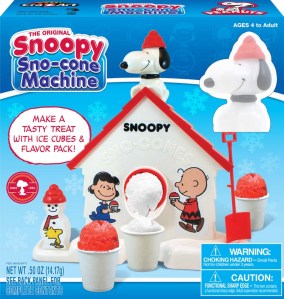
Charlie Brown says, “I hope you like red flavour, because otherwise you’re just eating ice cubes!”
The heart of the Peanuts empire was the comic strip, and the love that went into that makes it impossible for me to be too cynical about all the rest of the merchandise that was churned out. Charles Schulz loved these characters and as a result, I loved reading about their little adventures from the day I was old enough to locate the comics in the newspaper index, to the day I moved out of my parents’ house. The Peanuts was a landmark comic strip from start to finish, as Jay wrote about in an excellent piece a few months back.
That was way back on The Peanuts Movie’s opening weekend. It has taken until now for me to get around to watching it, mainly because despite how good it looked visually, I kept hearing that The Peanuts Movie didn’t have the comic strip’s heart. The heart that made the Peanuts so special. And now, having seen The Peanuts Movie for myself, my takeaway was that the Peanuts’ heart stopped beating when when Charles Schulz’s did (RIP).
The Peanuts Movie is not bad. It’s well animated and there’s a basic, tolerable story guiding us through the 80 minute-ish run time. And during those 80 minutes we see and hear lots of things we would expect to find here, like the adults’ trombone voices and the characters’ relationships, like Lucy loving Schroeder and pulling the football away from Charlie Brown. But those are the highlights and it quickly became clear that the best parts of this movie are good mainly because they remind you of the comic strip.
Seeing all these old standbys tied together by a basic plot felt strangely similar to Star Wars: The Force Awakens, and my complaint here is the same. Making me nostalgic is neither enough to make me enjoy your movie, nor enough of a reason to have made the movie in the first place. I would have been better off thumbing through a trade paperback of old strips than watching The Peanuts Movie.
So that’s what I would suggest to you: skip The Peanuts Movie and go straight to the source, Schulz’s old comic strips. Because those strips are pure magic while The Peanuts Movie only scores six zig-zag striped shirts out of ten.
 ASSHOLES WATCHING MOVIES