
According to Samoan legend, two goddesses intended to give tattoos, traditionally called “tatau”, to the Samoan women, but on their long swim to Samoa from Fiji the goddesses got confused and gave tattoos to men instead. Marks of Mana offers a look at a number of women who are now reclaiming the art of tatau for themselves as well as for the memories of their ancestors, and reporting these tattooing ceremonies as being a life-changing experience.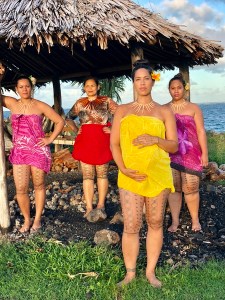
This documentary begins in Samoa, naturally, as we meet a female chief and her family of seven (grown) children. One of her five daughters is about to get her malu, which is a thigh tattoo only for women that is both a coming-of-age moment and a ceremonial recognition and affirmation of a woman’s connection to her ancestry. Meeting this family emphasizes the historical standing of women to Samoa’s indigenous people, as equals and leaders rather than as less than men. Similar longstanding “progressive” attitudes are on display at other South Pacific locations as well, such as Papua New Guinea, as it’s a consistent theme that women’s tattoos signify their knowledge and power within their societies.
Of course, the power that women traditionally possessed in those societies was suppressed, stymied and rejected by the island’s colonizers, who saw no problem with imposing their backwards, misogynistic cultures on the Samoans. The absurdity of that transaction and the colonizers’ arrogance in forcing their values on the Samoans and others is subtly displayed by this film in each of its segments, and nicely displaces the false narrative that colonizers were welcomed by the colonized because they improved the colonized societies with their intrusion.
The version of Marks of Mana shown to me was unfinished (the main omissions were subtitles and one segment out of five). Having seen the work in progress, I am eager to see the finished product because what has been created so far is a valuable, enlightening and uplifting look at the ceremonial aspect of Polynesian tattoos and the healing power of reclaiming one’s cultural traditions.
Marks of Mana is screening as part of Toronto’s ImagineNATIVE Film & Media Arts Festival on October 19, 2018 at 11 a.m. at the TIFF Bell Lightbox.
 Aboriginal people have been through a lot, historically, and still. Snatching children from out of their homes is among the most destructive of them. It breaks down their culture, their language, their family ties. It robs them of identity.
 Pariah is one of those unassuming movies that punch you in the gut. It’s written and directed by Dee Rees (
 Malkin (Oscar Isaac) and company manage to pick up Eichmann (Ben Kingsley) thanks in part to his indiscreet son who still hates Jews all the way from Argentina. They sweat it out in a safe house. For safe travel they require Eichmann’s signature, and Malkin vows to get it. The interrogation is heated; Eichmann is emotionally manipulative and he knows exactly which buttons to push. The agents have agreed to bring him back to Israel for a public trial, but not killing him proves to be a very big challenge for almost every single one of them. Eichmann knows this trial is not likely to rule in his favour, so he delays endlessly, which is also to the benefit of the Nazi rescue party determined to find him.
 because it was difficult, or because he was unsure. He’d quit because he couldn’t reconcile the two halves of himself: the need to be strong AND be a woman. In his male skin, he needed to be the biggest, the most muscular, but as a woman he wanted to be petite. When he cut weight, dieted and stopped lifting, he deprived himself of his friends, his support system, the world he knew and the lifestyle he loved. Muscles were a security blanket of sorts. It’s hard to let those go.
 last drop out of this respite. The trains and buses upon which they rely are predictably unpredictable, and Stevens is just a little too trusting, a little too good-hearted. Joan does not have this problem.
 a bearded dollar bill and a goat. Those pieces form the heart of Seder-Masochism, a unique look at the story of Exodus from the perspective of a couple lapsed Jews.
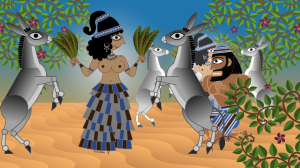 resolve the conflict between the Jewish God and the goddesses, but she does an excellent job of highlighting that conflict in the sunniest way possible.
 would have been a five minute drive up the road, wit both he and his bride making it back in time to cut the cake at their reception. Throw Thadeous into the mix and all you’ve got is a stoner period piece that’s a vehicle for Danny McBride. I mean, Your Highness looks pretty great, truth be told. It’s got a big enough budget to go through the motions. But McBride’s humour is stunted. It’s like he’s always writing for 12 year olds. And, sure, the first time you hear milady say the f-word it makes the tips of your ears blush, but you can’t build a whole movie on just out of place rude humour. Well, okay, point taken – apparently you can, and apparently Universal will pay you 50 million dollars to do it – but there isn’t a mammal on Earth who shouldn’t have seen this flop coming a mile away.
 there. But does he? Oh no. He does not. He becomes obsessed, scrutinizing the photos for every tattoo, every freckle, every…clue? And then he takes more pictures. Subgirl (Meital Dohan) leads an interesting life that seems to get more and more perverse. Would that excited you? Are you an exhibitionist like Subgirl? Or are you a voyeur like Theo? What would it be like to stalk someone with your camera? To film them in such compromising poses? To know that in a way, they are performing just for you. Sexy? Creepy? Both?
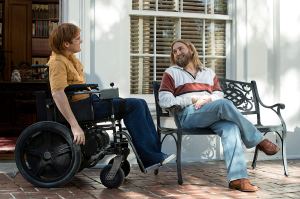 Callahan is injured enough that he cannot grasp a pen but he manages somehow to manipulate a felt-tip pen between two mangled hands and he finds inspiration in his life to create funny, and often controversial cartoons. His student paper sees fit to publish him and from there he develops a national following.
 ASSHOLES WATCHING MOVIES