

According to a classification system that goes unexplained in the film, a close encounter of the first kind would be a UFO sighting. The second kind is finding proof of alien life. The third kind, as you likely know, is making actual contact with aliens themselves. A fourth kind has since been named and might have applied had Spielberg known of it; the fourth involves alien abduction.
Close Encounters very nearly featured what would have been early attempts at CGI. Director Steven Spielberg hired animator Colin Cantwell to create a CGI test of three UFOs floating over a stadium. The single-shot test took three whole weeks to complete, which immediately ruled it out in terms of the film, but it was one of the first computer generated images ever created for a film.
Spielberg’s next idea was even crazier. He wanted his aliens to have a gliding mobility (easily distinguished from human bi-pedal walking). So the obliging production team rigged up a grey spandex suit, slapped it on an orangutan, and put that orangutan on roller skates. What could go wrong? Well, turns out, it was a pretty smart monkey who knew a bad idea when it was strapped to his feet, so he sat down, removed the skates, and deliberately crawled to his handler.They never even got a screen test out of him.
After the monkeys came the mimes: they filmed the aliens mingling among human technicians played by mimes moving in slow motion so that when the film was sped up, the aliens appeared to be moving really fast while the technicians appeared to be moving at normal speed. They scrapped this too.
Finally the resorted to kids. It’s 6 year old elementary school girls (who move more gracefully than boys, Spielberg thought) in those costumes made especially for them and heavily backlit to achieve the proper silhouette. Cinematographer Vilmos Zsigmond overexposed the scenes so they would appear fuzzy and diffuse, and this helps them not look like little girls in rubber suits. Although, some of the shots in the climatic scenes are miniatures: the bright light coming out of the ship was created by a set of Christmas lights strung up on the back of a metal plate, behind little tiny alien figures. This was composited into a shot with real-life actors.
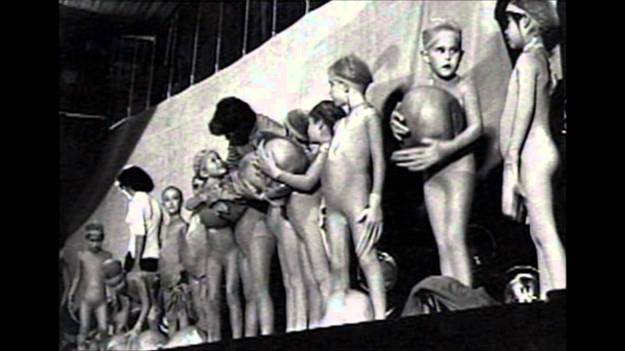
A special 9-foot version of the mothership was built for that one spindly-legged alien which appears briefly, spreading its arms in a peaceful gesture. That was a marionette prototype made by puppeteer Bob Baker. The marionette idea was nixed but “Daddy Long Legs” made it into the film.
But what about that final farewell where the alien signs the musical notes back to the humans? For that, Spielberg recruited a special effects artist by the name of Carlo Rambaldi who created a fully articulated steel, aluminum, and fiberglass animatronic puppet that Spielberg nicknamed “Puck.” Puck’s expressions were based on photos of Cary Guffey, the child actor who plays little Barry. The puppet was operated by a crew of seven puppeteers, with Spielberg himself controlling the final articulation before the alien leaves to go to the mothership.
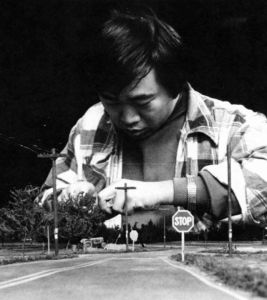
Greg Jein
Incidentally, the aliens were meant to appear to be floating around in their ship, it being zero gravity or thereabouts. Even Roy was supposed to be seen to float into it as he approached. But the crew just couldn’t hide that many wires. They did, however, achieve weightlessness for Richard Dreyfuss in an early scene in his pick up truck. the truck was put on a turntable and flipped 360 degrees!
[During filming, Spielberg kept ruminating on Puck and wondered “What if this little guy didn’t get back on the mothership?” – that, of course, was the germination of E.T., whom Rambaldi would also go on to design.]
A note on those musical notes, which aren’t really a practical effect per se, but are such an iconic but humble sequence, we can’t not talk about composer John Williams’ brilliance for just a moment. Williams and Spielberg worked together a year before shooting even began to make sure they had the perfect sequence. Williams was originally working with 7 notes but since they wanted a simple greeting, they pared it down to 5 notes. Williams whipped up 100 permutations based on the Solfège system of musical education and together they whittled it down. Tuba player Jim Self is the “musical voice” of the mothership in the final edit.
A second note on how to get a great performance out of little Cary Guffey who’d never acted before. Spielberg has of course gone on to work with loads of child actors, but Guffey is among the youngest. Spielberg would unwrap presents just out of view of the camera so that Guffey would smile and point (you can also hear him excitedly shout “Toys! Toys!”). To get him to show fear, he had two crew members dress up in costumes. A false cardboard wall would drop, revealing a clown, and the poor kid would frown in surprise. Then a second wall drops, revealing a gorilla, and that was pretty scary. So the gorilla whips off his mask, revealing friendly makeup man Bob underneath and ta da – you got yourself a performance, or at least a series of emotions that look very real on tape.
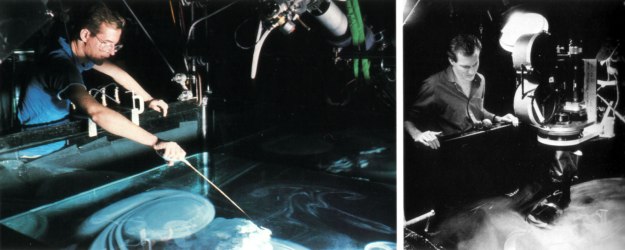
Douglas Trumbull was the visual effects supervisor on Close Encounters of the Third Kind who came up with techniques for this film that would lead to advances in motion control photography, which is how you combine pictures of miniatures with pictures of full-scale elements.
The mother ship was designed by Ralph McQuarrie and built by Greg Jein. Its aesthetic was inspired by an oil refinery Spielberg saw at night in India. Instead of the metallic hardware look used in Star Wars, which was coming out the same year, they emphasized a more light-heavy, luminescent look for the UFOs (Dennis Muren, who’d just finished up with Star Wars, put a tiny R2-D2 on the underside of the mothership). One UFO model was an oxygen mask with lights attached to it. They experimented with all kinds of ordinary objects that had interesting shapes. The miniatures were filmed in dark, smoke-filled rooms so their lights would cut through the fog and look super cool.
Douglas Trumbull created the cloud effects by injecting white paint into tanks half filled with salt water and half filled with fresh water.
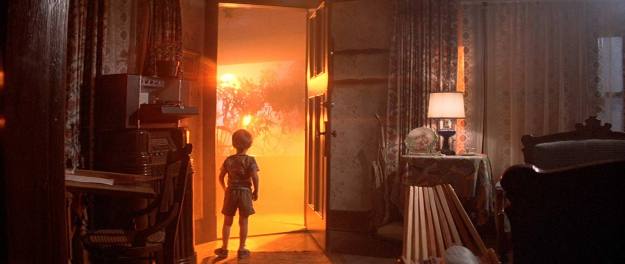
When asked in 1990 to select a single “master image” that summed up his film career, Spielberg chose the shot of Barry opening his living room door to see the blazing orange light from the UFO. “That was beautiful but awful light, just like fire coming through the doorway. [Barry’s] very small, and it’s a very large door, and there’s a lot of promise or danger outside that door.”
 charming and sweet, handsome and approachable. Franky doesn’t question his identity, he just absorbs it as part of it. It doesn’t need a label or a judgement. But there is a complication: Franky’s father (Kyle MacLachlan) has recently left the family because he’s gay. Franky’s resentment is mostly due to the abandonment and not the sexuality, but his feelings are complicated and confused and it makes dealing with this just a little harder than it has to be.
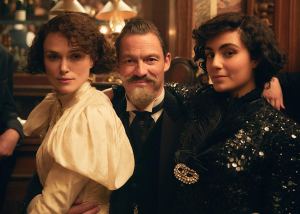 criticizes it for being too feminine and “full of adjectives” he signs his name to it and sends it off to be published. Of course it gets gobbled right up. Does Willy eat crow? He does not. He celebrates “his” success without a trace of irony and then gets mad at his wife for “implying” that she wrote it. Which, again, she did. This book does worlds better than any of his ever did so he’s eager to keep the gravy train going (imagine an actual gravy train! what a weird expression, especially since the carafe gravy is traditionally served in is called a boat). Anyway. He can’t help but lock her in a room until she produces another best-seller. It’s only logical! And she does. And when, oodles of success later, it begins to chafe and she suggests getting at least partial credit, her name alongside his, he bucks. Preposterous! Women writers don’t sell, he reminds her.
 about it. It’s a documentary about two guys who discover, quite by accident, that they are twins, separated at birth. They were both adopted and had no idea they had a look-alike brother until mutual friends confused them when they both wound up at the same college, which is amazing enough. Their story goes national: it’s the feel-good story of the year, two 19 year old boys jubilantly reunited. And of the millions who catch sight of their front-page story is a third identical stranger. They are not twins, but triplets.
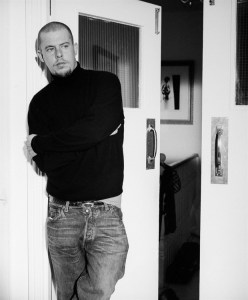 Lee’s flair for the dramatic meant he put on a damn good fashion show. Between his theatrical catwalks and his astonishing creations, he made a name for himself very quickly, very young. London loved to call him their own fashion bad boy, but he was nearly rejected by couture’s real epicentre, Paris, for being of the wrong cut. He was crass, he was lower class. He didn’t look the part or dress the part. Luckily fashion icon Isabella Blow discovered him, and through her, so did the world.
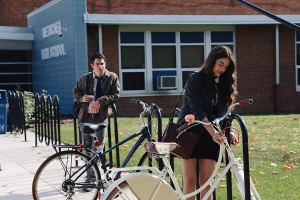 with the ostracizing and vilification of Abigail. Mr. Woods sees a lot of quiet talent in Abigail, and his singling her out for praise and attention only drives Melissa to more cruelty. But it’s ice to see Abigail being appreciated by someone, even if it’s her teacher. Until it’s her teacher’s, um, lips doing the appreciating, and that becomes problematic. Mostly for Melissa, oddly, who is insane with jealousy. To be clear, Melissa has every guy in school running after her, and she doesn’t want Mr. Woods. She just doesn’t want Abigail to have anything except Melissa-inflicted misery. And maybe she can’t stand to have anyone choose someone besides her. You’d have to invent a word above self-involved for the likes of Melissa.
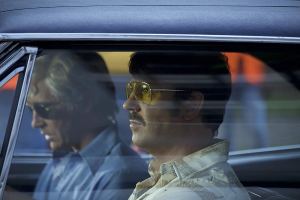 gravitates to him as he steals every scene. DeLorean could turn it on when he needed to, and that charisma bleeds through Lee’s performance – it’s only thanks to Sudeikis’ presence that I remember this isn’t a documentary.
 ASSHOLES WATCHING MOVIES