Monthly Archives: March 2019

Mortal Engines

I can see how this might be a pretty cool idea on paper, and might have succeeded as a novel, or better yet, a graphic novel (in fact it’s a whole series). But as a movie, it’s really just a bloat of CGI and very little narrative. In the years beyond civilizations collapse (presumably), London is now a predatory city on wheels. So, you know, a very large monster truck of a city that…eats other hapless cities? The why and when and who and how are all vitally important but completely neglected. We’re simply thrown into a story already in progress with all the juicy details left out. Even Michael Bay devotes a full 30 seconds of exposition about where the Transformers come from and why they care so much about dumb little Earthlings. This movie just drops you into the middle of a battle scene expecting you to care but not really caring itself whether or not you do.

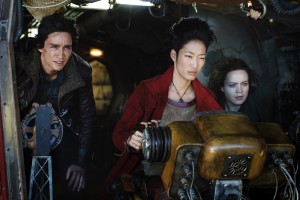
Film Title: Mortal EnginesHester Shaw (Hera Hilmar) is a young woman with a scar and a secret. When her little city is devoured and destroyed by London, you might think she’d be crushed herself -emotionally if not physically. The rest of her citizens become refugees on London, but it turns out London was Hester’s destination all along, and she’s come to strike down its primary architect and greatest celebrity, Thaddeus Valentine (Hugo Weaving). We don’t know why Hester is so dead set against the celebrated Valentine, but her cause is joined by nerdy Tom (Robert Sheehan) and a dangerous outlaw named Anna Fang (Jihae).

Mortal Engines is crowded with visuals but devotes no time to character or theme. It’s so busy setting itself up for future sequels it forgets to be good right now. The actors aren’t bad but they’re main preoccupation is jumping over steampunk set pieces, with little else to work with.

Mortal Engines wants to be, and could have been, like Mad Max meets Snowpiercer, except those movies are good and this one is just 129 minutes that would have been better spent feeding quarters into a broken vending machine.


The Highwaymen

In 1934, the infamous criminal duo Bonnie & Clyde were seemingly unstoppable. Their crime spree was turning more serious and their body count higher each day. Though they enjoyed almost movie-star status in certain circles, they were an embarrassment to the law enforcement they continued to evade – including Hoover’s FBI men.

The Texas Rangers have long since been disbanded – too lawless, too unsupervised. But Lee Simmons (John Carroll Lynch) manages to convince Texas governor Ma Ferguson (Kathy Bates) that since her new police force has proved ineffectual, perhaps what is needed is just a couple of highwaymen, doing things the old fashioned way.

Frank Hamer (Kevin Costner) chafes in his retirement, and though he hasn’t even held a MV5BMjM2NDg5NjQzMV5BMl5BanBnXkFtZTgwMzMyNzI5NjM@._V1_SY1000_SX1500_AL_gun in his hand in years, he doesn’t take much convincing. Maney Gault (Woody Harrelson) is a little more reluctant but pride is a tricky thing.

Following Bonnie & Clyde’s bloody trail is a complicated thing. These criminals are hailed as heroes by some, protected by family and friends. The men discuss whether they could shoot a woman, if it came to that. Neither really want it to come to that, but a job is a job is a job. It’s morally muddy ground maybe, but the script is a little shy about saying so, so it merely tiptoes around these dirty puddles, relying too heavily on the grizzled buddy-cop dynamic of Costner and Harrelson. And it’s not a bad dynamic at that: the two do a good job of seeming beaten down by their lives and their choices. But the movie plays it safe, and frankly, sometimes boring. Well, not boring, exactly, but not nearly as jittery and exciting as you might think literally any movie remotely associated with Bonnie & Clyde would be. But that’s the rub, isn’t it? Police work isn’t all car chases and whizzing bullets. Nor was Bonnie and Clyde’s life of crime nearly as glamourous as it was made out to be at the time. The actual truth is lost to us – no witnesses are alive today, and those that talked at the time tended to conflict each other’s stories quite a bit.

I imagine this movie will appeal most to a certain demographic: those inclined to beaten-up recliners and canned nuts. It’s a bit of a dad movie.

Second Act

I didn’t expect to like Second Act. I didn’t expect Second Act to be good. But I definitely didn’t expect Second Act to be so monumentally stupid.

It shouldn’t be too much to expect the writers of a big studio release to do some research and get at least up to a basic level of knowledge on the major plot points of their film. But that clearly IS too much to expect, because Second Act, a film about an outsider crashing the 1%’s corporate party, literally gets everything wrong about business when, after taking some creative liberties with her online profiles, Jennifer Lopez’s character, an assistant manager at a grocery store, secures a consultancy at a fake multinational company. A fake multinational company which seems to have its own skyscraper in Manhattan and which has made numerous questionable decisions, including having its R&D located in the same Manhattan skyscraper at its executive offices, categorically banning the use of non disclosure agreements, and making product decisions based on thirty-second presentations from two teams of four pitted against each other in a spontaneous three-month-long competition at the insistence of Lopez’s main rival. None of those things would or could ever happen because they are insane, but they happen in Second Act because that’s what the plot requires.

If that wasn’t infuriating enough, Second Act ALSO gets everything wrong about parenting, teen pregnancy, abortion and adoption, which should probably be tagged with a spoiler alert if I thought anyone would care.

And just in case I hadn’t been turned off by those shortcomings, Second Act throws in some needlessly cheap “comedy” including Jennifer Lopez taking a tumble during what should be a triumphant exit, and an exploding flock of doves released during Team Lopez’s product presentation.

Please don’t reward Second Act’s laziness and idiocy like I accidentally did after failing to find something for us to watch on Netflix earlier this week. I know you are better than that and will continue to say “no” to monumental stupidity. Say “no” to Second Act.

Us

“Why is nice Jordan Peele making such scary movies?”

As is often the case, Jay’s question is one that I can’t answer. But f you thought Get Out was too much, like Jay did, you will want to skip Us altogether. Maybe see Captain Marvel again while you wait for Dumbo, because Peele has clearly decided he’s made us giggle enough and now his goal is to induce heart attacks instead of belly laughs.

And yet, I still have to tell you to see it, even though you will kind of hate every minute. Us is just too good to miss. Like Get Out, there is a lot going on under the surface of Us, and like Get Out, it works as a thriller so if you want, you can ignore all the subtext and just enjoy the ride, or cringe in terror until the ride ends. In Us’ case, the ride is both metaphorically and literally a hall of mirrors, as a vacationing family is forced to face off against their evil twins. It’s like goateed Spock four times over, only in Us it is clear that the family from the mirror universe is out for blood and won’t stop til they get it.

Peele writes, directs and produces here, and in his sophomore outing as director he has already proven to be a monumental talent. He doesn’t appear as an actor but he’s imparted many of his mannerisms to Winston Duke, the family’s easygoing dad who seems more than anything is excited to get out on a rented motorboat that hangs slightly left. Duke provides a welcome dose of comic relief even as he does whatever is necessary to protect his family. He is equal to Lupita Nyong’o, and that’s the best anyone can ever do, because she brings it every time. Shahadi Wright Joseph and Evan Alex, as their kids, are both great as well. It’s awesome seeing them work together to survive as the stakes get raised higher and higher by the minute. Even more impressively, those four, and almost everyone in the movie, play dual roles, and there’s not a weak link to be found.

Us is one of those rare movies that stands above by being better executed, more thoughtful, and shamelessly cleverer than the rest of its genre. And like Get Out before it, Us is not a typical Oscar contender but it better get some attention next February. Because Peele and company deserve to be praised for what they’ve given us with Us: a brilliant film that manages to be brutal and restrained, and one that 24 hours later I still haven’t fully digested or shaken.

The Dirt

You may not even believe that the dudes of Motley Crue are literate, but in fact, they released their Confessions of the World’s Most Notorious Rock Band in 2001. The chapters (because yes, of course I’ve read it, I’VE READ EVERYTHING) alternate between the guys, and everyone’s got a version of the story they’re selling. Lots of the details conflict. In fact, lots of the big stuff conflicts too, but that’s part of the book’s charm. The guys sort of interact within its pages, rebutting each other’s alternate versions and extolling their own. The Dirt is even dirtier than you’d imagine.

So it’s kind of surprising that it took someone this long to make a movie out of it, but Netflix has, and it’s ripe for the streaming. 

The film alternates its point of view between the band members but the story is a little more cleanly told than it is in the book. And while almost by definition the antics are somewhat toned down, you’ll still get plenty of the sex, drugs, and rock n’ roll that Motley Crue was known for. In fact, you won’t have to wait more than 3 minutes to see a woman squirting. Stay tuned for the heroin overdoses, vehicular manslaughter, and anonymous head.

Nikki Sixx (Douglas Booth), Tommy Lee (Machine Gun Kelly), Vince Neil (Daniel Webber), and Mick Mars (Iwan Rheon) have some stories to tell. Tommy’s wholesome upbringing contrasts sadly with Nikki’s, while the other two get lost in the dust. The truth is, the 107 minute run time is brisk, and gives more screen time to trashing hotel rooms than it does to insightful backstory, because this is what draws the audience to any Motley Crue show: not the lessons learned or the underdog story, but the fights fought loud and proud and bloody. You come for the famous girlfriends and the venereal disease and the mountains of dope and the increasingly inventive use of leather. And fear not: director Jeff Tremaine delivers. He does best with those scenes of complete debauchery than he does with stitching them together into some cohesive story. And weirdly, the music is very nearly an afterthought. But if you’ve come for The Dirt, I promise you, you’ve found it.

Something Borrowed

Rachel (Ginnifer Goodwin) and Darcy (Kate Hudson) are lifelong best friends. Rachel is the goodie two shoes, the more reserved, quiet, wallflower of the two, and Darcy is of course attention-seeking and wild. But Darcy is, nevertheless, the one who is getting married to Dex (Colin Egglesfield), Rachel’s friend and secret crush from law school. No matter how many study sessions they enjoyed together, Rachel could never bring herself to make a move, but the minute Dex and Darcy meet, it’s fireworks, and the far more forward Darcy seals the deal and he is hers, forever. Rachel is left to quietly pine in the arms of her strictly platonic friend Ethan (John Krasinski).

It’s not really worth reviewing a movie like this because you get what you deserve. It’s a love triangle romantic comedy that’s gross and predictable and paints so carefully by the numbers that Bob Ross would burn in shame.

The only thing about this movie that I feel moved to comment upon is the friendship, the female friendship that is central to this movie and its premise. Rachel and Darcy are best friends. Except Darcy is routinely selfish and she’s completely dominant. MV5BMTM0NjI4MTk4Nl5BMl5BanBnXkFtZTcwMTA2NjE5NA@@._V1_SY1000_CR0,0,1503,1000_AL_Sometimes she’s mean to Rachel but mostly she just doesn’t really consider her feelings. At all. Even Darcy’s boyfriend seems embarrassed by this, and their mutual friend Ethan comments on it constantly. But Rachel is a pushover. She gives in to Darcy as if she’s a petulant child who must be tolerated and indulged. She gets nothing out of this friendship for herself. And you know what? I’m tired of Hollywood portraying female friendship in such a toxic way. A real woman would dump Darcy’s ass. But of course, the writer needs the audience to not hate Rachel too much when she steals/sleeps with Darcy’s boyfriend. Darcy is a bitch, so she deserves it. Never mind asking ourselves what kind of person Rachel is – a woman too passive to own her feelings, too insecure to insist on healthy relationships, too blind to see the hunky guy she’s friend-zoned, yet still an immoral homewrecker. Nice.

And while shitty people do exist, there is a huge gulf between the reality of this character and her questionable behaviour, and how she is presented as this cute, underdog, girl-next door heroine. So now we’ve got two weak and thoughtless women starring in a film marketed toward women. And that’s just gross.

Who is a Producer & What Does She Do?

I have often wondered what exactly makes up the difference between a producer and an executive producer, and now that I know, I’m passing it along to you, in case any one else dared wonder the same thing.

An executive producer is not really involved in the day to day of the film. Their role is mostly served well before a movie even begins filming. You pretty much get an automatic Executive Producer credit if you helped secure at least 25% of the film’s budget. You have to be a very well-known and well-respected producer to do that – you have to have a lot of hits under your belt. OR you have to be a big movie star with a guaranteed draw, and you have to be willing to be really attached to this film – no dropping out due to scheduling conflicts, even if your dream job opens up, no just showing up to the set for filming either, you have to actually go to all those boring pre-production meetings about money and where to find it and how to save it. You might also get an Executive Producer credit for coming through on some key thing without which the movie would not have been made – maybe you’re the one who secured the source material (ie, bought the rights to a book or a life story, for example), or maybe you had an in with the Pope, which allowed the movie to shoot inside the Vatican for a week. If your contribution was big enough and rare enough, they might repay you with an Executive Producer credit.

The producer, on the other hand, is actually intimately involved with the movie, working alongside the director. The producer is the person who actually handles all the money. They executive producer gets funding, and the producer spends it. And not just spends it, but allocates portions of the budget to all the departments, and tries her best to make sure everyone sticks to that budget. The producer is therefore involved right from the beginning; they will oversee writing and hiring and assembling the whole necessary crew. Then the producer becomes the time manager (or perhaps micromanager). The average Hollywood film has about 600 people working on it. A big-budget, effects-heavy movie like Avengers will have probably more than 3000. Budgeting for all of those people falls to the producer, and so does keeping them all on schedule. The average movie budget is $65 million to make, and another $35 million to market and distribute. And a producer has to know where that money has gone, down to the penny. She likely also has to fend off a director who constantly wants more more more, and sometimes has to go back begging to an executive producer for more cash if the movie is in danger of not getting made without another injection of funds. It is the movie’s producers who accept the Oscar for Best Picture when it wins.

Some of the top producers include

Kevin Feige: Feige producers the Marvel movies so he’s made a crap tonne of money. I mean, he’s done ALL of them, all the way back to Iron Man, so he’s got a well-oiled machine. Avengers: Infinity War had a production budget of 300 MILLION DOLLARS and went on to make 2 billion at the box office. So. Why has he been so successful? Well, he had a vision for the shared Marvel universe from the get go; he has allowed the movies to capitalize from being interconnected. He has kept in touch with the Marvel fandom but he’s grown his audience by making movies that people want to see, regardless of whether they were previously super hero fans. And he’s done it even with lesser known heroes, like Black Panther and Guardians. Plus he’s given the reigns to exciting new directors like Ryan Coogler and the Russo brothers, which has allowed him to make 3 Marvel movies every year, so he’s growing the talent pool and developing new voices.

Kathleen Kennedy: Kennedy has such a great story. She was hired in 1971 by Steven Spielberg to be a secretary on the production of 1941. Both agree that she was a lousy typist but had great production ideas. She came on to 1981’s Raiders of the Lost Ark as an associate and got her first producing credit in 1982 on a little low-budget movie called E.T. She co-founded Amblin Entertainment with Spielberg and fellow producer/future husband Frank Marshall, where she worked with Martin Scoresese, Robert Zemeckis, and Clint Eastwood. She has produced 8 Best Picture-nominated films: E.T., The Color Purple, The Sixth Sense, Seabiscuit, Munich, The Curious Case of Benjamin Button, War Horse, and Lincoln. She was Executive Producer on Best Picture winner, Schindler’s List. In 2012 she became co-chair of Lucasfilm with George Lucas, and she took over as president when it was sold to Disney, so she’s the brilliant mind behind all the recent prequels, sequels, and spinoffs. She is without a doubt the most powerful woman in Hollywood.

True Grit

Mattie Ross (Hailee Steinfeld) is just 14 years old when her father is murdered by the coward Tom Chaney. It should not fall to her to avenge his murder, but it does, and Mattie proves more than up to the challenge. Though not particularly skilled with guns or wilderness, she and her quick wit are nonetheless game when both are required as the search for Chaney takes her into Indian land. She hires Rooster Cogburn (Jeff Bridges), supposedly a man of true grit, to get the job done; Rooster is none too pleased to find a little girl as his sidekick, but the money’s too good to turn down. Mattie, however, is the one who ends up disappointed when she quickly learns that Rooster is a slothful drunk. Neither is she pleased when Texas Ranger LaBoeuf (Matt Damon) joins the fray – he’s after Chaney (Josh Brolin) for his own ends, but Mattie insists that he will hang for no other crime but her own father’s murder. It’s a fine point, perhaps a moot one, but to Mattie, it’s the whole point.

3688_truegrit1825 was not a great time to be female. LaBoeuf feels entitled to both kiss and spank Mattie, a 14 year old girl mind you, at his will and against hers. Most other men just discount her completely. But this is a story of true grit, and so it must involve a woman. Joel and Ethan Cohen edge the spotlight over to Mattie, where it belongs, which is what makes this film even stronger than the original. Which is not to say that Rooster and LaBoeuf are lost. Indeed they are not. The Cohens can write like the dickens (or, perhaps, like Dickens), and they’ve found a way to sharpen up a very interesting little triangle. Hailee Steinfeld was 13 when she was cast, but she acts alongside of Damon and Bridges like a gun toting, horse riding champ, and it earned her an Oscar nomination (which she lost, of course – True Grit got 10 nominations and 0 wins, which is what the french call “not right.)

True Grit is gritty, but it’s beautifully made. I love the snappy, tongue-twisting, quotable script, I love Roger Deakins’ gorgeous cinematography, I love the actual wild of the wild west, I love the slapdash feel of the gun fights, I love the sound of beans cooking in their can, I love the gleaming buckles on Matt Damon’s hat and the way he talks after losing his tongue. It feels improbable, and maybe even impossible, that you could take a beloved American classic and actually improve upon it, but credit the Cohens – they have, and they’ve made it look effortless.

Nothing In Common

I’m not going to write a full review, she tells herself. Not even a full rant.

1986: a year I can’t even fathom. The Challenger blows up. Out of Africa wins best picture. Chernobyl is unleashed. Oprah gets on TV. Lady Gaga, Robert Pattinson, Armie Hammer, Kit Harrington, Shia LaBeouf, and the Olsen twins are born. Donna Reed, James Cagney, and Cary Grant die. Top Gun, Crocodile Dundee, and Platoon top the box office. Dionne and Friends’ That’s What Friends Are For and Lionel Richie’s Say You, Say Me race up the top 40 charts. A jar of Skippy peanut butter could be had for $1.49, and a Mustang for $7452.

And Tom Hanks made a super weird movie with Jackie Gleason called Nothing in Common. Now, I thought I’d done a pretty deep dive into Tom Hanks’s catalogue, but I hadn’t seen this, or been aware of it, or been prepared for it, more importantly.

David Basner (Hanx) is a womanizing, successful ad executive whose life gets derailed when his mother (Eva Marie Saint) suddenly leaves his father Max (Gleason). This divorce is totally unexpected and shocking. For Max. And David. Not so much for the long-suffering wife who had a neglectful lout for a husband for 30 years or more. Of course, Max is a typical man of his time: totally and completely useless. He doesn’t know how to grocery shop, much less make a sandwich. Or how to do laundry. Or find which drawer the bills go in. Or prevent himself from getting lazy-boy-induced pressure sores (probably). So poor David has to put his life on hold to act as the go-between between his feuding parents.

And let me tell you, 1986 was a pretty slimy time. Because even goody-two-shoes Tom Hanks comes off pretty badly in this. He thinks his mother should go back just because. And he has to listen to his father call his virginal mother frigid. Garry Marshall’s in the director seat, and makes some very mid-80s decisions regarding music. There’s an EXTEEEENDED opening song. Whew boy, I’ve never been in a 30 year marriage but I almost felt like I had by the time the opening credits shut the fuck up. I can’t even tell if I liked this movie – it’s hard to tell ANYTHING when 1986 is punching you repeatedly in the face. And I have a worrisome feeling that this movie could be the story of my own grandparents’ mid-80s divorce, if they weren’t good catholics who believe that god wants them to be miserable in an adversarial marriage for 60 odd years before they die (67 years and counting!), although if my mother is the Tom Hanks in this scenario, she’ll die long before they do because they are driving her to an early grave, and not slowly either! Having old, cantankerous parents is fun, I’m told. Loads and loads of wildly xenophobic fun.

Tom Hanks is charming, but this movie is not so much the fun. But hey, at least Chernobyl can sleep a little better knowing it wasn’t the worst thing to happen to 1986.


Triple Frontier

Pope (Oscar Isaac) gets the Special Forces gang back together again for one last job. The only difference is, this one isn’t government sanctioned. Which means this drug lord take down is really more of a robbery, with extremely high stakes in the middle of the South American jungle – but also potentially high rewards. With no government agency looking over their shoulders, there’s a lot of drug money up for grabs.

Redfly (Ben Affleck) has been out of the game for a while, and he’s reluctant to be MV5BMjVmZjgyNmYtY2VlOS00YjAzLWI2N2EtMmE2MDYyNTk3NTE3XkEyXkFqcGdeQXVyNjg2NjQwMDQ@._V1_SY1000_SX1500_AL_pulled back in. But a lousy real estate market and a newly separated household are drains on his bank account, and the money is highly motivating. Ironhead (Charlie Hunnam) is in it for brotherhood. His little brother Ben (Garrett Hedlund) is in it for adventure. And Catfish (Pedro Pascal) is the much-needed copter pilot rounding out their crew.

For the first time in their lives, these heroes who’ve always operated in secrecy, for their country, are operating on their own, for financial benefit. So there’s obviously a moral or two at play when this operation goes south. I mean, there’s more money than anticipated. More money than they dreamed. More money than they can carry. More money than a helicopter can safely navigate, and these guys have a getaway route that has them flying over the Andes. You can basically play along and see how you’d react. Would greed trump safety? Does money win over planning and rational thinking? How many American dollars is one life worth? Or many lives? There’s lots of juicy moral conundrums, and these 5 guys don’t always agree, which makes for some intense conflict.

Charlie Hunnam and Oscar Isaac are magnetic. Ben Affleck seems a little lethargic. There’s lots of crazy car chases and gun fights to wake up the sleepy Batman though, and gorgeous if forbidding landscapes. Unfortunately, director J.C. Chandor doesn’t quite follow up on the most compelling bits. He dangles the ethics carrot and then throws it down a dark crevice. What is the meaning of it all? Oscar Isaac isn’t the only one exploiting war for profit – so is Hollywood, and this movie could have had a meta-quality to it, an incisive commentary, and you feel at times that we’re teetering on the precipice of it, but Chandor never dares take the plunge, and Triple Frontier remains a meaty but mediocre shoot-em-up movie.