I have often wondered what exactly makes up the difference between a producer and an executive producer, and now that I know, I’m passing it along to you, in case any one else dared wonder the same thing.
An executive producer is not really involved in the day to day of the film. Their role is mostly served well before a movie even begins filming. You pretty much get an automatic Executive Producer credit if you helped secure at least 25% of the film’s budget. You have to be a very well-known and well-respected producer to do that – you have to have a lot of hits under your belt. OR you have to be a big movie star with a guaranteed draw, and you have to be willing to be really attached to this film – no dropping out due to scheduling conflicts, even if your dream job opens up, no just showing up to the set for filming either, you have to actually go to all those boring pre-production meetings about money and where to find it and how to save it. You might also get an Executive Producer credit for coming through on some key thing without which the movie would not have been made – maybe you’re the one who secured the source material (ie, bought the rights to a book or a life story, for example), or maybe you had an in with the Pope, which allowed the movie to shoot inside the Vatican for a week. If your contribution was big enough and rare enough, they might repay you with an Executive Producer credit.
The producer, on the other hand, is actually intimately involved with the movie, working alongside the director. The producer is the person who actually handles all the money. They executive producer gets funding, and the producer spends it. And not just spends it, but allocates portions of the budget to all the departments, and tries her best to make sure everyone sticks to that budget. The producer is therefore involved right from the beginning; they will oversee writing and hiring and assembling the whole necessary crew. Then the producer becomes the time manager (or perhaps micromanager). The average Hollywood film has about 600 people working on it. A big-budget, effects-heavy movie like Avengers will have probably more than 3000. Budgeting for all of those people falls to the producer, and so does keeping them all on schedule. The average movie budget is $65 million to make, and another $35 million to market and distribute. And a producer has to know where that money has gone, down to the penny. She likely also has to fend off a director who constantly wants more more more, and sometimes has to go back begging to an executive producer for more cash if the movie is in danger of not getting made without another injection of funds. It is the movie’s producers who accept the Oscar for Best Picture when it wins.
Some of the top producers include
Kevin Feige: Feige producers the Marvel movies so he’s made a crap tonne of money. I mean, he’s done ALL of them, all the way back to Iron Man, so he’s got a well-oiled machine. Avengers: Infinity War had a production budget of 300 MILLION DOLLARS and went on to make 2 billion at the box office. So. Why has he been so successful? Well, he had a vision for the shared Marvel universe from the get go; he has allowed the movies to capitalize from being interconnected. He has kept in touch with the Marvel fandom but he’s grown his audience by making movies that people want to see, regardless of whether they were previously super hero fans. And he’s done it even with lesser known heroes, like Black Panther and Guardians. Plus he’s given the reigns to exciting new directors like Ryan Coogler and the Russo brothers, which has allowed him to make 3 Marvel movies every year, so he’s growing the talent pool and developing new voices.
Kathleen Kennedy: Kennedy has such a great story. She was hired in 1971 by Steven Spielberg to be a secretary on the production of 1941. Both agree that she was a lousy typist but had great production ideas. She came on to 1981’s Raiders of the Lost Ark as an associate and got her first producing credit in 1982 on a little low-budget movie called E.T. She co-founded Amblin Entertainment with Spielberg and fellow producer/future husband Frank Marshall, where she worked with Martin Scoresese, Robert Zemeckis, and Clint Eastwood. She has produced 8 Best Picture-nominated films: E.T., The Color Purple, The Sixth Sense, Seabiscuit, Munich, The Curious Case of Benjamin Button, War Horse, and Lincoln. She was Executive Producer on Best Picture winner, Schindler’s List. In 2012 she became co-chair of Lucasfilm with George Lucas, and she took over as president when it was sold to Disney, so she’s the brilliant mind behind all the recent prequels, sequels, and spinoffs. She is without a doubt the most powerful woman in Hollywood.

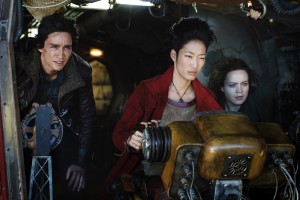 Hester Shaw (Hera Hilmar) is a young woman with a scar and a secret. When her little city is devoured and destroyed by London, you might think she’d be crushed herself -emotionally if not physically. The rest of her citizens become refugees on London, but it turns out London was Hester’s destination all along, and she’s come to strike down its primary architect and greatest celebrity, Thaddeus Valentine (Hugo Weaving). We don’t know why Hester is so dead set against the celebrated Valentine, but her cause is joined by nerdy Tom (Robert Sheehan) and a dangerous outlaw named Anna Fang (Jihae).
 gun in his hand in years, he doesn’t take much convincing. Maney Gault (Woody Harrelson) is a little more reluctant but pride is a tricky thing.

 Sometimes she’s mean to Rachel but mostly she just doesn’t really consider her feelings. At all. Even Darcy’s boyfriend seems embarrassed by this, and their mutual friend Ethan comments on it constantly. But Rachel is a pushover. She gives in to Darcy as if she’s a petulant child who must be tolerated and indulged. She gets nothing out of this friendship for herself. And you know what? I’m tired of Hollywood portraying female friendship in such a toxic way. A real woman would dump Darcy’s ass. But of course, the writer needs the audience to not hate Rachel too much when she steals/sleeps with Darcy’s boyfriend. Darcy is a bitch, so she deserves it. Never mind asking ourselves what kind of person Rachel is – a woman too passive to own her feelings, too insecure to insist on healthy relationships, too blind to see the hunky guy she’s friend-zoned, yet still an immoral homewrecker. Nice.
 1825 was not a great time to be female. LaBoeuf feels entitled to both kiss and spank Mattie, a 14 year old girl mind you, at his will and against hers. Most other men just discount her completely. But this is a story of true grit, and so it must involve a woman. Joel and Ethan Cohen edge the spotlight over to Mattie, where it belongs, which is what makes this film even stronger than the original. Which is not to say that Rooster and LaBoeuf are lost. Indeed they are not. The Cohens can write like the dickens (or, perhaps, like Dickens), and they’ve found a way to sharpen up a very interesting little triangle. Hailee Steinfeld was 13 when she was cast, but she acts alongside of Damon and Bridges like a gun toting, horse riding champ, and it earned her an Oscar nomination (which she lost, of course – True Grit got 10 nominations and 0 wins, which is what the french call “not right.)
 pulled back in. But a lousy real estate market and a newly separated household are drains on his bank account, and the money is highly motivating. Ironhead (Charlie Hunnam) is in it for brotherhood. His little brother Ben (Garrett Hedlund) is in it for adventure. And Catfish (Pedro Pascal) is the much-needed copter pilot rounding out their crew.
 ASSHOLES WATCHING MOVIES