
Inception, to me, is a near-perfect movie. It’s immersive and cerebral but also stunningly visual. It has some complex concepts but the script is so fine-tuned that it reveals only exactly as much as we can digest at a time so that the world opens up to us like a flower.
It’s about a man, Cobb (Leonardo DiCaprio) who goes inside people’s dreams to steal or plant ideas. It’s a dangerous world because when you fuck with the mind, screws come loose and there’s just no telling when the whole thing might come apart at the seams. But the money’s good, and Cobb’s got some troubling personal circumstances that make the game worthwhile. Arthur (Joseph Gordon-Levitt) is his right-hand man, and often the voice of reason. Eames (Tom Hardy) can impersonate anyone. And Ariadne (Elliot Page) is the architect – she’s the world-builder, the one who buries mazes inside of dreams. They’re hired by Saito (Ken Watanabe) to plant an idea in a business competitor’s mind so that he will sell off the company he’s just inherited from his dead father. Robert (Cillian Murphy) is the mark: he’s the grieving son who’s about to undergo inception – planting an idea so subtly that he’ll never suspect it’s not his own. And Mal (Marion Cotillard) is the one who can bring it all crashing down around them at any moment. Look out for her.
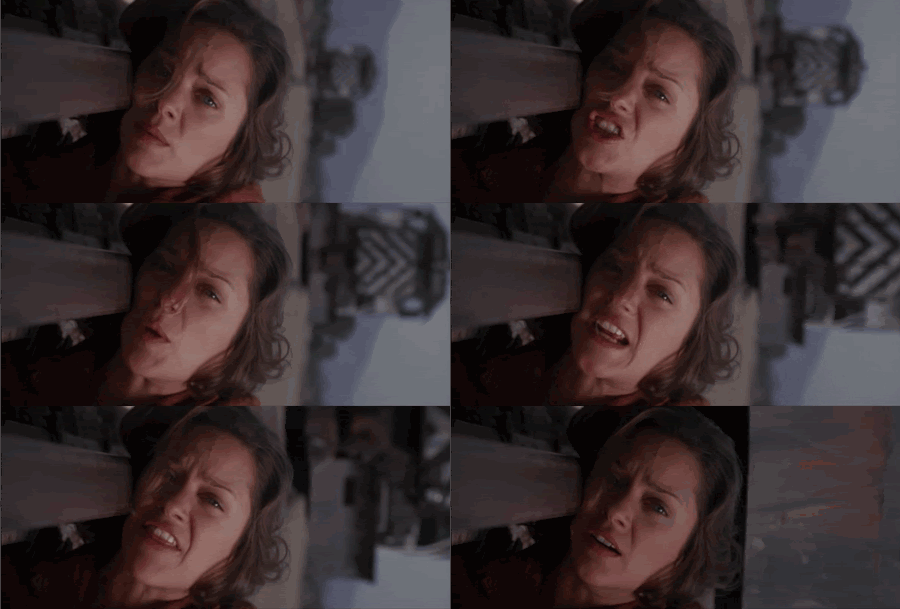
To pull off this memory heist, they’ll have to build a dream within a dream within a dream – levels that director Christopher Nolan is clearly all too gleeful to construct. In one, rain pours down in sheets; the dreamer has to pee. But just like the dreams themselves, Nolan’s movie is always working on multiple levels. The first is this new world of corporate espionage. But the second is Cobb’s sacrifice. It’s the things he has lost in pursuit of the ultimate theft, and his last shot at redemption.
When Inception becomes about Robert’s dream, there are multiple worlds on the go, so we flip deftly between them. But there’s a catch: each world is experiencing time differently – the further down you go, the slower time moves. There are some very worrying consequences to this. But then there’s also “reality” – though their bodies are sleeping, they have to be somewhere, and someone has to be taking care of them. In fact, someone has to care for sleeping bodies in each dream within a dream for them to be able to access the next level. It’s complicated stuff that Nolan somehow makes feel perfectly reasonable, a true testament to his talent as a writer as well as his precision as a director. He is the audience’s true friend, unwilling to lose us.
My favourite set piece is Arthur (Gordon-Levitt) in the hotel. At this point in time, they have lost gravity, so everything is floating around him. Not only is Arthur caring for the bodies of his comatose friends, he’s also coordinating an important and infinitely precise detonation, and he’s fighting off bad guys. I didn’t know it until I saw it, but a zero-gravity fight scene was exactly what I was missing in my life. Nolan prefers practical effects, so you can imagine the lengths he went to in order to breathe awe into the spectacle. JGL performed all but one stunt himself.

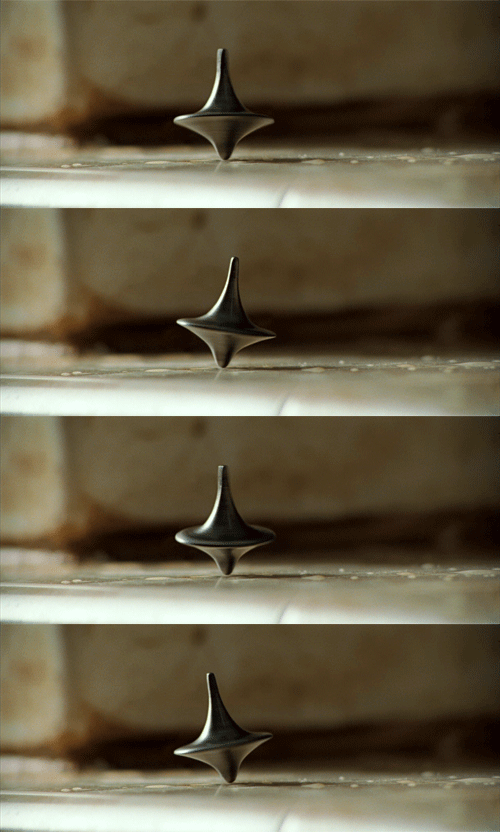
The film has a tantalizingly ambiguous ending. Cobb has a totem, a fool-proof method of testing whether he’s still dreaming, or back in reality. But in the movie, his character walks away – either distracted, or uninterested, or certain of the result. But not the camera. The camera stays with his totem, and it’s the most epic rim shot of all time. Will it or won’t it? Nolan focuses on the totem rather than on any human character. Nothing else matters. But it just keeps going and going, never giving us its judgment until – the screen goes black before a conclusion can be reached. I know it drives some people nuts, but I love an ambiguous ending. To me, it’s the ultimate mark of respect for one’s audience, that Nolan has trusted us to participate in his film’s end, to choose our own ending, in effect. And for someone who produced such a tight and specific script, it’s a ballsy move to put the ending in our hands. But that’s what he does. I believe there IS an answer, a right answer, and the movie is littered with clues that should point you in the right direction. But it’s okay not to know. It’s okay to debate it. It makes us collaborators.
Of course, the whole film is a show of respect for his audience. Inception is possibly the most complicated blockbuster of our time. Nolan is careful and exacting but he doesn’t dumb things down. He introduces concepts about the subconscious mind: the genesis of ideas, the source of pain, the malleability of memory, the vulnerability of reality itself. It’s a lot. And the more we chew on this, the more meaningful the movie becomes. It’s a thriller with higher stakes than anything before it, because Nolan has tapped into something worse than death. But he also makes the movie a game; it can be won, or it can simply be enjoyed. If there are bits of the plot that go over your head that first viewing, it’s okay. Inception is one of Nolan’s airiest and most forgiving pieces. There’s a gracefulness to the way this movie moves through its layers. Even if there’s something you don’t quite grasp, you don’t get stuck on it. It’s fluid, almost suspiciously fluid, as if plot holes don’t matter. Now why would that be?
Inception is also a capital M Metaphor. As in: to film is to dream. If you inspect Cobb’s team, you’ll see what I mean. Cobb is the director. Arthur is the producer. Ariadne is the production designer. Eames is the actor. Even more than that: Saito is the studio, and Robert is the audience.
We watched Inception recently because I had a dream wherein I was engaged to Prince Harry. We were working on the guest list for our wedding, and I was being all bubbly thinking about how Grandma would be so excited to meet the Queen. Grandma is 96 and a big fan of Elizabeth II, who is nearly her own age. Grandma is sharp as ever, sweet and bright and entertaining, but her mobility has taken a sharp hit recently, and even in my dream I knew that an overseas trip would be a stretch for her – but that the Queen would be quite the motivation. But then I realized: Grandma is not actually MY grandmother, she’s Sean’s. If I’m marrying Prince Harry, I’m not married to Sean and I don’t know Grandma. And the minute I had that thought, my dream started to crumble. Literally, the walls fell over as if they had been the set of a play that was being struck down. I had contradicted myself and shown the dream for what it was: a fiction. I routinely inflict my dreams on Sean while we shower the next morning, and being the disgusting cinephiles that we are, talk naturally turned to Inception (and, in fact, to Inside Out, wherein characters are seen “filming” dreams for the sleeping Riley). Movies and dreams have always mixed, and have always shared blurry boundaries. Inception exploits that. Nolan invites us to dream alongside him.



 ASSHOLES WATCHING MOVIES