Category Archives: Jay

Simple Passion

Hélène (Laetitia Dosch) is a French woman, a mother, a professor. The movie’s IMDB synopsis describes her lover’s career as “Russian diplomat” but diplomat must be a French euphemism for thug. Alexandre (Sergei Polunin) is, at best, a Russian diplomat’s shady head of security, maybe. And it wasn’t the prison tattoos that gave it away, it was that damn wispy mustache.

We can assume they have nothing in common because they almost never speak. We know little about her, actually, and even less about him. She’s single, he’s married (to a wife back home in Russia, presumably). He’s not young, but a little younger than Hélène. And he’s got all the control in this relationship, because he calls her, when he’s horny and available, and she drops everything, even her son, to be with him for a few hours in bed. Granted, they’re passionate hours, and the camera spends as much as 90% of the movie roaming up and down the contours of their bodies as they fuck in nearly all the positions there are for fucking, and a few I’m pretty sure they threw in just see if I was paying attention. These two make the jerks in 50 Shades of Whatever look like prudes.
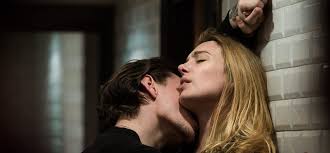
So I may not know much about Hélène, but I do know she loves that sweet D. She’s gotta have it. She gets nothing out of this relationship but frustration, heartache, and on the lucky days, a good dicking. But on the other days, she starts coming apart. She starts making more demands on his time, which only makes him pull away further, but she can’t help it, she’s obsessed. She’s addicted. She even tries to quit him, and finds she can’t. She has no resolve when he’s around. It’s rather undignified. Rather pathetic, really, to watch a smart and polished woman lose her shit over a guy with a wispy mustache.

Writer-director Danielle Arbid adapts Annie Ernaux’s novel for the screen, and there’s no doubt she is a fan of the material, and eager to put real flesh on those bones. However, her keen eye and high tolerance for erotica aren’t enough alone to explain Hélène’s intoxication for this man. The pounding of their bodies is enthusiastic but hardly tender. Without sustained conversation, or an emotional connection, this relationship feels cold and transactional. The only way this movie moved me was when I realized these colleagues had been humping each other raw for weeks if not months. It didn’t shock me, it didn’t turn me on, but most egregiously, it didn’t convince me.
Vampires Vs. The Bronx

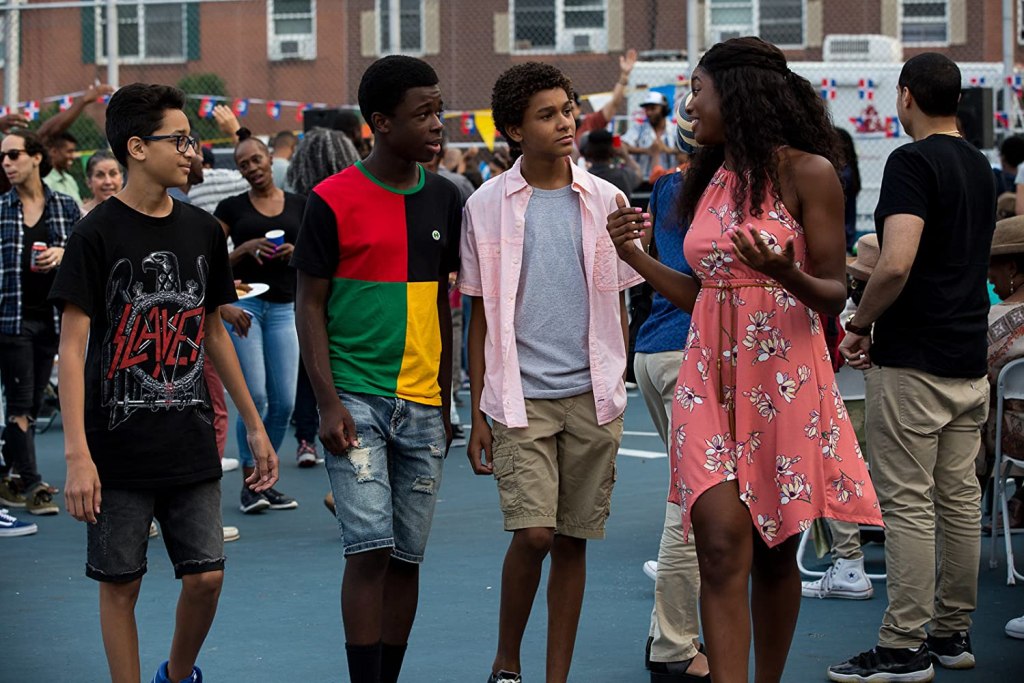
Best friends Miguel (Jaden Michael), Bobby (Gerald Jones III), and Luis (Gregory Diaz IV) are cresting their last wave of childhood growing up in the Bronx. They roam the neighbourhood independently but aren’t yet exempt from the dreaded mother yelling something embarrassing out the window for everyone to hear. Miguel is very plugged in to his neighbourhood; everyone calls him the Little Mayor, and it’s even what his (hand-drawn) business cards say.

Miguel’s current project is saving the neighbourhood bodega – lots of local businesses have been closing up shop, and a mysterious real estate company is swiftly encroaching. White people with canvas bags are merely the first step; gentrification is next. Except these white people are paler than most, and the renovations they have in mind are even more sinister than Lululemons and Starbucks and Blow Out Bars. Having recently watched Blade without parental supervision, Miguel, Luis, and Bobby are convinced the new neighbours are vampires, but who would believe such a thing? The only ally they manage to make is a neighbourhood teenager called Rita (Coco Jones), who has the distinction of not only being the only one to believe them, but also being a bit older, a bit cooler, and a heck of a lot prettier than our original trio.

Not even Rita’s credibility is enough to convince Moms not to open their doors to new neighbours or bodega owners to close shop. How then will they save the Bronx?

Longtime segment director at SNL Osmany “Oz” Rodriguez directs and co-writes the script with Blaise Hemingway, and together they’ve come up with something rather strange and wonderful. The kid cast is charming and exceptional (special mention to Imani Lewis whose character never stops her brilliant live stream), and the adult cast is fun and unexpected.

The allegory may be told through a very, VERY thin veil, but it’s as clever as it is unmissable, putting a new twist on a very old story. It’s rated PG-13 but the violence is far less graphic than what you’ll find in Blade, the movie the kids proficiently use as a vampire bible (and their rules hold up). As a comedy-horror, it’s a little light on both, but it’s an easy and enjoyable watch for everyone, including families with older kids and tweens, who will likely tolerate it with enthusiasm.

Last Moment of Clarity

Sam’s girlfriend Georgia died three years ago and he’s still carrying around the ring he never got the chance to give her. Through his flashbacks we know that she was shot, and her body burned in a terrible apartment fire that took several lives. But Sam (Zach Avery) doesn’t talk about it. He shuffles around Paris all wounded and haunted, but to his friend and boss Gilles (Brian Cox), he rarely opens up. So it probably comes as a bit of a shock when Sam declares that Georgia (Samara Weaving) is still alive – he’s spotted her in a movie, and despite a slightly different look, he’s convinced that actress Lauren Clerk is actually his dead girlfriend Georgia. After going full stalker online, Sam decides to fly his particular brand of creepy obsession over to Los Angeles where there’s a chance he can do it in person. And he does.

Lucky for him he runs into old high school friend Kat (Carly Chaikin), who is just jaded enough not to be put off by his remarkably strong stalker vibes. In fact, she helps him track down Lauren, who does not answer to Georgia and denies knowing the man with whom she once shared an intimate bubble bath (a VERY frequent flashback). As poor Lauren’s privacy gets invaded time and time again, we start to learn a little more about sketchy Sam and how his troubles extend beyond the one dead girlfriend.

Colin Krisel and James Krisel write and direct, though this is a first for both in either discipline. Between them, they fail to generate a single thrill in what is supposed to have been a thriller. Last Moment of Clarity is not thrilling, nor particularly clarifying, but it is competently made and competently acted. If the movie was a dead girlfriend trying to assume a new identity, it would do a much better job than Lauren as it is unremarkable, indistinguishable, and totally forgettable.

TIFF20: Shadow In The Cloud

When Maude Garrett (Chloe Grace Moretz) boards a B-17 Flying Fortress with top secret documents, the rest of the crew is surprised, and suspicious. Captain Reeves (Callan Mulvey) doesn’t know of any female pilots (it’s WW2, though I’m not sure they’re calling it that yet), and the other guys – Beckell (Nick Robinson), Williams (Beulah Koale), Tommy (Benedict Wall), Finch (Joe Witkowski), Taggart (Byron Coll) – are more interested in cat-calling her and making lewd remarks. None of them had anticipated an extra passenger and they’re suspicious of her documents, but she threatens court-marshals all around and they’re pretty anxious to get their wheels up, so off they go.

The movie takes almost entirely place inside of that plane. Maude is relegated to a tiny gun turret on the bottom of the plane that’s barely still attached, separated from her precious top-secret cargo. Of all the crew, only Quaid (Taylor John Smith) ever comes to her defense, but even he goes pretty silent when she starts babbling about some sort of…creature on the wing. They’re getting more resentful and increasingly skeptical, but they have bigger things to worry about, like bad weather, enemy planes, and their own flying fortress falling apart. And that’s before they discover what’s inside Maude’s top secret briefcase.

Roseanne Liang’s film is the Russian nesting doll of cinema: a monster movie within a horror movie within an action movie within a war movie, a daring and absurd mashup that works more than it doesn’t, surprisingly. It boldly confronts sexism and the super natural all in one go. It is, frankly speaking, sometimes altogether ridiculous. Unapologetically so, I believe. The film goes for broke while Moretz acts her ass off in a jumpsuit that doesn’t even showcase it. Director Liang isn’t afraid to crash and burn the whole thing if that’s what it takes. And as this film’s audience, you should be prepared to suspend your disbelief far above the Flying Fortress’ cruising altitude of 25 000 feet. It’s crazy. It’s completely bonkers. It is thrilling and terrifying and often flat-out bananas. You have to be willing to have fun with it, and willing to go along with a movie that refuses to stay within the bounds of any genre’s strict definition. If you’re in the mood for a quirky horror set piece, allow this one to surprise and delight and terrify you.

American Murder: The Family Next Door

If you have an appetite for true crime, this documentary newly released on Netflix will certainly serve as a hearty appetizer.

It’s a story you may already be familiar with: in 2018, 38-year-old Shanann Watts and her two young daughters disappeared in Colorado and since they were a typical suburban (and need I say, white) family, it made nation-wide headlines. You and I are no dummies when it comes to this kind of disappearance; we all know in which direction to look, and neither the cops nor this documentary waste time on any other perpetrator theories. Director Jenny Popplewell pulls together an impressive amount of footage taken at the time of the investigation (and of the investigation itself), and synthesizes it down to a watchable, digestible narrative. The one thing Popplewell can’t do is make sense of it. Technically, we do know the “reason” by the film’s end, but we can never be satisfied by it. It defies logic that anyone would think this was a good idea and it is immensely painful to know how incredibly unnecessary it was.

And yet, to me, the most intriguing part of the entire documentary is its title.

***SPOILERS***

American Murder

This has become such a frequent M.O. that we have now dubbed this the typical American crime.

Chinese checkers

Dutch oven

French kiss

Canadian bacon

Panama hat

American murder

More than half the time an American woman is murdered, it’s by her former or current romantic partner. In a third of those cases, it was right after a big fight. 15% of these women were pregnant.

Shanann’s partner was by all accounts a devoted husband and father. He provided for his family and said all of the right things. But around 2am on August 13 2018, Shanann is dropped off at home by friend Nickole, returning from a business trip they’d taken together. Footage from Shanann’s own doorbell camera is the last time she’s seen alive. Husband Chris claims they fought about his infidelity and the end of their marriage so he strangled her to death in anger. Her family maintains if that were the case, she would have fought back. They suspect he did it in her sleep. In any case, he wrapped her body in a sheet and loaded daughters Bella, aged 4, and Cece, 3, into the back seat of his truck along with their mother’s body and drove off before the sun was up, just a few short hours later. He buried his wife’s body near his job site, and then quickly killed his daughters as well, dumping their little bodies in an oil well. He had recently met a woman and wanted to be unencumbered to start a new life with her. Shanann was a little over 4 months pregnant at the time of her death.

Considering divorce is also very much an American way of life, it’s impossible to understand why Chris went with any other option, let alone one so gruesome.

He will spend his life in prison for the murder of his wife, their 2 daughters, and their unborn child.

Also spending his life in prison: a homeless man who procured two dime bags ($10 each) of marijuana for an undercover police officer who promised him a $5 commission. Five bucks: the price of a cheap meal. Marijuana: a substance that is legal or decriminalized in many states, and is actually sold by the government in Canada and elsewhere.

Two life sentences, one white perp, the other black.

American justice.

The Boys In The Band

Michael (Jim Parsons) is throwing a birthday for his friend Harold. He’s decorated the terrace of his New York City apartment, bought ice for the voluminous quantities of cocktails about to be consumed, and thrown together a guest list he flippantly describes as “all the same tired old queens.” Michael is a screenwriter who spends and drinks more than he should, and both are catching up to him. Michael’s former flame Donald (Matt Bomer) is unexpectedly in town for the event, filled with all the gems he’s been collecting in psychotherapy. Bernard (Michael Benjamin Washington) arrives with knee pads he’s bedazzled and monogrammed himself as a gift, and Emory (Robin de Jesús), a flamboyant decorator serves up what I believe is a lasagna laced with a little something special. Emory’s shared a tense cab ride over with lovers Hank (Tuc Watkins), who’s recently left his wife for Larry (Andrew Rannells), who doesn’t believe in monogamy.

If you’re thinking this birthday party, set in 1968, sounds a little ripe for conflict, you’re not wrong, but you don’t know the half of it. It’s about to be crashed by two unexpected guests: the first is a hooker named Cowboy (Charlie Carver), a big beautiful dummy meant to be Harold’s gift for the night, the second is Alan (Brian Hutchison), Michael’s straight college roommate to whom Michael is not out and asks the others to be discreet as well. Alan isn’t technically invited but shows up anyway, emotional, and well on his way to drunk. And only then does birthday boy Harold (Zachary Quinto) finally show up, chronically late, razor-tongued, cripplingly insecure.

Repressed sexuality and alcohol: a powder keg that’s absolutely, definitely going to blow up, the only question is whether it’ll be before the cake or after.

Joe Mantello directs a rather faithful adaptation of Mart Crowley’s play, allowing it to sit in a period when homosexuality meant so many different things: dangerous curiosity, underground relationships, chosen families, and more. Navigating this landscape is difficult, and each of these characters represents a different perspective, but they’re all just desperate to live life on their own terms. It’s the original cast from the 2018 Broadway revival, so not only is the cast extremely comfortable in the skins they’re temporarily inhabiting, but production can proudly claim that all 9 leads are themselves openly gay men. The ensemble isn’t just talented, but believable as a group with many permutations and entanglements, yet who continue to choose each other and probably always will.

This film is not just a fossil of its source material but a living, breathing thing where pain and expectation are lying in shallow graves, waiting to wound again.

Apples (Mila)

Any director lucky enough or prescient enough to be working on a movie about global pandemics just as one spread in the real world is probably going to have an automatic in this year, as we are greedy to see our own lives reflected in film, for both the drama and fear instilled by a rapidly spreading virus, and the stillness and isolation as the world shut down in response. These are strange times.

But not all pandemics are created equal. The one writer- (along with Stavros Raptis) director Christos Nikou imagines causes sudden amnesia. After a blinding pain in the head, the victim finds him- or herself void of memory. When Aris, a middle-aged man, wakes to the bus driver shaking him, his wallet is as empty as his head. Transported to hospital by ambulance, he can’t answer any questions, and after a few days on the ward, he is still unclaimed by friend or family. He’s not the only one. In response, a rehab program attempts to fill the void, a recovery method designed to help unclaimed patients build new identities and lives. Living in a sparse apartment and armed with a polaroid camera, he is given daily tasks on a cassette, meant to be performed and captured on film. It’s a strange life, and a lonely one, until he meets a woman on the same path (Sofia Georgovasili).

The treatment is unexpected, jarring, and increasingly bizarre. Just like Nikou’s film. As a feature film debut, it’s bold, and immediately establishes itself as a smoldering new entry among the Greek New Wave of weird cinema. And isn’t it glorious.

More than just memory, Apples is a meditation on nostalgia, reality, grief, and existential reminiscence. But between Nikou and the Disturbed Memory Department of the Neurological Hospital, what Apples really touches deep within its worldwide audience is our collective identity crisis. Sure it’s surreal and inevitably absurdist, but through its analog attempt at rediscovering personality, it’s a subtle condemnation of the hollowness and inauthenticity of the digital age, and it gives us all the space and permission to grieve.

Buffaloed

I have an innate (and probably unfair) dislike for celebrity kids who slide into the business. Dakota Johnson (daughter of Don Johnson and Melanie Griffith) may never win me over. Scott Eastwood (son of Clint) seems like he isn’t even trying. There are definitely exceptions to the rule (loving John David Washington, son of Denzel) but Zoey Deutch (daughter of Lea Thompson) wasn’t one of them. However, even my black heart and mega-level skepticism can occasionally be warmed by excessive and persistent charm.

In Buffaloed, she plays Peg Dahl, a low-level Hustler on the mean streets of Buffalo, New York. She’s not so much criminal-minded as highly motivated by money and not particularly phased by laws. Which is inconvenient when she starts dating the lawyer who once sent her away for a 40 month stint (Jermaine Fowler). However, her biggest entanglement is with her former boss and current rival, Wizz (Jai Courtney). Their business is debt collection, a dirty business even when you do it legally, which no one does, because money. Money money money.

The movie’s uneven, or going through an identity crisis. It’s got the heart of Wolf of Wall Street, a breath of The Big Short, the soul of Hustlers, and a light freckling of The Departed. But since those are pretty good references, it’s not much of a problem. Director Tanya Wexler pulls the best out of the chaos, and if you’re not sure what to expect one scene from the next, rest assured Deutch is will be your bewitching, effervescent guide through the bedlam. She’s so dazzling I wish the script had thrown a few more layers her way. Peg is clearly amoral and dare I say it – ruthless – but the script is so sympathetic toward her we don’t dwell on the darker side of her character. Deutch hints at it with a maniacal smile and her balls-to-the-wall performance.

TIFF20: Shiva Baby

Danielle is a good-ish Jewish daughter, so when her parents ask her to attend a funeral, she takes time out of her busy life as a college senior to do it. Is she on time? She is not. Does she know who died? Does it matter? She’s there, she’s putting in face time, fielding questions about job prospects and marriage prospects, putting up with frank evaluations of her body, her choices, her independence, her future, her past. It’s a lot, and she hasn’t even had a bagel yet. Has she been eating, by the way? The ones who aren’t grilling her are gossiping about her. Has she been a good daughter? A good student? A good girl?

It sounds painful, and it is, but I haven’t even told you the worst part. The worst part is that Danielle (Rachel Sennott) has an ex in the room, a sort of ex anyway, a secret ex. It’s family friend Maya (Molly Gordon), the girl next door that Danielle grew up with, went to prom with, went all the way with. And while their status is never mentioned directly by anyone in the room, not even by the young women themselves, there are enough furtive glances and averted gazes to indicate that their history isn’t as secret as they think. BUT, there’s an even bigger secret in the room. Danielle’s current beau is also there. With his wife and baby. Well, beau might be a bit of a strong word for Max (Danny Deferrari). I believe the website they use calls his position “sugar daddy,” though if he is surprised to find out that Danielle is a) not in law school and b) supported generously by her parents, she’s equally surprised that the cash he gives her after their encounters is apparently drawn from his wife’s account, and the bracelet he gave her this morning matches the one on his wife’s wrist.

Writer-director Emma Seligman has rigged this funeral like a powder keg ready to blow, and knowing the whole thing is always just one disclosure away from implosion gives the scene an electric crackle. This is the kind of comedy that’s only funny in the car on the way home, and that’s as long as you weren’t one of the main players. At the time, it’s painful and awkward, and yet no one can quite resist poking the bear. Seligman delivers a pretty big bear and a lot of eager pokers.

The ensemble cast, including Polly Draper, Fred Melamed, and Dianna Agron, is exceptionally good at driving this thing to its inevitable tipping point. And though Danielle’s lies outnumber her truths and her antics relegate the deceased to the forgotten, Sennott makes sure she is still drawn with a certain sympathy. Burdens and expectations are piled upon her like so much potato salad on her dumpy paper plate, and well-meaning though they may be (and I’m dubious about that), the barrage of questions are prying, invasive, and unwelcome. But they must be borne. All part of the price of being a good Jewish daughter, Seligman’s script implies, but it also implies that’s an achievement all but impossible.

Shiva Baby is a cringey comedy about running into your sugar daddy at a family funeral, but there’s a universality to it that rings true for many of us. When Selgman writes about family, she writes about obligation, comfort, ritual, values, pride, disappointment, and perhaps most of all, steadfastness. Which in fact is not so universal after all. Danielle may endure quite a bit at the hands of her family, but at the end of the day, blood is thicker than coffee stains. They’ve got her back, and that’s more than many of us can say.

TIFF20: Beans

The Oka Crisis. It’s an ugly piece of Canadian history that those of you outside our borders will not have heard of and those of us inside find shameful and painful to own. But own we must.

In brief: white people set sail to find a route to Asia and landed in and around Canada instead. White people are lousy sailors but they’re awfully good at taking what isn’t theirs. We even gave it a fancy word: colonization, a polite term for stealing land and dispossessing current inhabitants. By 1956, the Mohawk First Nation had just six remaining square kilometers from their original 165 around the Oka area and in 1959 the town (of white people) approved the development of a private nine-hole golf course on a portion of that land. The project bordered a sacred Mohawk burial ground in use for nearly a century but the Mohawk were not consulted and soon a parking lot bordered their cemetery. In 1990, it was announced that the golf course would be expanding by an additional nine holes and even more land would be bulldozed to make room for condos. In protest, the Mohawk people erected a barrier blocking access to the area. This land dispute lasted 78 days, with 2000 provincial police and 100 special operatives, as well as 4500 members of the Canadian Forces deployed to “keep the peace.” Tactical units used tear gas and concussion grenades on the barricade, prompting gunfire exchanged from both sides, killing one. At the time, there were only about 30 armed Mohawks behind the barricade. That number doubled after the raid, but obviously the sides were still incredibly uneven. The Mohawks had support from other First Nation communities across Canada but their white neighbours lined the streets to throw rocks at cars of evacuating women and children.

The Oka Crisis wasn’t so much resolved as ended with both sides feeling used and bruised. It was a dramatic stand-off for sure, but only a symptom of a much larger problem in Canada and in many countries where indigenous populations were pushed aside and marginalized in their own territories. The relationship between Canada and its Aboriginal people is still uneasy, with systemic racism practically baked right into the foundation of our country.

There have been many documentaries about this turbulent time in Canadian history, but Beans is the first narrative film, one that captures the time and the tension rather eloquently. The film is told from the perspective of an 11 year old girl behind the barrier called Beans (Kiawenti:io Tarbell) and largely divorced from politics. It is a humane and personal account of the crisis, which writer-director Tracey Deer experienced herself as a child.

Beans has no agenda. She’s just a kid who loves riding her bike and is excited to meet the new baby her mom Lily (Rainbow Dickerson) is carrying. Beans is a bright kid but she’s young, and susceptible to peer pressure. She doesn’t realize she’s living through a historical event, she’s just trying to make it through the summer without embarrassing herself in front of the older kids she’s been hanging out with. But as the tension becomes undeniable and the violence ever closer to her home, Beans is about to face things no kid her age ever should.

Because Deere (along with co-writer Meredith Vuchnich) is recounting events from the perspective of a child, the conflict itself is simplified and we experience it on a visceral rather than diplomatic level. We feel her fear, her shame, her confusion. There may be two sides to every dispute, but there’s no excuse for terrorizing a pregnant woman and her children. There are certainly challenges for Beans and her peers growing up on the reserve, but outside of Mohawk territory, the racism alone poses a real danger and threat.

Deere isn’t condemning anyone with her film, but she is exorcising some ghosts she’s clearly carried with her into adulthood. Her images are beautiful, her story is balanced, and she’s made an important contribution to our cultural legacy – for better or for worse.