Category Archives: Jay

The Boy Who Harnessed The Wind

There’s flooding in Mozambique, and when the rains finally come in Malawi, they come heavy. The farmers have been struggling for years, unable to cope after the big tobacco farms went elsewhere. The wealthy estates take advantage, offering a lump sum in exchange for the lumber on their lands. Cash-strapped, many are tempted, but the village chief warns that these trees are they only resource they have to protect from serious flooding.

William (Maxwell Simba) must drop out of school when his family’s money runs out. The harvest is poorer than anyone predicted; his father Trywell (Chiwetel Ejiofor) manages less than 70 ears of corn, and that’s all the family will have for the entire dry season. The government denies a food shortage but hunger makes people do bad things. Whole villages are starving.

William thinks he can generate power by building a windmill that would operate a water pump, extending the growing season, but to do so he’d need to sacrifice the family’s only possession, a bicycle. Trywell refuses. You might guess from the title that William will prevail. And if a movie is willing to spoil itself right in the title, then you know it’s about the journey, not the destination.

The Boy Who Harnessed The Wind is about hunger. Not just an empty belly, but a need for something, a strong desire. And that kind of hunger can be very motivating. But a child surpassing his parent is hard on both.

Chiwetel Ejiofor directs himself in the film; he bought the rights to the book after reading it and set to learning Chichewa, the Malawi dialect spoken in the film. He shot it on location in Malawi, helping to bring authenticity and context to a true story. Farming is getting harder for everyone, everywhere. Global warming makes weather unpredictable, too wet, too dry. In Africa, where so many have so little, there is little margin of error. A thirteen year old boy saved his village from famine by cobbling together a wind generator built out of garbage. He was self-taught from books he wasn’t technically allowed to read, not having paid his school fees. He makes it look easy, but for him, it was simply and urgently necessary. This impressing directorial debut from Ejiofor communicates both the hope and the despair, but above all, ingenuity.
 

All The Bright Places

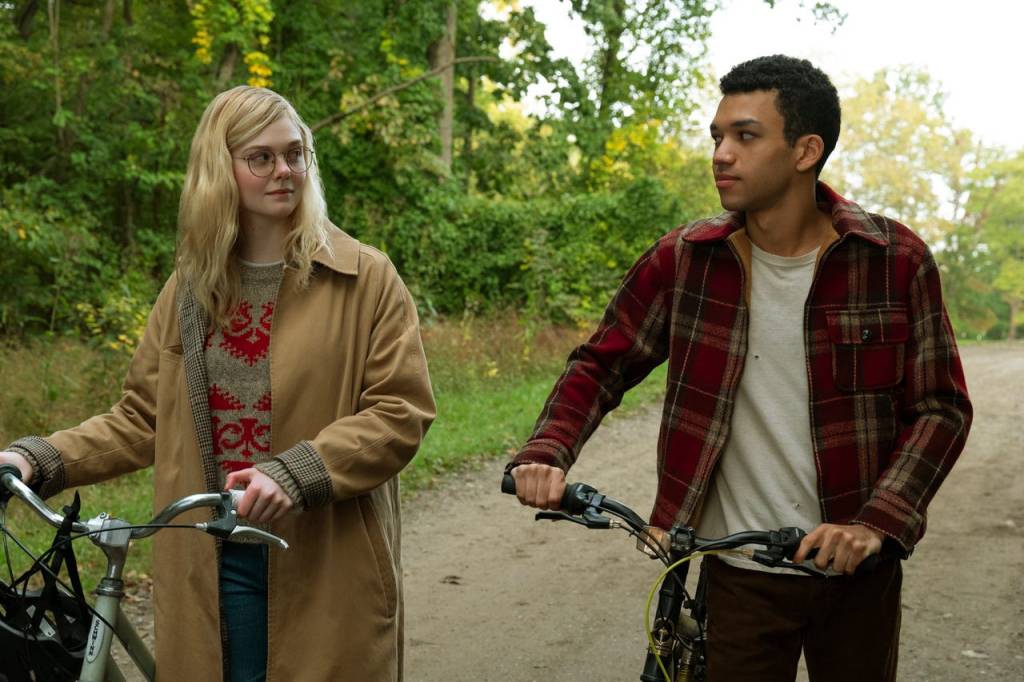
Violet and Finch meet atop a bridge. He is running across it, she is teetering on its ledge. He offers her a hand, and she takes it.

It’s a powerful and awful way to start a relationship, saving someone’s life. Violet (Elle Fanning) goes to Finch’s school. She is struggling with her sister’s death, a car accident Violet was in the passenger seat for. Finch (Justice Smith) sort of takes her under his wing, coaxing her out of her comfort zone under the guise of a school assignment. They travel to the wondrous places of Indiana, which will kill any thoughts of tourism you may have been harbouring because the wonders are underwhelming at best but Finch presents them with whimsy and charm, and how can Violet resist? But for all his saviour posturing with Violet, Finch has some pretty deep emotional scars of his own.

Despite its title, All The Bright Places can go to some very dark places. The leads are meant to be 17 but the story gives their characters some pretty heavy burdens and some serious sophistication. Fanning and Smith have great chemistry and give grounded performances, saving the film for what might have been maudlin or overwrought. Still, with Violet and Finch confronting grief, abandonment, and struggles with mental health, All The Bright Places is quite weighty for a teenage romance. I’m not sure the film quite handles itself correctly all the time; at times it feels a little superficial and easy. But on the whole I found it quite enjoyable. It’s based on a YA novel by Jennifer Niven and it feels like it. Which is not a criticism, actually, and it does deviate quite a bit from the book, it’s just that it wants to impart some wisdom, it wants to make some profound discoveries, and it doesn’t mind being rather obvious about it, like a parent or a guidance counselor might. Like, if you wanted to extrapolate that you should become your own bright place, the film will nod at you encouragingly while quietly nudging a box of tissues in your direction. Take the box.

Hail Satan?

I didn’t realize I would identify so much with the satanists, that’s for sure.

Not that I’d looked into it much. I don’t care much about what people believe, I mostly care when people form exclusionary clubs (which they often call church) that seek to divide people, shame people, judge people, and persecute those who don’t share their beliefs.

Turns out, satanists don’t worship satan. Most are atheists who don’t believe in a literal devil any more than they believe in a literal christ. But since atheism is just a term for what you aren’t, they’ve chosen satanism to represent their feelings, which are not so much anti-christ as post-christ. The satanic temple’s 7 tenets include compassion, empathy, respect, accountability, and science, all of which I find easier to endorse than an overemphasis on not coveting your neighbour’s crap and putting murder and swearing on equal footing in terms of badness.

Practically, the satanic temple chapters exist mostly in opposition to the christians encroaching on the American way of life. Logically we all know the importance of the separation of church and state. America was founded on the freedom of religion as people who were persecuted fled to build a country on their own terms. Colonial founders and founding fathers baked freedom of religion right into the constitution – in fact, it’s in the first amendment. And yet there are references to a christian god on American currency, in the country’s motto, even in the pledge of allegiance. And that’s particularly interesting because as mentioned, separation of church and state was pretty important to the founding fathers. Of course, there was no mention of god in the first version of the pledge, in 1892, and none in the next 3 revisions over the course of 60 odd years. It was only in 1954 that god suddenly popped up where god does not belong, in a time of increasing evangelicism.

So yeah. That’s how Netflix turned me on to satanism. They’re not trying to convert christians and they’re certainly not devil worshipers. If church and state cannot be separated, all they’re asking is that everyone be treated equally. If a school or courtroom or city hall has christian iconography, it needs to consider all other religions too – and there are BUNCHES of them represented in the American population. The first amendment forbids Congress from promoting one religion over others. That’s a basic American value. Apparently. America, what have you come to when the satanists are the level-headed ones?

Playing With Fire

Directors think John Cena is a bargain The Rock, but what they’re really getting is an overpriced tree stump. He has the personality of dry, slightly burnt toast.

It’s not entirely Cena’s fault. Director Andy Fickman clearly has no vision and no funny bone. He’s not sure whether he’s making a satire or a slapstick comedy. I mean, he’s not making a satire. Satire implies a basic level of intellect. Parody might be closer to what I mean but he’s not even doing that because parody implies you’re being bad on purpose. And the purpose is generally comedy. But nothing here is funny. The attempts at humour are such dismal misfires they suck the oxygen out of the room so fast it’ll flip your eyelids inside out. True story.

The slapstick, such as it is, is an even bigger problem. Physical comedy is the lowest form of humour. There’s such a high risk of failure it should only be attempted by a master. There are no masters in Playing With Fire. They aren’t even comedy interns. Not even comedy fetuses (feti?). They’re just monkeys flinging shit.

John Cena has the range of a rock. I can’t really blame him for eagerly shoveling up Dwayne Johnson’s leftovers. Hell, he’s probably pretty grateful for Dave Bautista’s scraps. But Keegan-Michael Key, I’m disappointed in you. Jordan Peele’s out here making the world a better/scarier place with his incisive social commentary and you’re…tasting farts. While playing second fiddle to JOHN FUCKING CENA.

The script is should have been flushed, and not because it’s a dead goldfish. It’s probably the worst offender in this huge steaming pile of donkey excrement. The script is to subtlety what Donald Trump is to modesty. Yeah, this review ain’t subtle either.

John Cena plays a fire fighter who prefers to be called a smoke jumper. He’s got a dweeb haircut and a complete absence of personality. He and his colleagues-in-flames (Key, and John Leguizamo) save a trio of runaways and end up pulling babysitting duty in their firehouse while the kids do more damage than a pack of wild dingos.

We have 3 categories here at Assholes Watching Movies – Kick Ass, Half-Assed, and Sucks Ass – and until now, that’s been enough. But I’m petitioning to add a fourth one because Playing With Fire EATS ass.

Can’t stop won’t stop ranting.

The Terminal

During a transatlantic flight, Viktor Navorski’s eastern European country suffers a coup and simply (bureaucratically and practically) ceases to exist. Unaware, Viktor (Tom Hanks) lands at JFK eagerly awaiting an NYC vacation filled with Broadway shows and Nike shoes. Instead he finds that his passport has been revoked. He is presently not the citizen of anywhere. Airport official Frank Dixon (Stanley Tucci) cannot allow him to step onto U.S. soil but nor can they board him on a plane home. There is no home. No passport, no visa, no valid currency, and a very tenuous grasp on the English language.

Days later, Frank is very surprised to see that Viktor is still inhabiting the airport. He’d assumed Viktor would just disappear through the cracks and be somebody else’s problem. Turns out Viktor is kind of a stickler for rules.

I’d seen this movie before, of course. I don’t often miss an offering from Hanks or from director Steven Spielberg. I remembered the gist: a man trapped by circumstance in an airport. Indefinitely. Broad strokes, but I didn’t remember the fine brushstrokes delivered by a masterful performance by Hanks (is there any other kind?). I hadn’t remembered the heartache and devastation of a man learning that his country is in violent turmoil. We don’t know much of what he’s left behind: a mother or brother who worry? A home that’s being repossessed? A dog that needs to be fed? A job from which he’d be summarily dismissed, not having shown up? Instead Spielberg focuses on the life he’s building in an empty terminal of the airport: what he’s eating, where he’s sleeping, how he’s passing the time. And the friends he makes!

First it’s beautiful flight attendant Amelia (Catherine Zeta-Jones) who he often sees dashing from one flight to another. Then it’s Enrique from food services (Diego Luna), who feeds Viktor in exchange for information about Dolores (Zoe Saldana) in customer service. [And who, for extra credit, reveals that she’s a trekkie, 5 years before she’d go on to play Uhura.]

You may know that The Terminal is actually inspired by the real life events of Merhan Nasseri, an Iranian refugee. In 1988, he landed at Charles De Gaulle Airport in Paris, after being barred from entry into England, because his passport and United Nations refugee certificate had been stolen. French authorities wouldn’t let him leave the airport. He remained in Terminal One, a stateless person with nowhere else to go. He was eventually granted permission to either enter France or return to Iran but chose to continue living in the terminal and telling his story to those who would listen. He lived there until 2006. 2006! Eighteen years! He only left in 2006 because they hospitalized him (I’m not sure for what, but his mental state had certainly deteriorated). He has since lived in a Paris homeless shelter. DreamWorks paid $250K for his story though in the end they chose not to use it.

Hanks and Spielberg have collaborated what, five times now? Perhaps The Terminal is not their best, but it’s not to be discounted either. Viktor is too pure and perhaps a little too slapsticky to seem like an authentic human, but Hanks is all charm and Spielberg’s interpretation of the American dream is something to behold.


Which Hanks-Spielberg collab is your favourite?


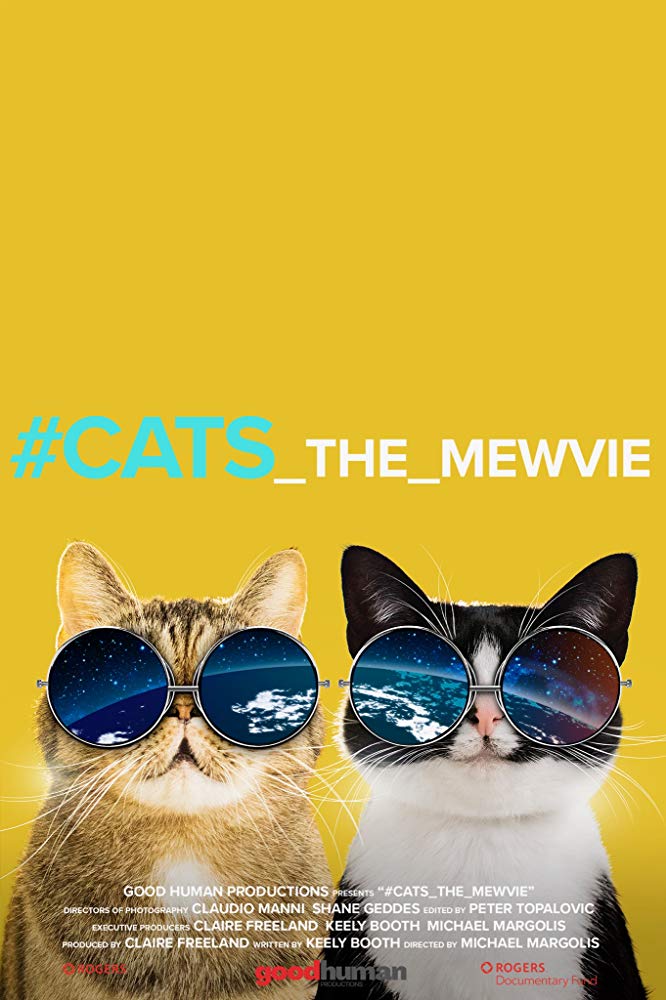
#Cats_The_Mewvie

The Internet is: a) is a cat archive b) a world-wide phenomenon for cat enthusiasts c) a cat content generating machine, for cats, by cats d) now with 35% more cats. Even if you’re a dog person, sure there are cute puppy videos, but let’s face it: the internet is all about cats. Well, 96% about cats. Also 1% random ranting, 1% recipes and 2% butt stuff. At one point, when we were fools, we thought the Internet would be a treasure trove of accessible information and a geography-busting connection between humans. We were wrong. It’s all cats.

Not to be confused with Don’t Fuck With Cats, a true crime documentary on Netflix about hunting our own homegrown Internet killer, or Cats, a cinematic travesty that limped quickly out of theatres, tail between its legs, #Cats_The_Mewvie is a documentary that explores the whys and the hows of the feline domination of the world wide web.

Because I am on Twitter, I constantly hear people talk about how negative and soul-sucking and bleak the Internet is. And I often wonder: are we using the same Internet? Because I do not ever feel that way. Of course, I also don’t seek out disagreements, or start flame wars, or engage people who do. When I’m feeling sleepy, I pull up my favourite song. When I need cheering up, I watch puppies doing puppyish things. The worst thing that’s happened to me on the Internet this month is a comment I received on Youtube where Sean and I were referred to as “Handsome man and beautiful hairy lady.” I’m choosing to believe it was a problem of translation…maybe they meant beautiful haired? I’d buy that. In fact, I already have! Why thank you. Thumbs up. 👍🏿👍🏿👍🏿👍🏿👍🏿.

The Internet is filled with cats and people like to look at them so much that some cats are famous. Some cats have agents. Some cat owners have made millions of dollars. Of course, like any show biz parent, you have to be willing to harass your ‘asset’ and turn them into a product to continually be exploited. The rest of us are just taking occasional, amateur, jittery videos of our pets doing stupid or silly things. Those are the ones we post. Most of the time our pets stubbornly refuse to do anything insta-worthy the minute you have your camera out and ready.

Truly, the world is a beautiful place, the Internet is bursting at the seams with quality cats, and Netflix is a black hole filled with documentaries such as this.

The End.

The Last Thing He Wanted

Do you like drama and intrigue and secret ops and exposing deeply classified cover-ups? Oh that’s too bad. This movie has none of that. The Last Thing He Wanted is the last thing anyone wants when they sit down to a movie. It’s sort of counting on you to turn it on and either take a two hour nap take a nap or walk out of the room for a snack and never come back.

Elena (Anne Hathaway) is a journalist who…covers foreign correspondence. She has a kid in boarding school since she’s never home and I have no idea what happened to the kid’s father other than he is indeed alive. Rosie Perez plays her friend/photographer. I think they get reassigned to cover the election at home, which pisses off Elena. She has a kooky father (Willem Dafoe) who is definitely into some shady business and possibly has dementia. He implores Elena to take care of a deal he’s sunk half a mil into but now cannot himself follow through. She does. Or she tries. And things get really shitty. Ben Affleck is around…pretty sure he’s CIA, possibly also into politics? Hard to say.


So this is a brand new Netflix Original that did two things very well: it confused me and it bored me. Granted, those aren’t generally things movies are trying to do, and maybe this one isn’t either, but that’s hard to believe given what a big fat mess it is.

IMDB seems to think it’s about a veteran D.C. journalist (that would be Hathaway) who loses the thread of her own narrative when a guilt-propelled errand for her father (Willem Dafoe) thrusts her from byline to unwitting subject in the very story she’s trying to break. So it turns out I did have the gist. I just didn’t give a fuck. I’m horrified to see this has been adapted from a Joan Didion novel. I hope she doesn’t have a Netflix subscription.

This isn’t a swing and a miss because it was never going to be more than a bunt. I lost track of motivations first, then plot. Anne Hathaway is…dogged. Either survived breast cancer or had a horrific boob injury. Her signature look is a chest covering scarf. She’s mad at everybody. She’s suspicious of nearly everyone but not suspicious enough. It’s so hard to get a handle on this and yet it was so underwhelming I can’t even be bothered to look it up.

Despite the brand name cast and director Dee Rees’ other successes, The Last Thing He Wanted is a real dud. It’s too late for me, but save yourself.


Rich Kid$

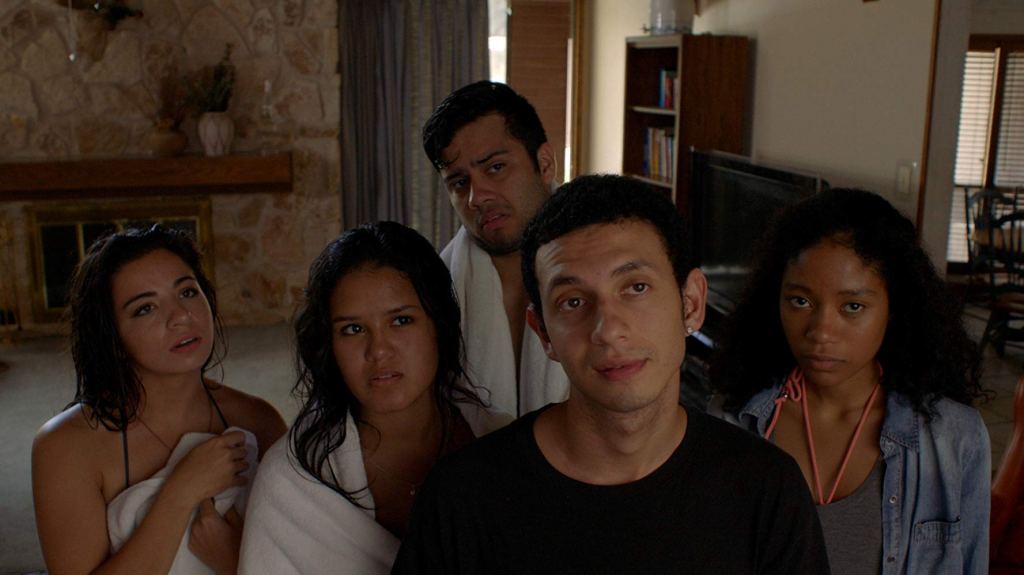
Matias (Gerardo Velasquez) has had a rough start to his day. The sheriff showed up with the landlord to evict his family. Mad at his father for being too proud to ask for help, he wants escape, but his neither his low-income neighbourhood or his similarly economically deprived friends offers much reprieve. So you almost can’t blame him when he and buddy Carlos (Ulysses Montoya) hop a fence to swim in the luxurious backyard pool of a wealthy neighbour who’s out of town.

They have such a nice time it seems almost criminal to keep their good fortune to themselves, so they’re soon joined by Carlos’ car-thieving, trunk-full-of-stolen-goods cousin Steve (Justin Rodriguez), and the girls: Vanessa (Michelle Magalon), Jasmin (Alessandra Mañon), and Isabel (Naome Antoinette). Of course, with the pool such a refreshing success, it’s only a matter of time before the group infiltrates the house as well, trying on clothes, microwaving food, inhabiting a life that, let’s face it, feels awfully good.

You can already sense that the stakes are getting incrementally higher; trespassing is one thing, breaking and entering another. But the kids aren’t doing a smash and grab, they’re cooling their heels on fine furnishings, drying off with plush towels, drinking top shelf booze. They’re pretending to be rich. They’re trying on wealth like a coat in a department store and it looks and feels so good they’re reluctant to part with it. But it’s not theirs, and thanks to subtle directing by Laura Somers, the audience never quite forgets it. Tension mounts the longer they stay; there’s a certain inevitability in the air, like the world they live in will want to put them back in their place.

Somers builds a line (or a wrought-iron gate) between the haves and have-nots. There’s no malice and there doesn’t have to be: the line simply exists. Wealth and privilege and the colour of one’s skin. It’s all tied together and it’s clear these kids have already felt how difficult these knots will be to untie.

A strong ensemble cast and some directorial restraint make Rich Kids a must-see.

After The Wedding

Isabel (Michelle Williams) helps manage an orphanage in India that is very strapped for cash. There’s a possibility of funding, but the investor stipulates that Isabel must come to New York in person, and Isabel isn’t keen to leave her little oasis or the children she loves dearly. But with serious money on the line and so many more children in need, she also can’t resist.

Her posh NYC accommodations are a stark contrast to the life she’s lived in India. Uncomfortable, she’s eager to get back, but the investor, Theresa (Julianne Moore), is adamant that she extend her stay. She even invites Isabel to her daughter’s wedding. Having promised not to return without “a suitcase full of money,” Isabel doesn’t want to disappoint her host, but it’s starting to feel as though Theresa has ulterior motives.

She does.

This is an American remake of a very good 2006 Danish film by Susanne Bier starring Mads Mikkelsen. This one isn’t bad, but it naturally suffers by comparison. This film, directed by Moore’s husband Bart Freundlich, swaps the genders of the leads and breaths a little bit of new life into the script because of it, but the only true reason to see this one at all is for restrained performances by its two formidable leading ladies (Billy Crudup, rounding out the cast, is at a disadvantage).

After the wedding is a very slight meditation on loss and regret but doesn’t quite pack the emotional punch of its predecessor. It’s definitely a quiet film about inner conflict, Williams suffering in near silence, Moore indulging in quite a fantastic display. If you watch it, watch it for them. But this film didn’t need to be remade. The first was so achingly perfect and less neatly resolved, its frayed edges lending it an authenticity that this highly-polished one lacks.


Kuessipan

In northeastern Québec lies an impossibly small village, an Innu community where many band members still live off the land and almost no English is spoken. Two young girls grow up inseperable; Mikuan (Sharon Ishpatao Fontaine) has a close and loving family, while Shaniss (Yamie Grégoire), like too many First Nation peoples, is picking up the pieces of a fractured family and broken childhood. And while their girlhood games of midnight fishing may not feel familiar, their little girl giggles are universal. Best friends forever, they vow to always stick together.

But just a few years later, when the girls are nearly 17, life is driving them apart. Shaniss has an abusive partner and a baby to care for while Mikuan is learning to express herself and pay tribute to her community through poetry. She falls in love with a white boy (Étienne Galloy) and dreams of leaving the small reserve to go to school. Shaniss, already grieving the loss of her friend, starts to feel abandoned.

Kuessipan, which means “your turn” in Innu, is adapted from a novel by the same name written by a young woman from this same reserve, Naomi Fontaine, who helped directed Myriam Verreault write it for the screen. Shot in and around the Innu Takuaikan Uashat Mak Mani-Utena reserve, the film uses band members rather than professional actors, which lends an authentic but not amateur feel.

The film, wise beyond the 21 years of its young author, is about finding one’s voice and one’s path, and having the courage to do so even when it means leaving people, and the comfort of familiarity, behind. With beautiful Indigenous imagery and stark cinematography, it’s also a look at contemporary life on a First Nations reserve, an infrequent subject in film or in literature. With a history of oppression and colonization, many First Nations people in Canada are still living impoverished, wounded lives. And yet their culture survives and thrives in many small communities across the land, their stories told through art that moves and inspires not just their own people, but Canadians across the country and people beyond its borders as well. Kuessipan tells the story of not one but two young women succeeding in their own way, leading lives that will pave the way for generations to come.