
How long is America’s memory? About 25 years, according to the Pee-wee Herman comeback.
 It was 1991 when Paul Reubens, the man behind the tiny red bowtie and obnoxious laugh who streamed his playhouse antics directly into your family room to mesmerized kids, was arrested for masturbating in an “adult movie theatre.” His arrest was widely covered, Reubens terribly ridiculed, even when wholesome famous friends like Bill Cosby spoke up on his behalf, saying “Whatever (Reubens has) done, this is being blown all out of
  proportion” (I guess he was hoping people would remember this sentiment when it came turn for his own shit to hit the fan).
At any rate, Reubens retired the child-like character that had entertained and confused Americans for the better part of a decade, but Pee-wee Herman never died, he only went underground, and now like a groundhog heralding spring, his little rose-cheeked head has popped up in 2016, ushering in a new era of what’s appropriate for a host of children’s television. He’s been testing the waters for a decade, appearing at fan conventions, guest judging on Top Chef, and even  doing a skit on SNL. Since nobody showed up to burn him on a stake, it seemed the way was clear for Netflix to greenlight a movie he’d been waiting a quarter century to make.
You may not know that the Pee-wee Herman character has been around since the late 1970s. Paul Reubens was performing for The Groundlings, only he wasn’t a typical comedian, having no talent for remembering the proper sequence of jokes, or even punch lines. So he and fellow Groundling Phil Hartman created the anti-comic character, a weird, manic, effeminate,ambiguous “boy” who got by on enthusiasm and catchphrases like “I know you are but what am I?” Pee-wee Herman was born, but was initially aimed at adults, appearing on The Dating Game, and in a Cheech and Chong movie. Eventually Reubens toned down the
 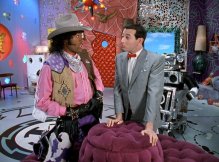 innuendo and became a childhood icon (although you only have to look as far as Cowboy Curtis, played by a young Laurence Fishburne, to know it was still there).
So now Pee-wee Herman’s back, bitches, and we’ve got Judd Apatow to thank for it. Hollywood has been milking the 80s nostalgia cow an awful lot lately, and Paul Reubens was of course anxious to re-write his beloved character’s ending. But what’s in it for Apatow? Apparently a little  wish-fulfillment. A longtime Pee-wee fan, this was a film he thought people wanted to see. “I just think there are very few characters in comedy history as strong and hilarious as Pee-wee Herman. The first moment you’re sitting in a room with Paul Reubens and he starts pitching you things Pee-wee might say or do, you think to yourself, ‘This can’t be happening.’ The first time he put on the suit, I thought I was going to pass out.”
So Judd Apatow and Pee-wee Herman have $30 million dollars from Netflix to make a movie, and who do they call? Joe Manganiello, that’s who. It turns out, Magic Mike is Joe’s serious oeuvre, so get that straight in your head. Because when he’s between such serious roles, he’s available to be Pee-wee’s sidekick. Bet you never thought you’d live to see that. The plot of 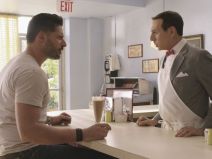 Pee-wee’s Big Holiday, which is nearly plotless, is this: Pee-wee has never left the small town he lives in, but one day a big, handsome movie star named Joe Manganiello drives through town on his sexy hog and the two hit it off as only two rootbeer-barrel-loving-boys can. Joe invites Pee-wee to his birthday party in NYC, and Pee-wee embarks on an epic adventure across the country. Or something like that.
This new adventure doesn’t have much to do with his other forays on the big screen or small screen, but if you’re a fan who’s been waiting for this moment for most of your life, there’s enough there to leave you satisfied. In fact,  Reubens, now 63, hardly looks as though he’s aged a day underneath the familiar pancake makeup. Pee-wee’s Big Holiday isn’t likely to win any new converts though. It’s a silly little thing, a very small fluff on some pretty major wind, but yes: it is in fact a movie. And you can watch it now on Netflix.

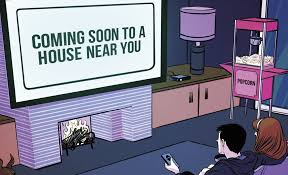 agle from your spouse and your dogs, and even a faux-fur throw to keep you cozy on the couch. You don’t even have to wear pants!* (presumably – no guarantee)
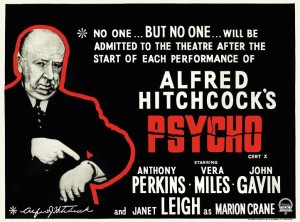 they’re “committed to the sanctity of the in-theatre experience” which sounds a little creepy seeing how we’re talking about a dark room with sticky floors and seating that I’m afraid might have lice. “We don’t understand why the industry would want to provide audiences an incentive to skip the best form to experience the art that we work so hard to create.”
 the rise in quality of home theatres, your sacred blue people will view just as well at home, and more comfortably. I’m sure Van Gogh isn’t thrilled that his most famous paintings are reproduced on coffee mugs, but do you hear him complaining? No. Because not everyone can afford a trip to New York City to the Museum of Modern Art, where The Starry Night is currently displayed (price of admission: $25). So now the masses can enjoy works of Van Gogh just about everywhere – on shower curtains, on umbrellas, on postcards, and Google. If Van Gogh can be a big boy about it, James Cameron, so can you.
 cinema is a group of strangers sharing stories and it belongs in a theater. Once filmmakers and theater owners open the door to this idea, there is no going back. The movie going experience is something to fight for! Watching a movie by yourself & watching a movie in a theater are two very different experiences. Film is meant to bring people together.”
 where the audience spontaneously burst into applause at the end because we were so moved. But I’ve been to too many movies where I’m disturbed by someone’s candy wrappers, hacking coughs, crying kids, deep abiding need to state obvious, observable facts, and an increasing inability to sit for 90 minutes without checking their goddamned phones. Is that part of your “art”, M. Night?
 Screening Room because it doesn’t “cannibalize” theatres – “Screening Room is very carefully designed to capture an audience that does not currently go to the cinema.” And that’s a pretty big audience. Because movie watchers aren’t just people who prefer theatres or not, they’re also made up of people who don’t have a choice. I missed a bunch of movies when I had back surgery and was attached to too many machines to travel. I still miss them intermittently (and always have, and always will) when my back is acting up and I don’t want to risk those shitty chairs. Parents with young kids who can’t get a babysitter will rejoice. Canadians who get snowed in or iced out will benefit. And people who are immobile, and families that deal with all kinds of physical and mental health problems who just aren’t able to tolerate a public theatre. Shouldn’t they have a venue for great “art” too?
 One such person who can never get enough is Drew Barrymore. In her 2015 memoir Wildflower, Barrymore describes begging for a chance to meet him after her good friend Tamra Davis (director of Billy Madison) raved about him. Barrymore was certain of his “goodness” and felt they should pair up despite them being complete opposites in their early 20s, “like a preppy and a punk set up on a bad blind date.” Her pitch worked: pretty soon he came calling with a little movie called
  The Wedding Singer in his pocket. Written by Sandler groupie Tim Herlihy, it was given an uncredited polish by Sandler’s friend and former roommate, Judd Apatow (another guy famous for working with a loyal crew, including Sandler himself of course, most notably on Funny People) and Carrie Fisher, to give equal weight to the feminine side. The movie was a hit, with Drew certifiably falling in love with the Sandler crew, calling them “real, no-bullshit friends” which I take is a high compliment in Hollywood.
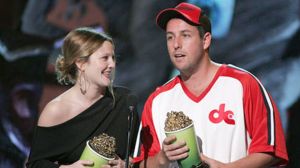 moved on. Drew worked intensely on a Penny Marshall movie called Riding in Cars with Boys, and it was around that time that she came across a romantic script that she thought was a great fit for her production company, Flower Films. Unfortunately that script was a hot commodity, and it kept changing hands, with big directors and stars attached, never becoming available to her, despite numerous attempts. Until one day she heard that it had landed at Adam’s studio, Happy Madison. By this time they each had an office just a few hundred feet apart on the Sony lot (she was doing Charlie’s Angels), so he was easy to hound. Sandler was already turning
 it into a comedy but welcomed Drew on board not only as a co-star but also as co-producer, and she’s responsible for keeping the important elements of the love story, the parts that turned us all to mush.
 broke records that opening weekend; I’m not the only one who finds these two irresistible.
 wives and kids” and she was able to make a family adventure out of it, even discovering on her last day of shooting that she was pregnant with a second daughter.
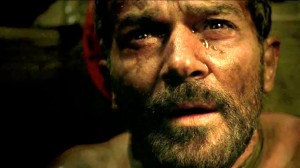 guy who should have been off but begged to work (all together now: oh, the irony!), and most importantly, the evil, greedy boss on whom we can pin all our hatred and frustration.
 country depends on mining as their primary industry. So who really cares for the miners? It took 100 years to drill down as deeply as they have, and they have about a half a can of tuna per man. How quickly can they be reached, and will they be corpses when (and if) they are? The miners are afraid their families will have graves up before they’ve even breathed their last down there.
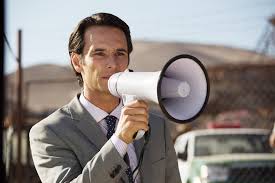 actors are Indian, Columbian, English, American. Actual Chileans are tough to spot but they’re banking on us not knowing, or caring, about the difference.
 I’ll take Phoning It In for 500, Alex.
 Dracula is back, the proprietor of a high-end hotel catering exclusively to monster guests. His daughter Mavis (Selena Gomez) has just married her human sweetheart Jonathan (Adam Samberg) and they’ve got a sweet little baby boy, the apple of Dracula’s eye. The only thing is, nobody knows yet whether the baby will turn out to be vampire or human. There’s a slight allegory here, something about “mixed families” but it’s not exactly groundbreaking stuff.
 Kattan, and Jon Lovitz; Sandler mainstays Kevin James, Steve Buscemi, Nick Swardson, and Allen Covert; and a rather inspired addition – Mel Brooks as Vlad, grumpy great-grandpa who doesn’t approve of vampire-human relations. My favourite of course, are Nick Offerman and Megan Mullaly, who together voice Jonathan’s super-square parents who get thrown into a crash-course in monsterdom when their son introduces them to vampiric in-laws and a “half-blood” grandson.
 Offerman and Mullaly are a real-life couple who met while doing a play. He was a lowly carpenter, and she was a TV star still in the throes of her Will & Grace fame. Over the course of their relationship, she’s seen his star rise as well due to a similarly iconic role on Parks & Recreation. We Assholes were lucky enough to catch them doing another play toget
 her, this time on Broadway, called Annapurna. It was a simple, 2-person play, deeply intense and emotional, and a real joy to watch two master thespians up close and personal. It’s clear that they love working together, even if it’s on a shitty kids’ movie.
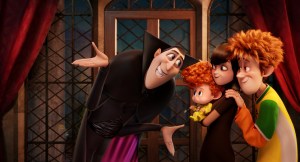 ask a kid, chances are they loved it. The sequel was a veritable monster at the box office, if you’ll forgive the pun, setting records as the biggest September opening, the biggest Sandler opening, and the biggest for Sony Pictures Animation as well. It grossed $469 million worldwide, and it just beat out
  And it doesn’t have much of a plot that I can summarize for you; it’s an unambitious slice of life. It’s about a guy (Nick Kroll) who shows up at his sister’s door in suburbia, looking for a place to live. He’s had some major setbacks and he’s feeling way too old to start his whole life over again. She’s (Rose Byrne) not in a much better place, kind of not sure about her job, her marriage, or even where to be or who to be. They’re listless. But the interesting thing about the movie, to me, is that they’re not painted as losers. They’ve just had some bad luck and some hard times, and that’s life.
 thoughtful and mature this movie is – maybe one of the more realistic movies about adult family relationships I’ve seen in a long while. Byrne and her on-screen husband, Bobby Cannavale, are a real-life couple, and they play well together. Throwing funny man Nick Kroll into the mix as a more or less straight-man is a bold and surprisingly effective choice. Everyone is some degree of flawed in this movie but we don’t make monsters out of any of them. They’re very relatable, and there’s a
  quiet generosity in the characterization, a forgiveness I’m not used to see in movies that was really refreshing and kind of a relief.
 a thing for sharp and feisty young women, and the two are a love match and plan to be at Oxford at the same time (unchaperoned, even). But every great love story needs an obstacle and feminism wasn’t enough, so along came The Great War to shake things up.
 hool to become a nurse.
 epic, called Birdsong (based on the Faulks of the same name). He plays a young man who goes off to war remembering the affair he had with his French (married) sweetheart. Clemence Poesy is beautiful as ever, but this one may leave you feeling faintly unsatisfied.
 wife’s) bring him low, low, low, low.
 Scottish liked bloody everyone else. But in this adaptation, she’s got this slight sense of foreignness and we begin to think what it might be like if she was just a little outside the community to begin with. Where exactly does her allegiance lie?
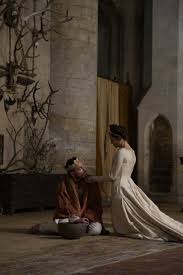 while I’d say Kurzel stays 90-95% faithful to the source, 5% is still cheating, isn’t it? The world hardly needed yet another Macbeth adaptation, so if you’re going to the trouble, you’d better have something new to say. But who is brave enough to believe they can best the bard? Justin Kurzel, evidently, a young director of just one prior movie, which I’d never heard of before. And there are three writer’s names in the credits, 3 brazen takers of liberty. Are they right? Can you take liberties with Shakespeare? Will the audience accept it? Forgive it?
 thing for bad boys, and he’s trying very hard to live up to her fetish. But it’s clear he isn’t as strong as she is. She is the driving force. Lady Macbeth has always been the one to watch, and Cotillard has always been eminently watchable. But then, having relished playing Dr. Frankenstein, she suddenly feels guilty for having created the monster. They’re a couple of complex characters, perhaps the best ever written, and if there are indeed actors worthy of them, these two come close.
 Taylor Schilling), who move their young family to L.A. and find it a challenge for making new friends. A fortuitous meeting in a park leads them to the swanky home of mysterious hipster Kurt (Jason Schwartzman) and his French wife, Charlotte (Judith Godreche).
 unraveling. Can it be saved by drugs?
 debauchery. You start to get the sense that writer-director Patrick Brice is just trying to shock us, and is relying on an onslaught of unpredictability to do so rather than any true wit or edginess. I guess I’m supposed to think it was cool and naughty but the next day I’m just feeling like I’ve got a bad comedy hangover. Like – did that really just happen? For me this was a great big no thank you, with a side of please, sir, put your pants back on.
 ASSHOLES WATCHING MOVIES