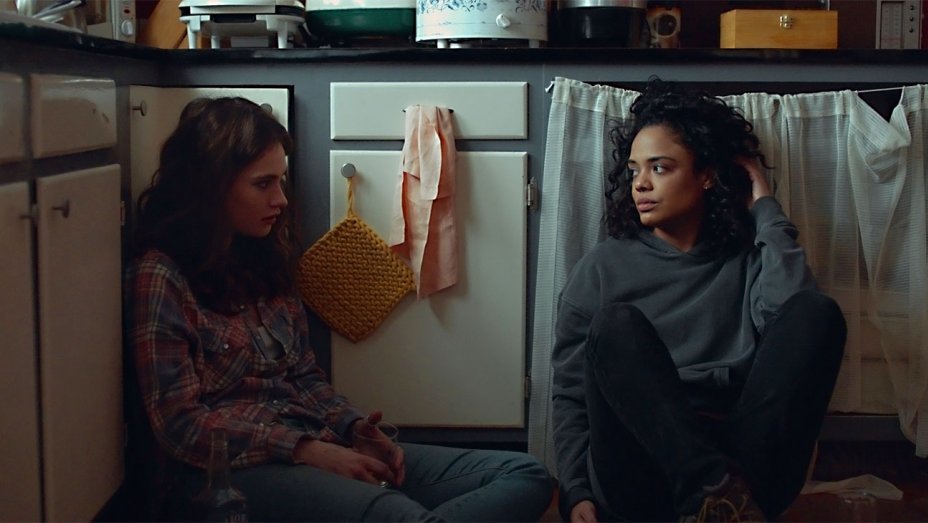
Ollie (Tessa Thompson) lives in a North Dakota fracking town, where the sudden boom has spelled disaster for all of the non-oil residents. She and her sister Deb have been estranged since their mother’s death. Ollie continues to live in her dead mother’s home as she rides out probation for pill running across the Canadian border, but the house is slipping into foreclosure. Deb (Lily James) prefers to live in a cramped trailer with her son, avoiding her volatile baby daddy (Luke Kirby) as best she can.
Ollie is looking for a job out of town, and hopes to leave as soon as she lands one. She’d like to leave sister Deb set up in the house before she goes, but they owe too much to make it work. They’re barely scraping by as it is. But when Deb discloses her pregnancy, Ollie feels driven to look outside the law once again. She’s got pills hidden in the woods. But does this lifestyle ever let you in, or our, easily?
Little Woods is a modern western, a gritty story of boom and bust, of struggle and self-sufficiency. It’s a slow burn, and the sense of place is dizzying and complete. Writer-director Nia DaCosta draws a thoughtful if bleak family portrait. Tessa Thompson takes that portrait off the wall and gives it life. Not just life: she makes it real, she makes it glow, she makes it necessary. Though DaCosta tends toward the economic, every time a scene lingers for just a beat or two, Thompson uses it, makes it hers, owns the space in a quiet, commanding way. Which is a good representation for the film as a whole. It might have crime and intrigue, but that’s almost incidental to the intimacy in knowing the sisters and the world they inhabit.
One small rant: The sisters cross the border to Canada to access our free health care and reasonably priced prescriptions. Deb makes some shitty passing comment about starting to see why people like Canada. Oh really, Deb? But do you see why people hate Americans? Because our “free” health care is actually paid for by our taxes. We pay for it directly out of our paycheques so that when someone is in need, the services are covered and no one has to worry about affording treatment. So when you come here and steal someone’s health card to get those “free” services, you’re stealing from every Canadian. But we look the other way. We feel sorry for you. But don’t think, for one single second, that Canada is only good for its socialized medicine. We’ve also got you beat in gun control, quality of life, education, space, and natural resources. Plus we have Starbucks and HBO. But yes, by all means, come here to steal from us and somehow look down on us at the same time. It’s the American way. End rant.
Ollie and Deb have ordinary, shabby lives. The kind that don’t always make for compelling viewing. Not exactly the kind of heroes we’re used to. But they have a valid viewpoint,and perhaps a familiar one. Thanks to good writing and terrific acting, their toeing of the poverty line feels heartfelt, genuine, and bold. These women have agency if not resources. The film’s hallmark may be harsh desolation, it is not without its sliver of hope. Definitely worth a watch.
 Obviously, I am not the only one who dreamed of becoming an astronaut. Space travel is clearly on a lot of people’s bucket lists, as shown by the proposed reality show cataloguing a one-way mission to Mars (which went belly-up earlier this year), the numerous space flights available for purchase (Virgin Galactic has collected $80 million in deposits for 90 minute voyages costing $250,000 each), and NSYNC’s Lance Bass attempting to buy his way onto a Russian rocket (he couldn’t afford it after Justin Timberlake left the band), among other examples.