Category Archives: Movie Reviews

Our reviews and thoughts on the latest releases, classics, and nostalgic favourites. Things we loved, things we hated, and worst of all, things we were ambivalent about.

Otherhood

Three mothers, originally friends because their sons were friends, have stayed in each other’s lives even after their sons have all moved away. We meet them at a mother’s day brunch they’ve thrown themselves because their lousy sons always forget (if any one of them had a daughter, or even a daughter-in-law, this movie wouldn’t exist; daughters are not allowed to forget). Not content to just sit around bitching and whining about their lives, they decide to inflict their neuroses on their grown sons, uninvited. So they pack themselves into the world’s most hostile road trip and storm New York City to make their problems someone else’s.

You likely know a mother or two just like this, and if it’s your own mother, well, god bless you. This kind of mother wants it both ways: she decides she MUST become a mother because her life is incomplete, but then she spends her kid’s life telling him or her that it was a completely selfless act that requires a well of gratitude whose depth cannot be measured as it is bottomless and unending and nothing will ever be enough. And when the child is grown, the mother is lost and without purpose because motherhood was everything and now she is nothing. And improbably, all three female characters in this film are suffering from this affliction.

Personally, I know tonnes of mothers who have managed to maintain a balance between forging a career, having their own life, nurturing friendships, and being better mothers because of it. I don’t imagine that’s easy, but it’s life, and the last time I checked, motherhood IS optional. But these women are acting like life is over because their grown sons don’t immediately reply to their inane and constant texting.

It must have been difficult for Netflix to promote this movie since one of the three women is Felicity Huffman and she’s not exactly winning any motherhood prizes right now (if you’re just poking your head out from underneath a rock, she’s one of the parents accused of believing that her kids are such profound idiots that they could only get into college with the help of large, illegal bribes, and that they still deserved to be there, perhaps taking the place of your own kids, who would have otherwise merited the position, because their mother is rich and famous and quite possibly she just wanted them out of the damn house). Leaving her aside, Netflix managed to convince both Patricia Arquette and Angela Bassett to join the ranks of the pitiful. And frankly, Arquette does nothing to dispel the pity party. She’s gotten a little too comfortably playing the kooky, offbeat, perpetually single mother. When she breaks into her son’s apartment to bake for him, it’s uncomfortably believable. When she fails to learn a lesson about meddling and instead declares that the only problem was that she didn’t meddle soon enough, you believe that too.

Bassett, on the other hand, is an asset. Her character has certainly invested too much of herself into living for the men in her life (her husband and her son), especially when those men haven’t deserved it, don’t return it, and don’t even want it. But because it’s Basset, her character doesn’t feel pathetic. She holds her head high. She clearly has strength. And she DOES learn her lesson, and earns herself a better life; in the end, she’s the only one we’re really rooting for.

I think a lot of women, and perhaps parents generally, struggle with the transition from parenting a child to parenting an adult. But the truth is, that role is always changing. A newborn baby is a round-the-clock, soul-sucking (and hopefully soul-nourishing) job; a two year old is a battle of wills; a twelve year old is an exercise in diplomacy; a fifteen year old is a test of nerves. You never stop being someone’s mother, but mothering stops being invasive and starts being supportive at some point – if you’ve done it right. Not everyone gets it right, and that’s okay too, because we’re all human and we’re all learning on the job. You might even have to be someone’s kid while also being someone else’s parent. But neither of those things should subsume your entire identity.

Otherhood isn’t a great movie but it’s possibly worth watching just because there isn’t enough Angela Bassett in the world as it is. Stories about women are worth telling. We don’t always get them right. We’re all fumbling around trying to figure shit out. And if you haven’t recently been federally indicted on charges of conspiracy to commit fraud, punishable by up to 20 years in prison, you’re probably doing okay.
Power of Grayskull

I don’t know of many men around my age who don’t know the opening words to He-Man: “By the power of Grayskull…I have the power!” It appealed to every kind of kid the world over. Whomever holds the sword, holds the power. And what kid doesn’t wish for power? The power to eat unlimited popsicles, stay up past bedtime, and rot your brain with comic books and candy. They were humble asks, really, but the very promise was intoxicating. Adam could, with the use of his sword, turn into the most powerful man in the universe. He-Man’s muscles were popping! His scaredy cat sidekick Cringer turned into a mighty Battle Cat who fearlessly leapt into battle, fangs first, with He-Man saddled to his back.

Mattel was struggling as a toy company. They had the successful Barbie line as well as Hot Wheels but wanted to get a great line of action figures for boys, a brand they could rely on. They were buying up movie licenses to release tie-in merchandise, but they always missed the mark. In the 70s, there still hadn’t really been a movie that spawned a successful toy, and Mattel’s Clash of the Titans line was another huge miss. The movie came and went in theatres, and the demand for toys immediately dried up (there weren’t home videos back then to keep the steam going). They had the opportunity to grab Star Wars licensing and passed. D’oh! So they went with the next big thing: Conan. Which might have been a good idea had the movie not turned out to be rated R with nudity and violence – not exactly toy-friendly. Shit. So instead of chasing after licences, they decided to just invent their own brand, which is where He-Man comes from – inside some Mattel guy’s brain. To sell the toys (and the vehicles, accessories, sidekicks, villains, etc etc etc), they came up with a back story to illustrate on the packaging, hopefully sparking the imagination of children. It worked. Little boys loved the toys, especially since Mattel released mini comic-books in the packaging to further flesh out the mythology.

In 1981, rules around children’s programming changed, and while before they would not have been able to create a show about a toy (essentially a 30 minute commercial), suddenly they could, and so of course they did. And heck yes the kids ate it up. The show had a whole cast of characters and cool locations that inspired toys constantly, which turned the Masters of the Universe into a billion dollar empire. The show and toy line were so successful that they thought: why not chase the girls too? So a twin sister was invented out of thin air: Adora, who of course turns into She-Ra, Princess of Power.

These stories were manufactured ass-backward to serve a need to sell bits of coloured plastic. It’s actually kind of fascinating to see how it comes together, and ultimately inspires a live-action movie starring Dolph Lundgren and Frank Langella. He-Man is remembered ever so fondly by fanboys of a certain age, who also embraced She-Ra, it probably goes without saying (her story lines were more sophisticated, her animation bolder, and she rides a goddamn horse with wings).

She-Ra was definitely my jam, although having little sisters usually meant that I was Swift Wind, the talking unicorn, more often than the princess of power herself (who wears the coolest head piece ever invented). So I really ate up every bit of this documentary which seeks out all the dusty corners of its creation. I love learning the practical ways in which creative ideas were born. It’s a call behind the scenes opportunity to pick the brains of those involved, and what a fabulous collection of creators!

The Red Sea Diving Resort

In the 1970s, Captain America went to Africa disguised as Captain Israel, where he assembled a crack team of Super Jews, including a harpoon-wielding Hawkeye and a Black Widow with feathered bangs.

Well, okay, that’s not exactly how it happened, and it DID mostly happen.

Ethiopian Jews were being slaughtered in their homes in the late 70s and early 80s, so Mossad agents led families on a 1000km walk to Sudan where, if they survived the journey, they became refugees waiting to be taken to Jerusalem, which was the tricky part. Sudan was receiving a stipend from the UN for each refugee they took in. The refugees starved, but the Sudanese government was not interested in losing easy money. In order to smuggle them out, the Mossad agents posed as hoteliers, actually running a resort, to remove Ethiopians by sea, toward a waiting Israeli Navy Seal ship.

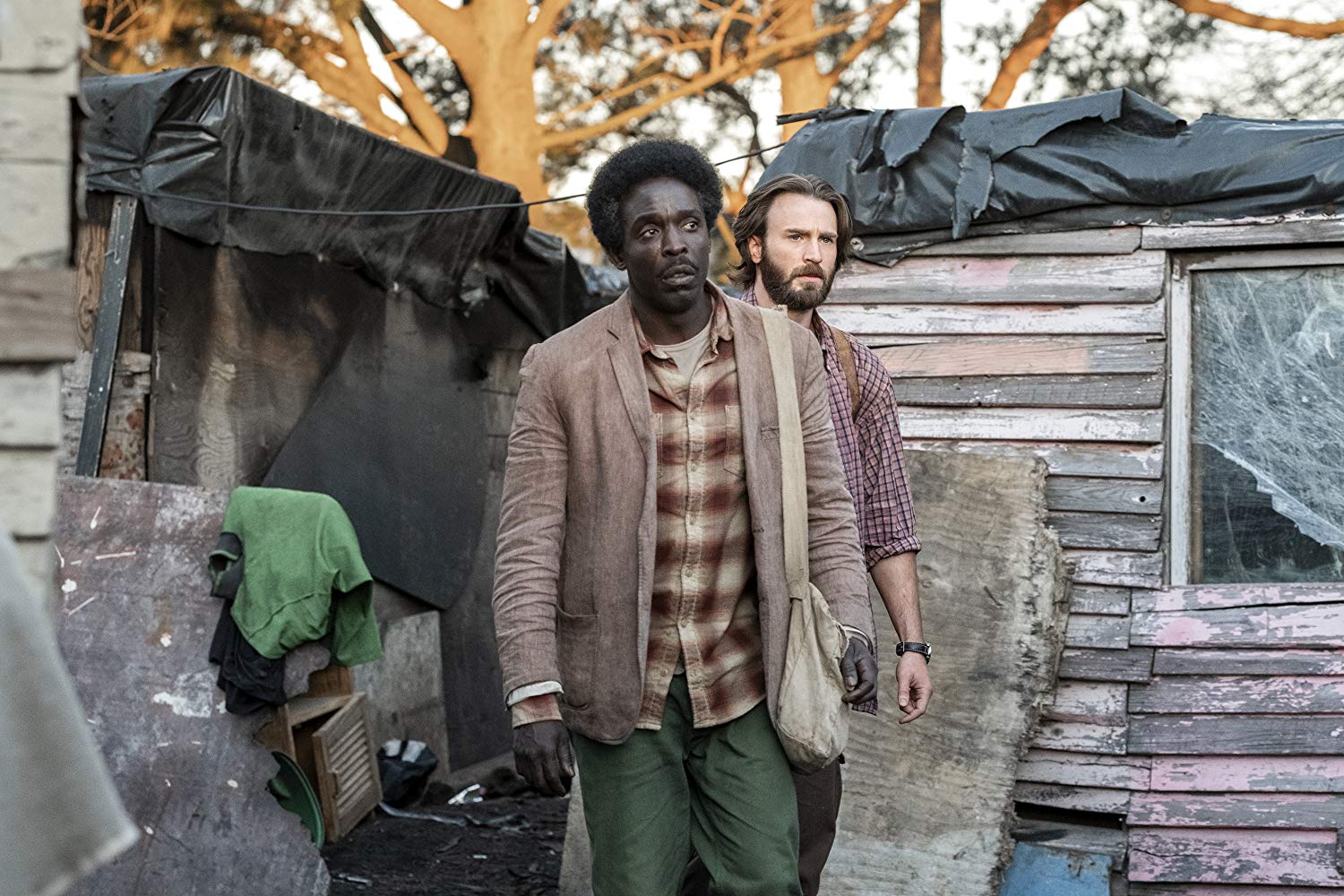
The crew is run by Ari (a bearded Chris Evans), a reckless agent known for running into danger without a plan for getting out. Always by his side, the very courageous local Kabede (Michael Kenneth Williams), for whom this is not a mission but very simply life.

Anyway, I callously poked fun at the casting of Captain America in this film, but it is a genuine problem. Not Chris Evans per se – he’s fine. He’s just too identifiably heroic, and the camera knows it. The story is infatuated with the idea of this rescue mission and it pumps up the hero aspect to 11 while disregarding their humanity. We know the group’s Black Widow (ie, only female component, played by Haley Bennett) is a mother and that she has left her child(ren?) behind for months or years in order to help save strangers but literally nothing is made of it. Who is she? How does she cope? How do the kids? Where are the kids? Ari is also a father, with an ex-wife who is already tired of his bullshit before this story even begins. His backstory is almost as empty as Black Widow’s, but his guilt is exculpated by a crayon drawing that implies his daughter forgives him for his repeated abandonment. What I’m saying is: the Avengers are super heroes who are just doing their jobs. In this case, the Mossad agents are real people with real loved ones and lives back home that they’ve sacrificed in order to save people, not from Loki or Ultron or Thanos, but from genocide, a less-glamourous, real-world problem that most people look away from. But the movie takes the one thing that it’s got going for it and ignores it almost completely.

Okay, scrub that: the film had 2 potential things going for it – the heroes, sure, but also the victims. Because these Ethiopian refugees are perhaps the true heroes of this story, and maybe any story. I’ve always thought that, as bloated as End Game was, the only story I was really interested in is the one they never told – that of normal people on Earth, those left behind by the snap, and those who disappeared because of it. What is their experience? Such a global, world-shifting event deserves some story-telling but never got any (they failed to even really touch on it in Spiderman Far From Home, disappointingly). But in this case, the Ethiopians escape with little else besides their lives, and know they are lucky to have that much. Many are missing children and spouses and parents. Many will lose more along the arduous journey, only to end up in a crowded, unhygienic camp where their bodies are worth money to their captors, so they are given just barely the means to stay alive. And that’s only half the trip: next they’re going to smuggled past armed check points, onto rubber rafts, and raced through the choppy waves of the Red Sea onto vessels that will sail them into a new life, one so different as to be unimaginable from their straw hut lives in Ethiopia. Now that’s a story. But by all means let’s eschew that for more of Michiel Huisman in a speedo.

So yeah, The Red Sea Diving Resort fails to overcome the same tired old tropes. It feels like a compilation of other movies you’ve already seen, but not a best-of compilation, more like a cross-section of the just-okay bits. Which is a weird compilation, I’ll grant you that. Who’d want to watch it? Not me. Not really. Not even for a bearded Chris Evans, still very much in Captain America mode.

UglyDolls

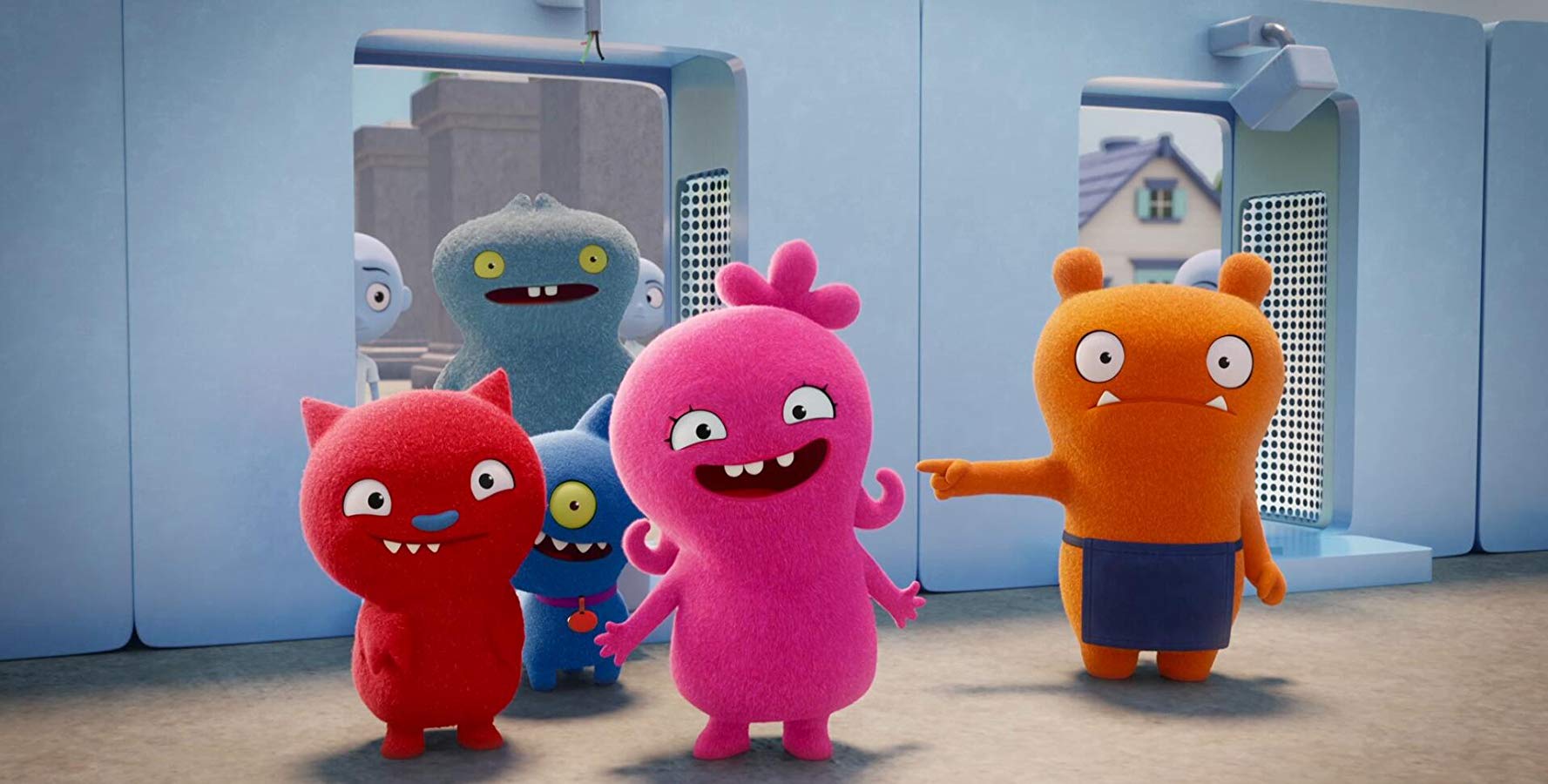
Uglyville is home to some fairly upbeat if misshapen dolls – they’re missing eyes or teeth or limbs – but most seem content. All but one doll, Moxy (Kelly Clarkson), who dreams of going to the “big world” and living with a child who will love her. She gets together a band of misfits (truly the only kind of band that CAN be assembled on this island of misfit toys by any other name), including Lucky Bat (Leehom Wang), Wage (Wanda Sykes), Babo (Gabriel Iglesias) and Uglydog (Pitbull), and together they stumble upon the Institute of Perfection, the last stop between the best dolls and their forever homes.

The Institute of Perfection is run by Lou (Nick Jonas), an alarmingly blonde-haired, blue eyed bastion of excellence. He gets all the beautiful dolls ready to run the gauntlet, the final hurdle to be cleared before being placed in a home. Moxy and gang find these perfect dolls to be outwardly pretty but inwardly ugly – they soundly and definitively and in many cases quite cruelly reject Moxy and friends for looking different.

From the very first frame, you know where this film is headed. We’re teaching kids to embrace differences and to accept imperfections. Sounds nice. But this movie takes an uncomfortably long time getting there and goes through too many catchy songs about the importance of beauty on the way. It makes you really start to sweat all the Hitler references.

In the end, the Uglydolls meet a perfect doll named Mandy (Janelle Monae) who (you may want to sit down for this) wears glasses. And through that hideous physical defect they’re able to bond and together they realize that not only is being weird okay, maybe it’s even possible for a kid to love you that way, in all your freaky glory.

UglyDolls plays like a watered down Toy Story, appealing to only the very youngest of children (my 5 year old and 7 year old nephews preferred to pick up live-action Dumbo over this for a recent car trip, but it was Sean’s recommendation of Shazam that really impressed, which meant we just spent 10 days sequestered in a cottage with kids who couldn’t go more than 5 minutes without singing “Lightning with my hands! Lightning with my hands!” and requesting this new band they’ve just been introduced to through the movie – Queen). Its fuzzy feltness and bouquet of primary colours should serve as a warning that this movie is nothing but saccharine and if you have any other requirements from a film then this one is not for you.


The Hitchhiker’s Guide to the Galaxy

In Canada we have only two seasons: winter, and construction. We are right in the middle of steaming, stinking construction season here in Ottawa, and we’re facing a weekend where the 417, a major highway and our main east-west artery, will shut down entirely. This after a flood season has left our infrastructure crippled and our commutes doubled. Which sort of makes the opening scene of Hitchhiker’s seem a little more likely. In order to make way for an intergalactic superhighway, a little lowly planet called Earth has to be demolished. We meet our hero Arthur Dent (Martin Freeman) just minutes before the Earth’s destruction. He learns that his good pal and towel enthusiast Ford Prefect (Yasiin Bey, then billed as Mos Def) is in fact an alien who can call in a favour to save his friend, but erm, nothing else of human history (don’t worry, the dolphins have already defected – so long, and thanks for all the fish).

They meet up with a clinically depressed robot, Marvin (Alan Rickman), an egomaniacal president, Zaphod Beeblebrox (Sam Rockwell), and most improbably, Arthur’s Earthling crush, Trillian (Zooey Deschanel). Together they’re going to zing around the universe, searching for the Ultimate Question, the meaning of life, a single solitary spot of tea, new chapters for an ambitious encyclopedia, and any remaining shreds of life as they knew it.

Director Garth Jennings bit off more than he could chew trying to adapt Douglas Adams’ influential and beloved work, but you can hardly blame him for trying. Is the movie always coherent? Of course not. If you aren’t familiar with the book, you might find it hard to keep up. If you are familiar with it, there are no doubt bits and bobs that you’ll miss. It is not so much a faithful adaptation as an ode to it, with Adams’ blessing, and mostly by his own invention (such as the sneeze religion helmed by John Malkovich – achoo!). But if it’s a little sloppy, well, what else can you expect from a movie with an improbability drive?

Ivan Reitman and friends actually optioned the film as far back as 1982, thinking it might make an interesting vehicle for Dan Aykroyd and Bill Murray (this is no doubt true). But then Ghostbusters came calling and they were off on a tagent, and Hitchhiker’s languished in development hell, at one point with Hugh Laurie and Jim Carrey slated to appear (I’m less thrilled with that pairing, personally). Douglas Adams wanted Hugh Grant for Dent but I’m so, so glad it went to Freeman instead, who plays the everyman so perfectly he is often overlooked.

In 2005’s finished product, Sam Rockwell steals the show as Zaphod Beeblebrox, basing the character on likely unequal dashes of Bill Clinton, Elvis, and Vince Vaughn. Personally, watching it in 2019, I saw all kinds of his George W. Bush in the role and it gave me a whole new appreciation for a performance I already loved.

Anyway, it’s inevitable that a film adapted from such a great book would fail to live up to it, but I actually give it a lot of credit and find it highly watchable and highly entertaining. So many of the little jokes really do work on the screen, and everyone involved is clearly relishing the opportunity to be involved. It’s hard not to find joy where so much exists.


Happy Cleaners

The Choi family are a family of Korean-Americans split along an immigrant fault line. Mom (Hyang-hwa Lim) and Dad (Charles Ryu) operate a failing dry cleaning business in Flushing, Queens while demanding the best from their American-born children, Hyunny (Yeena Sung), a hard-working professional, and Kevin (Yun Jeong), who is threatening to drop out of college and move cross-country to L.A. to start his own food truck.

Mom and Dad have some very strict values regarding success that their children don’t share. For Hyunny and Kevin, life is measure by more than just a dollar value, it’s about love, and passion. But those are luxuries bought by their parents’ hard work and sacrifice. But then why go through all of that to give your children an American life only to reject American values outright? It’s a hard spot familiar to many immigrant families in one way or another.

Happy Cleaners has a gently beating heart at its centre, but it doesn’t flinch away from the tension and drama that roil beneath a surface of filial piety and respect. Kevin and Hyunny recognize their unique positions, serving as links between the old country and the adopted homeland, and directors Julian Kim and Peter S. Lee are good at finding the nuance and the particularities faced by that first generation born in a new land. This division is intimately mined throughout the film, the family always at tug-of-war over the right way to embrace life and assimilate.

I don’t think Happy Cleaners has anything particularly new or ground-breaking to add to the immigrant conversation, but the film succeeds in its honesty and poignancy. For many immigrant families, this film may feel like a mirror being held in front of their own experience, but for the rest of us, Happy Cleaners is a window into the lives of those just trying to settle and be at peace in a new life.

Stockholm

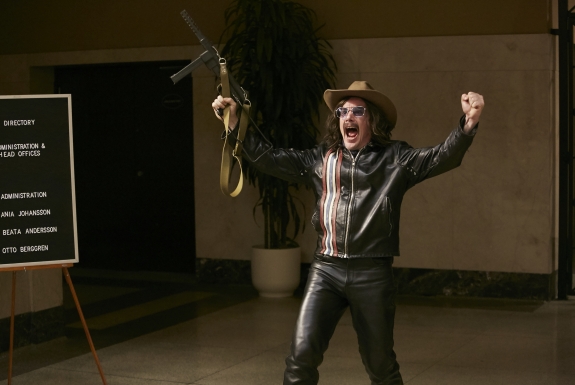
An American cowboy criminal flies to Sweden to host their first hostage situation. I mean, I don’t think he’s particularly interested in setting precedents, which is funny, because as you might have gleaned from the title, he’s about to create a situation that’ll become famous enough to named after it.

Lars Nystrom (Ethan Hawke) holds up a bank in Stockholm, but he doesn’t rob it. Instead, he uses it as leverage to have old buddy Gunnar Sorenson (Mark Strong) released from prison. On a roll, he throws in some extras, like a million dollars cash, bullet-proof vests, and a getaway car – standard bank robber demands. The dude doesn’t have an original bone in his body. He’s also not a planner: he asks specifically for a Mustang, and as someone who has not one but two of them in the driveway, I can tell you, you aren’t fitting hostages in that backseat. It’s a two-door car. When you’re running from the law, you don’t have precious minutes to waste trying to fold up grown-ups into a non-existent backseat.

But anyway. Lars has taken a couple of lovely ladies hostage, which is the kind he prefers. And also a dude, who hid rather than evacuated.

Stockholm syndrome is a condition which causes hostages to develop a psychological alliance with their captors during captivity. Sure it’s strictly irrational, but fear and stress and tension do create a rather specific kind of intimacy. Hostages and hostage-takers may feel like they’ve been through something together. It’s a form of bonding, in a weird way. It doesn’t make sense, but trauma does fucked up things sometimes. Stockholm syndrome is a fucked up thing.

Why would bank teller, wife, and mother Bianca (Noomi Rapace) bond with her captor? Perhaps partly because the cops seem inept. They’re not doing enough to save her and the others. The Prime Minister is not allowing the robbers to leave with hostages, and so they stay, festering in the bank.

Ethan Hawke and Noomi Rapace give terrific performances, but they’re stunted by a script that fails to do justice to the real events it portrays. Egregiously, it fails to sell the syndrome that gives it its title. I never felt a strong bond between captor and captives, certainly not one that would justify the three hostages not only refusing to testify, but fundraising for the dude’s defense. I rarely felt connected to anyone, or moved by anyone and I never felt any definitive chemistry between the characters either. This is not merely a missed opportunity, but supposedly the whole point of the movie, and it’s delivered so weakly it may as well not exist. I will not and cannot recommend what was ultimately a disappointment.

Stoke

Jane (Caitlin Holcombe) is a heartbroken Los Angeles attorney craving something big to shake her out of her depression. She sets her sights on Hawaii, but not necessarily the one seen on postcards. She’s going to chase lava, so she goes to the Big Island and hires two wannabe tour guides in the shadows of erupting Kilauea.

Locals Po (Randall Galius Jr.) and Dusty (Ka’uhane Lopes) are actually cleaners with tourism-dollar aspirations, but that won’t stop them from tricking Jane into their van, and ultimately their lives as the trio sets out on a Big Island road trip with distinct Hawaiin vibes.

Hawaii itself is the epic fourth character, asserting itself in nearly every scene, from its lush landscapes and hypnotic music, to the spirit of its people and the cadence of the natives’ speech.

Sean and I were lucky enough to visit Hawaii just a few years ago and were unprepared for but completely swept away by the natural beauty of the land and the welcoming hospitality of its people. We toured several of the islands, Big Island included, so it was a real treat to see some familiar sights in this film. But more than that, Stoke (a lava drama) shows us the side of the island little seen by visitors. It’s a reminder that volcanoes don’t perform for tourists, and an eruption has real-life devastating consequences for the people who live there year-round.

Stoke is a bit of a wild ride, embracing its independent roots by taking inventive chances and boldly charting its own course. In a strong cast of actually-Hawaiian Hawaiians (we’re looking at you, Aloha), Galius Jr is a stand-out for his unforgettable smile and screen presence. Directors Phillips Payson and Zoe Eisenberg have put together a thoughtful piece about the healing properties of America’s most beautiful state.

Alita: Battle Angel

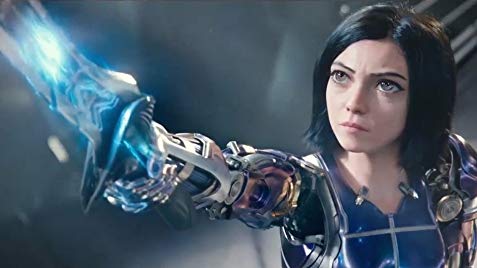
Alita: Battle Angel has robots, cyborgs, martians, floating cities, subterranean caves, hyperviolent arena sports, space battles, and an all-seeing immortal dictator pulling the strings behind the scenes.  And somehow, it manages to make all that stuff boring.  Like a three-handed guitar player (and make no mistake, Alita includes a three handed guitar player), Alita: Battle Angel is far less than the sum of its parts.

MV5BODMzMjlmZTYtOGU2NS00NGM2LWI4ZDItNzQzYTYwNDA2ZmU4XkEyXkFqcGdeQXRzdGFzaWVr._V1_CR21,0,939,528_AL_UY268_CR10,0,477,268_AL_The titular Alita (the Battle Angel, as it were) is found by Dr. Ido (Christoph Waltz) in an Iron City garbage heap. Well, Alita’s head and shoulders are, but the rest of her body is missing. Turns out, Alita is a 300 year old cyborg from before the “Fall” and Dr. Ido really easily brings her back to “life”. Like, it’s no trouble whatsoever for him to reboot her, and you might wonder why no one else has tried for the last 300 years.  But don’t, because if you start asking questions like that about this movie, you will never be able to stop.  Trust me.

We come to learn that in Alita the “Fall”  was a war between martians and Earth’s floating cities, rather than a name for the second worst season (anyone who thinks fall is worse than winter has never lived through a real winter), or an elevator between Australia and post-Brexit London (doesn’t it seem like Boris Johnson’s plan for Brexit might be to build that stupid elevator from the worse Total Recall? But I guess that makes sense when Donald Trump seems to have already ripped off the Mars colony part from the also-not-great original).

The only floating city that didn’t fall happens to be the one directly over Iron City, and oh yeah, Alita was found in the garbage falling from that floating city, and oh yeah, somehow after 300 years she still is in great condition without her body even though if any other cyborgs in this movie lose a finger they instantly die (except where screaming would add dramatic effect). Also, the only way to get to the floating city, obviously the home of the immortal dictator guy (Edward Norton!?! I had no idea he was even in this but of course Jay spotted him right away), is to win the Motorball championship (like a White House visit, I guess), but there is infinitely more political commentary in the previous two paragraphs of this review than in the whole of Alita. That’s probably for the better, considering how brainless this James Cameron script is. This was the best he could do after working on it for TWO DECADES?

There’s more back story and then some Matrix-lite fight scenes with a lot of cyborg spines and blue goo, but at this point I hope you are realizing that it doesn’t matter because it is all really stupid and you should avoid this movie at all costs. Some of the cyborgs might be kind of cool I guess but when Christoph Waltz, Jennifer Connelly, Mahershala Ali and Edward Norton clearly can’t be bothered with this movie, why should you?

The Best of Enemies

Picture it: Durham, North Carolina. 1971. Ann Atwater (Taraji P. Henson) is a civil rights activist. C.P. Ellis (Sam Rockwell) is the Exalted Cyclops of the KKK (the KKK should clearly not be allowed to make up their own titles). The two are about to clash over school integration.

City council is far from unbiased. Some will physically turn their backs on a person of colour, others will call on their friends in the klan to bolster their numbers. It’s not exactly the kind of town ripe for integration, and it likely wouldn’t have occurred to them had the black school not burned down, forcing some drastic decisions. Bill Riddick (Babou Ceesay) is given the unenviable, perhaps insurmountable task of mediating the two sides to negotiate a compromise, one city council will abide. A charrette, he calls it, though no one’s ever heard of the thing. or a collaborative, intensive community planning session. Riddick is a black man who has the magical ability to earn concessions from either side, but the “sides” aren’t exactly fairly drawn. If black vs white is enough to make your skin crawl, imagine black vs racists, men in hoods who won’t even concede that people of colour are people, who would wish the people sitting beside them dead, and in fact have taken shots at them.

1971 isn’t that long ago. It’s during Henson’s lifetime, and Rockwell’s.

The costume and makeup department have had a whole job of de-sexualizing Taraji P. Henson for this role. Her face is unadorned, her boobs are down to her belt. But her strength and presence are as keenly felt as ever.

The charrette ends up being a fascinating glimpse into a community – in 1971, as an attempt at a solution, and in 2019 as a reflection of the time. It’s a great reminder that it’s much harder to hate people you know. Humanizing the other side is always an eye-opener. These select community representatives spent a week together, discussing the issue, but also eating lunch side by side and taking field trips, sitting knee to knee on a yellow bus.

As interesting as I find the topic, the film itself is a little uneven, and thus, a little difficult to like without reservation. Writer-director Robin Bissell sympathizes with KKK president Ellis enough to give him a full backstory: a disabled son, a struggling business, an ambivalent wife. Meanwhile, Atwater, a real-life grassroots activist who fought the war on poverty, is given much, much less. Still, the two become…friends? Perhaps too strong a word. But familiarity reduces contempt. They are no longer just stereotypes to each other. And the fact is: perhaps this de-segregation thing is better for poor white folks than city council wants them to know.

This is how barriers are broken: regular people just listening to each other as best they can. That’s a lesson that still needs learning. That we have the power to influence each other, not by arguing, but by trying to understand. Sure it takes courage to stand up to your enemies, but it takes far more to stand up to your friends when you see that they are wrong.