Apollo 13

The real Apollo 13 mission was largely ignored in 1970. People had already seen men walk on the moon twice before, so this just seemed like more of the same. Interest was so low that lots of news programs weren’t even broadcasting it. Until, that is, things went wrong.

An oxygen tank exploded, which crippled essential systems. The 3 astronauts aboard just had to hang out in an increasingly inhospitable ship as the NASA crew on the ground scrambled to get them home safely. The planned moon walk was of course aborted; they never landed on the moon, just orbited around it. Over the next few days, the spacecraft had limited power, a worrying loss of cabin heat, a shortage or drinkable water, and an urgent need to fix the carbon dioxide removal system or die trying.

America might have been bored with moon walks, but for astronaut Jim Lovell, it would be the culmination of his life’s ambition. It was not to be.

Ron Howard brought this story of NASA’s most successful failure to the big screen in 1995, and still thinks of it as his best film. In fact, he thinks the launch sequence is the highest point of his career, and he’s not wrong. Watching First Man more than 20 years later, it’s clear that Apollo 13 had a huge impact on movies that would follow it.

Jim Lovell thought that perhaps Kevin Costner had a passing likeness, but once Ron Howard signed on as director, he immediately sent the script to Tom Hanks, who is a known space buff. Bill Paxton portrayed Fred Haise, while Kevin Bacon got the role of Jack Swigert, who was never supposed to be there. He was only on the mission as a backup, but blood screening suggested that Ken Mattingly (Gary Sinise) might have the measles, and he was replaced last minute. Though this was an undoubtedly heartbreaking switch, it was Mattingly’s expertise on the ground that ultimately helped save his crewmates. He sat in the simulator for days, doing simulation after simulation until he could work out a way to rescue his friends.
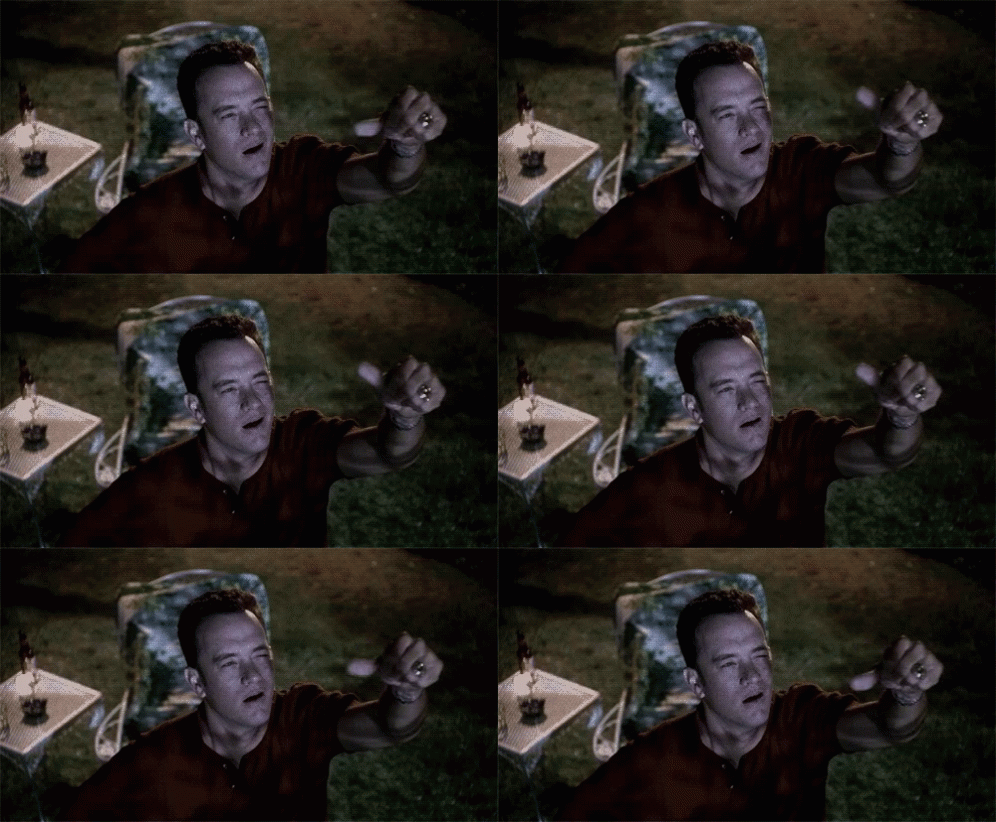
The actors, or actornauts as Howard called them on set, floated around in $30K space suits. And yes, they really did float. Steven Spielberg suggested that Howard approached NASA for special permission to use its KC-135 airplane, and permission was granted. Dubbed the vomit comet, the plane climbs to 38 000 feet and then does a big 15 000 foot drop, creating a zero-gravity effect, but it only creates about 23 seconds of weightlessness. For the film’s production, they had the plane perform 612 dives, for a total of 54 minutes of footage. Even still, sometimes when you see the actors just bobbing around in their capsule, they’re actually just sitting on seesaws. Pretending to be in space is hard! [Note: the 3 actors were very proud to report that none of them vomited on the comet…but several cameramen could not say the same.]

It took them 6 days to get them safely home, and while America did not care about a third module landing on the moon, it became obsessed with the imperiled mission that may or may not return. Millions of people tuned in every night, and so did the friends and families of the astronauts on board. NASA didn’t have time to give them proper updates, so they, like everyone else, relied on Walter Cronkite to feed them information. Ron Howard brought Cronkite in to record a few extra reports.

Tom Hanks and Gary Sinise had of course appeared together the year before in Forrest Gump, where Sinise’s Lieutenant Dan says to Forrest: ” If you’re ever a shrimp boat captain, that’s the day I’m an astronaut.” Lo and behold. The movie is full of little Ron Howard nods: Kathleen Quinlan who plays Jim’s wife Marilyn, actually had her first ever screen credit in American Graffiti, in which she played Peggy, a girl complaining in a bathroom about her boyfriend Steve – who was of course played by Howard himself. He also found a role for Roger Corman, the producer who gave Ron his first big break in Grand Theft Auto. Ron’s mother, his father, his wife, and of course his brother all appear in the film. The real Marilyn Lovell is briefly seen in the grandstands at the launch, and the real Jim shakes hands with the fake Jim aboard the Iwo Jima.

Apollo 13 was well-received, and it holds up well almost 25 years later. There are lots of movies about astronaut heroes, but Apollo 13 sets itself apart by portraying the time when someone’s dream doesn’t come true. It takes a story whose outcome is known (and in fact infamous: “Houston, we have a problem”) and still makes it feel tense and compelling.


Chasing Happiness

I missed the Jonas Brothers Happening. I mean, I wasn’t exactly living under a rock, but I was disconnected from pop music. I was going through a rough divorce from a partner whose mental health was on the rocks. I was rebuilding my life from scratch, working hard to finance my fresh start. I was exhausted and exhilarated and my playlist was full of power anthems, a kick-ass score for my happy new life. I remember being in a movie theatre and the trivia before the movie had me guessing between a Jonas and a Bieber, and I was clueless. Although I knew of them, I hadn’t knowingly consumed either – though I knew I’d likely heard their songs in malls or cabs if not clubs – and couldn’t name a song, or a brother. And then just as I was sticking my head up above the sand, the brothers were no more. Well, bands dissolve more readily than blood, but Jonas Brothers was over, and soon enough each Jonas was hitting the radio individually, which made it marginally easier to keep track of them.

Chasing Happiness is streaming now on Amazon Prime; it’s about Jonas Brothers reforming as a band now that they’re adults. A lot of shit went down, which they are surprisingly candid about. I’m obviously not a fan, but their transparency and realness are readily apparent and it’s hard not to get sucked into their particular brand of rags to riches.

They were close growing up, and they were competitive too. Like any brothers anywhere. Or indeed sisters. My sisters and I get super competitive if we’re playing a board game or competing for Mom’s attention, but I guess we’re not talented enough to have Jonas-level game. We’re not even good at the same things. But those brothers are disgustingly talented; any one of them can sing 9 out of 10 top 40 artists right off the billboard any day of the week. And they’re for real: they play real instruments, they write their own songs. Even as kids they were writing their own songs. Fifteen year olds are pretty shitty song writers, but they were so earnest and industrious it’s hard not to admire them anyway.

Few people have experienced such meteoric fame, let alone so quickly, and at such a young age. It’s three literal dreams come true, but enormous pressure too. Their father was a pastor, and he lost his job when his sons chose rock and roll (trying hard not to snigger when I write that), and the family home too. So now these teenage boys are the bread winners for their family. Meanwhile the machine just keeps getting bigger and bigger until it feels unmanageable.

Anyway, even having no idea who these guys really are, I still really enjoy sitting in on their family therapy sessions. Their Christianity and sexuality were on constant display despite them being minors. The media scrutiny sometimes made them into a joke, and their seminal years were tainted sometimes by fear and paranoia. There are cracks in Jonas Brothers, and one of the brothers plugs the crack with a stick of dynamite and lights it up.

Kaboom. Other bands can implode and go their own ways. But these boys are actual family. It’s sad and fascinating and honest. Man. I felt their pain. There’s resentment and betrayal and heartbreak there. Still is. It’s intense. But I really admire their willingness to lay themselves bare. I’m fairly confident that no one reading this has walked in shoes like theirs. But anyone with siblings will relate to this. We’ve all felt that knife. I’ve felt that knife. And anyone whose life changed after kids will relate to this. Anyone who’s grown apart from a best friend will relate to this. Maybe just anyone with a pulse will relate to this. I’ve gone and surprised myself by giving a damn about the Jonas Bros. I think I’m actually recommending this guys. Colour me surprised.

Then Came You

It cost me some dignity to even click on this film. That’s the first thing you need to know. The dying teen trope is practically my nemesis and it’s truly difficult to picture a universe in which I don’t resent it just for existing. So, not exactly a neutral space for writing impartial film reviews. But Netflix doesn’t pay me to write impartial reviews. Netflix doesn’t pay me at all.

Calvin (Asa Butterfield) and Skye (Maisie Williams) meet at a cancer support group where they’re both working on bucket lists, only they don’t call them that because that movie’s already been done. Their impending deaths lend an air of urgency to these lists – Skye wants to do loads of very general sounding things, like learn a trade and leave a mark, but she imposes only one item on his list: asking out a girl.

He works as a baggage handler at an airport where he’s seriously crushing on a flight attendant named Izzy. Which doesn’t stop Sky for going full manic pixie dead girl on him. That might be a nice farewell gift to a dying teen, only Calvin’s hanging on to a secret. He’s not dying. He’s just a hypochondriac.

Does this mean I only hate this movie half as much, or twice as much, on principle?

Then Came You has some nice moments, mostly because Butterfield and Williams are more watchable than a bag of dicks. Stop with the effusive praise, you say. No shade to Butterfield or Williams – they really are a sweet pair, she not quite convincing as a free-spirited punk, he all too convincing as an awkward, gangly spazz.

The problem is with the words coming out of their mouths. Whoever writes these things clearly thinks dialogue should double as a pancake topping: pure syrup. Skye had cancer, but she died of an overdose of cheese. Which actually sounds like my new top favourite way to die. Too much cheese! But not movie cheese. Cheese cheese. Goat cheese. Old cheese. Soft cheese. All the cheese. But Sky’s fatal dose of cheese came from doing all the tragic dying girl things that tragic dying girls always do in movies. Just once I’d like to see them go kicking and screaming. I mean, how many 17 year olds can possibly be so stoic in the face of the big sleep? I guess anger and fear and bargaining aren’t as photogenic. We like our tragedy porn to be youthful, docile, and composed. Tears are fine, but no ugly crying, it goes without saying.

Then Came You is ten cents out of $1.20 (a dime a dozen – is that how that works?). If you’re adding to your weepies fix, I suppose this one deserves a spot on the list. Otherwise it’s not a super great use of your Netflix account.

The Dark Crystal

Although my sisters and I were massive fans of Labyrinth when we were kids (I was later shocked to find out that David Bowie was some kind of rock star!) and can still sing every word to every song, The Dark Crystal was never on our radar. But it recently popped up on Netflix (not randomly: they’re actually making a series), so Sean and I thought we’d better give it a go.

And honestly, my life would have been better off without it. I was almost instantly confused, and I was utterly unprepared to be confounded by the complexities of a muppet movie. I told Twitter about my problem, and of the 43 people up at 2am and willing to commiserate, plenty of them simply made fun of me for how high I was (though honestly: doesn’t it seem like the kind of movie IMPROVED by weed???), but lots of them declared that this was among their favourite movies. And I was like: what the heck???

First, a synopsis as told by a lady (me. I’m the lady.) who did not understand the movie for any five second stretch at a time: Some dark crystal was damaged a long time ago and bad things have been happening ever since. For like 1000 years or something, so it’s weird they even remember the precipitating event at this point. Their little felt thumbs don’t look all that opposable but I guess they must be stellar record keepers. The Skeksis are so ugly you just know they’re the villains. They’ve been the evil overloads of their planet ever since. But our hero, Jen, has been raised by peaceful wizards. Jen is not like them though. He’s a Gelfling, the only one – or so he thought, until he meets a second, very pretty Gelfling named Kira, and she helps him on a quest to find the broken piece of the dark crystal, which would restore the universe’s balance.

Jim Henson clearly believed that being scared was a healthy emotion for kids to deal with. The Dark Crystal is a very dark fantasy, with little of Labyrinth’s signature levity. There’s a lot of peril encountered and a lot of responsibility on Jen’s shoulders, and let’s face it: there are lots of scary-looking creatures hatching evil plans. And there are also some drawn-out deaths, depressing old age shit that most kids movies stay away from.

Conceptual designer Brian Froud dedicated 5 years of his life to the look and feel of this movie, and almost all of it, from the design of the creatures to the world they inhabit, stemmed from his mind. In fact, he ended up changing a major aspect of the film when he came back to Jim Henson with designs that left him perplexed. Henson had intended to call the film The Dark Chrysalis, but Froud misheard and had developed the The Dark Crystal instead, and Henson was so enamoured with those first concept designs that they just went with it.

This movie came out in 1982, the same weekend as E.T. in fact, and went on to be the highest grossing film of the year in both France and Japan. It obviously has its share of fans, and perhaps a bit of a cult following. And I do see the incredible world-building undertaken by Jim Henson and Frank Oz; the ingenuity evident in the different sets and the creativity poured into each creature’s development. I just find that the characters in Labyrinth are friendly entry points into their universe, while the laborious time spent with both the wizards and the villainous Skeksis felt more arduous and less compelling. The Dark Crystal is a fascinating tour of the creature workshop, but I didn’t feel invested in a single character, whereas the Labyrinth gang still feels like a group of childhood friends.

Aside from the fact that I legitimately could not maintain a grasp on the story, The Dark Crystal just feels less colourful, less humourous, less memorable than its counterpart. I get that Henson wanted to just drop us into this strange land, and immerse us in it through showing rather than telling, but it made me feel alienated and cold. We hardly come to know the characters, except through what they’re doing. It just doesn’t speak to me or particularly engage me, but the one thing I’m impressed by is the lack of dumbing down for kids. Not a single fart joke in sight. Jim Henson really trusted his audience to make the leap along with him. Did you make the leap? Do you love the film? Help me understand why – leave comments down below.

The new Netflix series, The Dark Crystal: Age of Resistance, will be a prequel, focusing on a lost Gelfling civilization. It will look very familiar to fans of the original as Brian Froud is back, and he’s not alone. A nifty detail: Brain met a puppet designer on the set of The Dark Crystal named Wendy. They married and had a son, Toby, who went on to play little baby brother Toby in Labyrinth. All three of them are credited in the series. It’s got a LOT of major voice talent: Alicia Vikander, Andy Samberg, Simon Pegg, Gugu Mbatha-Raw, Keegan-Michael Key, Mark Hamill, Taron Egerton, and a lot more besides. It’ll be available on Netflix August 30.

Knives And Skin

Carolyn Harper makes out with a football player but when she pushes away his roaming hands, he leaves her alone in the woods and she’s never seen alive again. Her disappearance disrupts her high school and the entire community, as the disappearances of beautiful young white women often do.

In the aftermath of her disappearance, we watch things unravel for her friends, her fellow bandmates and classmates, her mother, and the well-intentioned but inexperienced local sheriff. More than that, though, we experience the way that grief accelerates the coming of age for a group of teenagers, which makes it rather obvious that their parents’ haven’t exactly completed the growing up process either.

Writer-director Jennifer Reeder creates a very atmospheric teen noir that pulls from a lot of sources but manages to be its very own thing. The closest thing I can compare it to is Twin Peaks for its eerie tone but believe me when I say Knives And Skin is its own gothic soup – a horror broth steeped with many surprising flavours. Reeder brings in familiar tropes and mixes them with haunting song and feminist references and the result is hard to categorize but fascinating to watch, even if it is uneven, a little long, and prone to meandering. If it occasionally feels a little piecey, it also feels dreamy, surreal. The story is less concerned about finding Carolyn than it is about exploring the various ways people feel trapped, and subtle reminders that escape is possible. Although it starts off with a dead girl in the woods, it subverts the expectations of that genre over and over with its confident female leads and the weaponization of sex. It’s like a parody, but self-aware and dead serious.

Reeder may value style over narrative, but Knives And Skin interesting, beautiful, and unforgettable.


Godzilla: King of the Monsters

Do you remember there was a Godzilla movie released in 2014? Neither did I, but maybe that’s because we saw it at the drive-in. Apparently Godzilla: King of the Monsters is a sequel to the 2014 film, and apparently in 2014 Godzilla stomped through San Francisco at some point. Well, during the mayhem, Vera Farmiga and Kyle Chandler’s movie son died, and it really put a strain on their marriage. So they split up, and now their movie daughter Millie Bobby Brown lives with Vera in a Chinese rainforest, researching classic movie monster Mothra. Things go sideways, though, when ecoterrorist Charles Dance kills everyone else at the research lab and takes Vera and Millie hostage along with Vera’s monster-controlling sound machine, in order to wake up lots of other monsters and let them run wild.

Obviously, the plot is really dumb. And the characters have some of the dumbest dialogue of the year. Mostly espository nonsense in between assorted lame quips (and very occasionally a good quip from O’Shea Jackson Jr., probably ad-libbed). Just terrible writing. So much terrible, terrible writing. But who cares, really? Godzilla should be about the monsters, and the monsters come to play.

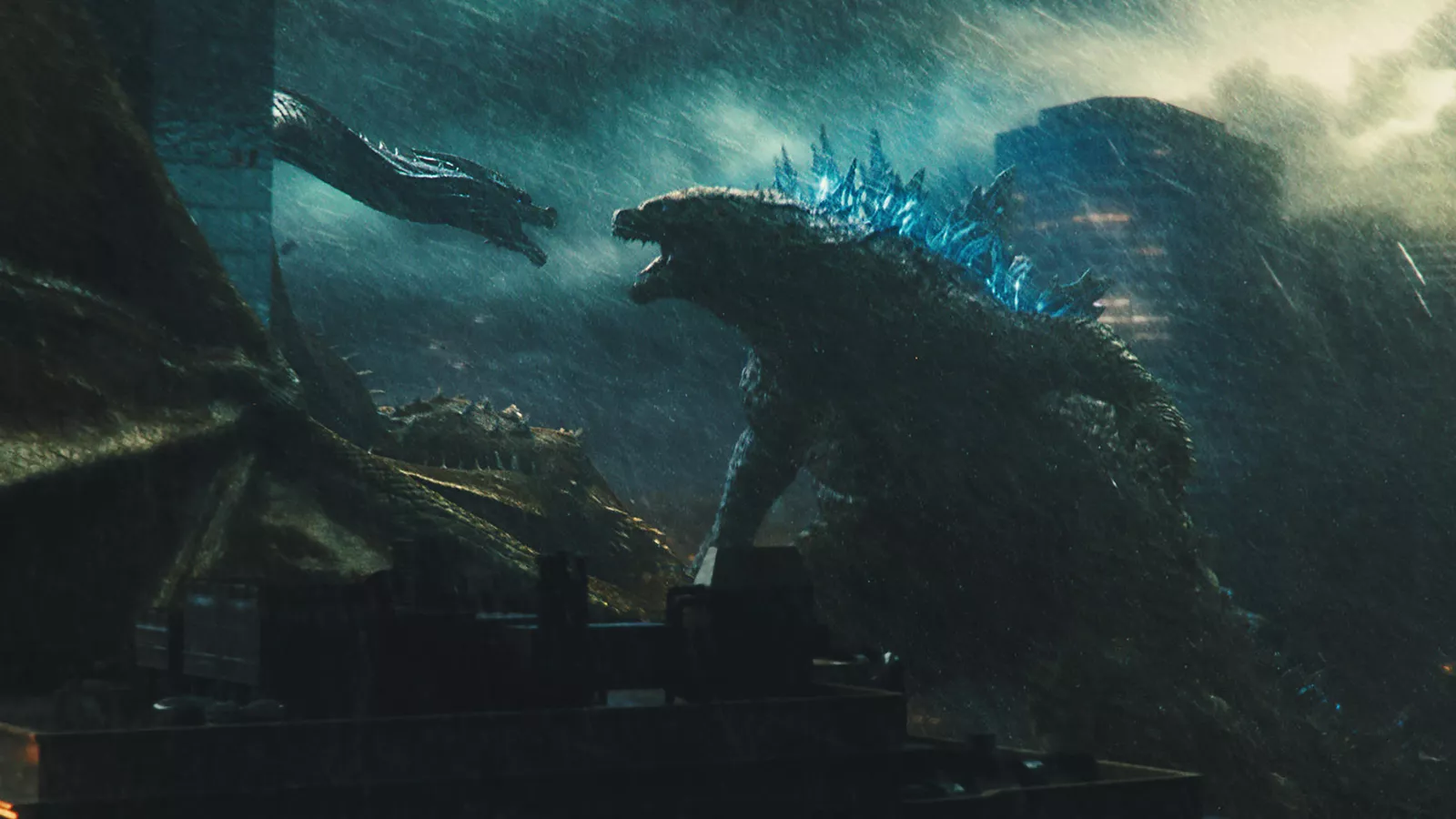
Godzilla, Mothra, Rodan and Ghidorah feature prominently, with King Kong and a bunch of other monsters making cameos (I don’t know who the other ones are but I bet someone does!). Monsters fight in Antarctica, monsters fight in Mexico, monsters fight in Boston, and I think they fought in one or two other places as well, but who can keep track? The important thing is, when the monsters fight, the movie works. And they fight enough that all the stupid writing can just be ignored, because you know another fight will come before too long.

Maybe next time they can fill the inter-fight lulls with halfway decent writing, plotting and character development. But if I have to choose between good human-vs-human scenes and good monster-vs-monster ones, I’m picking monster fights every time. After all, the monster fights are why I went to see Godzilla: King of the Monsters in the first place!

Always Be My Maybe

Sasha Tran is a famous chef opening a new restaurant in her hometown, San Francisco. Her fiance has just fled to India for 6 months, during which time they’re going to “see other people.” Those other people may or may not include Marcus, Sasha’s childhood best friend, with whom she lost touch after an ill-conceived grief-fuck in the backseat of his car. I mean definitely not. Their brief coupling was so awkward, and then she went off and did big things and he stayed behind to work in the family business after his mom died. It’ll never work. Never.

Sasha (Ali Wong) and Marcus (Randall Park) have a lot of love between them, but love is not enough. Their lives have diverged more than just geographically. Plus, it’s hard to take a dip in the hot springs of love when you’ve been lollygagging in the fallow fields of friendship all these years. Can they possibly overcome?

I mean, yes. Of course they can. This is a goddamned rom-com people. It’s not rocket science. There’s no will they or won’t they, there’s just how much longer until they do. And with this movie, you kinda hope it’ll be a while because you’re just enjoying the ride so much. Or at least I was, and improbably, I believe Sean was too. So that’s two people who hate romcoms (Sean because he literally has no emotions and myself because I’ve literally had eyeball surgery after bursting a network of vessels when I rolled them too much) who have made an exception for this one.

Always Be My Maybe is funny, and not just because the title is a pessimistic twist on a 1990s Mariah Carey song. Ali Wong is of course a comedy genius, and she plays very well against Randall Park, who I’ve always thought of as more of a dry comedian, but he’s got a bigger bag of tricks than I ever knew, including a musical side AND a violent side – and while I love them both, by god, I loved them even more when combined (stay through the credits).

This movie has absolutely nothing new to add in the romance department but you’ll be so busy being taken by surprise by random lines funny enough to stay with you for weeks you won’t even care. The cast is charmingly quirky and features a cameo (in fact, a meaty little part) that will pretty much make your year. Always Be My Maybe is streaming on Netflix right now, and it’s not a maybe, it’s a full-on yes.

Booksmart

It’s the last day of school, and best friends Molly (Beanie Feldstein) and Amy (Kaitlyn Dever) are ready to bid high school goodbye. They’ve been serious students, buttoned down and focused, and their hard work has paid off: they’re off to Yale and Columbia respectively. But their pride is tamped down a little when they learn that that many of their classmates are also headed for the Ivies – this despite the fact that they rarely seemed studious, and made lots of time for parties and fun. “I’m incredible at hand-jobs but I also got a 1560 on the SATs,” says one.

Molly is particularly devastated; sure she’s the valedictorian, but did she sacrifice fun for nothing? She doesn’t want to show up at college in the fall a party virgin. Her whole worldview is sliding down a crap chute, and her instinct is to dive in after it. Luckily, they have one last night before graduation, and Amy’s departure for a summer of volunteering in Botswana. One night to make up for 4 years of skipping parties and feeling left out of the in-crowd. They set their sights on Nick’s party – the most effortlessly popular kid in school (played by Mason Gooding, son of Cuba Gooding Jr).

The ladies do not get from point A to point B without boatloads (and sometimes they are literal boatloads) of shenanigans. This is Superbad, only because it’s girls, it’s much smarter. And it seems like this one night of trying to party teaches them more about themselves than the previous four years of high school. That sounds about right, doesn’t it?

The movie gets so much right even as we learn how much the girls have gotten wrong. Molly always assumed she was purposely excluded, but it turns out these kids are all too happy to greet her socially; her exile was self-imposed. How maddening, isn’t it, to discover that too late – and a good reminder for us all to check in with ourselves. How often do we impose our own limitations? Amy tackles her fears while Molly checks her ego, and her assumptions. The two women in the lead have amazing chemistry and it’s a lot of fun to witness the particular dynamic of their friendship. You and I know that college will test the bonds of their friendship, and inevitably change it if not crush it outright. They’re starting to have inklings that this might be so. So this last night out has some tangible pressure to it. Beanie Feldstein is a cinematic lantern, lighting up every screen she’s on, and lighting the way for others. Kaitlyn Dever is an excelling pairing for her, able to play off her energy in a more conservative and subdued way, while still holding her own.

Olivia Wilde tries out the director’s chair and seems to find it a pretty comfortable fit. She’s got an eye for letting actors do their thing; so much of the best bits feel spontaneous and are the best kind of weird. She’s also got an amazing feel for music – she introduces characters and themes with pop songs, and it really took me back. I bet most of us can come up with a soundtrack of our own high school experience. Music is such an important part of that time in our lives. I still surround myself by music constantly, but I will never again spend the day on my bedroom floor inhaling lyric booklets, or spend hours recording stuff off MTV like I did then. I know which songs I kissed to, slow-danced to, had sex to. Which ones we played on repeat as we drove recklessly and restlessly around parking lots doing donuts, which ones played at the diner as we split an order of fries, which ones we cried to when boys were mean to us, which ones accompanies us down the aisle at our own graduations and commencements. Wilde seems to have an intuitive sense of that, and I caught it.

There’s a theme in Booksmart that is hinted at but never spoken of: class. As in economic and social class. Molly points out the school’s 1% (Billie Lourd and Skyler Gisondo, whom Sean finds uproariously funny), but it’s clear that the Los Angeles high school as affluent as heck. Everyone, it seems, except for Molly. Not a single thing is ever said about it, but we see that she lives in an apartment building while everyone else has a McMansion, and her parents are absent from the film. So when Molly discovers that all her other classmates also got into good schools, she berates herself for having skipped the fun when she didn’t have to. But you and I know that she probably did: that kids like Molly have to earn their way in, but kids from rich families do not. They have legacy status, they know alumni who can pull strings. Their families donate money to schools. And, as we’ve seen in the news recently, they pay money to fake their way in on a little-used athletic scholarship or some other fraudulent means. College admissions are not the meritocracy we want to believe they are. There are very valid reasons why Molly worked so hard and others did not, even if the film never states them. So maybe Molly’s takeaway was to loosen up a bit, and experience life, which are not bad lessons. But for us, it’s a little bit more than that.

Even with these subtle layers, Booksmart never stops being fun. The cast is lively and diverse, the tropes are thankfully on the unexpected side, and the movie has a great pace. Plus it has an exception friendship at its centre. Just when you think we’ve said all there is to say about high school, Boomsmart is a charming, genuine and clever addition to the field.

Rocketman

Elton John has had a life full enough to fill many biopics, but Rocketman shines its spotlight on his most troubled years, as he shot to success and earned the world’s respect and adoration but struggled to know and love himself.

Little Reggie Dwight was a brilliant but shy piano player. His parents were by times abusive and neglectful in their own unique ways, and he retreated into the safe space created by music. As a young man, the self-styled Elton (Taron Egerton) could compose music easily but the lyrics came hard. So his meeting Bernie Taupin (Jamie Bell) was a special gift from the universe – together, they wrote pop songs that would change and infect the world with catchy, raucous tunes.

Elton developed an on-stage persona that was larger than life: in costume he could be brave, and better still, he could be merry. He could play for thousands despite being torn up inside by grief and self-doubt. He was tormented by the possibility that he would never truly be loved – this, even as he continued to seek the approval from parents who could never give it to him, and affection from a man who would use and abuse him.

Rocketman chronicles both the highs and lows of Elton’s life, whether plumbing the depths of his despair in group therapy or lifting an entire audience off its feet – this latter shown quite literally through the magic of cinema. These fantastical elements really elevate the material beyond the standard biopic and help establish a sense of the unreal. In other parts, the film’s a little draggy, and though his unhappiness is obviously a recurrent theme in his life, I wish it was a little less returned to in the film.

The monstrously successful, deeply conflicted, young, gay addict Elton is brought to life on the big screen by Taron Egerton, doing all his own singing, dancing, wallowing, and dazzling. He may not be his physical twin, but he embodies his spirit and he nails his tight-lipped grin. He manages both the bravura and the pathos, and nails them both.

Director Dexter Fletcher’s Rocketman is a bedazzled piece of inventiveness and daring. The movie truly thrills when he embraces his creative vision, translating the highest of emotions into visual delights that pair amazingly well with songs we still want to sing along to. While it’s by no means an exhaustive list of his hits, the movie folds them into itself with purpose and delight. It’s easy to get swept along by this engaging, vulnerable, triumphant story.

Snowpiercer

Thank you, Snowpiercer, for giving me a Bong Joon-ho movie that I can watch! Bong is such a talented director that it made a wimp like me try (and fail) to watch The Host. But not only is Snowpiercer his first English-language movie, it’s also accessible to jerks like me. Which is not to say it isn’t scary because intellectually, it’s nasty as hell. It’s not horror so much as dystopia, and the scariest thing of all is how soon it’s set: 2014. Well, technically the main action is taking place in 2031 or thereabouts, but basically in 2014 humans tried to repair some of the damage we’ve done to the climate and it went disastrously wrong. The earth froze over, so a very select few were chosen to fight for survival on a perpetually moving train. The train has elite passengers at the front, living in luxury, and the unwashed masses are crammed in at the back, living in filth and poverty and darkness.

Mason (Tilda Swinton), the train’s disciplinarian, doles out some very harsh punishments to those who step out of their lane. But there are serious rumblings coming from the back of the train – Curtis (Chris Evans) is the reluctant leader of a rebellion. Soon he and others (Jamie Bell, Song Kang-ho Song, Octavia Spencer, Asung Ko) will make a violent push toward the front, but as usual, the haves will never make it easy for the have-nots.

The film, based on a graphic novel, is a brilliant commentary on class warfare. But it’s not just a matter of class, or economics. It smacks of Marxism, but is tainted with Darwinism. The oblivious first class passengers see their station as right and just, pre-ordained even, and cluelessly talk about their own sacrifices. But ultimately, they are being controlled just as much as the proletariat in the back. The propaganda starts with the schoolchildren and never ends. Free will is an illusion carefully meted out by those in charge. So is hope, and that’s a pretty bitter pill to swallow.

The film’s momentum is as relentless as the rebellion. Once they start making their push toward the engine, the train itself is a revelation. Production made a 100m replica of the train, and each of the train’s cars is wilder than the last, each more breathtaking, each scattered with clues. And the view outside the train’s windows of the frozen wasteland of earth is strangely beautiful, almost mesmerizing – it’s both serene in its tranquility and violent as the train continues to punch through the continually forming ice and snow. Bong tends to shoot the action with the tail section toward the left of the screen and the engine toward the right, so you always get the sensation that things are moving. It’s a really cool way to orient the audience and keep things pressing forward.

Tilda Swinton gives one of the most compelling and bizarre performances of her career, and if you know Swinton’s body of work at all, you know what a tall, broad drink of water that statement is. Bong Joon-ho originally wrote the part of Mason with John C. Reilly in mind; at the time he was a much more peaceful character. When Swinton landed the part, Bong changed the role but left in the male gender markers. Swinton wears glasses that were once her own – when Bong visited her at her home, he found them in her children’s dress up box, and insisted she wear them. Mason has a gold glinting tooth that is often visible, especially the more unhinged she (he?) becomes. She’s based the character on Margaret Thatcher, which is the funniest thing I’ve ever heard. Thatcher died the year this came out (2013) so I doubt she ever saw/heard of this unflattering ode, which may be for the best.

Chris Evans pursued the part even though Bong Joon-ho thought he was wrong for it. Bong thought he was simply too fit for a guy who’s been living in the cramped quarters of a dirty train compartment for the past 15 years, never seeing sunlight, subsisting on protein bars made of ground up insects. Evans was clearly persuasive and he’s clearly right for the part – Bong made it work by strategically using wardrobe and camera angles to downplay his physique.

The action sequences are other-worldly. You know which scene I’m going to talk about: a door slides open to reveal a car full of men wearing black fetish masks. Only they’re not here to have safe-word sex. They’re all holding hatchets. They’re here to murder you. In a deep, cleaving way. And then the lights go out. It’s dark like a nightmare and the axe battle is on. They pass up torches from the rear and that’s the only light lighting the scene, which is expertly done. Park Chan-wook serves as a producer and you can’t help but see Oldboy flavours in this scene. It’s spooky and tense and brutal.

Though the train’s engine is meant to be one of perpetual motion, lots of stuff inside the train is actually going extinct (like cigarettes, which will be missed). Life outside the train, however, may actually be returning. In the film’s final shot, the survivors’ sense of hope is buoyed by the sight of a polar bear, a sure sign that life on earth will continue. I think the choice of a polar bear is significant: our news feeds have been inundated with the sight of starved polar bears, of polar bears literally drowning because the ice is melting and swims between ice floes have become too long to sustain. Polar bears are a vulnerable, at-risk species. Snowpiercer’s healthy, satiated polar bear indicates that what they really need to thrive is the loss of their greatest threat: humanity.