Guava Island

Donald Glover dropped a 55 minute short film this weekend – it streamed on Amazon Prime, and at Coachella. Music, TV, movies: there seems to be nothing he can’t do, and do extremely well, at that. His multi-facetedness might be annoying if he wasn’t so actually talented.

MV5BYWVhMGViNzEtMjRiZC00ZmRlLWEzZTUtYTVlYjAwYzBlMDYxXkEyXkFqcGdeQXVyMTAxMTcwMTEz._V1_The film, Guava Island, is hard to describe. It’s really more a parable than a traditional narrative, so don’t get hung up on that. And all praise to Childish Gambino: do not be surprised when a LOT of his music inevitably pops up.

He plays Deni, just a dude on this fictional island who is about to bring his music to an all-night music festival that’s super frowned upon by the island’s big boss, Red Cargo. Red can’t tolerate a music festival that might mean the island’s factory workers call in sick for the work the next day, a Sunday, including Deni’s girlfriend Kofi (Rihanna) and friend Yara (Letitia Wright).

It’s the perfect setting to talk about corruption, and the influence of art, its ability to unite a people. But it’s not the perfect medium. It’s not that the film is too short, it’s that the idea is both half-baked and heavy-handed. It made me wish it was less of a movie and more of a visual album, like Beyonce’s Lemonade, because that’s when the movie truly came live for me, when Glover lets his music take over and the reasons we love him and frequent collaborator/director Hiro Murai are allowed to shine down upon the island.

Rihanna and Wright are criminally underused; their main purpose is to smile admiringly at Glover. Rightly so, perhaps, but to have both of these women on hand and not give them something to do seems wasteful, and a tease. Maybe this concept works better for a Coachella audience. Few are likely to have stood in place to watch the film straight through, but maybe just standing under its shadow is enough.

Dumbo (2019)

Since the original Dumbo is only 60 minutes long, it was inevitable that Tim Burton’s 2019 update would veer from the scant story line of the first.

Max Medici (Danny De Vito) is the owner of a rinky dink circus where little Dumbo is born and immediately considered a monstrosity, despite the fact that our eyes tell us that between his big, sad, blue eyes and his soft, floppy ears, CGI Dumbo is perhaps even cuter than his hand-drawn cousin. A couple of kids, Millie and Joe Farrier, befriend Dumbo and together they discover he can fly. Their father Holt (Colin Farrell), a former trick pony rider and current one-armed vet, cares for the elephants but isn’t particularly warm to them, or to his own motherless children. When Dumbo’s mother, Mrs. Jumbo, is in the middle of an incident, she is labelled ‘mad’ and sold away. This is the straw that broke the circus’s back. It gets eaten up by a new amusement park called Dreamland, owned by Vandevere (Michael Keaton) and featuring the beautiful Colette (Eva Green).

As you can tell by cast alone, all the trappings of a Tim Burton movie are there, but sadly, almost none of the magic.

MV5BMTk3YzY3NmEtODExNy00ZGY5LTk3ZGYtMGUxOTlmN2Q2MTcxXkEyXkFqcGdeQXVyNzk5MTY4MTU@._V1_The first thing working against it, at least in my mind, is a circus scene in the movie Big Fish. It’s only a small part of the movie but it’s completely wonderful. Shouldn’t the wonder just multiply when set entirely at the circus? But no. Things start off relatively well at DeVito’s flea circus, but once it gets swallowed up by the soulless Dreamland, things go off the rails.

Second, I despised seeing Dumbo ridden. Dumbo is a flying baby elephant. Isn’t that enough? But no: 2019 needs to subjugate his whimsy by physically climbing aboard. It also doesn’t help that the sight of Eva Green on Dumbo’s back is some of the worst CGI work in the movie.

Mostly though, the movie just doesn’t feel coherent. Dumbo isn’t really even the star. Burton decided against the whole talking animal schtick, and while that makes sense for a live-action remake, it means a lot of improvised human characters and actor egoes who need screen time and dialogue and character arcs.

But when Dumbo himself is on the screen, the movie puffs its little chest and feels bigger for just a moment. Dumbo is irresistible, particularly in his clown makeup. My heart practically grows arms that yearn to embrace the poor little guy. Unfortunately, this little heart of mine just can’t quite make its way to liking this movie. It has everything going for it but the sum isn’t more than the parts. The sum is messy, and a little cold. Burton’s Dumbo is BYOH – bring your own heart.

The Perfect Date

Like 90% of teen movies, the general conceit is that the protagonist is reflecting upon his short life via the old college application essay.

Brooks Rattigan (the dreamy Noah Centineo) hopes to be Harvard bound, but his guidance counselor counsels him that he’s really quite bland and uninteresting, so he’s got to “find himself” in order to inject zing and zeal into his application.

A chance opportunity to be paid to escort the lovely if anti-social Celia (Laura Marano) to her high school formal births two very important plot points: Brooks falls for the MV5BZTJkZDZjYTMtNTNiYy00MGFlLWIzZmUtZjEzM2ZlMDY4NTI1XkEyXkFqcGdeQXVyNjg2NjQwMDQ@._V1_SY1000_SX1500_AL_terminally popular and super-rich Shelby (Camila Mendes), and he gets an idea for a business opportunity. He’s going to need a lot of money to pay for Harvard (and to woo Celia), so why not rent himself as a date for hire? It worked well enough the first time, with Shelby, so why not with other girls? He recruits best friend Murph (Odiseas Georgiadis) to set up a dating app, one where girls can choose what date he’ll take them on, what outfit he’ll wear, what topics he’ll discuss, even what personality he’ll embody.
Nothing could go wrong, right?

Every single thing that happens is boldly predictable and unimaginative. But you didn’t come innovative story-telling or artistic film making. You came to lose yourself in the deep chocolate pools of Noah Centineo’s soulful eyes. Which is a good thing because Noah Centineo has not one but two eyes, and the movie has otherwize a grand total of 0 reasons to watch. The characters are extremely rough drafts of real people and they have no motivation, no arc, nothing.

You know those cardboard cutouts of movie stars that used to dot your local Blockbuster? Well you could use those life-sized cardboard cutouts to reenact this movie and it would be fairly indistinguishable. I don’t think the quality would suffer at all. But then you’d miss out on Noah Centineo’s wavy hair, and the crinkles around his eyes when he smiles. Of course, if you are not a 12 year old girl, you may find yourself impervious to his Millennial charms, and therefore you should stay the heck away from this movie because it just isn’t any good.

Missing Link

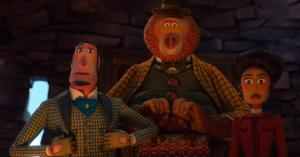
Sir Lionel Frost (Hugh Jackman) is an investigator of myths and monsters but his charismatic exploits have failed to yield any actual proof. There’s a boy’s club of pompous explorers Frost would kill to be a part of, but they won’t have him. In fact, Lord Piggot-Dunceby (Stephen Fry) would kill to keep him out – and unfortunately, he means that a little more literally than does Frost. Frost feels like his best and last chance is to go to America to find the elusive Sasquatch, and Lord Piggot-Dunceby sends Willard Stenk (Timothy Olyphant) to make sure he doesn’t.

Frost does indeed meet the Sasquatch (Zach Galifianakis), who turns out to be rather a MV5BNDFmMjlmNjEtN2RhNS00NWNhLWFjODgtN2IxYTY1NzExYWZlXkEyXkFqcGdeQXVyODEwMTc2ODQ@._V1_pathetic figure. The last of his kind, “Mr. Link” is lonely, and hopes Frost will help him find long-lost cousins, Yeti said to live in the Himalayas. With the help of Frost’s friend Adelina Fortnight (Zoe Saldana), who hikes the mother fucking Himalayas in heels, they have an adventure worthy of even the greatest explorer, facing adversity bigger than even Big Foot himself.
Laika’s last effort, Kubo and the Two Strings, is an absolutely incredible feat of animation and story-telling. It looks and feels like something truly special, almost magical. Missing Link, while quite charming, is no Kubo. Which is not to say it’s bad, not at all. It’s sweet, actually, and its straight-forward plotting is kid-friendly and accessible. The animation is what we’ve come to expect from over-achieving Laika, and the voice work is first-rate. The film manages to be funny and heart-warming throughout. But it doesn’t have that edge, that sliver of darkness I’ve come to expect from Laika.

Missing Link is a nice movie, a genuinely nice movie, but it’s less sophisticated, less complex than Laika’s usual fare, so for me it fell short of the high bar set by Kubo.

The Oath

A fear-mongering, power-hungry president has decided to asked his fellow Americans to sign a loyalty oath to prove their patriotism. There are incentives to signing – tax breaks, of course – but signing will be totally optional. Americans have nearly a year – until Black Friday – to opt in or out. No pressure. But during that year, things are not as easy-peasy as first promised. ‘Patriots’ turn vitriolic. Hate crimes increase. Protests often get violent. Protestors start to mysteriously disappear. ‘Concerned’ citizens start turning each other in.

Sound disturbingly plausible?

But of course holidays must still be observed, so we join Chris and Kai as they host is family for Thanksgiving.

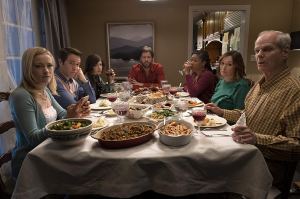
MV5BNDM3ODAwMTc1NV5BMl5BanBnXkFtZTgwMTM1NDQxNjM@._V1_SX1500_CR0,0,1500,999_AL_Chris (Ike Barinholtz) is staunchly against signing the oath; he and Kai (Tiffany Haddish) agree on that. But while Kai just wants to survive the family and survive her in-laws, Chris is glued to the television and obsessed with minute-to-minute reports from across the country. It’s hard to blame him: these are indeed crazy times.

Chris’s mother (Nora Dunn) insists on “no politics” at the table, but Chris can’t help but clash with his right-wing, oath-signing brother Pat and Pat’s alt-right, fake news spouting girlfriend. Even Chris’s “more reasonable” sister Alice (Carrie Brownstein) can’t get a word in. The first half of the movie plays out exactly like many of our own family gatherings would under similar circumstances. Ike Barinholtz, who also writes and directs, gets right to the heart of things, satirizing and underlining America’s troubling and polarizing partisanship. He keeps things interesting by casting Chris as equally culpable. He’s on the opposite side of the spectrum, but he’s every bit the blowhard, intolerant of every opinion but his own.

And then John Cho shows up. He and Billy Magnussen play CPU agents – that’s Citizens Protection Unit to you. It seems someone has reported Chris for his unAmerican activities. Cho plays a relatively reasonable guy, but Magnussen plays exactly the kind of guy who would be attracted to the position. Never mind that this oath was supposedly voluntary, he believes Chris is the worst kind of traitor, and he’ll stop at nothing (and I do mean nothing) to serve his country in the manner he’s deemed necessary. Shit goes south FAST. The film takes a detour toward the increasingly absurd, and yet Barinholtz never loses us because it never quite feels unrealistic. And maybe that’s the scariest part.

What I’ve failed to mention is that although this is technically a political comedy, it’s also a horror movie. It’s not gory or graphic or particularly scary to watch, but it is deeply frightening to feel how close we are to this very situation.

I may have enjoyed the concept more than I enjoyed the execution of this film, but damn if it didn’t keep me 100% mentally engaged and 110% emotionally enraged.

Every single character is acting out of love of family and love of country – every single one. But they’re coming at it from such different directions it feels impossible that they should all want the same thing. This is exactly American’s biggest problem right now, and the gap between the sides widens every day. No matter which side of the problem you think you’d come down on yourself, you must admit that in 2019, the most revolutionary act we can commit is one of compassion.

The Oath is a smart, thoughtful movie that I wanted to end only because I couldn’t wait to start talking about it.

Mary Magdalene

In bible times, everyone named their girl babies Mary, which has led to a lot of confusion over the years. Mary Magdalene is often confused for the Mary who was a whore – you know, the “sinful” woman who washed Jesus’s feet. In fact, Mary Magdalene, which is to say the Mary who came from the fishing village Magdala, was not a prostitute; she left her village to follow Jesus. She was the 13th apostle, never so named because of course she was a woman, but the truth is, the bible mentions her by name more times than it does any of the actual apostles. So Mary Magdalene was important. She witnesses Jesus’s crucifixion, his burial, and his resurrection. The catholic church now owns her as a saint in her own right.

This movie is a feminist take on a story that has always been told from the male perspective. When Sean asked me how I liked it, I said something like “Well, it’s the role Joaquin Phoenix has been dying to play.” To which Sean thoughtfully responded “Mary Magdalene?!?!?!” and I had to say “No, dummy, Jesus” to which Sean should have gone quiet but instead admitted “Oh yeah, I forgot who else was in that story.” So yeah. This is Mary Magdalene’s story of her time spent with that weird dude named Jesus.

In the movie, Mary M. (Rooney Mara) is a more independent woman than most. She does MV5BMTBjNDI1MTQtNDFlOS00MGE0LWI3OGYtYTIzMjBiY2NmMDQyXkEyXkFqcGdeQXVyMTk2NDA3MTM@._V1_SY1000_CR0,0,1500,1000_AL_not want to get married. So her father and brother obviously assume she is possessed by demons and try to drown them out of her, which mostly consists of drowning her. She barely survives their ‘help.’ Then they have the balls to act all shocked when she runs away from home to join the circus. I mean Jesus. She joins up with the Jesus train, which is not all that different from a circus when it rolls into town.

Jesus (Phoenix) is charismatic and he draws a big crowd. Mary M. isn’t the only one desperate to hear about this wonderful kingdom, free of oppression. But she realizes that women in particular might like to hear more about the end of tyranny, so she schools Jesus on how to talk and minister to them directly. Oh, the other apostles are shocked and appalled. Of course they are. Who is this woman who is automatically Jesus’s new teacher’s pet? Peter (Chiwetel Ejiofor) is particularly jealous and mistrustful. Of course, if you know anything about the bible, you know they’re all in for more difficult times thant these. The official film synopsis calls it a “dramatic turn of events” which is hard to say about the most-repeated story for the past 2000 years. It’s not exactly an M. Night Shyamalan twist. Spoiler alert: Jesus dies! AND he is risen! Lord have mercy.

Director Garth Evans takes a winding and melancholy route to death and resurrection, but it’s beautiful, and the cast is really strong. Mostly I just loved hearing this overly familiar story from a female perspective for once. It broke down the world’s most pervasive myth and made you think about it from outside the box – not a lot, just a little. It pushed the boundaries. But just accepting that the boundaries are flexible to begin with is a huge deal, and I found myself looking at the thing from all kinds of new and interesting angles.

Opens April 12 just in time for Easter for a special one-week engagement at Toronto’s Cineplex Cinemas Yonge-Dundas and VIP, Mississauga’s Cineplex Odeon Winston Churchill Cinemas, Vancouver’s International Village, Calgary’s Cineplex Odeon Eau Claire Market Cinemas, Edmonton’ Cineplex Odeon South Edmonton Cinemas, and Montreal’s Cinéma Cineplex Odeon Quartier Latin.

Holmes & Watson

How old am I? I laughed at Will Ferrell and John C. Reilly all the way through Talladega Nights: The Ballad of Ricky Bobby in 2006. And then I did it again 2 years later for Step Brothers. They were such a charming duo in their way. But here we are in 2019 and I can’t find one spare giggle for their reunion in Holmes & Watson. How old have I gotten that I don’t find these two funny anymore? Or perhaps the better question is: why are they still making the same movie when they’re both now in their 50s?

In fact, upon closer inspection, Holmes & Watson is NOT the same movie. The first two are birthed at the hands of Ferrell and Adam McKay, with just a magical sprinkling from Reilly. Holmes & Watson is written and directed by Etan Cohen, who is also responsible for Idiocracy, a movie which I find vile and deeply unfunny, so perhaps it’s no wonder at all that this one isn’t for me either.

The world is saturated with Sherlock Holmes stories and we didn’t need another, but I believe we would have made room for it if the movie warranted it. Benedict Cumberbatch has already staked an icon take on the role, and the writers on the show go MV5BM2Q0Y2UyNDEtODE1NC00ZTUyLTgzY2EtNjliM2VjNDk3NTZjXkEyXkFqcGdeQXVyOTMyMjYwNTA@._V1_SX1777_CR0,0,1777,888_AL_to great lengths to honour his brilliant mind and the world’s most esteemed detective. Will Ferrell’s Sherlock is also supposed to be brilliant, but Cohen can’t find a way to express that while still being funny. The result is a rim shot – you know, when the basketball can’t decide whether to score or not, so it just sort of hobbles around in midair, keeping everyone in suspense? Only the movie’s tone is the basketball, and it circles the rim for so long that you’d rather just walk away in disgust than find it whether it eventually lands.

As far as I can tell, most of the humour is derived from Holmes and Watson supposedly accidentally inventing things far before their time, like a selfie with the Queen (it’s Queen Victoria in the movie, even though at the time of Titanic’s sail, which is when the film is set, King George would have reined), and a telegraphed dick pic

Holmes & Watson is a blemish to Sir Arthur Conan Doyle’s memory, and a bruise for modern cinema, which it really didn’t need. It’s not just an unfunny comedy, it’s also a shockingly bad movie. When Sony realized it had a real stinker on its hands, it tried to just sell it off quietly to Netflix, and Netflix said: no thanks. So if you’re still wondering How bad can it be?, remember that you’ll have to pay a $5 rental fee to find out, and after reading this review, if you pay it, it’s not so much a rental feel as an idiot tax, and maybe you deserve to pay it after all.

Push

The right to decent and affordable is a basic human right. But housing is also a commodity. If you own your home, it may represent a significant portion of your wealth. People and companies are buying up buildings not as homes but strictly as assets. So what happens when a commodity is also a human right? It presents a conflict that is being felt around world-wide.

This documentary follows Leilani Farha, newly appointed UN Special Rapporteur on the Right to Housing, around the world in her fight to define affordable housing as a fundamental human right. She (and we) will visit markets where housing prices have eclipsed income levels, sometimes by margins of two and three and four times.

From Toronto’s addiction to luxury condos that sit vacant to the Grenfell Tower fire in London that claimed 72 lives, Farha, accompanied by director Fredrik Gertten, is there, asking the tough questions.

Push is a very watchable film. It speaks to us on a human level. Why is an investment company buying up low-income housing? What is a city, and who is meant to live there? Where will people go when they lose their homes, their communities? And how can we live with ourselves when literally trillions of dollars worth of real estate sits vacant while people die sleeping in the streets? And how can investment firms be allowed to buy up distressed mortgages and make a profit renting those same properties after a financial crisis OF THEIR OWN MAKING.

Once you start wading in, Gertten seeks out some very esteemed social and political thinkers to shed light and insight on a situation that is raging out of control. Yet the documentary remains accessible, its experts approachable. Gertten navigates this with clear intention. This is indeed a human crisis, one that should and does engage AND enrage us.

A Kandahar Away

Kandahar, Saskatchewan.  Population: 15.  A world away from Kandahar, Afghanistan both in size (the original Kandahar had 557,000 residents in 2015) and circumstance (as the larger Kandahar is under constant threat from the Taliban).  

Kandahar_Away_1But a name is a powerful thing, and Kandahar, Saskatchewan (named in honour of the 1880 battle of Kandahar, Afghanistan) is about the only link to his home that Abdul Bari Jamal can find.  Jamal came to Canada in 1991 with his wife and five children, refugees all, fleeing their conflicted homeland as the Taliban were taking control.  On an impulse, and without telling any of his family, Jamal bought eight plots of land in Kandahar, Saskatchewan, for himself, his wife, and his kids.  Ten years after that impulse purchase, Jamal takes his family on a trip to Canada’s Kandahar to let them in on the secret.
Their trip is chronicled by director Aisha Jamal, who not coincidentally is one of Jamal’s five children.  The whole family, including their parents, are urbanites to their core, so coming face to face with a dwindling prairie town approaching “ghost town” status is a huge adjustment.  But a far more problematic matter soon arises when Mr. Jamal comes up with the idea to use their land to memorialize the 158 Canadians who lost their lives in Afghanistan.  Judging from Mrs. Jamal’s shoulder-shrugging reaction, this is not the first such idea that Mr. Jamal has come up with, but his children are greatly shaken by the idea that their father wants to commemorate a force that invaded his homeland rather than the thousands and thousands of Afghans who’ve been killed in the conflict. 

It is fascinating to get an inside look at these discussions and disagreements between  a family that is clearly close-knit.  They have a lot of commonalities to larger issues in our society.  In particular, they give great insight into the refugee experience and the differences in attitude between an Afghan-Canadian and his Canadian children.  The elder Jamal seems afraid to voice any concern or raise any controversy over Canada’s military involvement in Afghanistan, while his children have no such qualms.  There’s something significant there about the importance and value of freedom of expression, as well as Canadian identity. 

Director Jamal handles these discussions brilliantly, letting both sides exist and allowing viewers to draw their own conclusions while the family drama, which would be sufficiently entertaining on its own, plays on.  It is a delicate balance to strike but Jamal successfully melds both aspects together to create a memorable and effective exploration of a very sensitive subject.

Shazam!

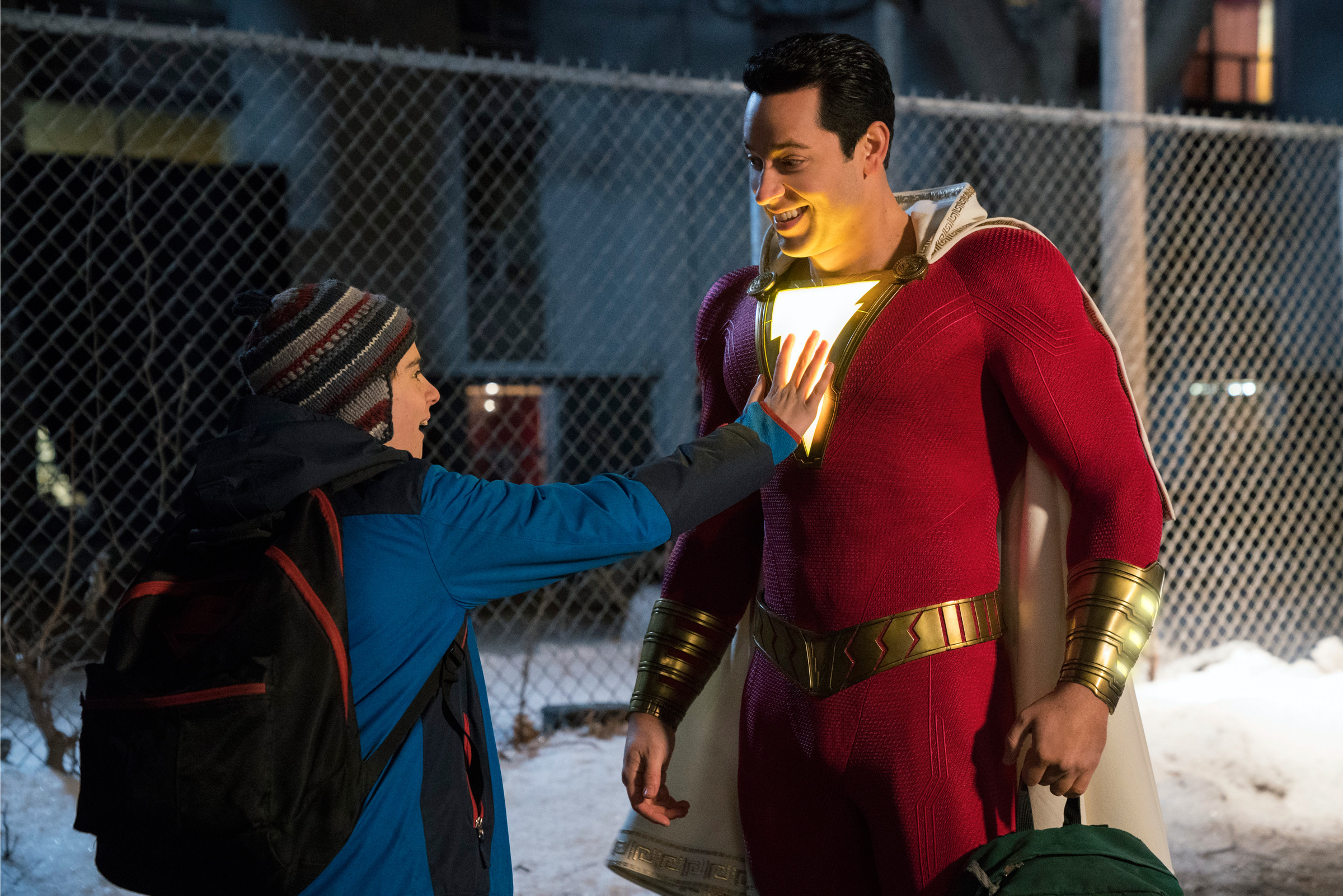
In Shazam, 14 year old Billy Batson is given magical powers by an old wizard (Djimon Hounsou). Suddenly, by saying “SHAZAM!”, he turns into an adult superhero (Zachary Levi) with super strength, super speed, and a whole lot of other powers. Billy is given these powers so that he can prevent the seven deadly sins from destroying the world. Naturally, teenager Billy has slightly different priorities, such as using his new powers and appearance to earn money, make killer YouTube videos, and buy beer.

SHAZAM_feb22_0125.dngAlso on Billy’s to-do list: picking a great superhero name. Billy and his best friend try out a lot of options for Billy’s superhero throughout the film, like Captain Sparklefingers, Power Boy, the Red Cyclone, Mister Philadelphia, Maximum Voltage, and on and on. None stick. Captain Marvel is noticeably absent from the list, and the name problem is a nice nod to the real world legal issues that Shazam has faced since the 1940s, as the character has been enjoined, traded, discarded, renamed and reimagined numerous times since. As a bonus, Billy even says “Holy Moly” a couple of times in the film, which was comic Billy’s go-to but which no one else has said since about 1962.

Billy’s behaviour is schlocky and charming and works wonderfully for a superhero who has also been called The Big Red Cheese. But interspersed with the corny stuff is a really terrifying villain (Mark Strong), who has a glowing rock for an eye, calls upon demons to decapitate, dismember and destroy a whole boardroom of corporate suits, and watches with a smirk as a rival turns to ash. These tonal shifts are not just uneven, they are jarring, and more than that, the dark aspects of this film make me hesitant to recommend this film to my brother even though my seven year old nephew insists on being notified whenever the Shazam trailer comes on TV.

Still, DC has delivered its second good film since trying (and then aborting) its shared universe project (Wonder Woman is still the best by far and will be hard to beat). The problem for DC is that having now said that each movie is its own entity and there’s no bigger narrative, meaning there is no need for regular movie goers to seek them all out. So when a good one comes along, people will go see it, but when the next one’s mediocre, the masses can skip it without worrying that they’ll miss something. In my view, a big part of Marvel’s success is that each chapter might add something important, so I’d better see it even if I’m superheroed out that month. DC has now walked away from that which only increases the pressure for their movies to measure up, and that’s a questionable choice when DC has more misses than hits to this point.