The Convenient Groom

Dr. Kate Lawrence, PhD. (Vanessa Marcil) is a small-town celebrity for giving no-nonsense dating advice. She’s about to announce her surprise engagement to boyfriend Brian, the elusive “no red flags” guy, proving to her fans that she can walk the walk. Kate thinks this incontrovertible proof that her relationship advice is the real deal will push her career in the right direction, so she allows her agent to nudge her engagement announcement into a very big, very public thing, which is pretty inconvenient when Brian unceremoniously dumps her in the middle of a live feed. Luckily (or shall I say conveniently), his identity has remained unknown to fans, so at the last minute, Kate’s old high school bud Lucas (David Sutcliffe) subs in, pretending to be her future groom.

With a book deal, not to mention her reputation, on the line, they agree to carry on this ruse for the foreseeable future. I don’t think anything could go wrong, do you? Her agent of course insists they go through the motions of planning their pretend wedding, even setting a date just three months hence. If you’re wondering what’s in it for Lucas, he’s harbouring a secret crush on her and has been since they were kids. Naturally. Very convenient indeed. Anyway, for lots of couples, planning a wedding can be quite stressful, but it turns out if you’re a fake couple planning a fake wedding, it can almost be kind of romantic. Especially when you’re doing it in front of cameras. Apparently.

You know what? Don’t worry about Kate and Lucas. They’re going to be okay. Plus they’re going to get to taste-test some raspberry-filled chocolate cake that they don’t ever plan on needing, so don’t feel too badly for them. perhaps feel a little badly for David Sutcliffe who once upon a time played Lorelai Gilmore’s baby daddy and is now reduced to this. Which is almost slightly better than average because he’s in it, and he’s a better than aver Hallmark actor. However, Vanessa Marcil is a worse than average addition to the cast, and her confusion between acting and hair tousling makes for a frustrating viewing experience. So the two cancel each other out, leaving just the story to make or break your experience, and it’s a pretty weird and contrived premise, even for Hallmark. These two are clear soul mates, only because between them they don’t have an ounce of dignity, and that’s makes us an awkward third wheel.

The Man Who Walked Around The World

Anthony Wonke has a wonky way of starting movies. It can never be any director’s intention to confuse the viewer into turning the movie off just to double check they’ve clicked on the right one, and yet that’s exactly the effect he creates when he introduces the topic in the most roundabout way possible.

For those of you who think you might like to tackle this documentary, know that the film will make you believe, for the first 5 minutes or so, that this is about some very bad men in Iraq, but when Mr. Iraq eventually gets to his point, which isn’t very interesting, it’s that whisky saved Iraq. Won Iraq? Whatever the hell they were doing there, whisky helped. And not just any whisky. Johnnie Walker whisky.

Note: I very much want to spell it whiskey, as I always have, and always will, but since Johnnie Walker spelled it whisky, I’ll honour his wishes this one and only time since we are indeed talking about the 200 year history of his well known and well loved brand.

Johnnie Walker was indeed a man, the son of a farmer who poured his inheritance into a grocery store where he blended and sold his own whisky, which his ancestors shrewdly turned into a global brand that may or may not help Americans end wars. Don’t worry, the hyperbole won’t stop there: Johnnie Walker was also the hero of prohibition, and the brave solver of racism. According to this documentary, which I’m beginning to suspect may be a little biased. It is not, however, contributing in any positive way to sexism, because the brand aims to be synonymous with masculinity, so if you’re a woman who drinks whisky, go fuck yourself.

But at least it’s not contradictory. For example, Johnnie Walker is a respected and recognized brand that is its own best advocate and is so sophisticated it would be demeaning to pay for product placement or celebrity endorsement, and don’t just take our word for it, let’s hear from brand ambassador Sophia Bush, or the guy in charge of pointing out it’s the preferred brand of Superman (in Superman 3) and Rick Deckard (Harrison Ford, Blade Runner).

The Man Who Walked Around the World is either a very bad documentary or a very good commercial. If you hit the red label hard enough, it probably doesn’t matter which. If you’re sober, however, you might want to…well, keep walking.

Love on the Slopes

Alex (Katrina Bowden) wants to be a travel writer but her boss at the travel mag tells her that travel writers are courageous and impetuous, things that she is not. But Alex really wants this new job and is determined to show her boss he’s wrong, so she decides to go on an extreme sports vacation even though using a paperclip where a staple would normally be required is usually as extreme as she gets – and even that scenario makes her sweat a little.

Anyway: does she have a panic attack causing a human pileup on the chair lift? Possibly. Did Sean invent the word “helichopter” because helicopter just wasn’t extreme enough? Undoubtedly. Was that a Hannah Montana reference I just heard? No idea. But hang on to the seat of your snow pants, folks, you’re in for a pretty wild ride – ziplining, suspension bridges, extreme tobogganing (well, it was pretty regular tobogganing, to be honest, but down a larger than average hill). Nothing so extreme it smudges Alex’s lip gloss, but extreme for the Hallmark channel, thanks to her “guide,” adventure photographer Cole Taylor (Thomas Beaudoin). Now, it is difficult to sift the bad dialogue from Beaudoin’s awkward delivery, nay, impossible, but there’s more than enough blame to go around.

Well guys, what do you think? Will Alex uncover a roaring desire for extreme sports? I mean, it’s Hallmark. They’ve got to channel their horniness into something productive, amirite? Those hormones have to go somewhere – might as well be off the side of a very high cliff.

Mangrove

On Amazon Prime, there is a series of films by Steve McQueen under the title Small Axe; they are related in that they are based on the real-life experiences of London’s West Indian community in the recent past. Mangrove is the first film in the series. The Oscars and the Emmys are perhaps more invested in hashing out whether they are technically films or episodes or something else entirely, but at 2 hours and 7 minutes of first-rate film-making, I’m just going to go ahead and review it.

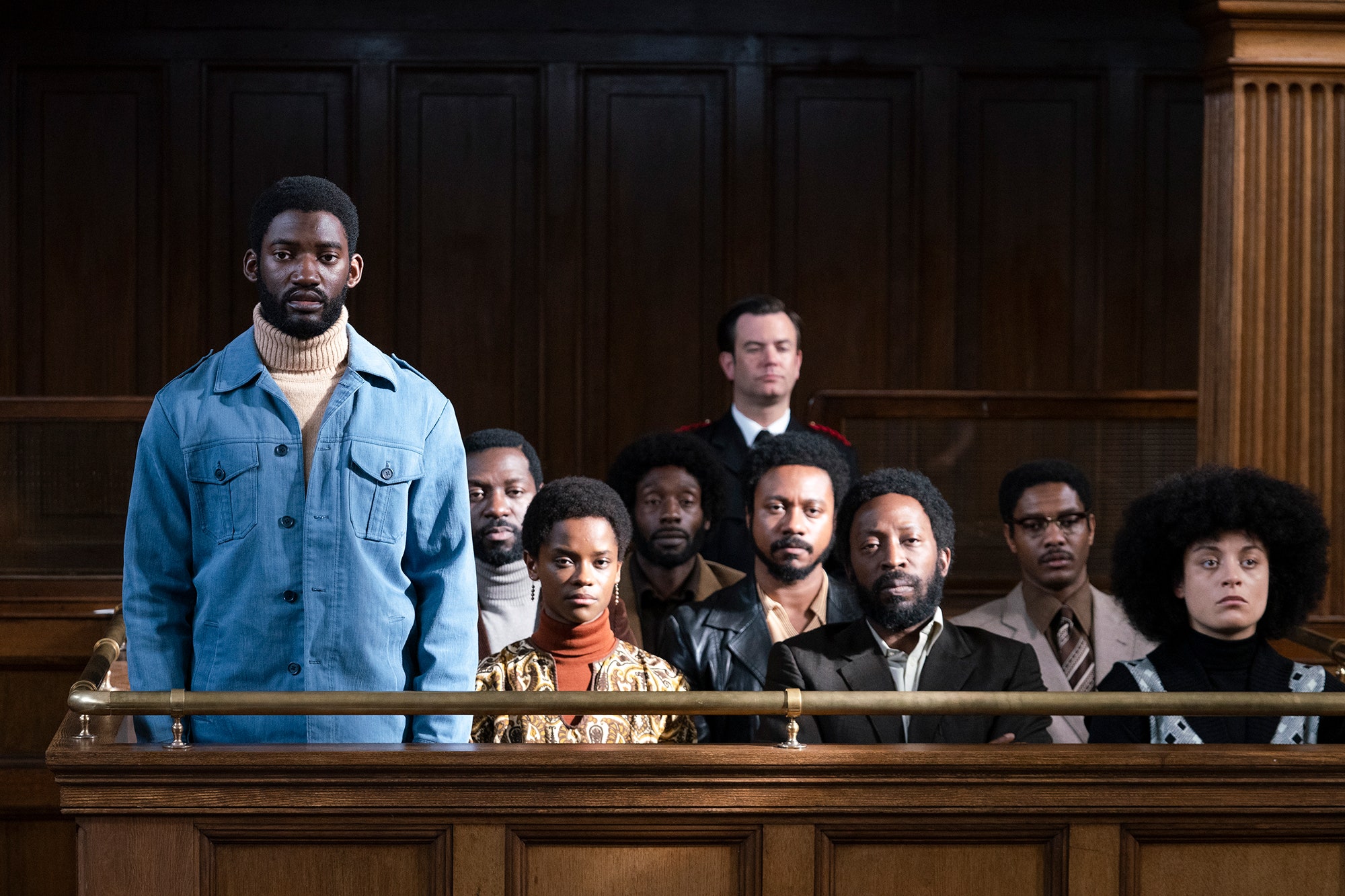
Frank Crichlow (Shaun Parkes) is the proud (Black) owner of Notting Hill’s Caribbean restaurant, Mangrove, a lively community base for locals, intellectuals and activists, not to mention the best joint for anyone looking for spicy foods in the 1970s. But it’s also beleaguered by constant police raids in what can only be described as a reign of racist terror (the cops are pretty upfront about it actually). Frank and the local community fight back the only way they can, by taking to the streets in peaceful protest. The cops, of course, strike back in what is by now such a familiar pattern that we can only despair. When nine men and women, including Frank and the leader of the British Black Panther Movement, Altheia Jones-LeCointe (Letitia Wright), and activist Darcus Howe (Malachi Kirby), are arrested and charged with incitement to riot, our blood boils with injustice but not particularly with surprise. A highly publicized trial ensues, and the pattern of discrimination and abuse by police emerges – but will that even be enough?

As I mentioned earlier, Mangrove along with the other films in the Small Axe series are based on true events, but director McQueen manages such vigour in his story-telling that it almost feels more like a documentary. The authenticity seems to lend itself so naturally to the film and the performances that it’s almost an embarrassment of riches, but it’s the passion and the commitment with which it is delivered that really seals the deal. Aaron Sorkin’s The Trial of the Chicago 7 really reinvigorated the courtroom drama for me earlier this year, so it seems improbable that this one would come along so shortly after and do so again, yet I’m amazed to be so fully invested once again in a genre that’s been tired and limp for so long. Sean and I kept up such a constant hubbub that I worried mean Judge Clarke (Alex Jennings)would find us in contempt and throw us out of his court. Mangrove, however, has its own internal engine, churning with emotional heft outside the courtroom. The movie may take a few beats to really get going, but once it finds its momentum, it is downright riveting.

One Winter Weekend

A recently dumped travel writer goes on a ski getaway with her best friend and they find themselves double booked with two eligible men. 

That’s what IMDB, indeed the movie itself, would have you believe it’s about. Let me make a few corrections. First: recently dumped? Not quite. More like, the guy she was seeing for all of 3 weeks kissed someone else on New Year’s Eve. She didn’t stick around for a dumping, if such a thing is even necessary after only 3 weeks. In fact, I think she’s the one who decided their fate when she simply turned and left. Next: travel writer. Not at all. Currently writing about relationships, formerly about beauty, aspirationally mysteries, never travel. And last: ski getaway. I mean, they are in fact vacationing at a ski resort, but all 4 people are avowed snow boarders, so let’s be accurate.

Cara (Taylor Cole) and her best friend/colleague/roommate Megan (Rukiya Bernard) take a weekend snowboarding trip up a cold, snowy mountain, which is usually the kind of thing I run away from on vacation, but there’s no accounting for taste. Cara is a relationship writer who’s currently on a dating cleanse; she’s contemplating novel writing and grad school instead, and working on all of the above even though this is very much just a two-and-a-half-day weekend. The powder is fine and no one’s complaining about the cold, but they’re less enthusiastic about the fact that both Megan and some random dude Sean (Dewshane Williams) both accidentally booked one half of the same ski chalet. Sean, a handsome young surgeon, and mysterious buddy Ben (Jack Turner), are also there for a quiet friend getaway, but now they’re on some sort of awkward double date, all four of them getting cozy and intimate against their will…until it’s not. Love ensues, as it always does. They got that part right. Love, to Hallmark, is inevitable. Soul mates magically come in pairs, and even though they all meet while on vacation, they also discover they live within blocks from each other back home.

But first there will be après-ski fondue (the only part of skiing of which I approve), a medical emergency, lots of trivia, and even some paparazzi. How does it all equate to love? Spend a winter weekend of your own finding out on the Hallmark channel.

A Nice Girl Like You

Lucy and her boyfriend Jeff are having some pretty lackluster sex when she accidentally shouts a grocery item (waffles, whole wheat I believe) instead of something racy. Seeing how she hasn’t even removed her flannel pajama top, Jeff surmises that Lucy (Lucy Hale) just isn’t that into sex. She tells him he’s wrong, he storms off to the garage to masturbate, she discovers that everything he’s been asking her to do comes from the copious porn he’s been watching in secret, and they break up.

At work the next morning, she confesses tearfully, and her friends judge her to be sexually unevolved, so Lucy does the only thing that makes sense – she writes the following Sex To Do List:

  1. watch 25 porns
  2. go to a sex store
  3. read (c)literature
  4. visit a strip club
  5. sex toy party
  6. take a sex seminar
  7. test vibrators
  8. stream some internet porn
  9. consult a sex expert
  10. visit a brothel
  11. meet a porn star
  12. use “hot throbbing cock” convincingly in a sentence

It’s a senseless list that promises way more than the film can deliver because despite the coming trips to brothels and furtive diddling, this R-rated comedy remains bland and banal. Sean likened it to a Hallmark movie, and he’s not wrong. It’s definitely more concerned with setting Lucy up with a more sex-positive relationship (enter Grant, ie, Leonidas Gulaptis) than with actually confronting what’s made her sex-negative in the first place, never mind ever titillating us with some of the juicier items on that list. Honestly, you won’t believe how unsexy porn stars and strip clubs can be.

The only thing interesting about this movie is that it manages to disappoint on so many levels (its only saving grace the fact that Mindy Cohn of the Facts of Life appears and works a dildo like there’s no tomorrow, but even that’s not NEARLY enough). Lucy’s love interest has the good grace to politely ask what a nice girl like her is doing in any number of the seedy establishments she frequents during the film; no one, however, has so far asked how a nice girl like me came to be watching a bad movie like this.

My Little Sister

My Little Sister is Switzerland’s official entry for the Academy Awards’ International Feature Film category this year, and its unofficial selection for Biggest Bummer of 2020, which is saying a lot.

Not that it’s a bad film, not at all. It’s just the opposite of cheery. Gloomy. Depressing. Upsetting. It’s about grown up twins Lisa (Nina Hoss), a playwright, and Sven (Lars Eidinger), a stage actor, who are dealing with his cancer diagnosis and resulting transplant. Even on the mend, Sven is still very unwell, and since their mother is a flake, Lisa’s been doing the caring. Lisa already put her life and career on hold once, to follow her husband to Switzerland where he runs an international school and she raises their children. Desperate to get back to the Berlin arts scene, Lisa isn’t happy to learn that her husband’s been contemplating extending his contract, but she’s already got more on her plate than most people can handle. Again she puts her life on hold to care for her “big brother” (born 2 minutes earlier) as he struggles to get back on his feet.

Sven’s illness is quite severe but Lisa can’t really face that. She has appointed herself the perpetual fountain of hope, and even goes back to play writing to make sure he has a meaty role to inspire his recovery. She is so committed to his recuperation she’ll even neglect her marriage to be at his bedside. Nina Hoss is nearly equally committed to the role, playing Lisa with sensitivity, and a naturalness that really helps to bolster the relationship between the twins. Clearly they are close, the kind of bond that can always be relied upon, as illustrated by Eidinger’s performance. Sven has bravado for everyone else, but in front of Lisa, he is vulnerable, he is weak. And though Hoss shows us how scared Lisa is, for him she is strong, sure, and optimistic.

Cancer dramas are a dime a dozen, but this one manages to detour away from the genre’s deepest ruts and treads new(ish) ground with intimate and instinctive performances from the two leads. Directors Stéphanie Chuat and Véronique Reymond give us a story that’s emotional without trying to be. It simply presents truth, unadorned. The death of a loved one can force us to reevaluate our own lives; Lisa’s certainly reassessing things, even with so many balls still up in the air. It’s a resonant reminder that life never stops, not even while you’re losing the person you hold most dear.

Frozen In Love

January is the most depressing month of the year; the 24th has the unfortunate reputation of being the absolute worst day of all. The joy of the holidays is over, the bill are due, the work has piled up, and there’s lots of long, cold winter months ahead. Maybe you’re feeling down because you’ve already broken your new year resolutions, maybe you’re feeling blue because you’ve hardly seen the sun, or maybe it’s because what feels like a “winter wonderland” on Christmas feels more like a “snowy, slushy shithole” just a week later – pass the Advil, my back is killing me from shoveling all that goddamned snow.

Bear with me, I do have a point. OR MAYBE the reason you’re feeling a little less happy is because the Hallmark Christmas romance movies have dried up, and you’ve had to tuck away the corner of your heart that enjoys them in the same storage bin as the wreath and the wrapping paper. But rejoice! The Hallmark channel is actually all year round now, and you can be enjoying generic winter romance movies like this one RIGHT FREAKING NOW!

Mary (Rachel Leigh Cook) is the owner of a severely struggling book store (also just known as a book store these days). It’s facing closure if she doesn’t magically rebrand it into something people will choose to overpay for books at in a really big way. She’s got a friend in PR who vows to help, but I think we should check her credentials because her great idea is to use a “buddy system,” pairing 2 of her clients (her only 2 clients as far as we know) together to somehow turn each other’s luck around. If Mary, a book store owner, doesn’t know how to run her book store profitably, why would anyone who is not a book store owner? And Mary doesn’t wind up paired with anyone, she winds up paired with Adam (Niall Matter), the bad boy of hockey. He’s been kicked off any number of teams and has recently received a 10 game suspension for being naughty again. He has to rehab his image and you know what they say: only a failing book store can do that!

Naturally, Mary and Adam hate each other at first; she’s a know-it-all but never-do, and he’s a jerk. But working together to solve their common book store-hockey problem turns their animosity into instant attraction. Hubba hubba! Only one problem: if they’re successful and his team takes him back, it’ll take him away from Mary and back on the road to unspecified glory. Oh well, that little wrinkle is their problem, not yours. It’s January. Take some time for yourself. Pour generously. Sit cozily. Munch happily. And watch guilt-free, because you deserve it, year round.

I’m Your Woman

Jean’s life is a little unusual even before it goes to shit. She sits on a lounge chair in the back yard, sipping wine in her marabou-trimmed dressing gown, dark glasses covering the sorrow in her eyes. She and her husband meant to have babies, she tells us, but couldn’t. So now she’s got nothing to do. Except one day husband Eddie walks through the door with a baby in his arms, provenance unknown, may as well have the tags still attached not unlike her fancy new dressing gown.

With a baby literally dropped right in her lap, Jean’s (Rachel Brosnahan) life is certainly turned upside down, and quite suddenly, but baby Harry’s actually the least of it. One night her husband goes out to work and in his stead, an associate of his turns up at some ungodly hour, stuffing a suitcase full of cash she didn’t know was in their closet, telling her not to pause for clothes or toiletries, they need to get out NOW. Delivered to her new minder Cal (Arinzé Kene), it turns out that her husband is a bad man who’s just betrayed his partners, and now she and baby Harry are running for their lives, their only allies Cal and his wife Teri (Marsha Stephanie Blake), who were complete strangers to her just minutes ago. Of course, she’s starting to realize that her husband’s been a stranger to her too, she just didn’t know it. A lot of his secrets are coming loose, and none of them are making Jean or her baby any safer.

I knew I was in for a 1970s crime drama of some sort but was pretty pleased to find it defying expectations. Director Julia Hart (who writes with husband/director Jordan Horowitz) wants to see things from the other side of the story, turning our assumptions on their head and finding fresh perspectives to breathe new life into a genre we’ve so many times before it’s already retro. Smart and subversive but sparsely told, I’m Your Woman examines mob life for the wives who’ve been left at home, but not entirely left out of the fray. The 70s were a rapidly changing time for women and the roles they played, and Hart discovers a very clever space for exploring it – at least between bouts of action, of course.

Beastie Boys Story

Mike Diamond and Adam Horovitz stopped performing as Beastie Boys when friend and bandmate Adam Yauch died in 2012 after a 3 year battle with cancer. Actually, their last performance was in 2009, though none of them knew that it would be then.

This is an untraditional documentary; Diamond and Horovitz have mounted a stage show about the band’s history, its improbable beginnings, the ups and downs of fame, success, and friendship, all filmed by director Spike Jonze in front of a live audience. With behind the scenes photos, intimate stories, and little-known details, Diamond and Horovitz paint an intimate portrait of the Beastie Boys origin story, the turning points, the slumps, the resurrections, the regrets, the compromises, the hardships, and the insane parties.

Of course, at the heart of it all is a 40 year friendship between 3 guys who never grew bored of creating together. It’s clear that Diamond and Horovitz relish the opportunity to remember and honour their fallen friend, but are still emotional doing so. I felt it too, not because of his absence but because he actually felt quite present, so well remembered, so vibrant in memory and legacy. If you’re any kind of fan, you’ll enjoy taking a trip back to their earliest days, and then riding that crazy wave all the way to their most recent success. With so many hits in their catalogue, it’s definitely an enjoyable trip.