Tag Archives: Amazon Prime

Shirley

Shirley Jackson was a wonderfully spooky and wildly talented writer and she undoubtedly deserves a biopic that lives beyond the borders of ordinary. This is exactly that movie.

Shirley (Elisabeth Moss) is a reclusive horror writer known for her gloomy temperament and spiky sensibility. Husband Stanley (Michael Stuhlbarg), a literary critic and professor at the nearby college, calls her “sickly” and “unwell” as he philanders all over campus. He and Shirley take in a young newlywed couple, Fred (Logan Lerman) and Rose (Odessa Young); Fred is to be Stanley’s protégé, and though Rose was not long ago a promising young student herself, Stanley now expects that she’ll cook and clean and care for his oft-bedridden wife.
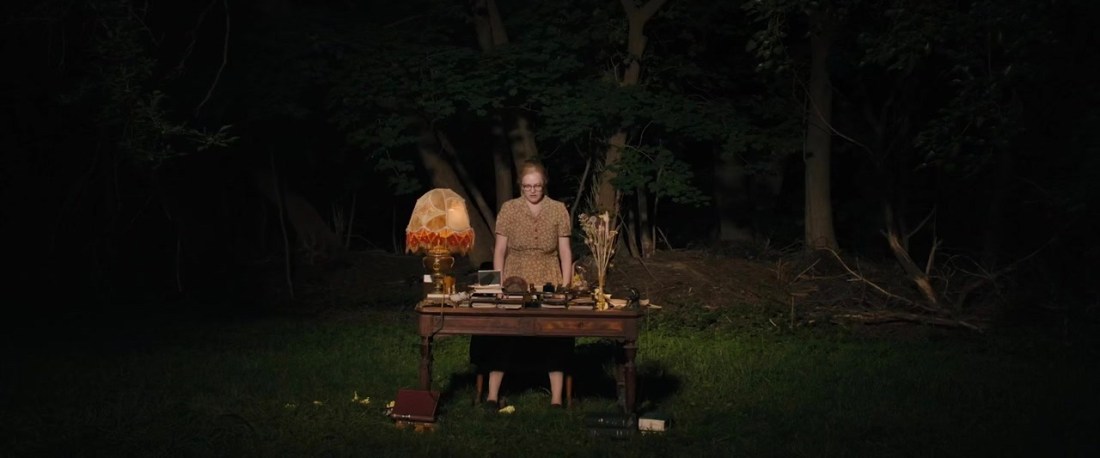
Shirley is writing yet another masterpiece and while her creative process is at first disrupted by the new arrivals, she soon finds Rose to be open and trusting and ripe for manipulation. Rose is curious, and fascinated by the brilliant author, and though Shirley seems, at times, grateful for a friend, her only true allegiance is to her work. And she is, of course, filled with neuroses and wildly unpredictable, so the house becomes volatile as loyalties shift too quickly to be counted upon. Meanwhile, Stanley is jealous of his would-be protégé and inappropriate with Rose, which means no one’s motivations are pure and home has become quite hostile. The more hostile things become, the more the film itself blurs the lines between fiction and reality.

Josephine Decker’s film is provocative and challenging much like the author herself – which, to be honest, means that I didn’t enjoy the film so much as admired it. Certainly I admired the committed, prickly performances, the dedication to some pretty unsavoury characters, and an ambiguous, haunting story-telling style that was nearly a performance in itself. It was an uncomfortable watch though, not what I would consider satisfying, too off-putting for me to truly recommend it. Although I appreciate the boldness it takes to make deliberately ugly art, I always end up wondering what the point is, exactly, if no one wants to watch it.

Herself

Sandra’s husband Gary apparently has such a history and pattern of abuse that she has an emergency protocol in place with her young daughters; the eldest (who is maybe 8), takes off for the nearest corner store with a tool box. Inside is a card instructing the shopkeeper to call the cops as her life is in danger. Meanwhile, the youngest daughter cowers in the backyard, watching her mother get stomped on.

This, apparently, is the last straw. She leaves, but working several jobs still leaves her short at the end of the month, and the three of them are living in a hotel because Dublin is apparently short on public housing. Fed up with welfare’s shortcomings, and with Gary still lurking around, asking for another chance, Sandra (Clare Dunne) takes things into her own hands. With a generous land donation, she prints off DIY instructions from the internet and prepares to build a small home for herself. It’s an unsubtle metaphor for the kind of rebuilding her life needs and deserves generally, and the more she opens up and asks for help, the easier it becomes and the fuller her life is. Abused women are often isolated, which is part of what makes it so hard to leave. Building a life is about more than just pouring concrete and laying floors; it’s about trusting people again and creating your own safe space.

Unfortunately, the abuse doesn’t always stop just because the woman leaves, especially when there are kids involved. She has two adorable little souls tying her to a man she’d rather never see again, and even the court will keep forcing them together.

Phyllida Lloyd’s Herself is perhaps trite, but sensitively told, allowing the power of the performances to take centre stage, and Clare Dunne proves herself worthy of the confidence, never over-reaching the emotional beats. Herself may be a difficult watch at times, but it’s also gratifying; Sandra has a voice, and Lloyd gives her a beautiful cinematic platform from which to use it. She aims a few choice words at an uncaring bureaucracy that deserve cheers from a jaded audience. There are no easy breaks in Sandra’s life, but Dunne allows her empathy and grace, which are more important anyway.

The Man Who Walked Around The World

Anthony Wonke has a wonky way of starting movies. It can never be any director’s intention to confuse the viewer into turning the movie off just to double check they’ve clicked on the right one, and yet that’s exactly the effect he creates when he introduces the topic in the most roundabout way possible.

For those of you who think you might like to tackle this documentary, know that the film will make you believe, for the first 5 minutes or so, that this is about some very bad men in Iraq, but when Mr. Iraq eventually gets to his point, which isn’t very interesting, it’s that whisky saved Iraq. Won Iraq? Whatever the hell they were doing there, whisky helped. And not just any whisky. Johnnie Walker whisky.

Note: I very much want to spell it whiskey, as I always have, and always will, but since Johnnie Walker spelled it whisky, I’ll honour his wishes this one and only time since we are indeed talking about the 200 year history of his well known and well loved brand.

Johnnie Walker was indeed a man, the son of a farmer who poured his inheritance into a grocery store where he blended and sold his own whisky, which his ancestors shrewdly turned into a global brand that may or may not help Americans end wars. Don’t worry, the hyperbole won’t stop there: Johnnie Walker was also the hero of prohibition, and the brave solver of racism. According to this documentary, which I’m beginning to suspect may be a little biased. It is not, however, contributing in any positive way to sexism, because the brand aims to be synonymous with masculinity, so if you’re a woman who drinks whisky, go fuck yourself.

But at least it’s not contradictory. For example, Johnnie Walker is a respected and recognized brand that is its own best advocate and is so sophisticated it would be demeaning to pay for product placement or celebrity endorsement, and don’t just take our word for it, let’s hear from brand ambassador Sophia Bush, or the guy in charge of pointing out it’s the preferred brand of Superman (in Superman 3) and Rick Deckard (Harrison Ford, Blade Runner).

The Man Who Walked Around the World is either a very bad documentary or a very good commercial. If you hit the red label hard enough, it probably doesn’t matter which. If you’re sober, however, you might want to…well, keep walking.

Mangrove

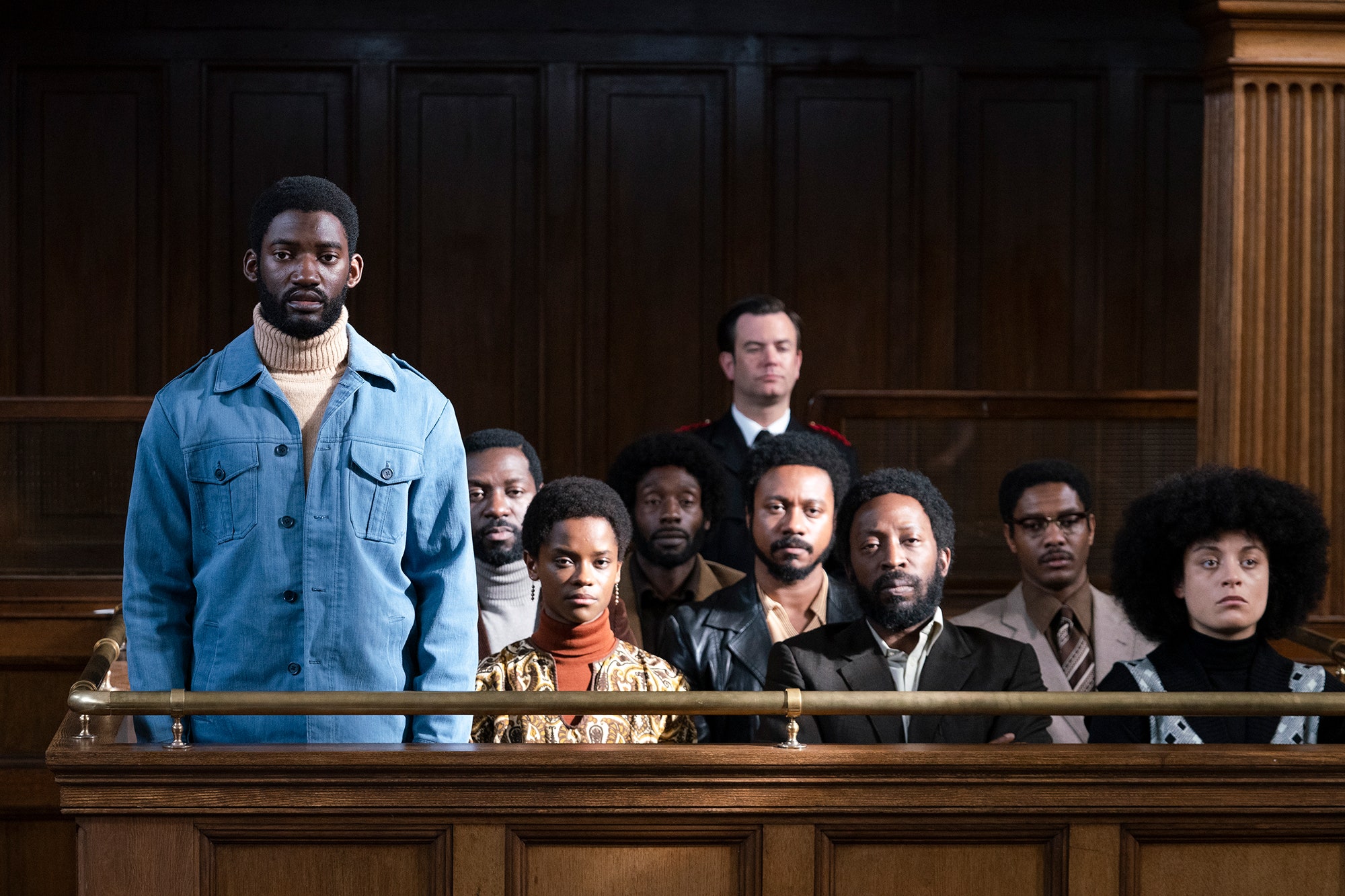
On Amazon Prime, there is a series of films by Steve McQueen under the title Small Axe; they are related in that they are based on the real-life experiences of London’s West Indian community in the recent past. Mangrove is the first film in the series. The Oscars and the Emmys are perhaps more invested in hashing out whether they are technically films or episodes or something else entirely, but at 2 hours and 7 minutes of first-rate film-making, I’m just going to go ahead and review it.

Frank Crichlow (Shaun Parkes) is the proud (Black) owner of Notting Hill’s Caribbean restaurant, Mangrove, a lively community base for locals, intellectuals and activists, not to mention the best joint for anyone looking for spicy foods in the 1970s. But it’s also beleaguered by constant police raids in what can only be described as a reign of racist terror (the cops are pretty upfront about it actually). Frank and the local community fight back the only way they can, by taking to the streets in peaceful protest. The cops, of course, strike back in what is by now such a familiar pattern that we can only despair. When nine men and women, including Frank and the leader of the British Black Panther Movement, Altheia Jones-LeCointe (Letitia Wright), and activist Darcus Howe (Malachi Kirby), are arrested and charged with incitement to riot, our blood boils with injustice but not particularly with surprise. A highly publicized trial ensues, and the pattern of discrimination and abuse by police emerges – but will that even be enough?

As I mentioned earlier, Mangrove along with the other films in the Small Axe series are based on true events, but director McQueen manages such vigour in his story-telling that it almost feels more like a documentary. The authenticity seems to lend itself so naturally to the film and the performances that it’s almost an embarrassment of riches, but it’s the passion and the commitment with which it is delivered that really seals the deal. Aaron Sorkin’s The Trial of the Chicago 7 really reinvigorated the courtroom drama for me earlier this year, so it seems improbable that this one would come along so shortly after and do so again, yet I’m amazed to be so fully invested once again in a genre that’s been tired and limp for so long. Sean and I kept up such a constant hubbub that I worried mean Judge Clarke (Alex Jennings)would find us in contempt and throw us out of his court. Mangrove, however, has its own internal engine, churning with emotional heft outside the courtroom. The movie may take a few beats to really get going, but once it finds its momentum, it is downright riveting.

Frozen In Love

January is the most depressing month of the year; the 24th has the unfortunate reputation of being the absolute worst day of all. The joy of the holidays is over, the bill are due, the work has piled up, and there’s lots of long, cold winter months ahead. Maybe you’re feeling down because you’ve already broken your new year resolutions, maybe you’re feeling blue because you’ve hardly seen the sun, or maybe it’s because what feels like a “winter wonderland” on Christmas feels more like a “snowy, slushy shithole” just a week later – pass the Advil, my back is killing me from shoveling all that goddamned snow.

Bear with me, I do have a point. OR MAYBE the reason you’re feeling a little less happy is because the Hallmark Christmas romance movies have dried up, and you’ve had to tuck away the corner of your heart that enjoys them in the same storage bin as the wreath and the wrapping paper. But rejoice! The Hallmark channel is actually all year round now, and you can be enjoying generic winter romance movies like this one RIGHT FREAKING NOW!

Mary (Rachel Leigh Cook) is the owner of a severely struggling book store (also just known as a book store these days). It’s facing closure if she doesn’t magically rebrand it into something people will choose to overpay for books at in a really big way. She’s got a friend in PR who vows to help, but I think we should check her credentials because her great idea is to use a “buddy system,” pairing 2 of her clients (her only 2 clients as far as we know) together to somehow turn each other’s luck around. If Mary, a book store owner, doesn’t know how to run her book store profitably, why would anyone who is not a book store owner? And Mary doesn’t wind up paired with anyone, she winds up paired with Adam (Niall Matter), the bad boy of hockey. He’s been kicked off any number of teams and has recently received a 10 game suspension for being naughty again. He has to rehab his image and you know what they say: only a failing book store can do that!

Naturally, Mary and Adam hate each other at first; she’s a know-it-all but never-do, and he’s a jerk. But working together to solve their common book store-hockey problem turns their animosity into instant attraction. Hubba hubba! Only one problem: if they’re successful and his team takes him back, it’ll take him away from Mary and back on the road to unspecified glory. Oh well, that little wrinkle is their problem, not yours. It’s January. Take some time for yourself. Pour generously. Sit cozily. Munch happily. And watch guilt-free, because you deserve it, year round.

I’m Your Woman

Jean’s life is a little unusual even before it goes to shit. She sits on a lounge chair in the back yard, sipping wine in her marabou-trimmed dressing gown, dark glasses covering the sorrow in her eyes. She and her husband meant to have babies, she tells us, but couldn’t. So now she’s got nothing to do. Except one day husband Eddie walks through the door with a baby in his arms, provenance unknown, may as well have the tags still attached not unlike her fancy new dressing gown.

With a baby literally dropped right in her lap, Jean’s (Rachel Brosnahan) life is certainly turned upside down, and quite suddenly, but baby Harry’s actually the least of it. One night her husband goes out to work and in his stead, an associate of his turns up at some ungodly hour, stuffing a suitcase full of cash she didn’t know was in their closet, telling her not to pause for clothes or toiletries, they need to get out NOW. Delivered to her new minder Cal (Arinzé Kene), it turns out that her husband is a bad man who’s just betrayed his partners, and now she and baby Harry are running for their lives, their only allies Cal and his wife Teri (Marsha Stephanie Blake), who were complete strangers to her just minutes ago. Of course, she’s starting to realize that her husband’s been a stranger to her too, she just didn’t know it. A lot of his secrets are coming loose, and none of them are making Jean or her baby any safer.

I knew I was in for a 1970s crime drama of some sort but was pretty pleased to find it defying expectations. Director Julia Hart (who writes with husband/director Jordan Horowitz) wants to see things from the other side of the story, turning our assumptions on their head and finding fresh perspectives to breathe new life into a genre we’ve so many times before it’s already retro. Smart and subversive but sparsely told, I’m Your Woman examines mob life for the wives who’ve been left at home, but not entirely left out of the fray. The 70s were a rapidly changing time for women and the roles they played, and Hart discovers a very clever space for exploring it – at least between bouts of action, of course.

Palm Springs

Nyles (Andy Samberg) is in Palm Springs (I assume – the title might have you believe this is of even the slightest importance, but it’s really not, could be anywhere) for a wedding. His girlfriend is a bridesmaid and he’s her plus one, which doesn’t quite account for just how uninvested he is in the proceedings. Even if you’re not close to the couple, you generally want to be respectful of their big day. Nyles shows up in a bad Hawaiian shirt, pops beers all ceremony long, and then hijacks the maid of honour’s speech to the bride. You can’t quite pinpoint how or why Nyles seems just a little bit off, but he is, considerably, and yet when he directs his charm toward the bride’s sister and maid of honour, Sarah (Cristin Milioti), even she seems unable to resist, and she doesn’t appear to be having a great day herself.

What gives? Turns out, it’s one of those infinite time loop situations you might have heard about. You know, like Groundhog Day? And a dozen other copycats, none of worth mentioning? Yeah, like that. Nyles has been reliving the same day over and over for goodness knows how long (you know who does know? The screenwriter. Excellent source. His answer: about 40 years. Forty fucking years!). Anyway, after a particularly nice day spent with Sarah, she follows him into the time loop cave of doom despite him cautioning her not to. The rest isn’t so much history as an infinite present. Nyles has 40 years of this under his belt, so he’s given himself over completely to nihilism (hence the Hawaiian shirt), but Sarah is new enough to the game to be fed by her anger, resentment, and frustration. She wants out, and she’s so determined to solve or win the time loop, she’ll try anything, including but not limited to: exploding an innocent goat, getting hit by a truck, making the ultimate sacrifice, and learning quantum physics.

Time loop movies are a dime a dozen and I haven’t liked a single one since Bill Murray, but now, suddenly, there are two. Like Groundhog Day, Palm Springs is a rom-com of sorts, or perhaps an anti-rom-com – there is no worse romance killer, not even death, than too much time together. But one man’s existential crisis is another man’s pure entertainment. Samberg and Milioti not only have a viable chemistry, she brings a darkness that balances Samberg’s goofball energy perfectly so that, despite the extreme challenge to mental health in this film, we don’t fly off the deep end of either side of the continuum, but we do enjoy a sliding scale of extremes and a lot of laughs because of it. Writer Andy Siara keeps us intrigued with a script that is unpredictable and unexpected, but most of all coated in well-earned giggles that are executed perfectly by the cast, including JK Simmons as Roy, someone else caught in the infinite loop thanks to Nyles, and not super gracious about it either. Siara and director Max Barbakow work well together to subvert our expectations and challenge what we think we know about rom-coms.

Palm Springs was bought by Hulu at Sundance for a record-setting sum: 17.5 million dollars and 69 cents. The 69 cents set the record; Birth of a Nation held it before this, and that turned out to be a bit of a debacle, didn’t it? But Palm Springs was a great investment for Hulu, becoming the most-streamed in its first weekend Hulu had ever seen. Since Canada doesn’t have Hulu, it is now available to stream on Amazon Prime, and that’s a good thing, because Palm Springs is one of the brightest spots in an otherwise dull year.

Stage Mother

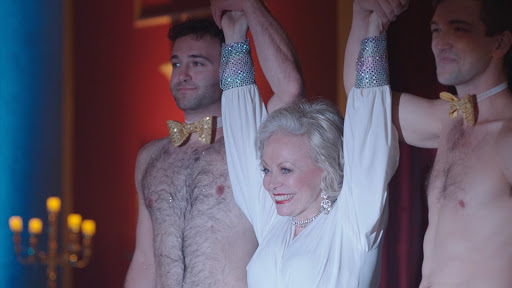
Maybelline Metcalf (Jacki Weaver) is pretty much what you imagine when you hear the name – conservative, christian, Texan. She’s the church choir director, a good friend, dutiful wife, and what the hell, a little catty. She’s also shocked and heart broken to learn that her only child is dead – a gay son who’s been estranged and battling addictions since he left for San Francisco years ago.

Though husband Jeb is determined to continue on as if they never had a son at all, Maybelline’s grief and regret lead her to San Francisco where she finds Rickey’s funeral is not quite to her taste. Her son’s drag family is performing their tribute to him and it’s all a little much for this mother who has never before claimed her son in public. Her clear disdain makes a bad first impression with her son’s grieving and offended boyfriend, Nathan (Adrian Grenier), who is suspicious of her sudden appearance. He suspects she’s come sniffing around for an inheritance, and indeed there is one since Nathan and Rickey were never married – the drag bar where everyone performs. The bar isn’t doing well with Rickey gone, so instead of going home, Maybelline inexplicably stays and not only whips the bar into shape, but nurtures the acts of Rickey’s drag family.

There is a heart ache to this film as Maybelline is clearly transferring the love and acceptance she was never able to show her son unto the surrogates she finds at the bar. And what a tragic comment on society that so many at the bar are indeed in need of mothering, even if it’s from someone else’s mother.

Director Thom Fitzgerald chooses not to have Maybelline wallow in self-recrimination; instead, she rolls up her sleeves and gets to work. Perhaps being useful and creating ties to her son’s chosen family is the only way she can cope. But overall, the film doesn’t carry a dark or heavy tone, it capitalizes on drag’s new mainstream status and concentrates on making things pretty and tuneful. The other drag performers are not much more than caricatures, but this is not about the resilient queer community of San Francisco, it’s about a traditional wife rejecting her husband’s bigotry and learning to judge based on the values in her own heart instead. Stage Mother is a bit old-fashioned, perhaps a bit dated in tone, but the movie’s upbeat feel combined with a terrific performance from Weaver makes Stage Mother a worthy watch.

Life In A Year

Daryn (Jaden Smith) isn’t even a senior in high school yet but he’s got his whole life laid out in front of him, a series of goals and how to achieve them. Or rather his dad does. His dad Xavier (Cuba Gooding Jr.) is a full-time dick so intent on -seeing his son accepted into Harvard that he doesn’t mind completely destroying their relationship to get it. To Xavier, Daryn’s new girlfriend Isabelle (Cara Delevingne) is nothing more than a distraction, and he’s super rude and dismissive of her accordingly.

What Daryn’s parents don’t know is that Isabelle is a rapidly dying teenage girl, and in the great cinematic tradition of dead and dying teenagers, Daryn has resolved to give her a whole life’s worth of milestones in the single year she has left. Basically, if you’ve seen one, you’ve seen them all; the dying teenage trope isn’t exactly original and Life In A Year isn’t exactly up to redefining the genre. Just look at that title: it’s 2/10 awful, it sounds wrong, it’s thematically meaningless, and it fails to distinguish itself from close relatives (a simple Google search confuses it with All My Life, A Year In My Life, The Worst Years of My Life, Life Itself, and more).

I never imagined I’d say this, but Jaden Smith isn’t the problem with this movie, and he’s the least problematic man among the cast. He’s mostly known for being the entitled son of Will Smith who can’t stop mistaking ignorant bullshit for poetry and philosophy. In this, he does a pretty good imitation of a decent human being, and in his best moments he briefly channels his more famous and talented father. Cara Delevingne isn’t the problem either. I’m never bowled over by her, but there’s probably not an actor in the world who could salvage this terrible material. Confusingly, director Mitja Okorn almost seems hell-bent on tanking this thing, or at least that’s what’s communicated when a film offers you two cancelled perverts for the price of one. Cuba Gooding, Jr. is of course currently on trial for forcible touching and of sex abuse to the third degree; at last count 30 women had accused him of groping. Disgraced comedian Chris D’Elia stands accused of  grooming young girls and attempting to solicit nude photographs from minors. He’s also been accused of sexual misconduct by grown women, alleging that he exposes himself randomly and masturbates in front of them without consent. Mitja Okorn is the guy who said: yes, please, I’d like to work with both. Grade A stuff.

But this movie doesn’t need perverts to dissuade you, it’d be bad either way. It’s formulaic and poorly written and the characters are bizarrely one-dimensional (Daryn has a friend whose single personality trait is that he used to be fat. He isn’t even fat anymore!) or just don’t make any sense at all (D’Elia plays a “drag queen” named Phil who, though we never see him perform, is always in drag – has the script confused profession with identity?). No matter how you slice or dice it, Life In A Year (ugh, terrible title, still not over it) is a failure and there’s not a soul in the world who needs to see it.

Winter’s Dream

Anna (Lizzie Boys) and her dad Ty (Dean Cain, yuck, I know) trek across the country to Bliss Mountain so that Anna can train with former Olympic skier Maddie Lastname. Anna’s eager to learn but isn’t really responding to Maddie’s tough cookie approach, so she seeks out Maddie’s less successful former teammate Kat (Kristy Swanson), who lives in town and teaches on the mountain. Teaches, not coaches, as in bunny hill novice skiers under 10. But although Kat’s still pretty gun-shy after her flameout on the slopes many years ago, she agrees to continue providing pointers and other fun lessons for technique. It makes her and Maddie a little competitive once again, but that’s not what this particular Hallmark movie is about.

First, Bliss Mountain is failing because its flashier counterpart Epic just 20 minutes down the road is drawing away all of its customers. Kat is chairing the Winter Fest committee, hoping to draw fresh blood and new dollars to town, and she’s not above drafting Ty to her committee even though he’s a paying customer. More importantly, of course, is the business of having Kat and Ty fall in love. Ty is a widower who lives on the other coast. Kat isn’t exactly splashing about in the dating pool herself. But honestly: how long can they keep telling us they’re just friends and expect us to believe it? We see the way he hangs banners for her. It’s hung at a pretty flirtatious angle if I do say so myself.

So. Kat will have to overcome her own fear of failure to train Anna. Anna will have to overcome her fear of wiping out to win an exhibition race. Ty will have to figure out how to commute all the way from New York. And Kat’s dad will just stand around wiggling his eyebrows at everyone. Sound good to you? Perfect. Winter’s Dream may be set on a mountain, but it will keep you nice and warm where it counts – right in the feelings.