
Mrs. Wong (Teresa Mo) is too exhausted to care that her husband is having an affair. She tolerates it in order to keep her family together, especially important since her 20 year old son Kwong (Man-Lung Ling) has autism, and developmental disabilities, that require stability and a lot of care. But one day the young mistress (they’re always young) stops by the house and agitates Kwong. After a terrible fight, Mr. Wong (Ray Lui) leaves. He leaves them. Now the burden of caring for her disabled son falls to Mrs. Wong entirely, and with his father gone, he’s acting out more than ever. If she was tired before, she’s beyond tired now. There’s almost nothing in Mrs. Wong’s life that’s just for her – her only indulgence during these dark days is to plot revenge scenarios against the dreaded mistress.
Teresa Mo, Ray Lui, and Man-Lung Ling make for a very attractive family; you’d hardly 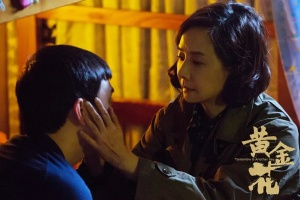 believe from the outside all the difficulties they face. But Mo and Lui are good at communicating a marriage strained by years of putting someone else’s needs above their own, of never having the time to honour their coupledom. We know that this is not Mr. Wong’s first dalliance, and we see the toll it’s taken on their marriage.
Ling’s portrayal of special needs is perhaps not the best we’ve seen on screen, but it’s Kwong’s relationship with his mother that is the most essential of the film. He’s normally cheerful and energetic; he skips along, vocalizing sounds more than words. But his meltdowns are ferocious. A full-grown man, when he starts self-harming, Mrs. Wong really can’t cope on her own. By showing us the enormity of her caregiver’s role, director Chan Tai-lee (the guy who wrote Ip Man) highlights a dearth of resources, of respite. Mrs. Wong shoulders it all, without complaint, facing down discrimination like that’s to be expected. All of her anger and resentment are saved for the mistress (a one-note, selfie-taking villain); murder fantasies are her only escape.
Her social life’s only balm is a group of housewives with whom she sews and sings karaoke. But these are the same women who will uncover her plot. And then what? You’ll have to watch to the end to find out.
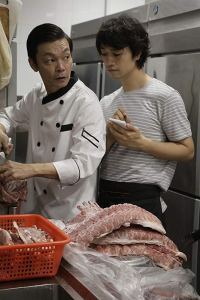 The cast is endearing, and I love how director Eric Khoo blends together race as if it’s fusion cooking. The Japanese and Chinese people have had an uneasy past and you can see that Masato has a hard time reconciling the two parts of himself. However, grief is a powerful motivator, and when he understands how his father honoured his mother’s memory by incorporating her culture into his cooking, Masato is inspired to do the same.
 multiethnic descent. Before I watched this documentary, I didn’t understand that these matches tend to be found within one’s own race, and how limiting that can be for all kinds of people. Multi-ethnic backgrounds are the fastest-growing demographic, but the waiting lists aren’t keeping up, leaving multi-racial patients struggling to surmount complex genetics on top of everything else. It’s already tragically unlucky to be struck by a stupid disease, but to fail to find a match because you’re losing at a numbers game? That’s just unacceptable.
 ASSHOLES WATCHING MOVIES