
Ugh. You know how they say opposites attract? Well, I wish that was more true. I mean, Sean and I are opposites in some ways: he’s quiet, I’m loud; he’s analytical, I’m passionate and creative. But our flaws are all the same, which is deeply unfortunate. We’re both slobs (Sean will no doubt want to argue this, so I will amend: he’s a slob, I’m just too lazy to clean). We’re both argumentative. We both have poor memory. We’re both procrastinators.
When we saw this movie at SXSW, I’m not even sure we’d gone a full block before I’d declared “not it.” I did not not not want to review this movie. Sean acquiesed, and to be fair, I wrote 27 SXSW reviews, and he wrote 5, so he kinda owed me. Ladies and gentlemen, it’s been a month. As you may have guessed, we’re also both Assholes, and we’re both deathly stubborn. We occasionally bring up this review with much throat-clearing, and then we discuss it in that overly-polite way that couples who have been married a long time have in order not to divorce over literally every third conversation they have. Still no review.
So fuck, white flag, here it is:
There once was a Texan singer-songwriter who went by the name of Blaze Foley. He was a good musician but not a super successful one; in fact, he wasn’t very successful at life. He struggled with addictions and pushed away the woman who tried to love him. He 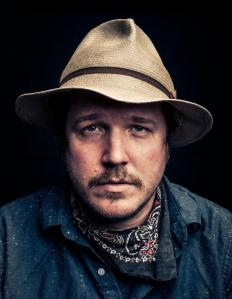 accessorized his western wear with duct tape and lived in a tree house with no plumbing or electricity. He was mentally unstable, volatile, poor every damn day of his life, and then he got shot in the gut and died. Lucinda Williams called him “a genius and a beautiful loser.” Townes Van Zandt suggested “He’s only gone crazy once. Decided to stay.” The only hits he ever had were when his songs were recorded by other people, and even then lots were posthumous (Merle Haggard, Lyle Lovett, John Prine). And for some reason Ethan Hawke just really, really wanted to make a movie about the guy. So, using Blaze’s ex-lover Sybil Rosen’s book Living in the Woods in a Tree: Remembering Blaze as his guide, he did.
If you’re a music nerd who knows the likes of Van Zandt, Gurf Morlix, Guy Schwartz, and Billy Block, then this film is the perfect way to worship your duct tape messiah. Ben Dickey in the title role and Alia Shawkat as his bride are both wonderful. But I found the movie sluggish, the content unremarkable. I think Sean enjoyed the film more than I did (at the very least he could argue as to why anyone would want to make a film about this particular life) but he wouldn’t write the damn review so this is what you get: meh.
Of course, screening the movie on Blaze’s old stomping grounds means having a lot of his musician friends in the audience, and later on stage, which was cool. But I didn’t know the man and I don’t think I’d have wanted to. And if Julia Roberts can’t get me to listen to Lyle Lovett then no one can. So this was a lost cause for me, a bore and a chore. Sorry, Blaze. I hope you’re resting in peace.
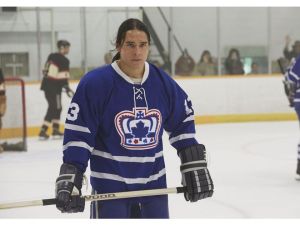 The residential school system is not the only black mark on our country but it has to be the darkest stain. We and our government could not have done worse by our indigenous people if we tried. We should have known from the start that this imperialistic plan would go horribly wrong. After all, we chose to put the Catholic Church in charge of many of these awful residential schools (and not just the Catholic Church, but a bunch of others share the blame, including the Anglican, Presbyterian, and United Churches of Canada), because it wasn’t enough to tear children from their families and literally beat their culture out of them, it seemed appropriate for some reason to facilitate child molestation too, feeding 150,000 potential altar boys and girls to more than a few insatiable priests over the lifetime of the program. 150,000!
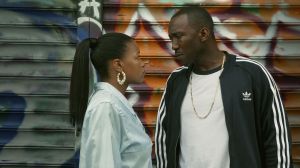 destroy her competition, but she’s a kid, one who engages the audience’s protective instinct. You may or may not know Roxanne Shanté, but she was well on her way to becoming a hip hop legend before she finished high school (not that she ever went). This film doesn’t feel like a typical musical biopic. Instead it’s more of a character portrait, quite intimate, and quite focused on the day to day details, which is a nice window into her little-known private life, but not much of a door to the bigger picture. Luckily, director Michael Larnell’s emphasis favours the excellence of his cast.
 great choice. He can pull off the sadness and the savage humour, playing it straight, breaking the fourth wall, talking directly to us, talking to himself. Doug Kenney was the Harvard editor of the Lampoon, and he had such an epically good time just fucking around with his good buddy Henry (Domhnall Gleeson) he decided to just keep it going and took their little humour magazine national. And as if the phenomenal success of the National Lampoon wasn’t enough, they expanded into radio shows, during which they enlisted the talents of Chevy Chase, Harold Ramis, Christopher Guest, and Gilda Radner. And then they started writing movies like Animal House and Caddyshack. And while some might feel content with having their dreams come true and writing the most successful comedy movie EVER, Kenney never can be. He tries to fill the hole in his heart by shooting stuff up his nose. It’s a circuitous route that doesn’t work very well, but not for lack of trying.
 Stronger doesn’t care much about the crime or about the terrorism; it follows a lone survivor who struggles to put his life back together afterward. Had Jeff Bauman lost his legs in a car crash, no one would call him brave, or a hero, because no one would be watching. But as the face of Strength and Hope in the war against terror, Bauman has to handle public scrutiny even on his darkest days.
 Maudie (Sally Hawkins) and Everett (Ethan Hawke) are a couple of odd socks – the world has discarded them and they do not belong together but for lack of anything better have somehow become a pair. Their relationship doesn’t exactly blossom into romance but their mutual tolerance and sometime thoughtfulness or generosity does translate into a partnership of sorts, and marriage. And while Maudie may neglect her household chores, she blossoms in Everett’s house as a painter. Her arthritis makes it increasingly hard to even hold a brush but her joyful spirit paints their modest, one-room home in bright, colourful designs. Soon the community around her will embrace her for it. Maud Lewis (1903-1970) is one of Canada’s best known folk artists.
 You may not know Nico by name, but I bet you have heard of some of her friends, people like Andy Warhol and Lou Reed. Nico, born Christa Päffgen, was part of the Velvet Underground for their first album (getting co-billing in fact) and, as a musician, that would seem to overshadow anything else one might do from then on. Nico, 1988 joins Christa in 1986 as she tours in support of her latest solo album. Understandably, Christa would prefer to keep the focus on her new music, but the press keeps asking about her past.
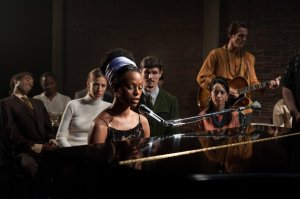 Mary J Blige was originally cast but had to drop out. Nina herself had hoped that it would be Whoopi who’d portray her on screen. Instead director Cynthia Mort went with Zoe Saldana, and thus created a furor. With Dominican and Cuban ancestry, Saldana identifies as a black woman, but critics felt she was not black enough. Not black enough? The notion makes me queasy. But when Saldana said she was honoured to play Simone, the Nina Simone Foundation nastily replied “Dear Zoe, please keep Nina’s name out of your mouth for the rest of your life.”
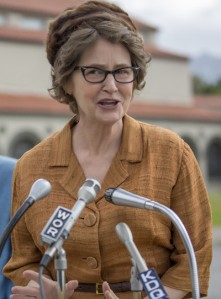 Anyway. This movie is NOT the story of Madalyn’s gleeful adoption of a derisive nickname given to her by Life magazine on its front page (“The Most Hated Woman in America”). No, this film instead focuses on that time in 1995 when Madalyn (Melissa Leo) was kidnapped from her own home, along with her son (Michael Chernus) and granddaughter (Juno Temple) by the likes of Josh Lucas and Rory Cochrane. A friend of the family has trouble convincing anyone that a crime has occurred, and only a reluctant journalist (Adam Scott) pursues their disappearance.
 ASSHOLES WATCHING MOVIES