
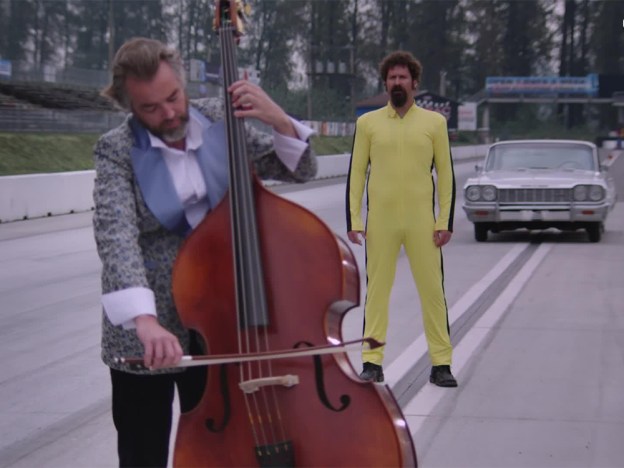
“It’s going to be a long 102 minutes”. This was my first impression of Aim for the Roses, which made its world premiere at the Hot Docs Film Festival in Toronto.
John Bolton’s documentary opens on a reenactment of Ken Carter (played by actor Andrew McNee with a yellow jumpsuit and terrible 70s beard) proclaiming his destiny to become the greatest of all daredevils. I was disoriented at first by the double bass player standing next to Carter on the fake ramp but his presence would still be explained.
Apart from a single reference to a Roger Waters concept album, Aim for the Roses is about as Canadian as it gets. In 1976, Montrealer Ken Carter declared his crazy ambition to jump over the Saint Lawrence River (literally from one country into another) in a rocket-powered car. In 2008, Vancouver-based composer Mark Haney got the crazy idea to make a double-bass concept album to pay tribute to “the daredevil stunt to end all daredevil stunts”. Finally, filmmaker John Bolton got the crazy idea that all this would make a good documentary. Basically, Aim for the Roses is a movie about Canadians doing crazy knuckleheaded things.
Visually, Bolton (the filmmaker) has a bit of a problem. There doesn’t seem to be nearly enough archival footage of Carter (the daredevil) to fill a whole movie and, as interesting as Haney’s music may be to listen to, it obviously doesn’t give us much to look at. Bolton’s solution is inspired. He turns Haney’s album into a music video, playing it over a reenactment of Carter’s feat filmed on a reconstruction of his takeoff ramp.
Bolton’s reenactment is bizarre. Maybe a little too bizarre. Haney’s soundtrack doesn’t help. His concept album has already been called “utterly amazing and completely fucking ridiculous” by the Georgia Straight. Passing off exposition as song lyrics, his music- as haunting as it is- can seem a little silly. But featuring McNee in that costume on a fake takeoff ramp with Haney playing base behind him is a little too much.
Fortunately, you don’t have to like Bolton and Haney’s musical to be fascinated by this documentary. Aim for the Roses is about the people who come up with crazy ideas and stubbornly pursue those ideas no matter how many puzzled looks they get. Haney , who is interviewed extensively in the film, is quick to point out the parallels he sees between his own life and that of Carter’s. He suggests that making the most ambitious concept album of your career is a lot like jumping a rocket-powered car over a river. It doesn’t matter what your ambition is. The best daredevils are artists and the best artists are daredevils. I wouldn’t be surprised if Bolton feels a certain kinship with these two men himself.
 Lenny is a young man in his 20s who, not unlike his peers, is struggling to find himself. He’d like to find a girlfriend, preferably a very independent one, but he feels strongly that they’re all out of his league. There’s anguish here. Lenny will break your goddamned heart. Lenny is a smart guy in his way, and he’s aware. He’s aware of how much his differences have set him apart and all he wants is to be “normal.”
 woman with her own disabilities. Though not a classic love story, you can see how much love and care there is between them. His wife knows how to get him talking, and how to recognize his affection. It’s incredibly endearing.
 it’s embarrassing, but you start to think that they’ve got it right, because in recognizing their weaknesses, they’re actually working harder at overcoming them than a lot of the rest of us. Their communication is open and honest, even if it’s a bit of a trial. Everyone should be so lucky.
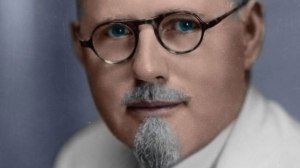 J.R. Brinkley was a doctor in small town Kansas who, through the grace of his revolutionary goat-testicle transplant surgery, cured many men of impotence and infertility while bringing vitality and prosperity to the town. Brinkley had to build hospitals just to deal with the growing demand, and almost accidentally became a radio pioneer simultaneously, broadcasting ads for his services and answering write-in medical questions between blasts of good ole country music. Despite exponential interest and a horde of faithful followers, the American Medical Association accused Brinkley of “quackery.” Just as they set out to discredit him, he came out with an elixir just as
  effective as the goat-testicle procedure but with much less risk. And then he ran for governor, with a slogan borrowed from a laxative commercial. True story.
 used for each segment, but there’s a uniform style that injects a lot of kinetic energy into a story hilariously but dryly narrated. You won’t believe how quaint goat fucking can look.
 exaggerated facial features on his favourite cartoon characters. One day Owen’s father is able to hold his first conversation with him in years simply by pretending to be Iago, the talking parrot from Aladdin.
 can express their love and see it reflected back, even if it’s a line originally quoted by Belle to the Beast. What I do know is that this film opens a lot of doors. This isn’t just a talking-head piece, we actually get to visit with Owen in his new situation, and his family as they continue to take on new challenges. We get to see autism in action, impacting a family and influencing a community. And we get to see that Owen is a guy with wants and needs like any other. He expresses them differently, and once you get the hang of his language, it’s not necessarily even worse, it’s just different.
 interesting and watchable is Owen himself, a very dynamic individual. He’s at his best at the helm of his Disney Club, where other learning-disabled young people gather to watch and discuss Disney animation. They may even run lines afterward, or play the score, and once in a while Jonathan Freeman, voice of Aladdin’s villain Jafar, drops in to lend a hand, and even Gilbert Gottfried, voice of Iago himself, has attended, but nobody knows the lines better than Owen himself.
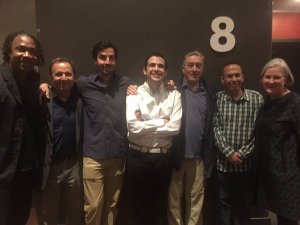
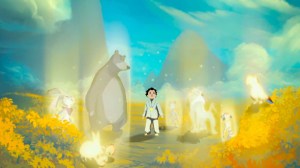 the lines. Many of the film’s crew were on hand, as well as the entire Suskind family, to launch this movie into orbit. There’s a lot of love and care gone into this work, and some of the best bits are when Owen’s own stories are beautifully animated (by Mac Guff). Owen identifies more with the sidekicks rather than the heroes of his beloved films, and he brings them to life in a very moving way.
 In Cheer Up, we meet Finland’s second-worst cheer leading squad. On the heels of a humiliating loss, Garland explores what it takes to keep going in the face of defeat. Where will the girls find motivation? The documentary follows three of the women in particular – coach Miia, and team members Patu and Aino. We soon realize that their struggles and failures are not just confined to the gym. Miia’s personal life is on the rocks, Patu is grieving her mother while her father impregnates a new girlfriend, and Ainu follows the highs and lows of first love, and all the teenage angst that comes with it.
 tears, tumbles, and bloodshed. Miia travels to the cheer leading mecca of the world, Texas, to seek inspiration but finds that their aggressive, winner-takes-all spirit just doesn’t translate back home.
 pep and ponytails. It’s refreshing to remember that not everyone goes home with a trophy. For these women, and many others, success will have to be defined elsewhere.
 wonderful documentary. Its gorgeous cinematography looks better than most features do. Better yet, as likeable as her subjects are, Nayar resists the urge to portray Arile and Matambo as one-dimensional inspirational symbols and doesn’t try to hide the fact that these are real and flawed human beings. She makes them easy to relate to and impossible not to root for.
 Wider and Wider have used Bishop’s case to exemplify the broader problem of how mental illness is addressed both in medical and justice settings, but also take the time to ask intelligent questions regarding individual rights. Because Linda Bishop was in fact an individual: a mother, a sister, a gardener, a knitter, a reader. She died tragically, needlessly, but in life, when she was well, she was vibrant and engaging. Wider and Wider treat her with dignity, and are able to do so in large part because of detailed journal entries she left behind at the time of her death.
 what her last days would have looked like with truly stunning, poetical cinematography rare in a documentary. Hopelessness and beauty intermingle, making for some stirring if haunting images. Did I sometimes find it a little pretentious? Sure I did. But even an Asshole like me can admit and admire when a documentary is trying to elevate itself. Combined with her journal entries read aloud, these images make her story all the more personal. God Knows Where I Am is both an intimate portrait and a rousing call to action.
 new drug dealers, and doctors the pushers. Pharmaceutical companies are more profitable than any other kind. They make HUNDREDS of BILLIONS of dollars, people get hooked, people die, and nobody ever goes to prison for it.
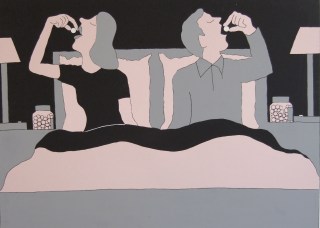 “business” of selling drugs, and the people who come to see them are customers, not patients.
 hydrocodone, diazepam, temazepam, alprazolam, and doxylamine. Pain relief, cough suppressant, anti-anxiety, sedative. His doctors were questioned but not charged. Mary Kate Olsen was found to be “not a viable target” in an investigation. We don’t know how he got the drugs, only that he took them, in excess, and he died too soon, leaving behind a very young daughter who will never know her father.
 ASSHOLES WATCHING MOVIES