Tag Archives: female directors

The Farewell

Billi (Awkwafina) is barely scraping by, trapped somewhere between her parents’ disapproval and her need for their continued financial support when she’s blindsided by the news of her grandmother’s cancer diagnosis. Grandma, aka Nai Nai ( Shuzhen Zhao), is in China, and totally oblivious to her health status. Billi’s parents, Jian (Diana Lin) and Haiyan (Tzi Ma) moved to America when Billi was 6, but she’s always managed to stay close to her grandmother. She’s disturbed when she finds out her parents are willing to keep the secret from Nai Nai, and even more dismayed when she learns they, and the rest of the family, will be travelling to China to say goodbye under the guise of a wedding. But Billi, known for being awfully emotional, is not invited. One look at her teary eyes would tip off Nai Nai for sure.

She goes anyway.

What follows is lyrical, moving and a thoughtful tribute to family, and the nature of goodbye. But it’s also a meditation on some of the differences between East and West. In China, it’s common practice to hide this type of diagnosis from a loved one. Billi feels conflicted about this choice, and reminds people that in America, it would be flat-out illegal for medical professionals to hide someone’s medical status from them. But Billi’s uncle insists that in Asia, family trumps everything, and it is their job to bear this emotional burden for her, so that Nai Nai’s last months or weeks or days are not wasted on sadness and regret.
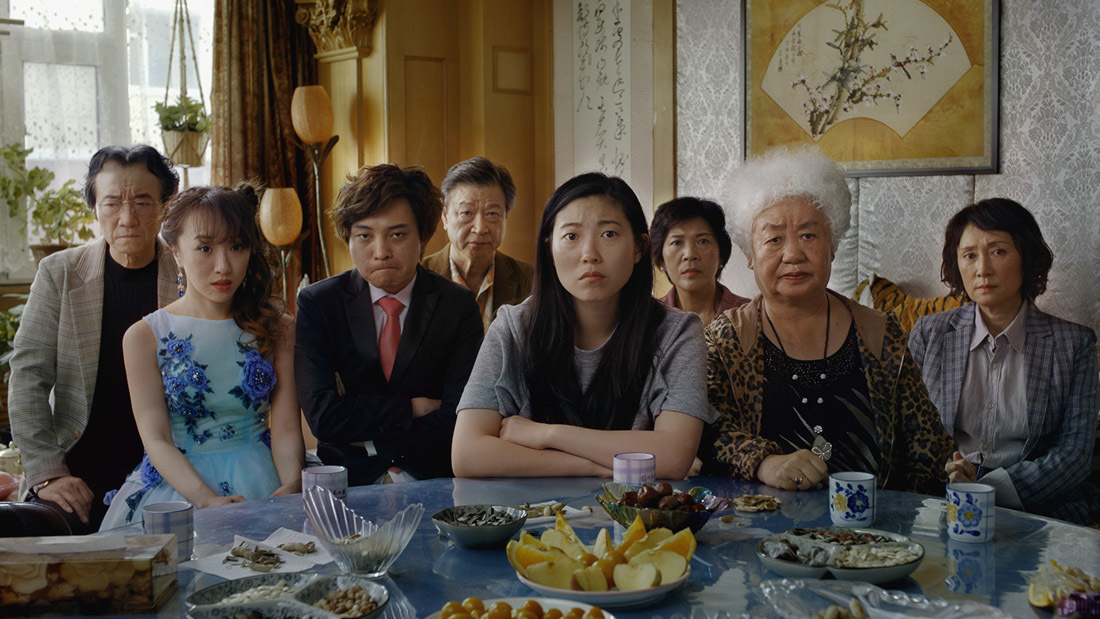
And certainly, the film is not wasted on sadness or regret. The family throws a wedding so that all Nai Nai’s friends and relatives can gather round her one last time without arousing her suspicious. A very obliging girlfriend of just 3 months goes along with it and wins good sport of the year for the next dozen years. So now the onus is on Billi to say goodbye in a non-obvious way.. And it turns out she’s not just saying goodbye to Nai Nai, but to her last real link to China.

The ensemble cast is uniformly terrific. They really create a dynamic that is utterly believable as a family, and that’s why the movie works so well. It could easily melt toward the sentimental but manages to stay firmly away from the overwrought. That said, the writing is good. Very good. it rings true and feels relatable. Awkwafina is of course the light and joy of the film, but don’t expect her usual goofball act. The Farewell is not a comedy. It is subdued, and tragic. But Lulu Wang’s writing and direction keep it authentic and filled with compassion, the kind of film that unites us in our humanity.

Poms

Martha (Diane Keaton) is dying. She has no partner, no children, not even a cat. Just a NYC apartment full of stuff she doesn’t need and one niggling regret. After selling off most of her worldly possessions and relocating to a senior’s retirement community in Georgia to die in a warm climate (where stupid hats are NOT optional), she knows exactly how she’ll spend her remaining days: cheerleading.

Sure it’s unconventional. But quilting and baking and playing bridge don’t really appeal to a woman like Martha. She’s been haunted her whole life by a childhood ambition that went unfulfilled, and if she doesn’t do it now she never will. And when she holds tryouts, it turns out that at least 7 other women wouldn’t mind humiliating themselves along with her – Jacki Weaver and Rhea Perlman included. And also Pam Grier, who quite possibly could never humiliate herself – she is a queen among peasants. No knock against anyone else, but Grier is the accidental sun in this solar system.

In many ways, this is a silly and frivolous film, one that won’t make any lasting impression on the world of cinema, and didn’t really make a dent in terms of sales. But I bet if you’re over 65, it might be nice to see an older person on film who isn’t just waiting to die, or to dispense their life’s advice to the young protagonist, but who is instead still pursuing dreams, still the protagonist in her own life. You may have heard that Anjelica Huston for some reason felt the need to take a shot at the film, which is unfortunate, because there are a lot of older ladies in Hollywood, and only about half a role to split between them. You’d think she might be a little more supportive. Perhaps she and her creaking hips were just jealous? I know why I’m jealous: there’s an old lady on the cheer squad who does the splits. And it’s pretty impressive that she can do the splits at her age, but it’s REALLY impressive that she can get back up out of the splits afterwards, unassisted. That’s who I’m jealous of. I’d be stuck FOR DAYS.

And I guess I’m jealous of anyone who knows their expiration date is approaching, and instead of living in fear, they just live. Martha uses her time. Instead of stewing in regret, she chooses joy.

The director, Zara Hayes, also chooses to slip some subtle messaging into the film about how we police women, and especially elderly women. How we default toward infantilization. While some older people will of course require care, they also, unfailingly, deserve respect. And it feels far too easy for an older woman to become disenfranchised and lose her power.

Poms is a sweet, well-intentioned film. The ladies make dreadful cheerleaders. I’m sorry, but it’s true. The movie really doesn’t glamourize old lady cheerleaders. Their moves are tame and lame and underwhelming, exactly as you’d expect them to be. But it’s the women’s verve and vitality that shines through. They’re not setting the world on fire with their dance moves or athleticism. But they’re not going gently into that good night. Until they’re dead, they’re alive. And in that way, it’s a very inspiring little film.

Otherhood

Three mothers, originally friends because their sons were friends, have stayed in each other’s lives even after their sons have all moved away. We meet them at a mother’s day brunch they’ve thrown themselves because their lousy sons always forget (if any one of them had a daughter, or even a daughter-in-law, this movie wouldn’t exist; daughters are not allowed to forget). Not content to just sit around bitching and whining about their lives, they decide to inflict their neuroses on their grown sons, uninvited. So they pack themselves into the world’s most hostile road trip and storm New York City to make their problems someone else’s.

You likely know a mother or two just like this, and if it’s your own mother, well, god bless you. This kind of mother wants it both ways: she decides she MUST become a mother because her life is incomplete, but then she spends her kid’s life telling him or her that it was a completely selfless act that requires a well of gratitude whose depth cannot be measured as it is bottomless and unending and nothing will ever be enough. And when the child is grown, the mother is lost and without purpose because motherhood was everything and now she is nothing. And improbably, all three female characters in this film are suffering from this affliction.

Personally, I know tonnes of mothers who have managed to maintain a balance between forging a career, having their own life, nurturing friendships, and being better mothers because of it. I don’t imagine that’s easy, but it’s life, and the last time I checked, motherhood IS optional. But these women are acting like life is over because their grown sons don’t immediately reply to their inane and constant texting.

It must have been difficult for Netflix to promote this movie since one of the three women is Felicity Huffman and she’s not exactly winning any motherhood prizes right now (if you’re just poking your head out from underneath a rock, she’s one of the parents accused of believing that her kids are such profound idiots that they could only get into college with the help of large, illegal bribes, and that they still deserved to be there, perhaps taking the place of your own kids, who would have otherwise merited the position, because their mother is rich and famous and quite possibly she just wanted them out of the damn house). Leaving her aside, Netflix managed to convince both Patricia Arquette and Angela Bassett to join the ranks of the pitiful. And frankly, Arquette does nothing to dispel the pity party. She’s gotten a little too comfortably playing the kooky, offbeat, perpetually single mother. When she breaks into her son’s apartment to bake for him, it’s uncomfortably believable. When she fails to learn a lesson about meddling and instead declares that the only problem was that she didn’t meddle soon enough, you believe that too.

Bassett, on the other hand, is an asset. Her character has certainly invested too much of herself into living for the men in her life (her husband and her son), especially when those men haven’t deserved it, don’t return it, and don’t even want it. But because it’s Basset, her character doesn’t feel pathetic. She holds her head high. She clearly has strength. And she DOES learn her lesson, and earns herself a better life; in the end, she’s the only one we’re really rooting for.

I think a lot of women, and perhaps parents generally, struggle with the transition from parenting a child to parenting an adult. But the truth is, that role is always changing. A newborn baby is a round-the-clock, soul-sucking (and hopefully soul-nourishing) job; a two year old is a battle of wills; a twelve year old is an exercise in diplomacy; a fifteen year old is a test of nerves. You never stop being someone’s mother, but mothering stops being invasive and starts being supportive at some point – if you’ve done it right. Not everyone gets it right, and that’s okay too, because we’re all human and we’re all learning on the job. You might even have to be someone’s kid while also being someone else’s parent. But neither of those things should subsume your entire identity.

Otherhood isn’t a great movie but it’s possibly worth watching just because there isn’t enough Angela Bassett in the world as it is. Stories about women are worth telling. We don’t always get them right. We’re all fumbling around trying to figure shit out. And if you haven’t recently been federally indicted on charges of conspiracy to commit fraud, punishable by up to 20 years in prison, you’re probably doing okay.

Stoke

Jane (Caitlin Holcombe) is a heartbroken Los Angeles attorney craving something big to shake her out of her depression. She sets her sights on Hawaii, but not necessarily the one seen on postcards. She’s going to chase lava, so she goes to the Big Island and hires two wannabe tour guides in the shadows of erupting Kilauea.

Locals Po (Randall Galius Jr.) and Dusty (Ka’uhane Lopes) are actually cleaners with tourism-dollar aspirations, but that won’t stop them from tricking Jane into their van, and ultimately their lives as the trio sets out on a Big Island road trip with distinct Hawaiin vibes.

Hawaii itself is the epic fourth character, asserting itself in nearly every scene, from its lush landscapes and hypnotic music, to the spirit of its people and the cadence of the natives’ speech.

Sean and I were lucky enough to visit Hawaii just a few years ago and were unprepared for but completely swept away by the natural beauty of the land and the welcoming hospitality of its people. We toured several of the islands, Big Island included, so it was a real treat to see some familiar sights in this film. But more than that, Stoke (a lava drama) shows us the side of the island little seen by visitors. It’s a reminder that volcanoes don’t perform for tourists, and an eruption has real-life devastating consequences for the people who live there year-round.

Stoke is a bit of a wild ride, embracing its independent roots by taking inventive chances and boldly charting its own course. In a strong cast of actually-Hawaiian Hawaiians (we’re looking at you, Aloha), Galius Jr is a stand-out for his unforgettable smile and screen presence. Directors Phillips Payson and Zoe Eisenberg have put together a thoughtful piece about the healing properties of America’s most beautiful state.

Astronaut

Becoming an astronaut was always a dream of mine.  As early as I can remember, I was fascinated by the idea that there were other planets and stars surrounding us, and the idea that I could float around in outer space and jump so much higher and further on the moon than on Earth.  At the time I lived in Kentucky and learned at school that I could write to NASA and they would send back random photos of space shuttles, planets, satellites, and so much more.  So write I did.  I wrote almost as many letters then as Jay does now (she is singlehandedly keeping Canada Post’s lettercarriers employed), and ended up with stacks of photos that I treasured throughout my childhood.

AstronautObviously, I am not the only one who dreamed of becoming an astronaut.  Space travel is clearly on a lot of people’s bucket lists, as shown by the proposed reality show cataloguing a one-way mission to Mars (which went belly-up earlier this year), the numerous space flights available for purchase (Virgin Galactic has collected $80 million in deposits for 90 minute voyages costing $250,000 each), and NSYNC’s Lance Bass attempting to buy his way onto a Russian rocket (he couldn’t afford it after Justin Timberlake left the band), among other examples.
In Astronaut, Angus (Richard Dreyfuss) definitely has space travel on his bucket list.  He’s always looking to the stars and, as a retired civil engineer, possesses the type of scientific knowledge that might grant a seat on a NASA mission.  Unfortunately, he never secured a NASA spot during his career and his dreams of space travel seem more and more distant as his health begins to fail.   But the stars align when a billionaire (Colm Feore) announces a contest that will give the winner a seat on the first commercial flight to space, which otherwise would be too expensive for Angus (and the rest of the 99%) to afford.  You can probably guess who becomes one of the twelve finalists in that lottery, but even with that stroke of luck things don’t come easy to Angus, not only because of the health issues I mentioned, but also because he’s trying to settle his wife’s estate and he’s struggling with an impending move to a retirement home.

Astronaut asks us to suspend our disbelief on more than one occasion, and in exchange rewards us with a sweet and engaging fairy tale.  The pieces fit together so neatly and conveniently that there is never any real tension or possibility of failure, but the movie works even with relatively low stakes because of Dreyfuss’ stellar performance.  Angus is a great combination of gruff and personable, and Astronaut is elevated by Dreyfuss’ wonderful chemistry with Angus’ family and friends, particularly his daughter (Krista Bridges), his son-in-law (Lyriq Bent), and his grandson (Richie Lawrence).

Writer-director Shelagh McLeod wisely focuses on Angus’ personal relationships rather than the space flight itself and Astronaut is better for it, because the fantastical (and potentially unbelievable) elements of the film are just minor details.  What matters is watching Angus reach for the stars, and I happily cheered him on from start to finish.

Tig

Tig Notaro is one of my favourite comedians. Although always an amazing, deadpan comedian, she hit the popularity rocket when she did a ground-breaking set the day after she was diagnosed with cancer. She just stood on the stage and bravely free-associated her new reality, and people were floored. Floored.

I mean, if you know her story at all, cancer was just the cherry on top. Weeks before, she’d been in the hospital in crazy pain with a life-threatening diagnosis of C-Diff. She got out of the hospital just in time to make her mother’s funeral, who’d died suddenly after a freak accident, falling in her own living room and hitting her head, a seemingly benign incident that killed her 24 hours later. Then Tig went through a break up, though moments before they’d been considering starting a family. And then: breast cancer. So it was a tumultuous few weeks, and you can only imagine her frame of mind when she wandered on stage that famous night. Although, technically you don’t have to: Louis C.K. was in the audience that night, and helped her put out an album of that set, which for obvious reasons could never be recreated.

So in the wake of her having a double mastectomy, she was suddenly very famous and a very sought-after comedian, one who now had no material since she could never re-perform the cancer bit. Crazy. Tig (the documentary) is a clever reflection upon that crazy time in her life, with the help of similarly funny, famous friends like Bill Burr and Sarah Silverman.

I love stand-up comedy. Like, LOVE love. I love how accessible comedy has become thanks in part to Netflix, but also satellite radio and Spotify – I listen to lots of podcasts in my car these days. Tig is among my favourites, and Sean and I meant to see her at Just For Laughs last year, only she cancelled her set at the last minute, but we saw other favourites of mine, like Maria Bamford, Fortune Feimster, and Carmen Esposito. This year we’re seeing Marc Maron and Fred Armisen. But as much fun as it is to see a live set, it’s such an exciting time to be able to supplement those with bonuses, of which I’d say that this documentary is most definitely one. It’s an incredible story either way, but she’s also a comedian that you just need to get into. She has a very watchable, very bingeable show as well, called One Mississippi. Maria Bamford had one called Lady Dynamite. Jim Gaffigan had one less inventively titled The Jim Gaffigan Show (do you suppose men just reflexively have to slap their names all over things?). Anyway, it tickles me to no end when comedians pop up in things, and I will continue to seek them out, because to my mind, comedy is the absolute hardest thing to get right. Comedies are largely underappreciated and downright ignored by critics and award-givers, but that’s absurd. When humour works, it unites us all in such a base, instinctual way. It’s glorious. But as you know, a lot of humour comes from pain. It takes a special talent to extract the funniness from a horrible situation.

And maybe that’s what makes Tig so special. That she was willing to use her own personal hell, her own heartbreak, not only to entertain us, but to make us whole. Comedy is healing. Laughing is medicinal. Give yourself a Tig injection; it keeps the doctor away.

Advantageous

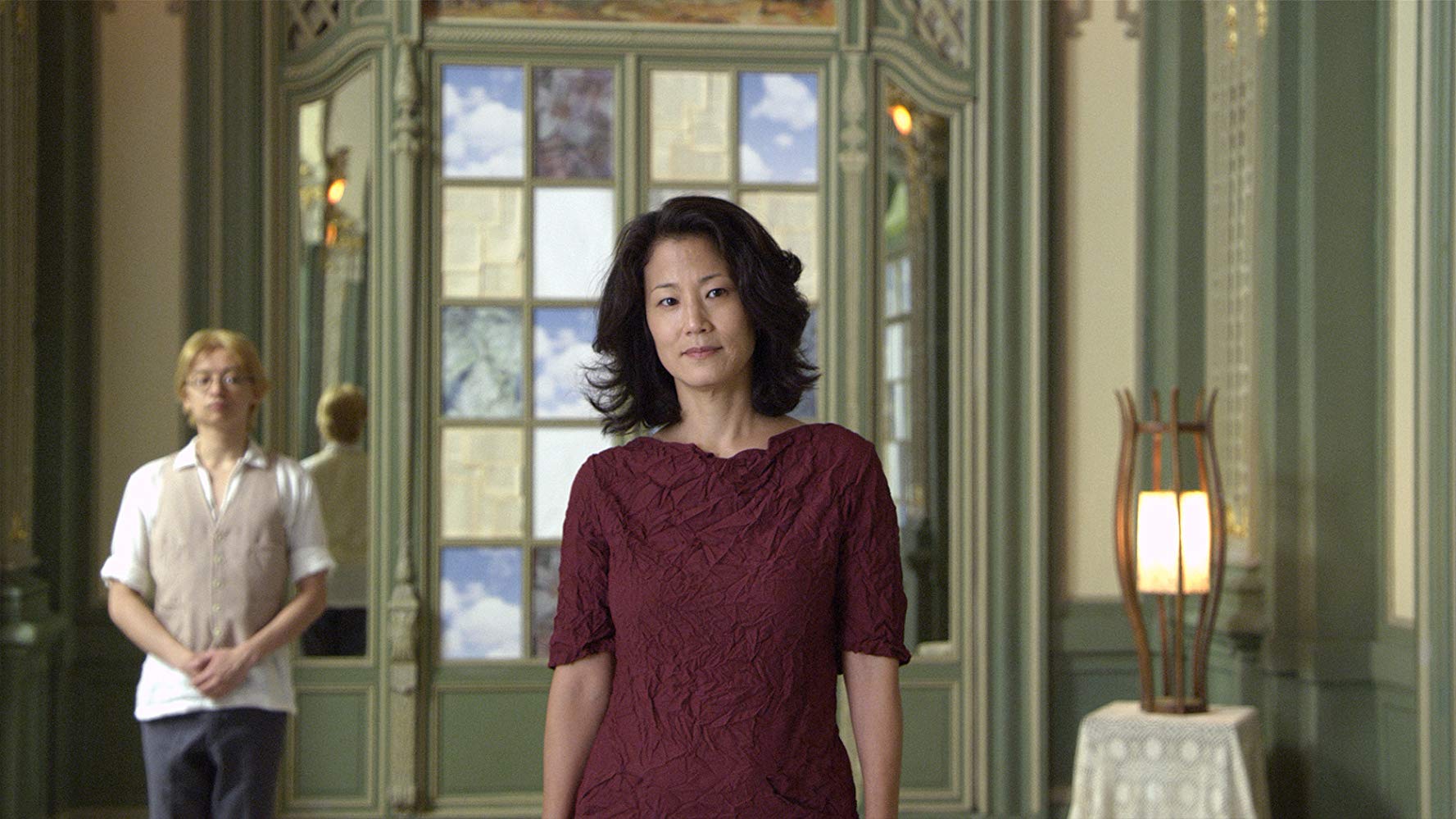
Gwen and her daughter Jules live in a near-future metropolis where economic disparity is increasing. There’s incredible wealth and progress but also increasing instability and hardship, and more and more, women are being pushed out of the workplace complete. Up until recently, Gwen (Jacqueline Kim) has been the face of a biotech company, but she’s been released from her contract for daring to approach middle age, and she’s finding that prospects have dried up considerably since she was last in the job market.

A single mother with not a lot of help or resources, Gwen’s primary concern is for daughter Jules (Samantha Kim). It feels vitally important, now more than ever, to set Jules up with the absolute best start in life, and a prep school will go a long way to getting things right. A school that Gwen can’t necessarily afford, even when she had a salary. But how will Jules fare in a world increasingly hostile toward her gender without a head start? Gwen casts about for options but finds only one – ironically from the company that’s just fired her. Their particular brand of bio technology is a procedure that would lift your consciousness into a young, beautiful host body. They’re still in the beginning stages and could use a “volunteer” to be the first civilian subject. If Gwen accepts, she’ll be young and beautiful enough to get her old job back. Two scoops with one cone?

Imagine explaining this to your kid. Mommy’s going to the hospital, and when she comes home, she’ll be a MILF. These arms that hold you, these lips that kiss you, these hands that soothe you will be no more. It’s nearly impossible for a small child to comprehend this, but it turns out that Jules won’t have the hardest time with this. Gwen suffers a huge mental hurdle trying to reconcile her past memories with her current body. And the surgery has left her different emotionally, too. Even her personality seems different. What will life be like for her now?

I LOVE when female directors get behind science fiction. Advantageous is character-driven, and the details of the world they inhabit are cleverly dispersed. It’s low budget, so the effects aren’t what will keep you interested. But there are so many questions that will poke little holes in your soul. Gwen’s choice is a little extreme but the commodification of women’s bodies is apparently something we’ll never be able to stop talking about, and this film makes us confront the line that is so easily overstepped along the way. If this were merely about our obsession with youth culture it would be one thing, but this is also about a mother’s love, and the depths she’ll go to to ensure her daughter’s health and happiness.

Late Night

Mindy Kaling is an actress, a director, a producer, an Emmy-nominated writer. She’s written best-sellers and acted alongside Oprah and created television series. You may not know that her foot in the door was portraying Ben Affleck in an off-Broadway play she co-wrote with her best friend called Matt & Ben, about how the pair came to write Good Will Hunting. I wish to god I had seen it.

She was hired to write for The Office when she was just 24 years old – the only woman in a room full of men. She was technically a diversity hire, part of NBC’s diversity writing programme, but don’t mistake that for a lack of qualification. “For a long time I was really embarrassed about that. No one [on The Office] said anything to me about it, but they all knew and I was acutely aware of that. It took me a while to realize that I was just getting the access other people had because of who they knew.” Mindy’s parents, an architect and an OB-GYN, immigrated to the U.S. from India (via Nigeria) only months before she was born, and gave her the most American of names, ripped from their favourite sitcom, Mork & Mindy.

In Late Night, Kaling plays Molly Patel, also a diversity hire, straight from a chemical plant (don’t call it a factory!). She’s hired to be the first and badly needed female writer on Katherine Newbury’s show as its steady ratings decline threatens its existence. Kaling wrote the role of Newbury specifically for Emma Thompson and it is indeed a perfect fit. Newbury is exacting and imperious, but has grown out of touch with her core audience. Molly is exactly the injection of colour and culture that this writer’s room needs even though it longs to stay beige. Of course, Kaling had to invent a fictional world in which a woman is actually allowed to host a late night show, but once she does (and we get over that depressing fact), she invents a very good one, one in which her very successful host is over 50 and undeniably at the top of her game, but hasn’t had to sacrifice her life to gain such a position. Newbury has both a love life (John Lithgow) and a sex life, and she still gets to be the boss. Kaling is so devoted to this character, she took a page from her parents’ baby naming book and called her own daughter Katherine.

Late Night is a lot of laughs, and it benefits from the excellent chemistry between Kaling and Thompson. I suppose it takes a woman to write two such meaty yet tender roles for women. Roles that don’t apologize for emotions and characters who don’t get disempowered for expressing them. And a female director to give these ladies their space to create complexity. Late Night tackles a lot of themes as you might imagine, but it never loses its sharp and incisive comedy. Thompson proves more than able, with impeccable timing and buckets of condescension. She’s formidable. Meanwhile, Kaling orbits around her, not just absorbing her light but casting her own glow as well. They don’t diminish each other, they brighten the whole damn screen. It’s a party where ambitious women, perhaps for the first time this century, are truly celebrated. Yes there were applause-worthy moments, though the theatre I was in was unfortunately a packed but non-clapping one (well, okay, save for me, who couldn’t resist). And there’s a lesson plan for how to apologize correctly and take responsibility like a big kid. But mostly there’s just a lot of zing, and a surprising amount of relatability [My work recently turned one of two women’s washrooms in the building into a “gender neutral” washroom which is nice in theory but in practice has become the washroom where men go to poop. Because men, who still had 2 bathrooms to themselves, think it’s more important to stink up a third than to create safe spaces. They’re literally shitting their privilege all over the place.]

Kaling wrote this movie while she was pregnant, and on the set of A Wrinkle In Time. She shot it while literally breastfeeding her daughter. Motherhood is not slowing her down, it’s just another bullshit hurdle she’s going to plough straight through while we lay down our dollars like a red carpet made out of green because she is the Queen and we her loyal subjects.

Summer ’03

In the summer of 2003, Jamie is 16, and her grandmother is dying. Don’t feel too bad about it, Grandma (June Squibb) is a bit of a bitch. On her deathbed, she confesses to Jamie that she had her secretly baptized as a child (Jamie’s mother is Jewish). She also imparts a very important last piece of advice: learn how to give a good blow job.

How surprised would you be to learn that Jamie learned a way to combine those two tidbits? More on that in a minute. First: Grandma had some bombs to drop for other family members as well, so everyone’s reeling. Big time. Total shit show. And yet Jamie’s evil-Jew mom is still in charge of planning the funeral. So much fun for her! First you live under your mother in law’s tyranny and disapproval for years, then she confirms her hatred for you and disrespect for your culture and religion…and then she dies and you get to clean up the mess. Families are the best. And sixteen year olds are so well-equipped to deal with the drama!

Yeah so anyway, Jamie (Joey King) decides to check out this whole being a secret half-Christian thing, and she goes to church where she actually ends up checking out the hot, young, priest-in training, Luke (Jack Kilmer). He’s about as many days away from being ordained and super duper officially off the market as Grandma is from being buried, and yet Jamie thinks it’s a good idea to use Grandma’s second piece of advice on him. And he’s so committed to God he goes along with it. Haha, “goes along with it” like he’s not a guy with a condom in his pocket like any other – eager to stick it in, not so eager to reciprocate. Romantic.

Writer-director Becca Gleason is offering up her story, alarmingly “based on true events.” Jamie is believably self-centered and short-sighted, but Becca should have the powers of hindsight, and in fact, 15 years worth of precious insight, so it’s a little disappointing that her main character still feels a little flimsy. Anger, grief, and a teenaged identity crisis. So it never quite jumps the tracks from your typical teenage film. It’s an odd enough story you might want to tune in anyway.

Knives And Skin

Carolyn Harper makes out with a football player but when she pushes away his roaming hands, he leaves her alone in the woods and she’s never seen alive again. Her disappearance disrupts her high school and the entire community, as the disappearances of beautiful young white women often do.

In the aftermath of her disappearance, we watch things unravel for her friends, her fellow bandmates and classmates, her mother, and the well-intentioned but inexperienced local sheriff. More than that, though, we experience the way that grief accelerates the coming of age for a group of teenagers, which makes it rather obvious that their parents’ haven’t exactly completed the growing up process either.

Writer-director Jennifer Reeder creates a very atmospheric teen noir that pulls from a lot of sources but manages to be its very own thing. The closest thing I can compare it to is Twin Peaks for its eerie tone but believe me when I say Knives And Skin is its own gothic soup – a horror broth steeped with many surprising flavours. Reeder brings in familiar tropes and mixes them with haunting song and feminist references and the result is hard to categorize but fascinating to watch, even if it is uneven, a little long, and prone to meandering. If it occasionally feels a little piecey, it also feels dreamy, surreal. The story is less concerned about finding Carolyn than it is about exploring the various ways people feel trapped, and subtle reminders that escape is possible. Although it starts off with a dead girl in the woods, it subverts the expectations of that genre over and over with its confident female leads and the weaponization of sex. It’s like a parody, but self-aware and dead serious.

Reeder may value style over narrative, but Knives And Skin interesting, beautiful, and unforgettable.