Tag Archives: independent film

SXSW: The Ballad of Lefty Brown

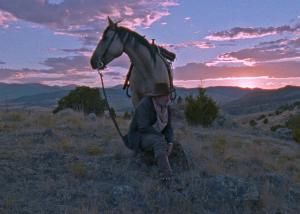
the-ballad-of-lefty-brown-F71455The Ballad of Lefty Brown starts from an interesting place. Writer/director Jared Moshe was curious about the bumbling sidekick in John Wayne movies, the guy who functioned as comic relief. That archetypal character could not do anything right, so why did someone like John Wayne choose to have a bumbling guy like that as the one watching his back?

Lefty Brown is one such bumbler. Played by Bill Pullman, we join Lefty late in life, near the end of a lifetime of sidekicking for a Montana rancher who has just been elected to the U.S. Senate.  Lefty would be at a loss anyway due to his mainkick, but things are made much, much worse when the rancher is ambushed and murdered by a cattle rustler that he and Lefty were tracking.

Pullman is very believable as Lefty, a sad-sack who believes he contributed to, or at least could have done something to prevent, the death of his idol and only friend. Other characters, including many familiar faces, come and go but serve mainly to advance the story. Unfortunately, we don’t get to know them as much as I would have liked, but this is Lefty’s story for once so it would be cruel to complain that he got too much screen time!

The landscape is beautifully shot, and the cinematography really emphasizes Lefty’s isolation. He’s literally in the middle of nowhere for most of this movie, and even when he’s accompanied by others that feeling of isolation remains.

Because of the rancher’s death, Lefty has to assume the leadership role, and as we spend time with Lefty we get to learn why the rancher was willing to place so much trust in Lefty. It’s an enjoyable journey even though, paradoxically, the movie plays out like a typical western because the rancher’s death makes Lefty the lead with a sidekick of his own. But I like to think that the rancher knew all along what our stand-in hero Lefty was truly made of.

If, like me, you’re intrigued by the concept and are in Austin TX this week then you have one more chance to see The Ballad of Lefty Brown at SXSW, on March 15 at 2 p.m.


SXSW: Ramblin’ Freak

Although ostensibly about a specific bodybuilder’s incredible true story, Ramblin’ Freak is also about the randomness of life. Parker Smith wants to make a film but he’s not sure of what. He buys a used camera off Ebay thinking maybe he’ll set it up on his dashboard as he drives cross country, but the camera has a different idea. Lightly used, it comes pre-loaded with an old tape of some bodybuilder, and it turns out that body builder is “the man whose arms exploded” so Smith naturally feels that the universe has told him to document this man’s story, and off he goes.

Ramblin’ Freak captures the aimlessness of youth. Smith, 24 years old, seems untethered, his plan for the documentary really no plan at all, and the finished film turns ramblin-freak-F71268out to be largely unstructured: 50 minutes into the film we still haven’t seen any exploding arms, but we’ve seen plenty of Smith’s unironic mini van, his cat, and his Hipster facial hair. The film is dotted with seemingly random Youtube videos that slowly reveal the personal tragedy behind some of Smith’s listlessness.
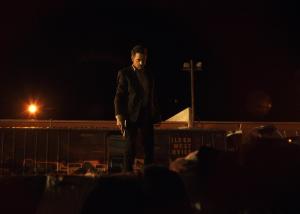
Smith’s camera work leaves a lot to be desired. Don’t set your heart on perfectly composed shots. Don’t be surprised when the camera accidentally tilts up and you experience a scene via a shot of the ceiling, that may or may not have sound. And the story telling isn’t much better; unraveling Smith’s intentions feels like an opaque job that we’re not fairly equipped for. But as we made our way through hapless encounters, I began to feel that this disjointed film making was an accurate, authentic reflection on the film maker’s state of mind. If Smith lacks the vocabulary to express his pain, he’s letting his documentary do the talking for him, and it’s a mess.

All told, this is not the story of a body builder with exploding arms, or even about the journey towards that end. It’s really about a young man’s pain, his tentative exploration of it, his bravery and willingness to show it for what it is. Grief is never any one thing, and perhaps coping looks and feels different to this new Millennial generation. Parker Smith engages in this extended, 90-minute selfie and shows us a new kind of navel-gazing as he picks the scabs of his wounds and tries to heal himself.

Ramblin’ Freak screens at SXSW:

March 13: Alamo Ritz

March 16 & 18: Alamo Lamar


SXSW: Small Town Crime

small-town-crime-F68309No matter how hard you try, you can’t see everything at a festival like SXSW. To prepare for these big festivals, we study the schedule like our lives depend on it, read the synopses repeatedly, and try to see as many of our favourite artists as possible.  All that prep work helps a lot, but sometimes a tight schedule makes a choice for us. That happened today with Small Town Crime and we were better off for it. Put simply, Small Town Crime is an indie gem that is one of the best films I’ve seen in 2017.
Featuring too many compelling, well-written characters to count, and matched by great performances from pros like John Hawkes, Octavia Spencer, and Robert Forster, Small Town Crime sparkles.  We are introduced right away to Hawkes’ suitably pathetic, yet undeniably charming, alcoholic ex-cop. He’s got a few skeletons too many in his closet, so he needs some breakfast beers in order to get underway each afternoon. But he is determined not to let that disease keep him from solving a mystery that falls right into his lap.

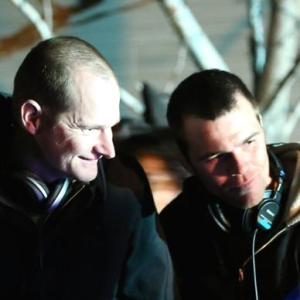
ian-nelms-F68309Functioning both as a whodunnit and an offbeat action-comedy, Small Town Crime is consistently good, especially when Hawkes’ character shares the screen with Forster’s concerned grandfather and Clifton Collins Jr.’s refreshingly self-aware pimp.  Writer-directors Eshom and Ian Nelms clearly recognized what they had and give those three characters a hefty share of screen time. That must have been particularly difficult here since the cast is extremely deep. Even with the focus on that trio, I was left wanting to see more of them. I’d be first in line for a sequel (or a television series) showcasing more of their adventures.

In addition to its fantastic characters, Small Town Crime also delivers great action scenes and showcases a wide array of memorable vehicles (the Nelms brothers are self-professed car nuts). Small Town Crime is a fantastic film that shoots right to the top of the list of must-see indie movies. I cannot recommend it strongly enough.

If you’re at SXSW, you still have two more chances to see Small Town Crime on March 12 and 17, and otherwise, you should cross your fingers for this film to get a well-deserved wide release.

Other People

Cancer is what happens to other people. It just so happens that right now, the Mulcahey family are those other people. It’s happening to them. Technically, it’s happening to matriarch Joanne (Molly Shannon) but her last year is having quite an effect on the whole family – on her husband, Norman (Bradley Whitford), on her son David (Jesse Plemmons), on her two daughters, her colleagues, her friends, her extended family, on a whole bushel 960of people who are grieving even as she still lives, dealing with a loss that is still happening before their very eyes.

David has moved home to care for and spend time with his mother. He lives in New York City, and is trying to be a writer, but the pilot he was working on didn’t get picked up and he hasn’t had much other luck. His return is complicated by his religious family’s refusal to accept his sexuality. Ten years after he came out to them, his mother is trying to make amends but his father is still unable to come to terms with it.

The movie avoids most of the cancer cliches and rewards us with a more subtle look at loss. Plemmons is really great, and I like Zach Woods in a small role as his boyfriend. But I’ve been holding onto a dirty secret for two whole paragraphs now and it’s time to air it: I really dislike  Molly Shannon. I disliked her on SNL and I’ve disliked her in every thing since. She just bothers me, but for some reason I feel like a bad feminist admitting it. In this century, all of the greatest SNL talent has been female, but in the 90s, that wasn’t true. With the exception of the truly great – Gilda Radner, Jane Curtin, Jan Hooks – female cast members were tokenish, ill-used, mistreated up until Tina Fey and Amy Poehler landscape-1473341376-other-people-leadstarted turning things around. But Molly Shannon was a break-out, and some of her characters even got movie deals. I just didn’t like them. I thought she was brash, over the top, and obnoxious. I still do. But in this movie, as they dying mother, she’s none of those things. I still don’t like her, but she was easier to stomach when he’s mostly occupied evacuating hers. Is that a terrible thing to say? Yes it is. But it’s the truth.

This movie blends comedy and drama successfully, with a touch of cynicism and just enough compassion. Cancer isn’t exactly new ground to break in an indie film, but you’ll find that writer-director Chris Kelly finds truth in small things, and those add up to a pretty satisfactory whole.

Manchester by the Sea

I knew going into Manchester by the Sea that it was one of the most critically acclaimed American movies of the century so far but I was still somehow surprised by how blown away I was.

Kenneth Lonergan has made a fantastic film about family, grief, and how easy it is to push people away when we’re hurting. It’s one of 2016’s best films not because it has any particularly new ideas or innovative style but simply because it’s refreshingly honest.

Casey Affleck (believe the hype, he kills it in this) plays Lee Chandler, a reclusive janitor who returns to his hometown after the sudden death of his brother (played by Kyle Chandler). Lee is surprised to learn that he will need to be staying home a lot longer than he had planned when he discovers that his brother’s will has named him as the guardian of his teenage nephew (Lucas Hedges). Losing a brother and raising a grieving teenager is further complicated by the memories of unspeakable pain and tragedy that his hometown holds.

Manchester by the Sea isn’t always pleasant but, with its sense of dark humour, never feels like a chore. Lonergan is an expert at finding humour in the unlikeliest of situations without it ever feeling forced. Actually, nothing really feels forced. It’ll make you feel powerful emotions without resorting to sentimentality. Even its non-linear structure doesn’t feel like a gimmick.

And there’s not a bad performance to speak of. Affleck has never been better and his scenes with Hedges are priceless. 2016 Golden Globe nominee Michelle Williams makes great use of her limited screen time as Lee’s ex-wife in her emotionally rawest performances in years.

Go see it!

NHFF: Hunter Gatherer

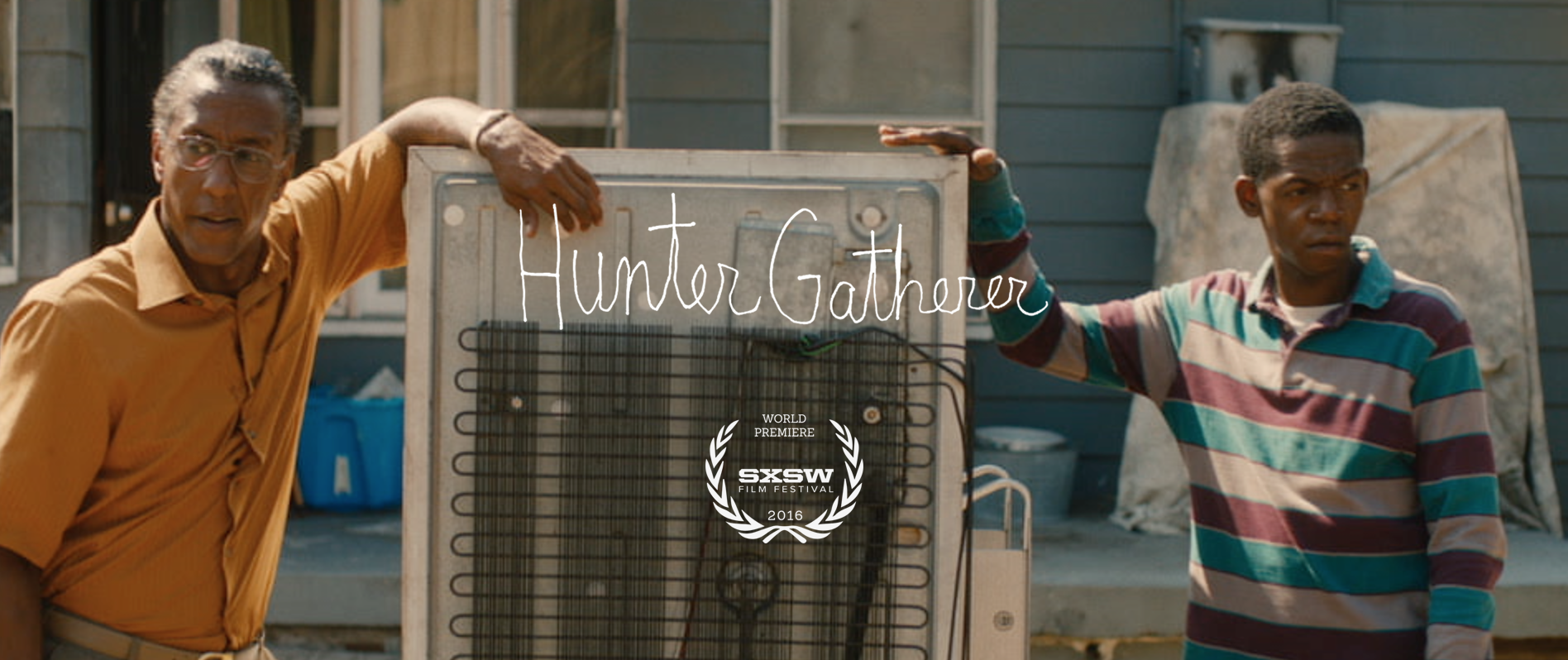
Hunter Gatherer is a little film that demonstrates the value of fully-realized characters.  It is not a flashy film or a high concept one, but it is powerful in its own way.  Through the misadventures of a man just released from prison, Hunter Gatherer illustrates the constant struggle we all face as we try to find our way in this crazy world.  The characters are a little exaggerated but not to the point of farce, and the film succeeds in large part because there is something real at their core.hunter-gatherer

The two protagonists are particularly memorable.  Andre Royo and George Sample III play off each other well and their actions, while often nonsensical to the viewer, have a certain logic that makes their antics believable.  Given the bizarre schemes these characters are involved in, writer/director Joshua Locy deserves a lot of credit for making the characters convincing.

Locy’s efforts pay off because as things turn for the worse, we feel these characters’ pain and understand their responses even if we would have done things very differently.  And we would have done things differently, because if either of these characters made even slightly rational decisions then the movie’s whole course, including its starting point, would have been completely different.  That it could have been avoided with a little common sense makes Hunter Gatherer’s ending all the more heartbreaking.

Like so many small indie films, Hunter Gatherer is unlikely to get a wide release, but it is making the rounds on the festival circuit.  If you have the chance to see it at one of those festivals, I would recommend that you take advantage of the opportunity.   As an aside, we do our best to post release information on our Twitter feed (@AssholeMovies) for all the films we review.  So if you’re not already following us there, now is a good time to start!

Weiner

“Good to see a bunch of political junkies like me,” quipped a beaming NHFF programmer as he introduced last week’s screening of Weiner. “You’d think most people have had enough of political scandals at this point. But not you”. The packed Music Hall Loft cheered in agreement.

I’ve been so busy feverishly reading everything I can find about the American election lately that I couldn’t help seeking out anything the festival had to offer on elections and the issues facing voters this year.

There’s nothing quite like a public meltdown. I’ve caught myself snickering out loud all morning just thinking about some of Trump’s most quotable sulking from last night’s debate. I didn’t know nearly as much about Anthony Weiner’s crash and burn so was looking forward to learning more with Josh Kriegman and Elyse Steinberg’s documentary Weiner.

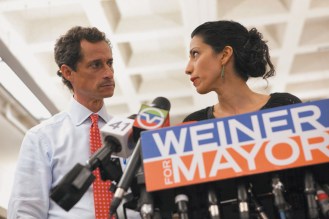
Directors Kriegman and Steinberg were given seemingly unlimited behind the scenes access to Weiner’s 2013 campaign for Mayor of New York City, just two years after his resignation from Congress after his first sexting scandal. Amazingly, everything seems to be going just fine with the campaign until another embarrassing photo resurfaces. Kriegman and Steinberg’s cameras are there from day one to capture his staff’s attempts at damage control and some seriously uncomfortable moments between Weiner and wife Huma Abedin.

“So, yes, I did the thing,” Weiner admits at the very start of the film. “But I did a lot of other things too”. His self-destructive habits, of which his fits of public anger are as damaging as his possible sex addiction, make it hard to find anyone but himself to blame for his downfall. But as tempting as it is to laugh at him (the festival audience laughed, cheered, and jeered at he screen so much you’d think you were at a midnight genre screening), a nagging feeling  of weird sympathy for him may give you pause. There’s something almost unjust about seeing a charismatic politician fighting so passionately for his constituents brought down by such an embarrassing scandal. Sure, the story plays well on late night comedy shows and his last name- hilariously appropriate to the fourteen year-old boy in all of us- makes his mistakes impossible to forget. But he did other things too. And this documentary makes a strong case that his wiener isn’t the only thing he should be remembered for.

Holy crap. Never mind. I literally just read an article about him carrying on texting a 15 year-old girl. Fuck that guy.

So…. still. It’s worth watching for the voyeuristic pleasure of watching an ambitious and prideful man dig a hole for himself. And it might just make you ask some important questions about what really matters when deciding who to vote for and about the media’s obsession with scandal.


A Woman, A Part

Maggie Siff (Sons of Anarchy) plays Anna, a woman who wanted nothing more than to become an actress all of her life, and left her friends in the lurch in order to pursue her dreams. Now a successful TV actress, she hates her life. She’s disillusioned with her career. She wants out. But her contract says 5 more years. Burned out, she retreats to the last place she really felt engaged: New York City, where her friends have moved on and her famous face isn’t quite welcome.

It turns out that things are a little more complicated than she imagined: Oscar a_woman_a_part_john_ortiz_maggie_siff_cara_seymour_photo_by_chris_dapkins(John Ortiz), an ex lover, is married with a kid, though his relationship isn’t rock solid. He’s excited to have Anna around again, but you wonder if it’s real friendship he’s after, or the attention she can bring to his flagging career. A play wright, he’s got one ace in the whole: a new script he’s developed that revolves around a character that very closely (and unflatteringly) resembles Anna. Kate (Cara Seymour) is more reluctant to see her old friend. Is it because of the betrayal, or something else?

These three make a very complex and compelling little story that unfolds around more general themes of addiction, gentrification, sexism, burnout, and friendship.

Director Elisabeth Subrin’s appropriately looks at women in the entertainment industry, and the demands and expectations that constrain them. As the title suggests, Anna is not merely the part she plays, but seems to have trouble extricating herself from that notion. Who is she outside of Hollywood? A simple change in geography is clearly not the answer.

A Woman, A Part works best as a critique of the film industry, a theme that resonates all the more when you factor in Siff’s own most famous role (as the a-woman-a-partgirlfriend on Sons of Anarchy), which registers a double impact for every blow the film lands. Literally seen swimming amid a sea of scripts containing empty female parts, Siff is every female actress of a certain age searching for meaningful work. Anna’s opposite, Nadia (Dagmara Dominczyk), has given up her own work to be the rock of her family; her husband, Oscar, depends on her to be the stable one at home. But Nadia doesn’t want to be the rock anymore – “the rock is boring” she says, a line many of you will want to high-five because women are more than just someone else’s support (note to Jax!).

There are no big dramatics here, but a respect for the characters and their flaws, and the space for some talented actors to showcase those nuances. It’s a small film that explores not just Gender as a general theme but on an intimate scale as one woman tests her own self-perception.


A Stray

Adan, a young Muslim refugee in Minneapolis, is temporarily homeless and forever between jobs. This film is cross section of his every day experience. On this particular day, he’s cut off from home, wandering around with nowhere to go: a stray. But then he crosses paths with a fellow stray, a scruffy mutt that, being Muslim, Adan can’t even bring himself to touch. But that doesn’t mean he doesn’t get attached…

Adan (Barkhad Abdirahman) is a little immature, and finds the outside world to be all-too tempting. He’s not equipped to care for himself, much less a dog that his religion rules unclean. But perhaps he sees a bit of himself in the mutt he calls Layla.

Writer-director Musa Syeed shows us a side of Minneapolis rarely seen – the mosques, alleys, businesses, and social services accessed by its influx of Somalian refugees (the largest population outside of Africa). The film is mv5bzmrlnzzlmjutnge5ys00ytnhltk4odqtngzmztm5mdi3ztk3xkeyxkfqcgdeqxvyntqxnjm5ndc__v1_sy1000_sx1000_al_meandering but not as aimless as it first seems. Adan has a lot of room for self-actualization and self-improvement, but Syeed doesn’t insult us with a quick fix. Instead, the dog is a catalyst for Adan’s adopting a gentler perspective to the unknown. The result is a realistic testament to the immigrant experience. Both Adan and the stray dog are unwanted but the film resists a too on-the-nose metaphor. Instead it chooses to see possibility and understanding, which is a beautiful thing to see in theatres, especially at this particular time when the question of refugees is so urgent, and some people’s response so full of hate and ignorance.

Barkhad Abdirahman gives a strong performance, thankfully since he’s the anchor in this minimalist story. He and Ayla (yes, the dog gets second billing!) have excellent chemistry, and his care for her pulls our heart strings gently in the right direction.


The Architect

Drew (Parker Posey) and Colin (Eric McCormack) are a blissful suburban couple about to invest in a dream home together. The cracks, though, aren’t that hard to find: she’s an artist, he’s buttoned down. She’s impetuous, he’s a planner. She wants a baby, he’s avoiding sex.

So when they hire a kooky architect, Miles Moss (James Frain), he’s just the thing to wiggle between the cracks and push the couple apart. Colin is the_architect_stillimmediately suspicious of his impractical, ego-driven work. Drew, however, is flattered to be his muse and determined to be a “good client.” But as the two work more and more closely together building this dream home (whose dream is it?), Colin starts to be the third wheel in an awkward little triangle. And he’s footing the bill!

Posey and McCormack have terrific chemistry together – which, in the confines of this story means they have very little, but their awkwardness is funnily unbearable. Although billed as a comedy, The Architect doesn’t have much in the way of jokes, it relies mostly on the absurdity of the situation, which sometimes is a little much. Or, you know, a lot much. Because this movie honestly relies on a lot of clichés. Like, architect as tortured artist. The characters are not so much finely drawn as crayoned stick figures. James Frain has little to do in the way of acting because his scarves tell you he’s a pompous ass.

I kind of love Parker Posey and I wish there was more of her usual satire in this when instead we get some pretty lowball comedy, mostly digs at the narcissism of the middle class. I’d like to give it a little more credit and wonder if perhaps the architect is not just the guy who designs buildings, but also acts as a catalyst to their crumbling marriage – an architect of change, if you pardon how trite that sounds. But the movie didn’t give me enough evidence that they aspired to such heights. And the resolution is so easy that all you can do is shrug your shoulders – it’s hard to care what happens to a marriage when we never knew why they were together in the first place.