
By outward appearances, Violet (Olivia Munn) is very successful. Her career is thriving, her beautiful home is under renovation to become even more beautiful, and everyone who knows her is largely jealous. But Violet has become crippled with self-doubt. Those nasty voices in her head (she calls them The Committee) have become highly critical and belligerent. She’s been allowing her inner fears to choose for her, guided not by what she wants, but what she should want.
Writer-director Justine Bateman insists that the most important character in the movie is you – YOU, the audience member. I suppose that she means that how we relate to Violet (or not) will inevitably colour our experience of the film.
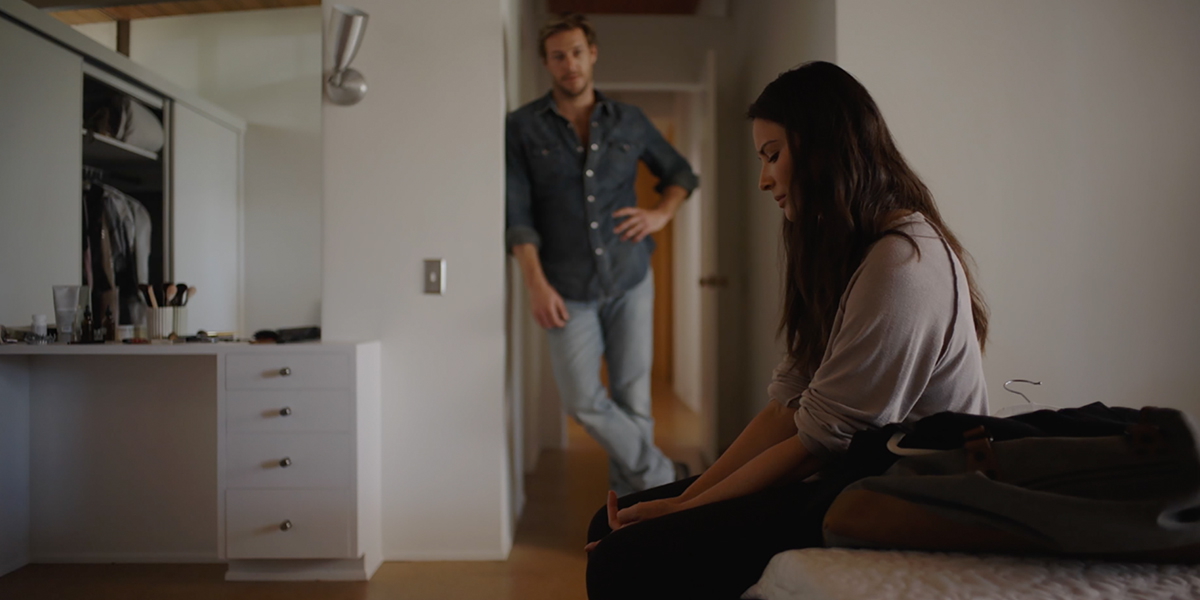
The Committee is voiced by Justin Theroux: we literally hear her anxiety, always nagging, always insisting that she’s less capable, less valuable, less desirable, less worthy. Her innermost thoughts, the ones where she allows herself to be vulnerable and honest, to express her needs and wants, go unvoiced, never even whispered. We’re made aware of them only by writing on the screen. So we see the push-pull between what she truly wants, what her self-doubt thinks she deserves, and then the path she actually chooses, rarely the one she actually wants. We see her long for comfort and company even as she pushes someone away, and that inner conflict resonates so deeply that it almost takes your breath away.
Bateman has actually captured the essence of the human spirit. Negative thoughts are loud and cyclical, difficult to ignore because they voice our darkest fears. The heart’s private desires are so much harder to express; we fear their rejection so wholly that we’d rather not give them voice at all. But how are we to find happiness while repressing so much of our true selves? That’s not just Violet’s quest, it’s all of ours. To live openly and authentically is to be exposed. Violet is a grown woman, some would say in the prime of her life, yet she’s still grappling with this basic, foundational notion of self-image.

Violet is part of the Toronto International Film Festival’s lineup this year, and anyone who’s attended TIFF with any kind of regularity knows that by day two, audiences are intimately acquainted with the commercials aired before each film (often audiences will have perhaps even spontaneously developed call-and-answer reactions to each, which will haunt us all for the duration of the festival). This year, one of TIFF’s regular sponsors, L’Oréal, has a commercial starring Viola Davis about self-worth, about how it’s not a destination but a journey. I almost cannot believe that a commercial from the beauty industry feels like a companion piece to this thoughtful film, but there you have it. Quashing negative thoughts takes a lifetime of diligence and practice. First we have to learn to identify them, which is where Violet’s at when we meet her. The Committee has become aggressive, but she’s on to them. Next we’ll have to actively challenge them, which is much harder, especially for women who are conditioned to be deferential, and to expect less. Violet is fighting her fight, forging identity, worth, and satisfaction, essential tasks of adulthood. Between a lovely cursive font and Justin Theroux, we’re aware of her fight, but also subtly conscious that the other characters in the film must also be experiencing something similar, battling their own self-doubts, dousing their own anxieties. And so must we all. And learning that is perhaps the greatest lesson of all. It’s called empathy.

 would have been a five minute drive up the road, wit both he and his bride making it back in time to cut the cake at their reception. Throw Thadeous into the mix and all you’ve got is a stoner period piece that’s a vehicle for Danny McBride. I mean, Your Highness looks pretty great, truth be told. It’s got a big enough budget to go through the motions. But McBride’s humour is stunted. It’s like he’s always writing for 12 year olds. And, sure, the first time you hear milady say the f-word it makes the tips of your ears blush, but you can’t build a whole movie on just out of place rude humour. Well, okay, point taken – apparently you can, and apparently Universal will pay you 50 million dollars to do it – but there isn’t a mammal on Earth who shouldn’t have seen this flop coming a mile away.
 the whole the movie still worked for me, as a light and breezy r-rated comedy. I came to laugh and I did – mostly at her, granted, but she’s so fantastic and so talented and if the movie doesn’t quite measure up, I think this is her best role to date. I could have watcher her and her cat earrings fangirl over Gillian Anderson for hours.
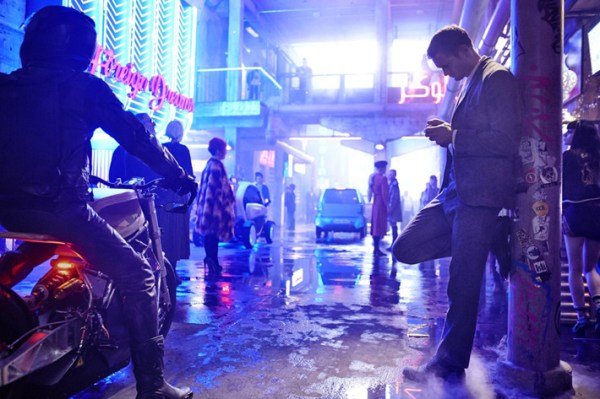 For me, the most memorable scene in Mute was a few-second long callback to director Duncan Jones’ debut, a marvelous little movie called Moon, starring Sam Rockwell, that you should track down immediately if you haven’t seen it yet. Apparently, Mute is intended to be the second entry in a very loose trilogy, an approach that Netflix seems to be very keen on at the moment (as evidenced by
  Are people being drawn to Mute because it’s related to Moon? Did anyone choose to watch Mute because of that link who otherwise would not have? Is Rockwell such a big box office draw that his inclusion got Mute off the ground? I have a hard time believing this one little throwaway scene helped Mute and yet, why else even bother?
 The gist of the movie: Garmadon (Justin Theroux) is the bad guy threatening the world of Ninjago. But every time he tries to invade it for good, he’s thwarted by a band of teenage ninjas trained by his brother, Master Wu (Jackie Chan) and led by the son he abandoned 16 years ago, Lloyd (Dave Franco) though none bear any familial resemblance. Being the son of a noted bad guy is hard, and so is being the vaguely named “green ninja” in a crew of ninjas otherwise named for the elements – Cole\Earth (Fred Armisen), Jay\Lightning (Kumail Nanjiani), Kai\Fire (Michael Pena), Zane\Ice (Zach Woods), and Nya\Water (Abbi Jacobson). They get to ride around in really cool LEGO robots that can shoot things and fly, and I can totally see the toy appeal. Lloyd’s robot vehicle is a dragon that shoots missiles from every body part imaginable – what kid could resist? But the genius is that that they all have something different, so the potential for you to spend money is almost limitless.
 ASSHOLES WATCHING MOVIES