
In the 1980s, British social worker Margaret Humphreys uncovered a secret. Her government had sent hundreds of children to Australia. Supposedly orphaned, these kids were sent to be adopted by Australian parents, though some wound up in orphanages instead. Turns out, the kids weren’t necessarily orphans. If their parents turned up to reclaim them, they were told their kids had already been adopted. In fact they’d vanished into a child migration scheme that was kept quiet for decades. Humphreys set out to reunite these displaced children, scattered across Australia over decades, with parents who might still be living in Britain. Neither country wanted to take any responsibility, of course.
Margaret Humphreys is a real woman who took this on herself because she saw the 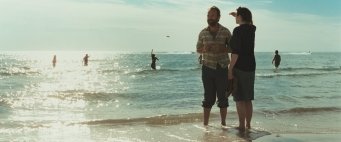 injustice, and people’s pain, and she decided to do something about it. She was threatened and abused because she was exposing some very dirty secrets covered up by some very powerful people. The only help she ever got was from the adoptees themselves, all of them different shades of broken, harbouring the wounded children within. The real Margaret was awarded the Medal of the Order of Australia in 1993, and Commander of the British Empire in 2011 for her work, but as this film can attest, life was not made easy for her.
I believe that we can’t start healing from a trauma until the truth of the injury is admitted. This story was quite shameful on Australian and Britain, but they’re not the only ones with blemishes. Here in Canada we have our own sorrow. We call it the 60s scoop though it’s much broader than that. It refers to the over-eager removal of Aboriginal children from their homes. In some cases removal may have been appropriate, but others not, and in any case, the children weren’t just taken from their parents, but from the culture. They were raised off-reserve, losing their language and their identity, breaking social and familial bonds. Although not deported, these kids also lost more than just their parents.
In Oranges and Sunshine, Emily Watson plays Margaret Humphreys, and she does the formidable woman justice. Watson always does, doesn’t she? Hugo Weaving plays Jack, the adoptee through whom we experience the grief and loss of the process. Seeing it from both their perspectives keeps the film balanced; this is not merely an interesting case, but a personal and painful journey that doesn’t guarantee a happy ending for everyone. It’s not a flashy movie. It’s mostly fact-based. But it is sincere and at times quite powerful.
 Their love story unfolds slowly, as it must when one person is physically removed from the other. In the novel they communicate by text or instant messaging. To make that play a little less boring on screen, director Stella Meghie imagines them within the architectural models that Maddy’s always working on. It’s a device that works while still reminding us that these conversations don’t actually take place in a face-to-face reality. Still, it’s a talk-heavy, plot-light movie that doesn’t move around too much. If you aren’t swooning over Olly’s too-long-locks, you’re probably going to find this long.
 things. Amandla Stenberg is very charming as Maddy, the brave, beautiful, but socially awkward girl next door trapped in a glass castle. She succumbs to the kind of romantic gestures no teenage boy would be caught doing and only a young-adult novelist could dream up. There’s some major eye-rolling to be had in this movie, and it starts rather early, when Olly first appears in his driveway, tossing his luscious locks in the unfiltered sunlight, shooting his pretty neighbour a cocksure grin while showing off on his skateboard. I was so sure he was about to eat it, and truthfully hoping he would, that it set a really weird tone to the movie for me. I guess my lusty teenage days are too far behind me. Your enjoyment of this movie will depend on the calculation between yourself and your own misspent youth.
 cheap booze. Between men they live out of their piece of shit car. They have almost nothing going for them but Rita makes keeping Ruthie out of child services her top priority, and so far, she’s always succeeded.
 could throw him back in prison, or worse, death row. So obviously he should cast aside his plans to live a better life, and to earn back the right to see his daughters, and murder the mob boss who could ruin everything for him. Just one problem. Well, okay, just three problems: a bitter D.A. (Michael Kinny), an unhinged war vet (Macon Blair), and the mob boss’s son (Pat Healy). It’s such a shoddily erected pyramid that the very least thing could cause it all to come crumbling down – and it must come down. Things are further complicated when Denton falls for the palliative nurse caring for the mob boss: fat chance he’s going to impress her with the mess he’s in.
 movie ever made, the Citizen Kane of bad movies, a movie so bad it’s achieved cult status. Tommy Wiseau was obsessed with movies and had enough cash to get one made, so he did. And he did it with such earnestness and such a complete lack of talent that people love to watch it. Ottawa’s own
 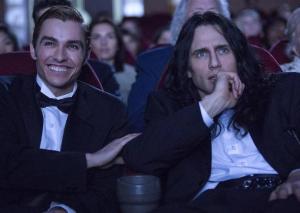 with him. James and Seth debuted
 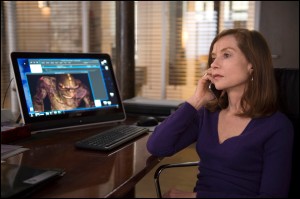 mother. She has exes, lovers, and erotic fixations. Some of them may surprise you. She reminds us that there are many ways to respond to this kind of violation, and none of them are necessarily wrong. But victimhood does not sit well with Michèle; Michèle plots revenge. Michèle’s complexity is a welcome layer to this psychological thriller, and it’s superbly executed by Isabelle Huppert. Huppert won the
 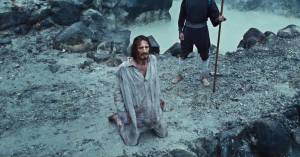 doesn’t kill me. Having read the book, I knew exactly what we were in for with the movie, and I warned anyone who would listen, but that doesn’t mean I didn’t want to see it. It’s Scorsese. I mean, that alone is enough. But I also know that Martin Scorsese has something to say about spirituality, and if he’s gotten away from it with his last few movies, this one is a major reinvigoration of his theme.
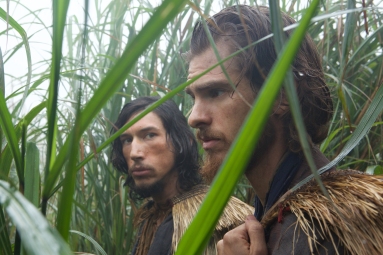 that Rodrigues faces, or the hell that he’s in now. Even though the movie is relentlessly brutal, you’ll still be wowed by the images, the beauty lurking within the swamp.
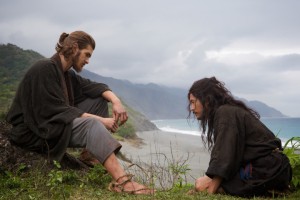 This Asshole Atheist really noticed the distinction between religion and faith – religion being something a government can choose to eradicate; faith, however, is much more difficult. Silence is really a question of belief, not just what you believe, but how strongly you believe it, how strongly you think others should believe it, how far you’re willing to go to impose those beliefs, how much pain you can endure before you abandon those beliefs. And if god himself can hide in silence, can belief dwell there also?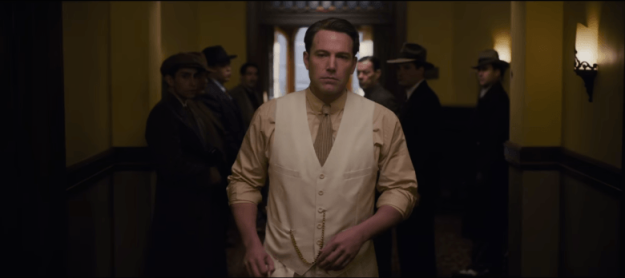
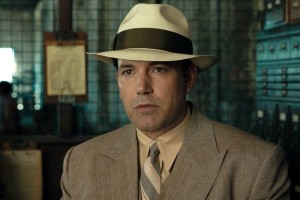 e if nothing else the role he has created for himself is a terrible one. The lead character is remarkably unsympathetic and no amount of teary-eyed inner conflict or monotone monologuing in voiceover form (because this character doesn’t like to express feelings aloud) can change that. On top of that, his hats make him look ridiculous, and there are so many hats.
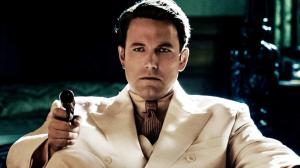 aniacs shooting at each other that leave the viewer unclear as to who’s on whose side (spoiler alert: the guys doing the killing are the ones on Affleck’s character’s side). Affleck also completely wastes Brendan Gleeson, Zoe Saldana, Chris Cooper, Elle Fanning, and most egregiously Agent Coulson (though Jay took Chris Messina’s bad teeth and pot belly hardest but at least Messina got a decent amount of screen time).
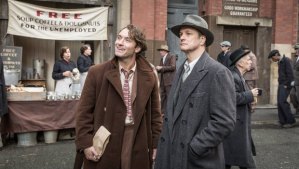 time, counting F. Scott Fitzgerald (Guy Pearce) and Ernest Hemingway (Dominic West) among his authors. They’re all jealous of each other, of course, all big egos with weighty demands on Max’s time, and skill. This movie will make you feel as though editors do not get paid nearly enough. It might also question just who is the Genius referred to in the title – is it the brilliant writer, or is the man editing his writing so that it may appear brilliant to others? Certainly Max is good at spotting talent, but also at shaping it.
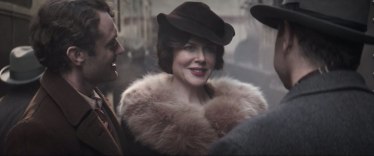 pull necessary to hone a manuscript into a masterpiece. Max Perkins has an excellent track record but still prefers to hide behind an editor’s anonymity, still grapples with the fear of having “deformed” someone’s work.
 friend Maggio (Frank Sinatra) keeps running into trouble with a stockade sergeant (Ernest Borgnine) with a mean streak. And Prew himself is falling in love with Lorene (Donna Reed). It might seem like normal every day stuff, except you and I know what’s coming: Pearl Harbor. It’s awful to know what’s around the corner for them, how petty all of these problems will seem soon enough, if any of them are left to still have them.
 performances from his cast mates. Burt Lancaster was so nervous to act alongside him he’s visibly shaking in their first scene together. Sinatra was just grateful for the part. You may know that Mario Puzo fictionalized his movie career in The Godfather; a certain studio exec is convinced to hire him after finding his prized horse’s head in his bed. In real life, it was a lot less dramatic: Sinatra was married to Ava Gardner at the time, and she happened to have some pull with Columbia. Or at least that’s the version everyone agrees to.
 lots of naughty projectionists would cut out a slice to keep as a souvenir. Censors demanded that Kerr’s swimsuit be skirted so as not to be too “provocative.” And that wasn’t the only modification made. In the book, the captain’s wife gets gonorrhea from her philandering husband, but that part is conveniently edited out. And in the credits, Donna Reed is credited as a “social club employee” which is 1950s code for hooker. And the military had their own standards to contend with: you couldn’t portray military sloppiness, hypocrisy, brutality…or homosexuality. Not to worry. The gay stuff was also left out, along with all the other juicy bits that led to the novel being called From Here to Obscenity by some. But that scene. The scene on the beach. Makes me want to recreate it when we’re in Oahu today (it was in Halona Cove), but only if I can find a modest skirted swimsuit.
 ASSHOLES WATCHING MOVIES