Tag Archives: movies based on books

The Late Bloomer

A sex addiction therapist endures a severe kick in the nuts that leads to a hospital visit, that leads to the discovery of a brain tumor. That’s the good news. The brain tumor is benign, and has been leaning heavily on his pituitary gland this whole time, which means 30 year old Peter (Johnny Simmons) has NEVER gone through puberty. Buckle up, folks: he’s about to!

And he’s pleased as punch. He’ll finally get to have sex! Finally know the joys of erections and masturbation and third base! The opening title card warns us we’re in for “some ridiculously fucked up shit” and they’re not wrong. They took a “true story”, made it unbelievable and yet generically raunchy, and stripped it of any humour. The situation is bursting with potential but director Kevin Pollack decided nah, let’s just be basic and boring about it. And be sure to completely waste the supporting cast while we’re at it.

It feels like the stuff that Judd Apatow left on the cutting room floor after editing The 40 untitled.pngYear Old Virgin, and the fact that Jane Lynch is in both is just a painful reminder that this subject actually CAN be funny, should be funny, and in fact probably took a lot of effort to screw up this badly. How much effort, you ask? Well, by my count: there are 2 credited with “story by” and FIVE credited with screenwriting. Five! All dudes, naturally. Dudes who like visual jokes about morning wood and sneaky semen. And that doesn’t even count the guy who wrote the book, you know, the REAL guy that this actually happened to.

His name is Ken Baker. The real dude spent one season as pro hockey’s “oldest rookie” and is a “journalist” who has worked for People magazine and the E! network. He is not and never has been a sex therapist, which is an unnecessary layer added by lazy writers who thought it would be funny and in fact is just plain stupid. How someone smart enough to earn a PhD would refuse to see a doctor about his condition but deem it a good idea to give advice to people about an act of intimacy he’s never done himself and is in fact biologically incapable of completing is just unacceptable. Do not insult me with such stupidity.

If you surf by this one on Netflix, don’t be fooled by the recognizable cast. It is not worthy of your time. It will fail to incite a single laugh. It should be flushed down the toilet like a used condom.

The Prestige

prestigeChristopher Nolan’s bad movies are better than most people’s good ones.  I count three of them (Memento, Inception and The Dark Knight) among my all-time favourites, and I have enjoyed everything else of his that I’ve seen (Batman Begins, The Dark Knight Rises, and Interstellar).  Noticeably absent from that list, until this week, was The Prestige, which usually appears near the top of critics’ “best of Nolan” lists.  So when The Prestige popped up on Netflix’s “recently added” row, I dove in immediately.

The Prestige is a tale of the ever-escalating war between two rival magicians, played by Christian Bale and Hugh Jackman.  Bale is the purer magician while Jackman is the larger commercial success.  As the stakes get ratcheted up, Bale is arrested for Jackman’s murder.  But in a battle of illusionists, can we really believe what we see?

Structurally, The Prestige is as complex as anything that Nolan has thrown at us.  This movie shouldn’t work as well as it does.  There are flashbacks within flashbacks but I knew at all times where/when a scene fit in with the rest of the film.  We’ve got enough examples by now of Nolan’s capabilities, but The Prestige is yet another display of his narrative mastery.  Basing the film on the three parts of a magic trick works very well, keeping the viewer on edge until the big reveal.

The reveal itself, though, left me disappointed.  It was a huge stretch that went completely against the movie’s prior suggestions that the secret of magic is setting up the trick and selling it to the audience.   I found the reveal of both Bale and Jackman’s methods problematic, in different ways, but Jackman’s big surprise was what really took the air out of the film for me.

Because of that, on my list The Prestige gets relegated to the lower tier of Nolan films, somewhere in Interstellar territory.   Make no mistake, though, that’s due to Nolan having made so many great films as opposed to The Prestige being a bad movie.  It’s still pretty damn good!

The Adderall Diaries

If you dial your memory reel back a few years, you may remember the controversy surrounding James Frey’s “autobiography” A Million Little Pieces. Oprah, having endorsed the book, came down particularly hard on him for fabricating many of the juiciest bits of the book.

Stephen Elliott is a lesser-known memoirist with a similar fate: one night at a reading for his book in which he details the death of his mother, his father’s abuse, the group homes and addictions, living on the streets, and ultimately his father’s death as well, his father stands up from the crowd and declares himself alive.

adderall-diariesHm. Okay. Elliott’s publisher and agent are not terribly impressed. Book deals crumble. His integrity’s in shambles. And so he falls down a deep dark hole called writer’s block.

Before we move on, let me just state: all of this may or may not be true of the real Stephen Elliott. Elliott’s a real guy who sold the rights to The Adderall Diaries to James Franco for a good heap of money, but has since said that the material is so altered it seems strange, and dishonest, that they still call the character by his name.

Elliott’s father did heckle him at a book reading though. And he left a nasty trail of Amazon reviews to Elliott’s books. Their relationship is certainly strained, and now matter how you slice the cake, the dude has been through some shit. Writing has helped him cope, acting as a release valve for all the hurt and anger he carries around.

When faced with a bad case of writer’s block, Elliott dealt with it by a) taking Adderall, a drug for people with ADHD and b) attending the murder trial of Hans Reiser, who used a “nerd defense” to no effect and was convicted of murdering his wife. The book is subtitled A Memoir of Moods, Masochism, and Murder, and all three are are intertwined messily in the film.

Lots of famous faces lined up to take part in The Adderall Diaries: Franco as Elliott of course;adderall-diaries-1 Amber Heard as his girlfriend; Cynthia Nixon as his agent; Ed Harris as his father; Christian Slater as the accused murderer. Unfortunately, the “story”, such as it were, is a jumbled mess, and you can’t make much sense of the conflicting plot lines. And James Franco just wants to swagger through it all, convinced it’s his chance to play a badass in a leather jacket when actually he’s supposed to be playing a man stunted with pain.

The film, Pamela Romanowsky’s directorial debut, neglects to make much of an impact, though it does have some interesting stuff to say about trauma’s effect on memory. But on true crime, family, forgiveness, and addiction it widely misses the mark. It’s too bad. I think there was a better film in there somewhere, between the daddy issues and the flouncy flashbacks. But it just feels ironic that a book about “retrieving memories and reordering information” gets a movie treatment that illustrates how slippery truth can be by obscuring the most basic of facts.

You can watch The Adderall Diaries on Netflix, and judge for yourself, but be warned: the only thing more subjective than truth is art.

The Girl on the Train

I felt such an affinity for Rachel, the main character in The Girl on a Train, that it was easy for me to love Paula Hawkins’ novel. Partly, it’s because I’ve woken up with a hangover more times than I’d care to admit with an instinct to immediately check my email, text, and call history to see if I need to apologizing to anyone. But, just as important, I love people watching and especially enjoy speculating about the lives of strangers.

So Rachel (played in the film by Emily Blunt) wakes up from a night of drinking to find that her favourite stranger to watch (Haley Bennett) has gone missing and she may have seen something that could help find her. If only she can remember what it is. As the story unfolds, her behavior is frequently frustrating and not always easy to empathize with but I’d be lying if I said that she didn’t feel completely real to me. A great protagonist is really all you need to make even the simplest murder mystery seem gripping and, told from Rachel’s point of view, I found this one nearly impossible to put down.

The best film adaptations are able to identify what worked best from their source material and build a story around those elements that suits the medium. Because the film version of The Girl on the Train is a shitty adaptation, director Tate Taylor and screenwriter Erin Cressida Wilson try to pack in as many of the events of the book as possible without seeming to give any thought to how well the structure would play on screen. Neither seem interested in Rachel’s state of mind.

These may seem like the typical “the book was better” complaints but I can’t imagine the movie would impress anyone who hasn’t read the book either. Considering the popularity of the novel, the roll that Emily Blunt has been on lately, and the fact that just two movies ago Tate Taylor directed a Best Picture nominee (The Help), The Girl on the Train feels surprisingly TV-movieish. For a book that was marketed as an edge-of-your-seat thriller, its film is curiously boring, talky, and whiny.

The good news, as you may have heard, is that Blunt is terrific. She makes Rachel a lot easier to sympathize with even when her actions risk making her unlikeable. She plays the various levels of drunkenness quite well. But her efforts are wasted in a boring, lazily structured movie.

Middle School: The Worst Years of My Life

middleschool

This movie needed to be written by someone who got past the first lecture at the M. Night Shyamalan school of plot twists.   Or better yet, someone who didn’t make 12-year-olds talk like pretentious idiots and make their principal respond to the kids using flower child slang.

Actually, the principal was mildly entertaining, if I’m being honest, even though his character was just one in a long line of tired cliches this movie threw at me.  Clueless mother and her secretly kid-hating boyfriend, a school bully who’s a dick for no reason but will come around by the end, and a bunch of random poppy songs that the kids probably stopped listening to six months ago, with the Strumbellas’ contribution agonizingly censored to sing about “dreams” and “hearts” instead of “guns”.

This movie has absolutely nothing to offer to adults and even the hordes of tween terrors in attendance seemed restless during my screening.  The first few fart jokes got a reaction, but after a while the kids stopped giggling at the rude sounds that everything seemed to make, including school bells as well as a cartoon gorilla landing on a zombie driving a motorcycle.  As well, the big twist confused the kids both in front of and behind me, probably because it was contrived, unnecessary and rendered the movie even more nonsensical, and I would not have thought that to be possible until it happened.

Visually, there are interesting animated bits and some creative and colourful pranks that function as diversions, as long as you don’t think about any of it too much.  Not only are the pranks impossibly large to have been pulled off overnight, how do these students gain entry into their school after hours, spend entire nights inside undetected, and pull these all-nighters for weeks on end without dozing off in class once?

It would be generous to call Middle School a lazy and half-baked adaption of a popular book series.  Incidentally, I had to drop in the “half-baked” reference because the film painstakingly identifies Lauren Graham, the clueless mom, as a sous-chef, and then I swear she was making beef-a-roni in a food processor at 6 a.m., which must qualify as professional misconduct.   And that’s not a one-off thing.  The Middle School experience is 90 minutes of incomplete thoughts and unanswered questions.

Middle School: The Worst Years of My Life gets an F and a month’s worth of detention, and even that is too lenient.


TIFF: Their Finest

London, 1940: most have gone to war but a few are left behind to entertain the people in this bleak time. The department of war is demanding that happy-ending war movies be churned out for morale.

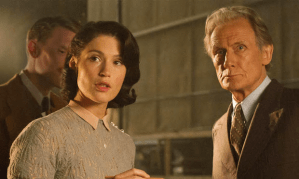
At any rate, Lone Scherfig’s Their Finest was indeed a boost to my morale. Of course I love Bill Nighy, and he’s at his Nighest, with his signature gestures and snorts. He plays a very vain actor who can’t quite believe he’s perhaps aged past leading-man status. Luckily a diplomatic new writer, theirfinestCatrin (Gemma Arterton) hired to write “slop” (ie, the female dialogue) appeases him by enlarging the role of the drunk uncle just for him. Convincing her boss Tom (Sam Claflin) to let her do this is as infuriating and degrading as you’d imagine – until he starts to fall in love with her, of course.
Keep in mind that though they’re writing about the Miracle of Dunkirk, the war is still raging, and Catrin must decide whether to risk losing the thread of her story every time the air raid sirens go off. The cramped office remains nearly a sanctuary but outside the city is badly bruised.

The war was a time when, with young men absent, older gentlemen and women stepped up to get the work done. Catrin is constantly reminded, however, that her employment status won’t hold up when the boys return. untitledShe mustn’t get too attached to feeling useful or creative. The war makes everything tenuous.

But despite this sounding rather dire, it is very much a comedy, and a bit of a love letter to film making. The laughs are plentiful, robust. The stars are endlessly charming. I haven’t much cared for Sam Claflin and don’t have much of an opinion on Gemma Arterton, but both are excellent here. Nighy of course, is a prize scene-stealer, and he deftly makes away with every one he’s in. Sometimes the war is seen through rose-tinted glasses (a nostalgic effect?) but when the war does assert itself, it leaves a crater. This one’s not to be missed.

TIFF: Lion

I was a little caught off guard by audience reaction to this movie at TIFF. I’d read the book and liked it well enough but the movie didn’t strike me as particularly must-see. Boots on the ground at TIFF though had me hearing something different. In fact, had me hearing that it was giving La La Land a run for its money as People’s Choice. People’s Choice! So I did what any sane woman would do: I gave up my tickets to I Am Not Your Negro and secured tickets to a last-minute additional screening of Lion.

mv5bndjimtnhmgmtntewzs00zdazlthhmdutngm4nzfhnjzhy2rjxkeyxkfqcgdeqxvymtexndq2mti__v1_Lion tells the true story of a 5 year old Indian boy named Saroo. Separated from his brother one night, he falls asleep on a train and wakes up miles away from his home, his family, from people who speak his language. He survives on his own for weeks before being thrown into an orphanage and then shipped down to an Australian family who adopt him.

Once grown, Saroo finds himself thinking about the mother he disappeared from, who might very well still be looking for him. So he uses the only tool he has available to him: Google Earth. With little information to go on, he scans the internet every night for signs of his childhood home. It’s an impossible mv5bmdu4zgi4yjgtywzlns00nte2ltg1mmutytk2njflnzhjotrjxkeyxkfqcgdeqxvymtexndq2mti__v1_task but Saroo is miraculously lucky. Off he goes to India, to see if he can locate any family near the place he once called home.

Sunny Pawar will quickly win your heart as 5 year old Saroo. His big, adorable eyes immediately indicate his innocence and vulnerability. His half of the movie is gripping and heart-wrenching because Pawar easily elicits our sympathy. While a lost child living on the streets would surely be attended to here, in India it is unfortunately all too common a sight. His pleading is ineffectual. I felt ready to shout at the movie screen myself. And such a tiny thing navigating the streets of Calcutta – it’s an indelible image that speaks directly to your heart.

When Saroo is sent to his new Mummy (Nicole Kidman) in Australia, it becomes a new movie: a fish out of water experience for a little boy who probably didn’t even know that such a country existed. But for all intents and purposes, Saroo grows up Australian. His brown skin gives him away, but he feels a fraud among other immigrants, his culture and background a mystery to him. Dev Patel plays grown-up Saroo, a man searching the Internet not just for his hometown but really also for himself. He doesn’t want to hurt his adoptive mother though, so he pulls away to protect her.

Unfortunately, Google Earth isn’t all that interesting or cinematic. Garth Davis chose to stick with Saroo’s real-life methods but it’s not thrilling or sexy on mv5bndu0mgqxndmtndc5zc00otm4lwe0zmqtndjmzdiwmju1zjezxkeyxkfqcgdeqxvymtexndq2mti__v1_the screen. It literally is just a guy staring a screen night after night for weeks, months, years. He’s moody and emotional in between, throwing his relationship (with Rooney Mara, in an underwritten role) onto the rocks. Nicole Kidman gives an admittedly strong and stirring performance as his mother and helps bridge the gap, but there’s a marked lag until Patel goes back to India.

The Indian scenes are triumphant, but they also raise a lot of questions. Where was Saroo better off? What happens to kids adopted outside their culture? Which one is his real home, his real mother?

I worried that Lion was garnering attention at TIFF because the audience, who skews older, might have felt good about watching something multi-cultural while still safely ensconced in a white lady’s movie. The film, however, won me over. Maybe it tries a little hard to be upbeat, but a feel-good ending is hardly a negative. Davis acquits himself well in his first directorial feature. The chapters are perhaps a bit uneven but the victory is not.


On a TIFF sidebar: While La La Land did end up receiving the People’s Choice award (Lion was the runner-up), the tickets I gave up, I Am Not Your Negro, would have had me watching the People’s Choice documentary winner. Ah well. You win some, you lose some. I can’t regret much since I was watching a great movie either way.

TIFF: The Journey Is The Destination

This is supposed to be the inspiring biopic of photojournalist/artist/activist Dan Eldon. But something is lost in the translation between his real-life journals that inform the story, and its appearance on the big screen. Namely, the inspiring part.

Supposedly Dan Eldon was an activist from a young age, raising money for various good causes. British-born but raised in Nairobi, he had a silver-spoon life, having the best in x9kbt0q2zcmaybswkkqklezuxi3education, the ability to visit over 40 countries while still in his teens, and loads of opportunity. He sprinkled his good fortune with charitable acts for others. But in the movie we don’t see a lot of Dan Eldon, activist. Rather we see Dan Eldon, purveyor of white privilege, with a side of white saviour to further sour the milk.

The film is brought alive under Bronwen Hughes’s able direction. She attempts to turn the film into a literal scrap book of sorts, travel-logging his adventures to honour creative source material, though this conceit is used sporadically. And it’s also not a great fit for the film, tonally. By the movie’s end, The Journey Is The Destination will have brought you to some very dark places. Cutesie scribbles and doodle a la Diary of a Wimpy Kid don’t really belong somewhere that ultimately ends up more Hotel Rwanda.

I want to believe in Dan Eldon, good person. It’s just that this movie keeps showing me Dan Eldon, man of many advantages and almost no self-awareness. The cast is strong: Ben Schnetzer is charming as Eldon, plus the likes of Maria Bello and Kelly Macdonald in particular are welcome additions, but they can’t do much with material that’s inconsistent and contradictory. In fact, in researching this guy, I’ve learned that most of what we see in the movie is just plain wrong. And the edits they’ve made, perhaps to make him seem less flighty, more substantial, also make him less sympathetic.

If you’re truly interested in the man, reading his writings is likely the better bet.

TIFF: Arrival

Arrival is exactly the kind of sci-fi film I’ve been waiting for all my life.

There are no guns, no star wars, no green men, no space cowboys, no mutually-assured destruction. The aliens touch down, and we’re not sure what their intentions are. Do we fire lasers at them? No. We study them. We gather together top academics, and we attempt to learn, peacefully (with the army on speed dial, just in case).

Amy Adams plays Dr. Louise Banks. Of all the people on Earth talking to arrival-movie-1-600x399aliens, she’s the one who listens well enough to actually crack the code. And it’s a hell of a code, unlike anything our puny human brains can really comprehend. This deep gulf of understanding makes plenty of people nervous – people with their fingers hovering over big red buttons. Annihilation-type buttons. Dr. Banks puts her own life at risk to keep things from escalating to an out-and-out global (universal? galaxal?) war.

Amy Adams is as good at playing Dr. Banks as Dr. Banks is at solving language problems. Both are beautiful to watch. Director Denis Villeneuve worked doggedly to make sure all the science is sound, but it’s also almost magical. It makes me want to call it the movie Interstellar aspired to be: rooted in science, hinging on human connection.

Arrival is the most intimate of sci-fi films, the aliens (if that’s what they are) almost incidental to humanity’s expanding comprehension of time and memory. It’s like poetry. And it doesn’t hurt one bit that visually, it’s slick as hell. Bradford Young’s cinematography is nearly stark, but it is absolutely arrival2arresting. It works in synchronicity with a hauntingly beautiful score by Jóhann Jóhannsson. Twinned together they remind you that though the plot feels startlingly realistic for a sci-fi film, there’s something otherworldly at play. Young’s work is atmospheric, Jóhannsson’s is pulsating.

It’s refreshing to have an alien encounter that relies on communication rather than violence, and to have a woman stepping in as Hero(ine) feels only natural. In fact, the only part of the movie that didn’t gel for me is a 2-minute montage that serves to pilot the plot further ahead and is narrated by Ian (Jeremy Renner). The rest of the story is told completely through the eyes of Louise, so to have her voice suspended during these few scenes is jarring and emotionally blunting.

Adams, though, is faultless; she turns out a character that is mature and complex, and I won’t be one bit surprised to see her name alongside Natalie Portman’s, and likely Emma Stone’s, come Oscar time.

TIFF: American Pastoral

pastoralbar640Ewan McGregor makes his directorial debut with American Pastoral, an adaption of Philip Roth’s novel. As always, I haven’t read the book and Jay has. She reports the movie to be quite faithful to the book, even pared down to have a two hour run-time.

I feel like the book must have a black cover, because American Pastoral is dark from start to finish. It is methodical in chronicling a family’s unravelling and is as far from idyllic as you can get.

With its dialogue-heavy scenes divided by contextual stock footage clips, American Pastoral felt more like a play than 21st century cinema. It is richly shot but largely static. The style mostly fit but at times the transitions were jarring. When they worked the transitions felt like covers of Life magazine, reenacted. Except as far as I know, Life magazine never featured a pipe bomb explosion at a small-town post office. Perhaps my dad’s magazine collection is incomplete.

In the Q&A session following the screening, McGregor described his approach to directing as an attempt to give life to the movie he saw in his head when he read the script. He imagined some nice shots and paid the price to get them (literally in the case of some costly train platform scenes). His foray into directing is a workmanlike effort but not a distinguishing one.

As an exploration of the destructive power of children, American Pastoral succeeds. As entertainment? Not so much, not for me.

By the closing credits I felt sad and drained, which I have no doubt is exactly how McGregor and Roth would have wanted me to leave the theatre. But because nothing stuck with me other than that empty feeling, American Pastoral is not a movie I can recommend.  If you enjoyed the book it’s likely worth a shot though, and in that case I hope you can connect with it in all the ways that I didn’t.