
Two suspiciously attractive Seattleites are expecting a baby boy and they are happy: yay! Will flies to Chicago to ask for his in-law’s blessing in marriage, despite the fact that he’s, ah, already stormed the beach. An awkward conversation about money ensues and he more or less gets asked to leave.
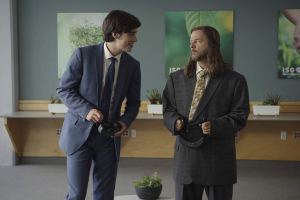
So, not a success. “Luckily” he gets a second chance. An “event” happened “out west”. Something happened, something catastrophic. He’s on the phone with Samantha when it goes down, but they’re cut off, and she’s scared. The airport shuts down. The roads are immediately impassable. So that leaves Will (Theo James) to traverse America mid- catastrophe (mid-apocalypse?) with his disapproving, openly hostile, not-yet-father-in-law, Tom (Forest Whitaker). Who would have thought that the end of the world would only be the second worst thing that happens to Will today?
[Acting Master Class 101: If you have a wound, you immediately stick your fingers in it so that you can wince and prove to us how painful it is.]
The road to Seattle is paved with hell. Okay, that doesn’t make a lot of sense, but you know, the going is rough. It’s like: murder, murder, murder eVeRy day. Brain-flecked hair, coughing blood, impossible storms, raging fires, fucking over your fellow man, and a vague end of world scenario.
How It Ends sometimes feels like it may never end. It has a pretty good hook but then it meanders in a way that you wouldn’t think possible what with all the mayhem. It almost feels like the director loaded his actors in a car and headed out across Manitoba (standing in for rural Ohio since 1905!) (that was a random date, please don’t pay me any attention) with no destination or conclusion in mind. Which is maybe not the best way to make a movie. But David M. Rosenthal makes sure there’s something menacing and apocalyptic in nearly every scene, and dude knows a thing or two about disaster porn. It should be noted that Sean, an avowed enthusiast of ridiculous premises, said at one point “They’ve overplayed their hand here.” And yeah, the writer is not subtle. The whole thing’s pretty obvious. But did I hate it? No. Not at first. But then it started to end. And the ending just boggles the mind. So that’s my case. I’ll let you, the jury, decide. The prosecution rests.

 drive them further apart? Oh who am I kidding – there’s isn’t a single inch of this movie you don’t see coming, but somehow I don’t mind the cornball cutesie comedy of it all because Grammer and Bell have such a sweet chemistry between them. There’s pretty much nothing of Bell’s that I won’t give a go, she’s so luminous and honest and I just find her enjoyable and I’m pretty sure that would be true even if she was changing a tire, or the laundry, or her mind for the 15th time as we stand outside the movie theatre in the rain.
 His best friend Larry’s life is not, but they’re goddamn 22 years old, and I can’t even imagine being that young and worrying that my life wasn’t totally together yet. And anyway, when you’re measuring yourself against the fathers available for comparison, you win every time. Ben’s dad, David Spade, is a Boston red neck with no money, no plan, no prospects. Larry’s dad (Nat Faxon) is so spineless he can’t even stand up to his 8 year old son, let alone his wife.
 beautiful model. So he seeks comfort in his precious laws of thermodynamics to reassure himself that love is just another quantifiable thing, an equation he can puzzle out and make sense of. But the more that real life seeps in, the harder he has to spin things to keep the laws working for him.
 doesn’t have a unique voice or anything that super sets it apart. It’s comfort food: the kind of mac and cheese you might bring to a potluck. Not gourmet. Not lobster mac. Not truffle mac. It probably doesn’t even have gouda. But it’s warm and creamy and just gooey enough to convince you you want it. Rom-coms are predicable almost by definition. We know they’re going to get together; the “fun” is in how they get together.
 great choice. He can pull off the sadness and the savage humour, playing it straight, breaking the fourth wall, talking directly to us, talking to himself. Doug Kenney was the Harvard editor of the Lampoon, and he had such an epically good time just fucking around with his good buddy Henry (Domhnall Gleeson) he decided to just keep it going and took their little humour magazine national. And as if the phenomenal success of the National Lampoon wasn’t enough, they expanded into radio shows, during which they enlisted the talents of Chevy Chase, Harold Ramis, Christopher Guest, and Gilda Radner. And then they started writing movies like Animal House and Caddyshack. And while some might feel content with having their dreams come true and writing the most successful comedy movie EVER, Kenney never can be. He tries to fill the hole in his heart by shooting stuff up his nose. It’s a circuitous route that doesn’t work very well, but not for lack of trying.
 inserts herself into cramped dynamics like she’s determined to put the Wicked back into Step Mother. Both throw out the red carpet when favoured son Matthew (Ben Stiller) makes a reluctant appearance. Harold has fostered a competitive streak between his children by different mothers but they otherwise aren’t close. So when their father’s life and career necessitate them pulling together, it’s a little awkward. Actually, it’s extremely awkward and kind of heart breaking. Because they aren’t bad people, they’ve just been starved of their father’s love and have no idea how to act like a family now that there’s no real chance that things will ever be different.
 Director Eli Craig clearly has some fondness for the genre, and little odes to other possessed-kid movies pop up from time to time. Another thing that pops up is Craig’s own mother, Sally Field, as a social worker who thinks Gary just isn’t trying hard enough. It’s a small but terrific role for her – possibly the kind of role only her son could ask her to play.
 ASSHOLES WATCHING MOVIES