
Jin is summoned from Korea to Columbus, Ohio by Eleanor when his estranged father collapses. Jin impatiently waits out his father’s coma, and seems to prefer death over recovery, for selfish reasons. He can’t bear to to sit by his father’s hospital bed, and he’s not going to speak to him now since the two haven’t spoken in a year. So he wanders about, trying to appreciate what his father loved about Columbus’s unique architecture.
This is how Jin (John Cho) meets Casey (Haley Lu Richardson), a young woman stayed in Columbus to take care of her addict mother rather than pursuing her own dreams in college and beyond.
The cool thing about Columbus is its cinematography, which is surprisingly beautiful in such a small, independent film. It frames the architecture well – except scratch that, I’m embarrassed by this underwhelming sentiment. Because the truth is, the way the buildings are framed and posed and shown and hidden – it made me feel 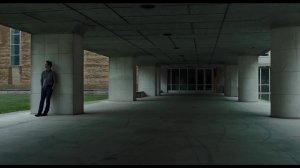 things about architecture. The photography is just as kind to its human characters, but the way it treats the artistry of the buildings turns them into characters as well, characters that reflect and mirror or juxtapose and contrast. It’s clear that writer-director Kogonada has put a lot of thought and time and research into his baby.
Columbus isn’t an ambition story, it’s just two people, fairly dissimilar, who cross paths as they kill time in different ways. They’re both waiting on parents, and probably shouldn’t be. They’re both learning what that means and who it makes them as people and what effect they’ll allow the past to have on their futures. It’s mostly quiet and introspective, but the composition and structure and the precision of the visuals come together – not to overcome the silence, but to act in synchronicity. Kogonada finds serenity in stasis but that doesn’t mean his film doesn’t pack an emotional punch. It’s just a minimalist canvas upon which you can project a lot of your own feelings, and come away feeling just a bit refreshed, and just a tiny bit hopeful.
 successful than you, and you might actually find her vulnerable enough to prey on her heartbreak and win. For a while. But since you’re still nerdy old you she’ll eventually wise up and leave your ass, potentially even for the ex who doesn’t deserve her, and you’ll have to content yourself with second place. If second place always looked like Blake Lively you might thank your lucky stars, but Woody Allen is an idiot, so here we are.
 impression, right down to the self-conscious body language and flighty hand gestures. Bobby moves to Hollywood, trying to escape the family business. He goes to his uncle Phil (Steve Carrell), an important guy at a big movie studio, who barely makes time for him, and pawns him off on his secretary, Vonnie (Kristen Stewart). Eisenberg and Stewart have a twitchy chemistry that works well, but it does mean you’ll have to watch the two most high-strung performances in Hollywood today. Simultaneously. In a Woody Allen movie.
 immediately suspicious of his impractical, ego-driven work. Drew, however, is flattered to be his muse and determined to be a “good client.” But as the two work more and more closely together building this dream home (whose dream is it?), Colin starts to be the third wheel in an awkward little triangle. And he’s footing the bill!
 sincere than scathing, but no less amusing for its kindness. Christopher Guest’s body of work is so aligned with what I find funny that Mascots was my number 1 pick for TIFF, ahead of
  with total obsessiveness, and he shows us the incredible underbelly. It’s fascinating. Like a car wreck or a wonky boob job, you can’t help but stare.
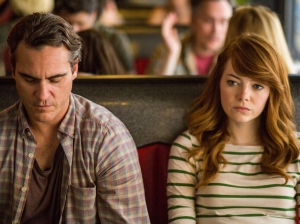 promising student (Emma Stone) engages him mentally, but he’s still, shall we say, unresponsive, until he starts plotting a hypothetical murder.
 endeavour”, or is that just the typical justification of an unfulfilled philosophy professor?
 ASSHOLES WATCHING MOVIES