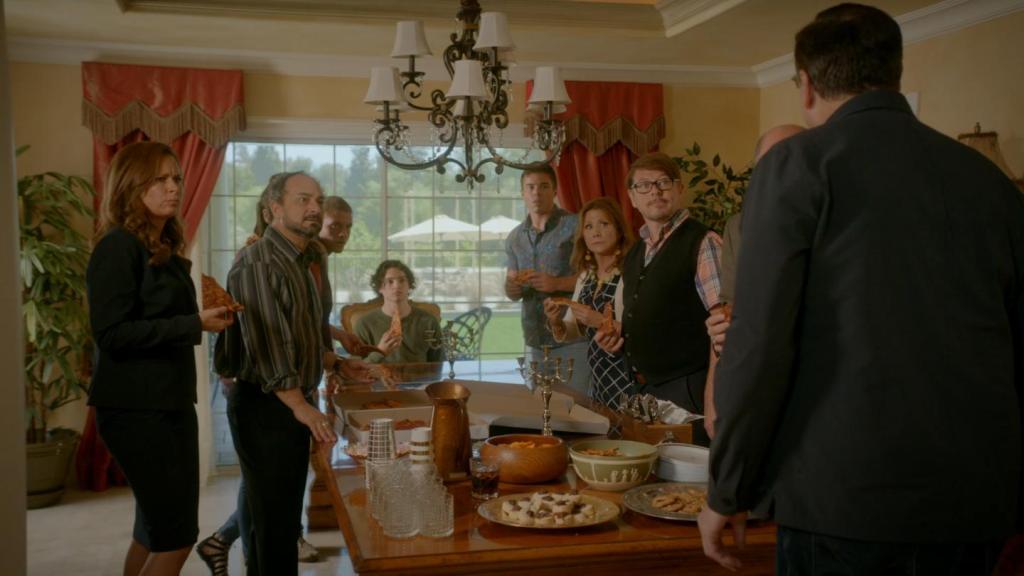
This intervention is classy as fuck. I mean, how often do you see hors d’oeuvres at these things?
Ed (Bob Saget) smelled crystal meth through his teenage son’s door and panicked. He has assembled what can only be described as a rag-tag game of misfits to confront his son and force him into rehab…IF he has a problem, which Ed is still loathe to admit. Aunt Clarice (Chery Oteri) and Uncle Mitch (Dave Foley) haven’t seen him since he was a baby. Ed’s BBF, a doctor also named Ed (Rob Corddry) will lead the way despite the fact that he’s an OB-GYN. Jeanette (Mary Lynn Rajskub) is running the whole thing, though she prefers to emphasize her girlfriend part of her credentials rather than assistant. Benjamin’s sister Amber brings a date, and a spare, and is mostly there to antagonize her father. It is unclear who put together the guest list, but the guest list was their first mistake. It was not their last.
Long story short: these people may be bigger fuckups than the kid they’re intervening, and without any moral superiority, it’s hard to sustain authority. Ya know?
Bob Saget is not a good enough actor to be allowed to direct himself (and yet here we are). I’m not saying he’s the worst part of this but…he is. He totally is. And there are a LOT of broken parts. Danny Tanner would have done a better job and – dare I say it – he would have been less corny. Saget might have one of the most recognizable faces on the shoddiest piece of work: total amateur hour. How was Full House his prime? How on earth do you go downhill from America’s Funniest Home Videos? Benjamin styles itself as a dark comedy but you know what’s problematic about that? I didn’t hear anyone laughing.
The (true) story begins when three white young strangers become friends when they meet each other backpacking in South America. Yossi (Daniel Radcliffe) shames Kevin (Alex Russell) and Marcus (Joel Jackson) into ditching their “touristy” plans and joining him on a jungle trek to find a lost tribe of Indians in the Bolivian wilderness led by guide/bushman Karl (Thomas Kretschmann).
Turns out, the jungle is a hard place, guys. But with testosterone and adventure pulsing in their veins, none of these boys stopped to ask “Can we?” or “Should we?”, they just argued over who was going to hold the machete. The first day is grand, and they congratulate themselves on being ever so manly, panning for gold and taking lots of pictures. But then their shoes get wet and the bugs are big and their feet hurt and the whole thing turns into a whine-fest, which is when they get two very stupid ideas: 1. to split up and 2. to build a raft. Build a raft? Has building a raft ever worked in a non-cartoon?
Anyway, long story short, Yossi (Radcliffe) gets separated from the rest and ends up wandering in the Amazonian rainforest alone, for weeks. And you may have heard that the rainforest is quite large, and um, dense with trees but also with stuff that can kill you.
Jungle is a movie determined to alienate its audience with constant gross-out scenes. And it’s hard to know whether to emphasize CONSTANT or GROSS because neither can be overstated. There might be an interesting movie in here somewhere – Harry Potter loses his mind, has a nice relaxing quick sand mud bath and voluntarily gets eaten by fire ants just to stay awake. It’s based on a true story about a guy who defied death for so long in such harrowing circumstances that a two hour movie couldn’t even cover some of Yossi Ghinsberg’s highlights, such as waking up covered in leaches, finding a swarm of termites eating the patches of skin where he’d peed on himself, and sliding down a slope only to be rectally impaled on a stick. If that’s the stuff that DIDN’T make it in, just imagine what did.
I couldn’t help but think to myself that all these man vs. nature movies are the same in that they truly are MAN versus nature. Women are smart enough to never get themselves in these predicaments. Only men are stupid enough to march into a jungle completely unprepared for its realities in inadequate shoes, with the rainy season fast approaching, and an unvetted, complete stranger for a guide. In fact, I think we should rename the genre “men getting what they deserve” and they should all end with said man getting eaten by a cougar from the bottom up so he has to watch. That’s the only kind of karma I’m interested in. Until Jungle gets this re-edit, it’s really not for me.
Emma (Emily Watson) is a hard-working mom who wishes her family had more time to do fun things together. It’s been a while since they were all happy. In an effort to reconnect, Emma plans a fun Halloween night out but the party is a bust and instead of growing closer, they get cursed by a witch, who turns them into the monsters inspired by their costumes – Emma into a vampire, husband Frank (Nick Frost) into Frankenstein’s monster, daughter Fay (Jessica Brown Findlay) into a mummy and son Max (Ethan Rouse) into a little werewofie.
Being turned into monsters is an inconvenience, certainly, but not without its upside as well: little Max uses his fearsome fangs to confront his bullies. Fay tests her boyfriend’s superficiality. Frank, well Frank has so little personality he just continues to fart a lot.
This is a kids’ movie, so there’s a lesson to be learned about making time for what’s important (and secondarily, weirdly, that our abusers were perhaps abused themselves). There’s some sympathy for the Yoda-speaking witch, though less for her boss, the creepy incel Dracula (Jason Isaacs). Mostly there’s just a very confused plot, the result of a screenplay that’s just not concerned with giving good story. I think you’d get more satisfaction from the story arc in the lyrics to monster mash than you do in this movie which pays lip service to family bonding while utterly boring us to tears.
Kids might like the bat sidekicks and the hazy green fart jokes, but there’s so little in between that attentions will wander. The lips don’t even match the voice work, if you can even call it that when poor Nick Frost is relegated to grunts. I mean, he’s probably pretty expensive for grunt work. You might have gone with no-name grunts and saved yourself a pretty penny, which then could have been invested in better writing or more compelling animation. Too late now – the movie is what it is, and what it is is entirely missable.
Dr. Dylan Derringer, D.D.S. (Sorry, I couldn’t resist. Well, I didn’t try all that hard, so maybe I could have, but I didn’t) is a lonely dentist with not a whole heck of a lot going on in his life besides golf when he learns some surprising news: he has a daughter. A 25 year old daughter.
Dylan (Wendell Pierce) stalks his daughter before working up the courage to introduce himself. Stalking has such a negative connotation, but it’s only about half as creepy when you’re watching a father fall in love with his grown daughter from afar. And I mean fall in love in the father-daughter bonding way, totally above-board and asexual and all that good, appropriate, wholesome stuff. Lucy (Jurnee Smollett-Bell) is at least as surprised to learn she has a father, as she’s always believed him to be dead.
Of course, a relationship doesn’t just pop up out of nowhere. It needs to be earned, so they go about putting in the time, getting to know each other. They do the What-If dance over and over, ruing their absence in each other’s lives. His is fairly empty save for a sexy hygienist back home (Joanne Froggatt), and hers is extremely empty, her mother having died and left her to be raised in foster care. She does have a girlfriend who isn’t very nice to her, though it’s a little dicey as to how much her brand new father can really object.
But anyway: she’s also desperately in need of a kidney, it turns out. Which seems quite fortuitous for her, and less so for him, or at least for his favourite kidney. It’s kind of sticky, asking your new dad/total stranger for a vital organ. And it’s also kind of awkward watching your new friend/new daughter die, right in front of your eyes. You can shuffle your feet and avoid eye contact all you want, but reality is, she’s gasping painfully for breath, and you’ve got life-extending capability right inside your body cavity.
Family is generally (though not always) good for more than just organs, so there’s a bargaining to this relationship that’s interesting to navigate. The film is utterly predictable of course, but sweetly executed. I found this movie streaming on Netflix and you can too!
Judy Wood (Michelle Monaghan) and her young son Alex drive to California to start a new life. He’ll get to live near and have more time with his dad, and she’ll get to restart her career as an immigration lawyer. Not exactly what she had planned, but not exactly a choice, either.
She was a very successful public defender in her previous life, but it turns out you don’t need a lot of qualifications to be an immigration attorney because the clients are in no position to complain. They get what they get. Lucky for them, Judy Wood is a tireless crusader.
But she still has the capacity to be shocked by what she finds: people who have been held in custody for months or years, drugged for their own “protection,” the burden of proof on the detainees because, since they are not accused of crimes, they do not enjoy the protections afforded the common criminal. They are guilty until proven innocent – and with overworked, underpaid, unqualified lawyers, that’s a pretty dodgy concept.
Director Sean Hanish makes no bones about sainting his subject – it’s right there in the title. So basically we get to just sit back and watch this woman (based on a real-life woman) work up a steam of righteous anger all the way to making actual changes in the American law of asylum to actually save women’s lives.
Lawyers are often depicted as sleazy scumbags in Hollywood, and there are enough real-life counterparts that it’s hard to really object. But for every piece of shit in The Laundromat, there’s also a warrior in Just Mercy. Mercenary lawyers give everyone a bad name, but changes in law come from lawyers who care and are exceptional in their work. I don’t know Judy Wood but I bet she’s not actually a saint. Good news: you don’t have to be a saint to make a difference. Judy did it through hard work, compassion, and belief. And though I think this movie is needlessly formulaic and one-sided, if it serves to inspire a young woman to go to law school and believe that she too can be the change she wants to see in the system, then that’s a great thing.
Clarence Avant: he’s the brilliant mind, the visionary who brought people together in exactly the right way for decades. Never famous himself, he knew everyone. Everyone everyone. And was respected by everyone. He was the rainmaker, as they say, in TV, music, movies, business, and politics. He was a mentor to nearly anyone who’s anyone – particularly in the black community. So how is it I don’t even know his name?
Avant is the kind of man who understands that his power lies behind the scenes, but believe me, he is not without recognition. He doesn’t just have a finger in all the pies, he’s baking and selling all the pies. But he’s so humble he can’t even bear to acknowledge the nickname that grateful thousands have bestowed upon him: The Godfather. He’s so humble he never even went looking for half the jobs he ended up with, it’s just that those around him couldn’t help but be impressed by his talent and were smart enough to move Clarence where he could do the most good. Because at his core, he’s a good and decent man. Imagine having all those connections, all that respect and power and influence, and it never going to your head. Well THAT’s what makes Clarence Clarence.
Quincy Jones describes their relationship as “love at first sight” and my favourite thing about this documentary is that rather than just talking-head interviews, these two greats are in a room together, Avant hanging his head as Jones confesses their youthful indulgences. It’s glorious insight. Interviews with his family go similarly, swimmingly. It’s wonderfully intimate, engaging, and fun to watch.
He may have often been the only black man in the room, but he always belonged. And this was at the height of Jim Crow bullshit. And he puts his client, Jim Brown, in one of the first interracial love scenes (with Raquel Welch in 100 Rifles, 1969). He didn’t march in the streets but he lifted up his people.
The documentary consults many stars: Cicely Tyson, Hank Aaron, Bill Withers, Bill Clinton, David Geffen, Snoop Dogg, Lalo Schifrin, Jim Brown, Jamie Foxx, Barack Obama – but to hear them tell it, they may be the stars, but Clarence Avant is their sun.
It cost me some dignity to even click on this film. That’s the first thing you need to know. The dying teen trope is practically my nemesis and it’s truly difficult to picture a universe in which I don’t resent it just for existing. So, not exactly a neutral space for writing impartial film reviews. But Netflix doesn’t pay me to write impartial reviews. Netflix doesn’t pay me at all.
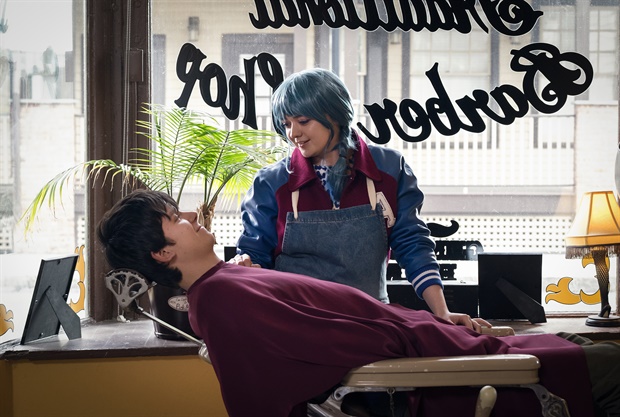
Calvin (Asa Butterfield) and Skye (Maisie Williams) meet at a cancer support group where they’re both working on bucket lists, only they don’t call them that because that movie’s already been done. Their impending deaths lend an air of urgency to these lists – Skye wants to do loads of very general sounding things, like learn a trade and leave a mark, but she imposes only one item on his list: asking out a girl.
He works as a baggage handler at an airport where he’s seriously crushing on a flight attendant named Izzy. Which doesn’t stop Sky for going full manic pixie dead girl on him. That might be a nice farewell gift to a dying teen, only Calvin’s hanging on to a secret. He’s not dying. He’s just a hypochondriac.
Does this mean I only hate this movie half as much, or twice as much, on principle?
Then Came You has some nice moments, mostly because Butterfield and Williams are more watchable than a bag of dicks. Stop with the effusive praise, you say. No shade to Butterfield or Williams – they really are a sweet pair, she not quite convincing as a free-spirited punk, he all too convincing as an awkward, gangly spazz.
The problem is with the words coming out of their mouths. Whoever writes these things clearly thinks dialogue should double as a pancake topping: pure syrup. Skye had cancer, but she died of an overdose of cheese. Which actually sounds like my new top favourite way to die. Too much cheese! But not movie cheese. Cheese cheese. Goat cheese. Old cheese. Soft cheese. All the cheese. But Sky’s fatal dose of cheese came from doing all the tragic dying girl things that tragic dying girls always do in movies. Just once I’d like to see them go kicking and screaming. I mean, how many 17 year olds can possibly be so stoic in the face of the big sleep? I guess anger and fear and bargaining aren’t as photogenic. We like our tragedy porn to be youthful, docile, and composed. Tears are fine, but no ugly crying, it goes without saying.
Then Came You is ten cents out of $1.20 (a dime a dozen – is that how that works?). If you’re adding to your weepies fix, I suppose this one deserves a spot on the list. Otherwise it’s not a super great use of your Netflix account.
Although my sisters and I were massive fans of Labyrinth when we were kids (I was later shocked to find out that David Bowie was some kind of rock star!) and can still sing every word to every song, The Dark Crystal was never on our radar. But it recently popped up on Netflix (not randomly: they’re actually making a series), so Sean and I thought we’d better give it a go.
And honestly, my life would have been better off without it. I was almost instantly confused, and I was utterly unprepared to be confounded by the complexities of a muppet movie. I told Twitter about my problem, and of the 43 people up at 2am and willing to commiserate, plenty of them simply made fun of me for how high I was (though honestly: doesn’t it seem like the kind of movie IMPROVED by weed???), but lots of them declared that this was among their favourite movies. And I was like: what the heck???
First, a synopsis as told by a lady (me. I’m the lady.) who did not understand the movie for any five second stretch at a time: Some dark crystal was damaged a long time ago and bad things have been happening ever since. For like 1000 years or something, so it’s weird they even remember the precipitating event at this point. Their little felt thumbs don’t look all that opposable but I guess they must be stellar record keepers. The Skeksis are so ugly you just know they’re the villains. They’ve been the evil overloads of their planet ever since. But our hero, Jen, has been raised by peaceful wizards. Jen is not like them though. He’s a Gelfling, the only one – or so he thought, until he meets a second, very pretty Gelfling named Kira, and she helps him on a quest to find the broken piece of the dark crystal, which would restore the universe’s balance.
Jim Henson clearly believed that being scared was a healthy emotion for kids to deal with. The Dark Crystal is a very dark fantasy, with little of Labyrinth’s signature levity. There’s a lot of peril encountered and a lot of responsibility on Jen’s shoulders, and let’s face it: there are lots of scary-looking creatures hatching evil plans. And there are also some drawn-out deaths, depressing old age shit that most kids movies stay away from.
Conceptual designer Brian Froud dedicated 5 years of his life to the look and feel of this movie, and almost all of it, from the design of the creatures to the world they inhabit, stemmed from his mind. In fact, he ended up changing a major aspect of the film when he came back to Jim Henson with designs that left him perplexed. Henson had intended to call the film The Dark Chrysalis, but Froud misheard and had developed the The Dark Crystal instead, and Henson was so enamoured with those first concept designs that they just went with it.
This movie came out in 1982, the same weekend as E.T. in fact, and went on to be the highest grossing film of the year in both France and Japan. It obviously has its share of fans, and perhaps a bit of a cult following. And I do see the incredible world-building undertaken by Jim Henson and Frank Oz; the ingenuity evident in the different sets and the creativity poured into each creature’s development. I just find that the characters in Labyrinth are friendly entry points into their universe, while the laborious time spent with both the wizards and the villainous Skeksis felt more arduous and less compelling. The Dark Crystal is a fascinating tour of the creature workshop, but I didn’t feel invested in a single character, whereas the Labyrinth gang still feels like a group of childhood friends.
Aside from the fact that I legitimately could not maintain a grasp on the story, The Dark Crystal just feels less colourful, less humourous, less memorable than its counterpart. I get that Henson wanted to just drop us into this strange land, and immerse us in it through showing rather than telling, but it made me feel alienated and cold. We hardly come to know the characters, except through what they’re doing. It just doesn’t speak to me or particularly engage me, but the one thing I’m impressed by is the lack of dumbing down for kids. Not a single fart joke in sight. Jim Henson really trusted his audience to make the leap along with him. Did you make the leap? Do you love the film? Help me understand why – leave comments down below.
The new Netflix series, The Dark Crystal: Age of Resistance, will be a prequel, focusing on a lost Gelfling civilization. It will look very familiar to fans of the original as Brian Froud is back, and he’s not alone. A nifty detail: Brain met a puppet designer on the set of The Dark Crystal named Wendy. They married and had a son, Toby, who went on to play little baby brother Toby in Labyrinth. All three of them are credited in the series. It’s got a LOT of major voice talent: Alicia Vikander, Andy Samberg, Simon Pegg, Gugu Mbatha-Raw, Keegan-Michael Key, Mark Hamill, Taron Egerton, and a lot more besides. It’ll be available on Netflix August 30.
Lisa (Regina Hall) is the hard-working manager of a tittie bar. She’s a little defensive about it; you might hear her call it a family sports bar “with curves,” but the uniforms leave little room for debate.
On this one day in particular, Lisa is dealing with a thief stuck in the vents after a robbery goes wrong, an undocumented worker in her kitchen, TVs that aren’t working minutes before a big game, an employee who’s dating a customer, a revolt over a missing pool table, and a half dozen new girls who show up for interviews and training. Plus there’s the impromptu car wash she’s organizing to raise money for another employee dealing with a DUI, which she has to hide from her boss, who’s an asshole. Oh, and her marriage is falling apart.
Despite the fact that she’s undervalued and underpaid, Lisa clearly cares about her job, and about doing her best. And she definitely cares about her girls. Usually when your employer starts calling you ‘family’ it’s because they’re about to ask you to do something for nothing. But when Lisa says it, she means it. She’s got misplaced optimism coming out the wazoo but on a day like this, even Lisa’s perky sunshine demeanor will be tried.
Support The Girls is a workplace comedy, but it tackles bigger themes than that. You just might not notice because writer-director Andrew Bujalski has such an impressively light touch. He manages to keep everything witty and bright. His biggest asset is of course Regina Hall, who never stops shining her light. Lisa is doing her best to sell the American Dream, even though it’s not her dream and she’ll never see the profits. Bujalski clearly has compassion for Lisa though Lisa never asks for any. Hall makes sure that her unending kindness is seen as strength, not weakness. These are perhaps tough to pull off amid a cacophony of T&A, but that’s why you buy them. Because integrity is not what you expect to find at your local Hooters, but that doesn’t mean it isn’t there. The smartest thing Bujalski does is that he never, ever underestimates the women in his film.
CJ (Eden Duncan-Smith) and Sebastian (Dante Chrichlow) are the smartest kids in their Bronx high school, and they’ve got the perfect experiment to win a pair of scholarships to M.I.T.: a time machine.
Any time travel movie that makes a bold reference to Back To The Future is all right in my book, but this one’s got an even twistier twist. It’s a time travel movie with a social conscience.
CJ’s brother Calvin (Astro) is one of the dozens of unarmed young black men who get murdered by the police every year. If you were a teenage girl with both a dead brother and the ability to move through time and space, wouldn’t you go back to save him?
But like their high school teacher tries to warn them, time travel has moral and ethical implications that are not just beyond their understanding, but beyond ours. Even the tiniest unintentional change can have unpredictable consequences.
Despite its science fiction premise, See You Yesterday feels very grounded thanks to its social relevance, its community in mourning, and the anger that simmers just below the surface. I really enjoyed this genre mashup, the in-your-faceness of reality interfacing with the fantasy. The world feels believable too – sure there are a surprising number of nawt nerds in one high school, but CJ and Sebastian are experimenting in grandpa’s garage, with grandma’s cheese and cracker snacks. The cast is uniformly strong, but Duncan-Smith is the inevitable stand-out.
It’s the grieving, though, that makes this film exceptional. I had no idea what I was in for when I put this movie on. I didn’t expect to be moved. I didn’t expect such powerful imagery. Plenty of sci-fi has a social agenda, but most have to be set in the dystopian future to make their point. This one is set today. Without ever saying it, the message is clear: if you’re poor, if you’re a minority, today IS your dystopia. But director Stefon Bristol leaves us with a shard of hope: the future is female. The future is black. The future may be a young kid working away in the garage next door. Please don’t shoot her.





 Despite the fact that she’s undervalued and underpaid, Lisa clearly cares about her job, and about doing her best. And she definitely cares about her girls. Usually when your employer starts calling you ‘family’ it’s because they’re about to ask you to do something for nothing. But when Lisa says it, she means it. She’s got misplaced optimism coming out the wazoo but on a day like this, even Lisa’s perky sunshine demeanor will be tried.
 implications that are not just beyond their understanding, but beyond ours. Even the tiniest unintentional change can have unpredictable consequences.
 ASSHOLES WATCHING MOVIES