
Oh, Facebook. You’re so full of junk. Tonight my colleague hustled Matt out of the  room because she wanted to share something for “just the ladies.” Turns out, it was a GIF she’d seen on Facebook: Name your vagina by using the last movie you watched. Of course, instead of being boring and truthful (and smart and scrolling by without comment), women (and men) are falling over themselves to come up with the best titles they haven’t recently, or ever, seen: No Country For Old Men, Lethal Weapon, Sausage Party. Feel free to take you best shot in the comments section. As for me, well, I couldn’t quite remember the name of the last movie I’d seen – only that it was a documentary on Netflix about Hasidic Jews. I was a little worried.
Turns out the title is quite ordinary: One Of Us. But the watching of it is quite extraordinary. I mean, I really love documentaries that open the door to a world I know little about, and this one definitely does that. The Hasidic Jewish community is insular, secretive, closed. And that’s exactly the way they want it. They believe it’s what keeps them safe. They believe it was the only way they could rebuild after the Holocaust, and maybe they have a point. But what it means today is that the community is strictly guided by “laws” written by old, male rabbis that everyone must adhere to, or be excommunicated by all the friends and family they’ve ever known. The Hasidim live as their ancient peoples lived, and you can imagine that’s not easily accomplished in 2017. Though most sects have their own particular rules, no internet and no TV is usually a no-brainer; they don’t want to be “contaminated” by secular (ie, the rest of us) society.
And don’t even get me started on the oppressive rules for women (instead, let the documentary get started, it’s quite a bit more knowledgeable than I am). One of Us gleans its knowledge from 3 ex-Hasidim who have left the community with varying degrees of success. A young woman left her abusive husband but the community won’t let her children escape with her. One man dreamed of being an actor and left for L.A., and hasn’t seen his kids since either. Another, much younger, is struggling to find acceptance in a world he knows virtually nothing about. The very existence of Wikipedia was a watershed moment for him.
The film will make you shake with rage and empathy. The courage to leave, and then to come forward, must be abundant. The consequence is ostracism of course, but there are darker threats too. Made by Heidi Ewing and Rachel Grady, directors of another favourite, must-see documentary, Jesus Camp, there’s a lot of truth uncovered here. There are still some questions left unanswered though: why are these crazy unfair Orthodox courts even legal? I get religious freedom and cultural sensitivity, but what about keeping kids safe?
One of Us is well made, with well-chosen subjects. It tries to be fair and open, but mostly it just tries to engage us, the viewers, and it definitely, definitely succeeds.
 every book attributed to her name, I wasn’t sure that there would be much left for me to discover. But when Dunne asks her what it was like, in the 1960s, to have seen that 5 year old girl she once wrote about, the one tripping on the LSD her mother had given her. There’s a pause, and we mentally fill in the appropriately horrified responses, but instead she quietly says “Let me tell you, it was gold.” And that’s what made her work so riveting, her voice to incisive. She was a serious, ballsy reporter, and in a time when female reporters were rare and journalists of her ilk were unheard of.
 inserts herself into cramped dynamics like she’s determined to put the Wicked back into Step Mother. Both throw out the red carpet when favoured son Matthew (Ben Stiller) makes a reluctant appearance. Harold has fostered a competitive streak between his children by different mothers but they otherwise aren’t close. So when their father’s life and career necessitate them pulling together, it’s a little awkward. Actually, it’s extremely awkward and kind of heart breaking. Because they aren’t bad people, they’ve just been starved of their father’s love and have no idea how to act like a family now that there’s no real chance that things will ever be different.
 Cambodian population died from malnutrition, forced labour, and mass murder in the time period between 1975-1979. Almost all Cambodian artists, actors, and film makers were killed during this regime, so getting the story out has been a difficulty. Cambodia’s film community had all but expired and is only now starting to recover. With Netflix fronting $24 million for this film, First They Killed My Father is the biggest movie shot entirely in Cambodia, and director Jolie was careful to use as many Cambodian cast and crew as she could (she herself is a Cambodian citizen since 2005). Some of them are genocide survivors themselves (such as producer Rithy Panh), so therapists were on standby on the set to avoid re-traumatizing the people who’d already lived through events depicted in the film. Jolie’s son Maddox worked on the film as well.
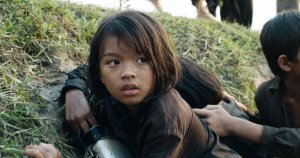 adsorb all that is happening around her, like she herself must have been at that young age. The film also engages our inner protectors: watching this little girl plant land mines and fire guns is just too much to process.
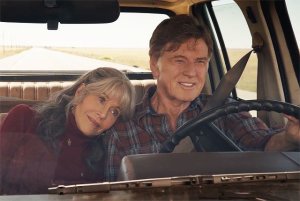 solitary existences up until Addie gets up the courage to ring Louis’s doorbell and invites herself in for a chat and a little proposal. Why not sleep together, she suggests. No, not sex. Sex doesn’t interest her. But the nights are long. Very long. Couldn’t they come to some arrangement? After thinking on it, he agrees, so off he goes in his best blue plaid shirt, to have a platonic sleepover with a neighbour he’s lived alongside for decades but never really known.
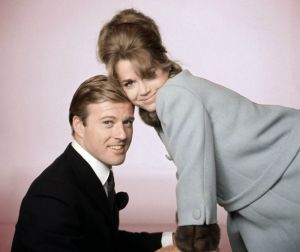 Venice Film Festival, in a ceremony preceding the screening of their new film. They’ve co-starred in movies before: The Chase (1966), Barefoot in the Park (1967), and The Electric Horseman (1979); this is their first in 38 years. To mark the occasion, Fonda said “It was fun to kiss him in my 20s and then to kiss him again in my almost-80s.” I have to say, it was fun for the audience, too. Yes, it’s great to see mature faces getting meaty roles, but you’re also getting a masterclass in acting. These two make it look easy. Their chemistry feels effortless.
 Of course, if you’re looking for classic, cheesy romance, this isn’t it. Louis and Addie are too wise for that. They have responsibilities, baggage, obligations. Kent Haruf, who wrote the novel upon which this film is based, knew a little about that. He wrote his book under a death sentence: he was 71, and he finished it just months before he died of lung cancer. The novel was published posthumously, so Louis and Addie are his legacy. Fonda and Redford would have made him proud.
 So off they drive in a stolen Mercedes. They have a cross-country adventure that only two people determined to die could possibly have: madcap, in a non-urgent way. The script doesn’t feel compelled to follow the usual formula for a road trip movie, so it’s sprinkled with surprising pit stops and hijinks. Kenny and Lolita have nothing to lose, so anything is possible.
 grown on me. She dances around her apartment so unselfconsciously I couldn’t help but see myself in her. By the film’s half way point, I quite agreed with the title: incredible indeed.
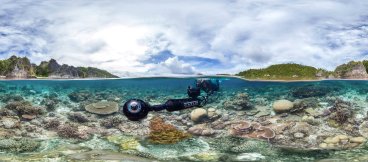 technique could be applied to the reefs, so he called up director Jeff Orlowski, and an idea was born.
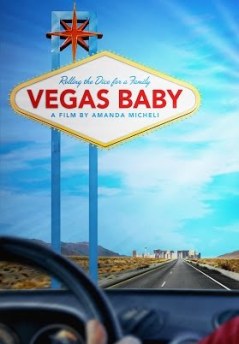 a) Is it even ethical to “give away” a baby as promotional material?
 to be paraded around by its parent corporation (to disguise the secret testing) – unless of course she’s kidnapped by the Animal Liberation Front headed by Jay (Paul Dano), “not a terrorist,” along the way. And the ALF is only the first group of people Mija will come across that want to control the fate of her large friend, Okja.
 as we know it. This is the way Bong Joon Ho choose to frame Okja’s predicament.
 ASSHOLES WATCHING MOVIES