
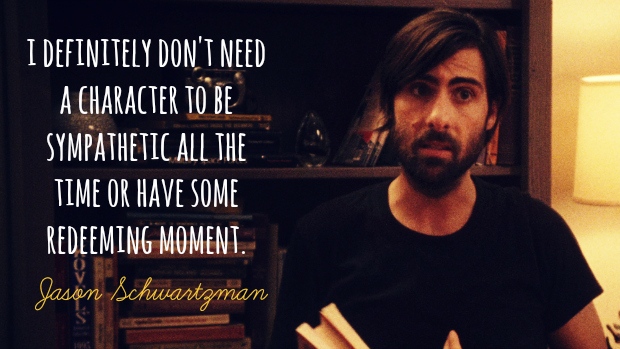
I recently watched Listen Up, Philip because for some odd reason I find Jason Schwartzman irresistible. Not that I like him. Upon reflection, I often find him quite intolerable, but still irresistible. It’s probably some positive reinforcement from his nearly ubiquitous presence in Wes Anderson movies, which I tend to love, as a rule. But outside of the Anderson oeuvre, I find Schwartzman to be a lot less easy to swallow. Anderson allows us to laugh at the pompous ass. In everything else, he’s just a pompous ass. And if an actor plays a pompous ass in 37 film and television credits to date (roughly), then maybe he’s not playing one, maybe he just is one.
And yet, I hardly ever miss a Jason Schwartzman film. Just in case, I guess. In case it’s secretly a Wes Anderson film? In case Bill Murray will suddenly pop out of his breast pocket, waving a polka-dotted pocket square? In case he loses his hipster facial hair and there’s no one else there to notice it? I really don’t know why, but I’ve observed this weird tendency in myself, so there it is.
Hence, Listen Up, Philip, which I managed to like despite itself. Because it feels like the kind of movie that defies you to not like it. It wants you to turn your nose up at it. It’s too cool for approval. There’s a great review of it over at Epileptic Moondancer if you care to check it out. As for myself, I’m going to discuss some particular traits that I found to be of note from director Alex Ross Perry
- Unlikable characters. Holy unlikable in this case. It’s a huge risk to present a story with a protagonist the audience won’t like, because that’s how we’re supposed to connect with the
 story. We’re supposed to identify a bit of ourselves in the hero and experience the film through his or her eyes. If it becomes personal for us, then we care about the outcome, and we are engaged. But a main character who is thoroughly unlikable is a bit of a problem. Philip is neurotic and selfish and ungenerous and conceited: not the kind of guy you’d want to be stuck next to at a dinner party, so why willingly listen to him whine throughout a two hour movie? There’d better be a compelling reason. I’m thinking of movies like A Clockwork Orange, and Wolf of Wallstreet, and Mommy, where I loathed the main characters but still felt the stories were worth telling. But some people are totally turned off by characters they despise. Despicable as he is, Philip does teach us a thing or two about ‘success’ and ‘achievement’ and ‘asshats wallowing in their own shite’.
 - Heavy handed narration. I didn’t enjoy the narration in this movie. I tried to give it a chance because Philip is a writer and I felt that perhaps this was clever and meta if only I could get over myself. I never did. And it reminded me of other times I felt the narration got in the way. The Age of Adaline is probably freshest in my mind. And The Assassination of Jesse James By the Coward Robert Ford, if you can think that far back (2007 – ew). Both times I’d say that the narration lent nothing to our understanding and only took us out of magic of the movie. And we’re supposed to get lost in the story, aren’t we? With such abrupt narration we can be jerked right out of our reverie, and that’s a harsh reminder. But now that I’m thinking of it, there are times when I do like me some narration. Without mentioning Wes Anderson again, I’ll go with Ron Howard’s brilliant narration of Arrested Development. His little asides feel like fun thought bubbles or hilarious foot notes, and I always enjoy them. They feel organic, and enhance my enjoyment. And if you remember the opening sequence of Amelie – also some brilliant narration that sets a breathy tone for the movie. So that’s the difference. If a movie is relying on narration because the director needs to tell me what he has failed to show me, then narration bad. If the narration is like an elbow in the ribs to say, if you liked that, then get a load of this, then count me in.
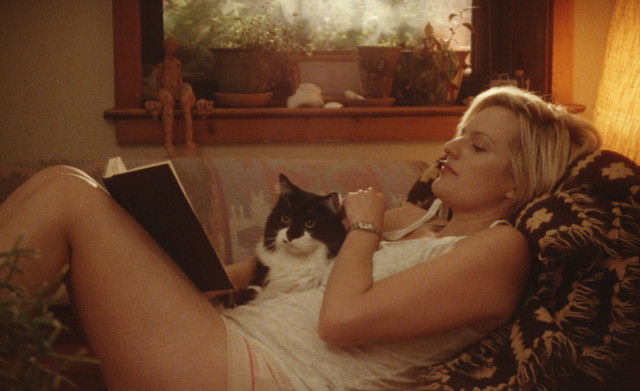
- Rotating protagonists. Philip is the main character in the first portion of the movie, but then we shift, abruptly, to the girlfriend he’s left behind, Ashley, played rather discreetly by Elisabeth Moss. Up until the switch, Ashley feels like a pretty negligible piece of the story. At
 the end of the film, she still feels this way. Her portion of the story is not very revealing, and almost completely severs us from the narrative that Philip’s been following. Perhaps it was just to give us a little space to breathe between all of Philip’s self-loathing and caterwauling, but I found it jarring. Lots of movies move deftly between characters, sometimes even between settings or between eras, but still manage to make you feel like it’s all part of a whole. This one just felt a bit broken to me. Philip must not be a very good writer if he can’t even maintain the point of view in his own story. But it does recast him as a pitiable character, so maybe this shift in focus serves to connect with him in some small way. The other interesting thing is that the narration is done by the same guy in both sequences. So who’s narration is this? The narrator does seem to side with Philip at one point, even though Philip is clearly the arse, and that can’t be coincidence. But what kind of device is this narration being filtered through? We never know, but are left to decide for ourselves.
So there you have it. I can’t tell you if this movie is good or bad, because it’s interesting and complex and probably that most awful of things – post-modern. You can decide for yourselves if this movies make you want to tear your hair out, or grab a bottle of pinot to discuss, or is to be avoided altogether. I must say that I do like a movie that takes chances, and that makes me think and evaluate why I’m having the feelings that I’m having. Is not liking a character, or a narrative tone, or a story arc, the same as not liking the movie? And is not liking the movie the same as it being bad?
Holy fuck.
The Avengers are playing somewhere, right?

 r thing and did it well, and I’d say Shaun the Sheep one ups Minions because not even the humans speak English (which is ironic for a movie coming out of the UK) yet the story still seemed clear and easy to follow even for the younger audience members.








 ASSHOLES WATCHING MOVIES